
Structured Data for AI Search: Schema Stack for ChatGPT, Perplexity, AI Overviews
Structured data for AI search is the JSON-LD schema markup that tells ChatGPT Search, Perplexity, Google AI Overviews, and Bing Copilot what each page is about, who wrote it, what entities it references, and how its content maps to user queries. Schema is the cheapest, most effective AI SEO signal you can ship, and the one most often left half-finished.
Want the schema stack shipped for you? Gatilab’s AI search optimization service implements the markup, validates it, and tracks what it changes in AI citations.
Why Schema Markup Matters Specifically for AI Search
Structured data for AI search serves three functions LLMs depend on. First, it gives the engine a canonical mapping of what the page answers (which questions, which entities, which procedures). Second, it surfaces relationships between entities (author-publisher-organization-knowledge-graph) that the model uses to score trust. Third, it makes content extractable in machine-readable form rather than forcing the model to parse messy HTML.
AI search engines parse JSON-LD during retrieval and again during generation. The retrieval layer uses schema to score candidate pages on completeness and trust. The generation layer uses schema-marked content as a structural map of which paragraphs answer which sub-queries. Pages without schema force the engine to do the structural inference itself, which costs compute and lowers confidence. Pages with clean schema get prioritized.
Five concrete reasons schema moves the citation needle:
- Entity disambiguation. Organization with sameAs links connects your brand to the engine’s knowledge graph (Wikipedia, Wikidata, LinkedIn). Without sameAs, your brand is ambiguous.
- Question-answer mapping. FAQPage schema turns each Q&A pair into an extractable unit. Engines cite those units directly.
- Procedural extractability. HowTo schema gives engines a clean ordered step list to surface in step-by-step answer formats.
- Author trust. Person schema with sameAs anchors the author in the knowledge graph. AI Overviews specifically reward pages with identified authors.
- Freshness signal. Article schema’s datePublished and dateModified give the engine a confidence weight on how current the content is.
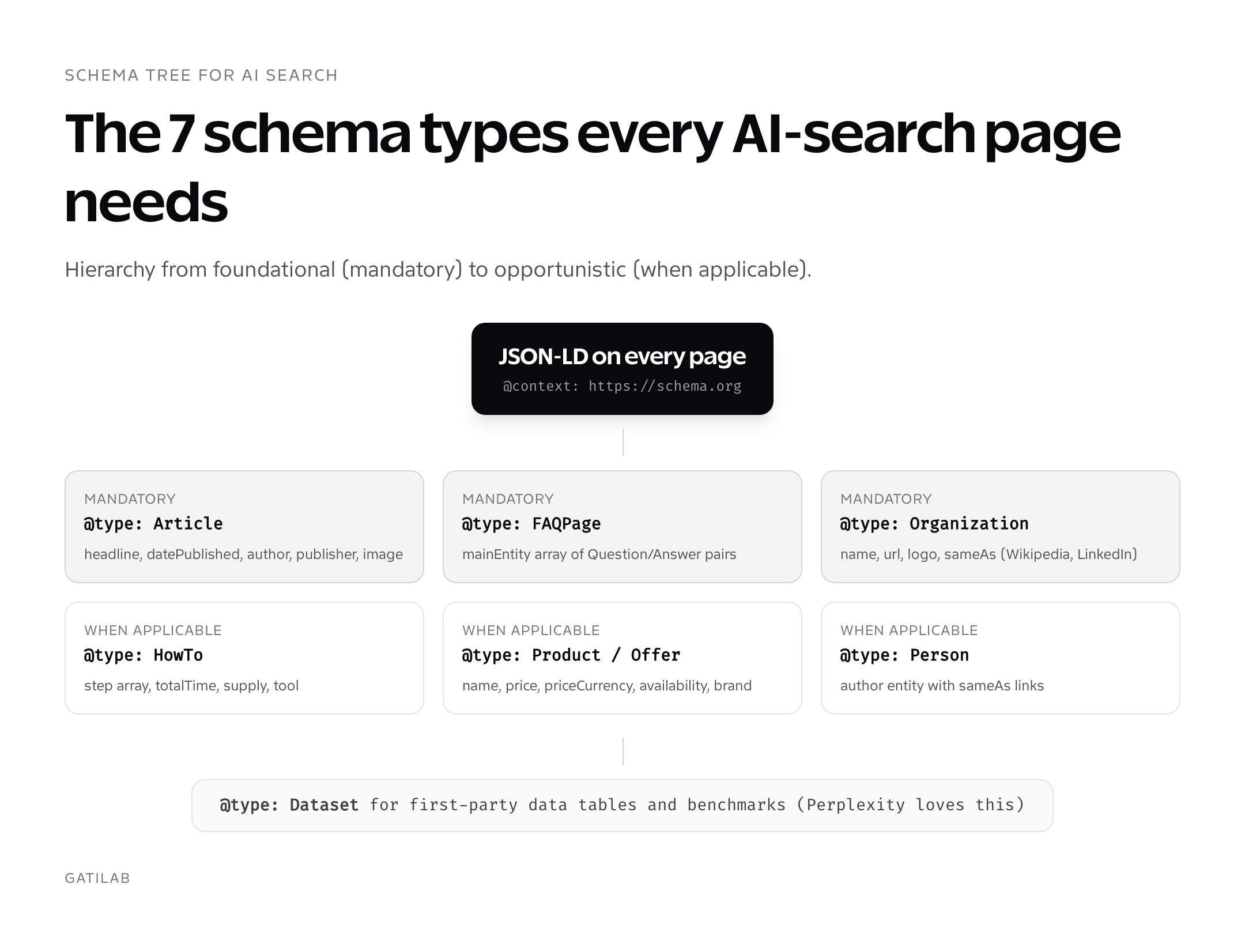
The 7 Schema Types Every AI-Search Page Needs
1. Article schema
Mandatory on every blog post and editorial page. Required fields: headline, datePublished, dateModified, image, author (with full Person object), publisher (with full Organization object). Article schema gives the page a canonical entity in the engine’s index.
{
  "@context": "https://schema.org",
  "@type": "Article",
  "headline": "Structured Data for AI Search",
  "image": "https://r2.gatilab.com/wp-content/uploads/2026/05/hero.png",
  "datePublished": "2026-05-09",
  "dateModified": "2026-05-09",
  "author": {
    "@type": "Person",
    "name": "Gaurav Tiwari",
    "url": "https://gatilab.com/author/wpgaurav/",
    "sameAs": ["https://www.linkedin.com/in/gauravtiwari", "https://en.wikipedia.org/wiki/Gaurav_Tiwari"]
  },
  "publisher": {
    "@type": "Organization",
    "name": "Gatilab",
    "logo": "https://r2.gatilab.com/logo.png"
  }
}
2. FAQPage schema
Mandatory on any page with a FAQ section. The FAQPage schema turns each Question/Answer pair into a directly citable unit. AI search engines often cite the FAQ entry verbatim because the structure is unambiguous. My FAQ schema guide walks through the FAQPage payload that survives validation, including common gotchas around HTML in answer text.
{
  "@context": "https://schema.org",
  "@type": "FAQPage",
  "mainEntity": [
    {
      "@type": "Question",
      "name": "What is structured data for AI search?",
      "acceptedAnswer": {
        "@type": "Answer",
        "text": "JSON-LD schema markup that helps ChatGPT, Perplexity, and AI Overviews understand and cite content."
      }
    }
  ]
}
3. Organization schema
Mandatory in your sitewide JSON-LD (often in the header, applied across all pages). Required fields: name, url, logo, sameAs. The sameAs array is the most important field because it anchors your brand identity in Google’s, Wikipedia’s, and Wikidata’s knowledge graphs. Without sameAs, your Organization is just a string of characters with no connection to existing knowledge graph entities.
{
  "@context": "https://schema.org",
  "@type": "Organization",
  "name": "Gatilab",
  "url": "https://gatilab.com",
  "logo": "https://r2.gatilab.com/logo.png",
  "sameAs": [
    "https://www.linkedin.com/company/gatilab",
    "https://twitter.com/gatilabhq",
    "https://www.crunchbase.com/organization/gatilab"
  ]
}
4. HowTo schema
Conditional. Use on tutorial articles, step-by-step guides, recipes, and any procedural content. Required fields: name, description, image, totalTime, step (array of HowToStep objects). Each step needs name and text fields. AI search engines extract the step list reliably and surface it in step-by-step answer formats.
{
  "@context": "https://schema.org",
  "@type": "HowTo",
  "name": "How to add Article schema to a WordPress post",
  "totalTime": "PT5M",
  "step": [
    {"@type": "HowToStep", "name": "Open Rank Math settings", "text": "..."},
    {"@type": "HowToStep", "name": "Choose Article schema", "text": "..."}
  ]
}
5. Product / Offer schema
Conditional. Use on product pages, software listings, and pricing pages. Required fields: name, image, description, brand, offers (with @type Offer). Offer requires price, priceCurrency, availability, url. AI search engines surface product schema in commercial-investigation answers and product comparisons.
6. Person schema
Conditional but high-impact. Use for every author byline. Required fields: name, url, image, sameAs (LinkedIn, Twitter, Wikipedia where applicable), jobTitle, worksFor. Google’s guidance on helpful content asks whether it’s self-evident who authored a page and strongly encourages accurate authorship information. Person schema makes that authorship explicit to machines.
7. Dataset schema
Conditional but powerful for Perplexity SEO. Use on pages that publish first-party data (benchmarks, surveys, testing results, statistics dashboards). Required fields: name, description, license, distribution, creator. The schema signals the data is canonical and citable.
JSON-LD vs Microdata vs RDFa: What AI Search Actually Reads
JSON-LD is the only format that matters for structured data for AI search in 2026. Microdata and RDFa still validate but every major LLM-based engine prefers JSON-LD parsed from a script tag in the head or before the closing body. Use JSON-LD exclusively. Don’t waste time on the alternatives.
Concrete reasons JSON-LD wins:
- Cleaner separation. JSON-LD lives in a script tag, not interleaved with rendered HTML. Easier for the engine to parse, easier for you to validate.
- Better tooling. Schema.org validator, Google Rich Results Test, and every major SEO plugin (Yoast, Rank Math, SEOPress) generate JSON-LD by default.
- Lower error rates. Microdata errors are syntactic and hard to spot. JSON-LD errors are caught immediately by any JSON validator.
- Engine preference. Google’s documentation explicitly recommends JSON-LD. Perplexity, ChatGPT, and Bing Copilot all parse it preferentially.
Schema Patterns Specific to Each AI Engine
All four major AI search engines parse JSON-LD, but they weight different schema types differently. Knowing the engine-specific preferences lets you prioritize.
| Engine | Schema priorities | Optional but useful |
|---|---|---|
| Google AI Overviews | Article, Person, Organization (with sameAs to Wikipedia) | HowTo, FAQPage, Product |
| ChatGPT Search | Article, FAQPage, Organization | HowTo, Person |
| Perplexity | Article, Dataset, FAQPage, Organization | HowTo, Person |
| Bing Copilot | Article, Organization, FAQPage (shares Bing index with ChatGPT) | HowTo, Product, Person |
Two cross-engine truths: Article + Organization is the floor (without these you’re invisible), and Person schema with strong sameAs is the single strongest author-side signal across all four engines.
Implementing Structured Data on WordPress
Three implementation paths on WordPress, each with trade-offs. Most production sites I audit use a combination.
SEO plugin schema (Rank Math, Yoast, SEOPress). Easiest. Plugins ship Article, FAQPage, HowTo, Product, Organization, Person schema generators in the post editor. Yoast 24.0 and Rank Math 1.0.250 both added improved AI-search-specific schema in early 2026. Limitations: schema customization is limited to plugin-supported fields. Custom @type values require code.
Schema App or other dedicated tools. More flexibility, more cost. Schema App ships templates for almost every Schema.org type and handles dynamic schema across taxonomies. Worth it for large sites with complex schema needs (ecommerce, multi-author publications, structured data at scale).
Custom JSON-LD via theme functions or a child theme. Most flexible. Use for one-off schema types not supported in plugins (Dataset, Course, ProfessionalService). Inject the JSON-LD via wp_head or a custom block. Validate every page after deployment.
For the broader WordPress SEO toolkit context, see my best SEO plugins for WordPress guide. Pair the plugin choice with the cluster strategy in content cluster strategy.
Validating Structured Data: The Workflow
Validation is the step most teams skip and the one that determines whether your schema actually works. JSON-LD that’s syntactically valid but missing required fields gets ignored by AI engines. Validate every page with two tools, every quarter.
- Google Rich Results Test. Pastes a URL, returns parsed schema and a list of warnings/errors. Free. The canonical first-line check.
- Schema.org validator (validator.schema.org). Stricter than Google’s. Catches type-mismatches and missing required fields that the Rich Results Test passes silently.
- Schema App’s validator if you already use the tool. Adds AI-search-specific checks layered on top of the standard Schema.org validation.
- Periodic resampling. Schema.org adds and deprecates fields quarterly. Re-validate top pages every quarter to catch deprecation.
Common validation failures I see in audits:
- Missing required fields (Article without datePublished, FAQPage without acceptedAnswer)
- Type mismatches (“@type”:”FAQ Page” with a space, “@type”:”How-to” with a hyphen)
- Malformed HTML in answer text fields (unclosed tags break the parse)
- Wrong publisher type (string instead of Organization object)
- sameAs with broken URLs (always test the URLs resolve to 200)
Measuring Schema Impact on AI Citation Rate
Set up before-and-after measurement on schema rollouts. Pick a control group (pages without schema) and a test group (pages getting schema upgrades). Probe AI citation rates on each group’s target queries before and after. Sample size of 20-30 pages per group is enough to see the lift if it’s real.
Tools that connect schema audits to citation tracking:
- Sitebulb or Screaming Frog: crawl your site, list every page’s schema status, export to CSV
- Google Search Console: Enhancements report shows valid/invalid schema across the site
- Profound, Otterly.AI, or Semrush AI Toolkit: track AI citation rate by query, segment by schema status
- Manual probing: for small sample sizes, query each engine weekly with target queries and log citation
Schema Mistakes That Kill AI Citation Rates
Six mistakes that consistently break structured data for AI search. Each one is fixable. Each one suppresses citations until fixed.
- Schema for content that isn’t on the page. Don’t add FAQ schema for questions that don’t appear in visible content. Engines cross-reference and downweight when schema doesn’t match the rendered page.
- Multiple conflicting Article schemas. One canonical Article per page. Multiple Article objects (often from competing plugins) confuse the parser.
- Person without sameAs. An anonymous author Person schema is worse than no Person schema. Add at least 2-3 sameAs URLs.
- Stale dateModified. If your schema says dateModified=”2024-03-01″ and your content was last touched yesterday, you’re sending a freshness penalty signal.
- Empty or trivial FAQ entries. One-line answers don’t get cited and lower the average citation confidence on the page.
- Forgetting Organization schema entirely. Most sites have it on the homepage and nowhere else. Should be sitewide via the header.
Future-Proofing Your Structured Data Strategy
Schema.org evolves quarterly. AI search engines update their reranker preferences continuously. The structured-data-for-AI-search strategy that works today will need adjustments within a few months. Build the maintenance cadence into your workflow now.
The maintenance pattern I run for client sites:
- Quarterly schema audit. Re-validate top 50 pages. Update for any deprecated fields. Add new schema types as engines start supporting them.
- Monthly citation review. Compare citation rate by schema type. Identify pages where schema isn’t lifting citations and audit for content-schema mismatch.
- Annual sameAs refresh. Verify all sameAs URLs still resolve. Add new identifiers (Wikidata IDs, ORCID for academics, GitHub for technical authors).
- Continuous engine watching. Monitor engine documentation (Google’s Search Central, Schema App’s blog, Bing Webmaster Tools) for schema-related updates. AI engines often signal preferences months before competitors notice.
Schema Patterns for Specific Content Types
Different content types win AI citations through different schema combinations. The mandatory floor (Article + FAQPage + Organization) doesn’t change but the conditional layer does. Knowing which combination matches each content type saves time and prevents schema bloat.
Comparison and “vs” articles. Use Article + FAQPage + Product schema for each compared product, plus an HTML comparison table marked with itemtype Microdata as a fallback. Perplexity and ChatGPT both extract from comparison tables reliably when paired with Product schema. Avoid acf/compare style blocks that complicate the parse.
Listicles and roundups. Use Article + ItemList schema. ItemList tells the engine the page is an ordered or unordered set of items. Each item gets minimal Product or SoftwareApplication schema. AI Overviews routinely surface ItemList items as bulleted answers.
Tutorial and how-to articles. Article + HowTo + FAQPage. HowTo provides the ordered step list. Each step’s name and text become extractable units. Pair with images per step and totalTime in ISO 8601 duration format (PT5M for 5 minutes).
Definitional and explainer content. Article + DefinedTerm schema where applicable. DefinedTerm marks the term being defined and its formal definition. Engines cite DefinedTerm payloads at high rates on “what is X” queries.
Data-heavy posts and benchmarks. Article + Dataset + FAQPage. Dataset schema is the strongest move for Perplexity citations. Include name, description, license (CC-BY-4.0 or similar), distribution (CSV, JSON download links), and creator.
Service and agency pages. Article + Service + Organization + LocalBusiness (if applicable). Service schema describes what you offer with provider, areaServed, and serviceType fields. AI search engines surface service pages on commercial-investigation queries when the schema is complete.
Connecting Schema to Off-Page Signals
Schema is on-page work but its effectiveness depends on off-page signals. The sameAs URLs in your Organization and Person schema only carry weight if the linked entities actually mention you. A Wikipedia sameAs URL pointing to a Wikipedia article that doesn’t mention your brand sends a weak signal. The same URL pointing to an article where your brand is named carries real citation weight.
This is where structured data for AI search compounds with brand-mention strategy. The schema declares the relationship. The off-page mentions verify it. AI engines cross-reference both. Pages with declared sameAs that don’t verify in the linked sources get downweighted in the reranker.
Concrete moves to make sameAs verifiable:
- Wikipedia. If you can earn a Wikipedia mention or page, your sameAs to Wikipedia carries real weight. If you can’t, don’t fake it; pick a different sameAs target.
- Wikidata. Easier to get than Wikipedia. Create a Wikidata entry for your Organization and link to it via sameAs. Engines parse Wikidata extensively.
- Crunchbase. Most companies have a Crunchbase entry. Verify it’s up to date and link via sameAs.
- LinkedIn Company page. Active LinkedIn presence with employee mentions. Link via sameAs and keep it current.
- GitHub. If you ship code, your GitHub organization page is a strong sameAs target. Engines weight it heavily on technical queries.
Structured Data for AI Search: A 30-Day Implementation Plan
Run this 30-day sequence to deploy structured data for AI search across your top pages. The plan assumes a 50-100 page content site. Larger sites scale the audit and rollout phases proportionally.
- Days 1-3: Crawl your site with Sitebulb or Screaming Frog. List every page’s current schema status. Identify gaps.
- Days 4-6: Set up sitewide Organization schema in your theme header. Include name, url, logo, sameAs (LinkedIn, Wikipedia, Wikidata, Crunchbase). Validate.
- Days 7-10: Add or upgrade Article schema on the top 30 pages. Required: headline, datePublished, dateModified, author Person object with sameAs, publisher Organization.
- Days 11-14: Add FAQPage schema to every page that has a FAQ section. Validate every page. Fix errors immediately.
- Days 15-18: Add HowTo schema to tutorial articles. Add Person schema for every author byline with full sameAs links.
- Days 19-22: Add Dataset schema to any first-party data tables. Add Product/Offer schema to product pages.
- Days 23-26: Run Schema.org validator on all pages. Fix every error. Re-validate.
- Days 27-30: Set up citation tracking baseline. Probe AI engines weekly with target queries. Compare citation rate before-and-after over the next 60 days.
The 30-day plan above gets you to a measurable schema baseline. Maintenance afterward is light: re-validate top pages quarterly, refresh sameAs annually, and add new schema types as the major engines start surfacing them. Structured data for AI search is a foundational investment, not a one-time push, but the maintenance cost is minimal compared to the citation lift you keep earning month over month.
Structured Data for AI Search FAQs
What is structured data for AI search?
Structured data for AI search is JSON-LD schema markup that tells ChatGPT, Perplexity, Google AI Overviews, and Bing Copilot what each page is about, who wrote it, and how its content maps to user queries. Schema is the cheapest, most effective AI SEO signal available.
Which schema types matter most for AI search?
Article, FAQPage, and Organization are mandatory. HowTo, Product, Person, and Dataset are conditional based on content type.
Should I use JSON-LD or Microdata?
JSON-LD only. Every major AI search engine prefers JSON-LD parsed from a script tag. Microdata and RDFa still validate but offer no advantages and have higher error rates. Use JSON-LD exclusively.
How does schema differ between Google AI Overviews and Perplexity?
Google AI Overviews weight Article + Person + Organization most heavily, especially Person with sameAs to Wikipedia. Perplexity weights Dataset schema heavily because it rewards original-data sources. ChatGPT Search relies on Article + FAQPage. Floor is the same: Article + Organization.
Do I need Person schema for every author?
Yes. Person schema with strong sameAs (LinkedIn, Twitter, Wikipedia) is the single strongest author-side signal across all major AI search engines. Google’s helpful-content guidance asks whether it’s clear who authored a page, and Person schema makes that explicit.
How often should I validate my schema?
Validate every page when you publish it. Re-validate top 50 pages quarterly because Schema.org adds and deprecates fields regularly. Use Google Rich Results Test plus Schema.org’s validator together because they catch different errors.
Can I use FAQ schema if my page doesn’t have a visible FAQ?
No. AI search engines cross-reference schema against rendered content. FAQ schema for questions that don’t appear on the page gets downweighted and can flag the page as manipulative. Match schema to visible content.
What’s the most effective schema upgrade for AI citations?
Adding FAQPage schema to existing content. The lift is consistent across engines because FAQ entries become directly citable units.
Does Dataset schema help Perplexity SEO?
Heavily. Perplexity rewards original-data sources, and Dataset schema tells the engine your page contains canonical citable data.
Should Organization schema be sitewide?
Yes. Most sites only put Organization schema on the homepage and miss the citation lift on other pages. Apply Organization schema sitewide via your theme header. Include sameAs links to LinkedIn, Wikipedia, Wikidata, and Crunchbase to anchor the brand in the knowledge graph.
Pair this schema playbook with the engine-specific guides on LLM SEO, ChatGPT SEO, Perplexity SEO, and how to rank in Google AI Overviews. Schema is the foundation. The engine-specific moves are the layers that compound on top.
Tell Google you want more of this.
Add Gatilab as a preferred sourceOne tap, and this site shows up more often in your own Top Stories, AI Overviews and AI Mode. Remove it any time.