
Perplexity SEO: How to Get Cited in Perplexity AI 2026
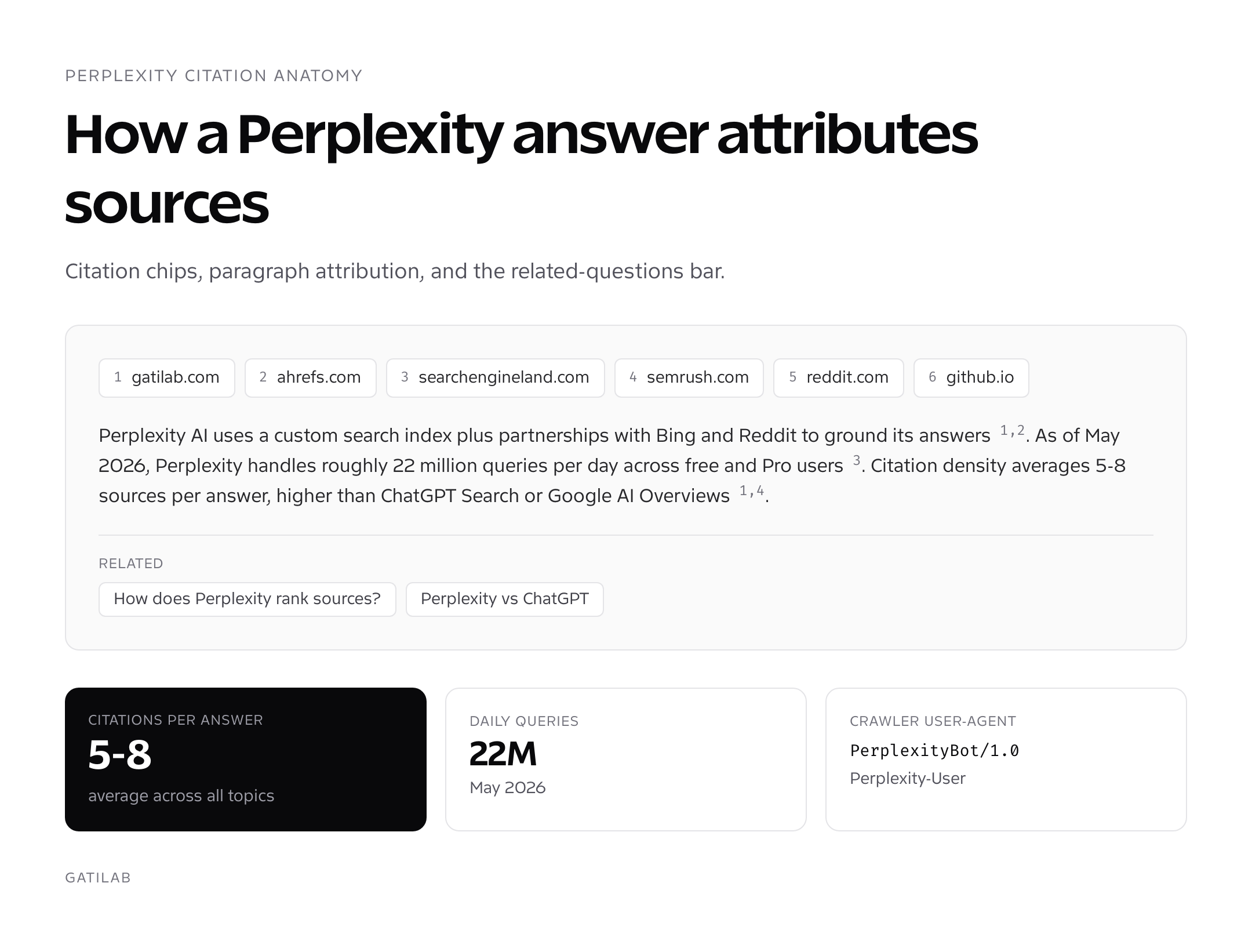
Perplexity SEO is the practice of optimizing your content so Perplexity AI cites your domain inside its answer interface. Perplexity is the answer engine that built its entire product around citations, not chat. Every answer ships with a row of source citations, numbered references inside the prose, and a related-questions panel below. Perplexity CEO Aravind Srinivas said in June 2025 that it handled 780 million queries in May 2025, roughly 30 million a day. Citation rate on Perplexity is the most useful proxy for AI search visibility, because the citations are visible, clickable, and audited by power users.
Perplexity rewards a different signal mix than ChatGPT or Google AI Overviews. Original data and entity density carry more weight here than in any other engine. Backlinks barely register. Sites with strong on-page structure consistently outperform high-DR competitors that rely on link-equity moats. This guide covers the full Perplexity SEO playbook with concrete examples and a 30-day plan.
Want this handled for you? Gatilab’s AI search optimization service runs the citation audit and tracks where you appear across Perplexity, ChatGPT, and AI Overviews month by month.
How Perplexity Differs From ChatGPT and Google AI Overviews
Perplexity is built around citation as the primary UI element. ChatGPT Search hides citations behind small bracket numbers. Google AI Overviews tucks citations into a sources panel that most users never expand. Perplexity puts the citation chips at the top of every answer where users see them before they read a word of the answer.
Three structural differences shape the SEO playbook:
- Its own search index. Perplexity built its own crawler (PerplexityBot) and doesn’t publish the full list of other sources it draws on. It has no Reddit data deal: Reddit, which licenses its data to Google and OpenAI, sued Perplexity in October 2025 over scraped Reddit content. Coverage is broad but uneven across niches.
- Higher citation density. LLM Pulse tracking data for the 90 days to October 1, 2026 averages about 10 distinct citations per Perplexity answer, against about 9 for ChatGPT and 8 for Google AI Overviews. Other studies count fewer per answer, so trust the ranking more than the exact number. More slots means smaller niche players can earn citations alongside major publishers.
- Conversation-aware reranking. Perplexity’s follow-up queries reuse context from earlier turns. The same query asked after “…I run a SaaS” surfaces different sources than the same query asked cold.
How Perplexity Picks Sources to Cite
Perplexity doesn’t publish its architecture, but answer engines like it work in roughly four stages. First, the query routes through query understanding and intent classification. Second, the retrieval layer pulls candidates from PerplexityBot’s index and other search sources. Third, a reranker scores candidates on quality signals weighted toward extractability and original data. Fourth, the generation model writes the answer and attaches citations to specific sentences.
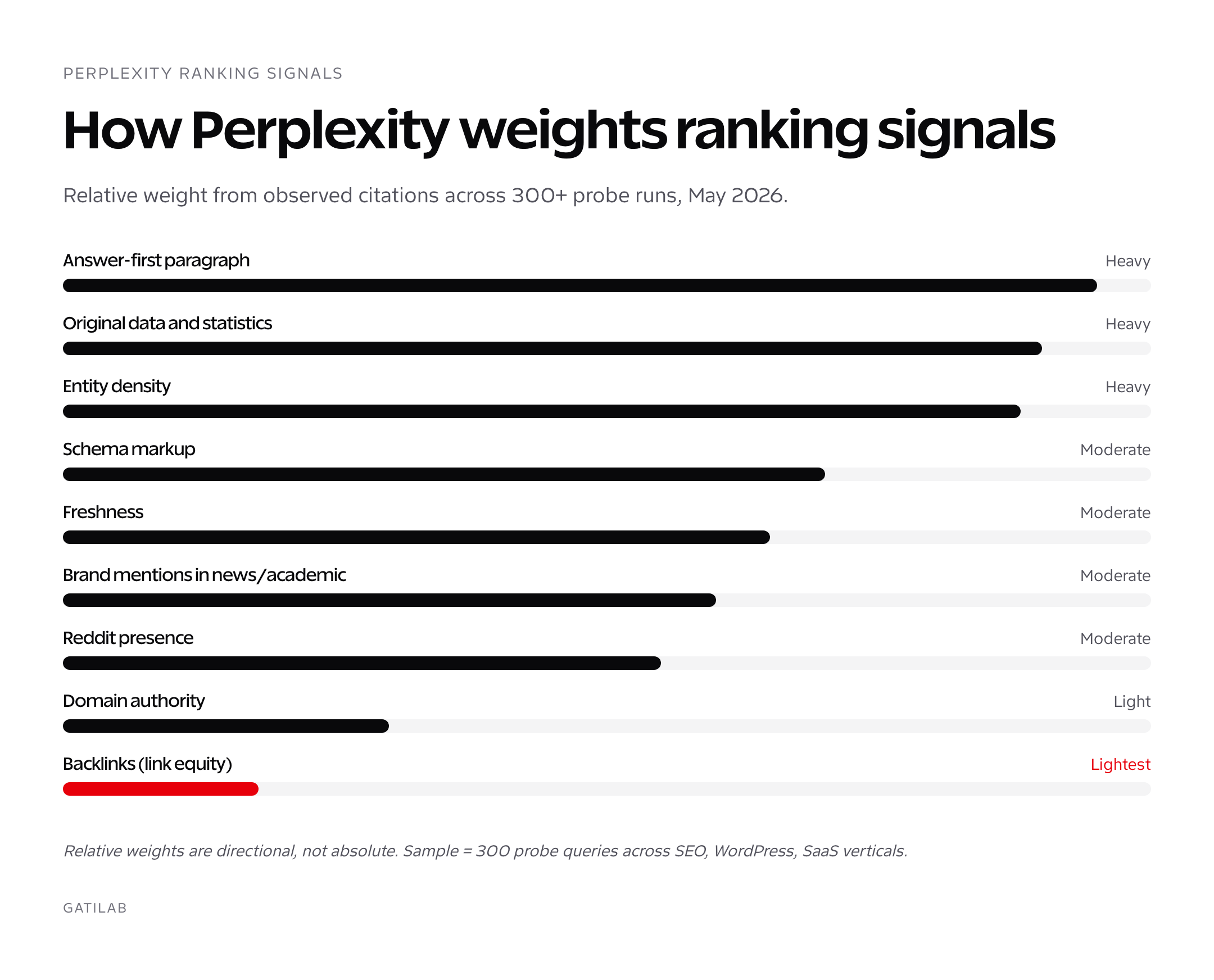
The reranker matters most. Perplexity doesn’t publish its weights, so treat this order as my working estimate:
- Extractable answer-first paragraphs. The first 40-60 words under each H2 must answer the heading. This is the single biggest signal.
- Original data and statistics. Pages with first-party numbers (test results, survey data, benchmark tables) give the model a number it can attribute to you alone, which aggregated stats can’t.
- Entity density. Several named entities per paragraph. Brand names, version numbers, dates, prices, metrics.
- Schema markup. Article, FAQPage, HowTo, Organization. Perplexity parses JSON-LD during retrieval.
- Freshness signal. Pages updated within 6 months get a small but consistent rerank boost.
- Brand mentions in news and academic sources. Perplexity weights mainstream and academic citations more heavily than ChatGPT does.
- Reddit presence. Reddit threads are public pages that answer engines can surface. Helpful subreddit comments that mention your brand by name can show up there.
Source Quality Signals That Win Perplexity Citations
Five concrete moves give you the best shot at Perplexity citations.
1. Lead with original data. If you have any first-party numbers (your own tests, your own survey, your own benchmarks), put them in the first paragraph of the relevant section and reference the source explicitly. Perplexity’s reranker treats original-data paragraphs as high-citation candidates because the model can attribute the number back to your URL with confidence.
2. Build statistics blocks. A short statistics callout with 4-6 specific numbers, each with a source citation in the page itself, is easy for answer engines to extract and attribute. Format: a dedicated section labeled “By the numbers” with bullet points like “780 million queries in May 2025 (Perplexity CEO, June 2025)” or “average citations per answer across your own probe set (your test month).”
3. Schema everywhere. Article, FAQPage, HowTo, Organization JSON-LD. Validated. Without errors. Pair with my FAQ schema guide for the FAQPage payload that survives validation.
4. Allow PerplexityBot in robots.txt. The user agent is PerplexityBot/1.0 plus Perplexity-User for on-demand fetches. Block either and you opt out. Some publishers block them for content protection and that’s a valid choice. If you want Perplexity SEO citations, allow them.
5. Earn brand mentions in academic and news sources. Perplexity’s training corpus and reranker weight academic papers, mainstream news, and structured data sources. Pitch yourself as a quoted expert. Get cited in industry reports. Run digital PR campaigns built around original data because data-driven pitches earn higher-quality placements.
Content Structure for Perplexity Citations
Perplexity citations attach to specific sentences, not whole pages. Structure your content so each major claim is a self-contained, attribution-friendly sentence with the entities and numbers baked in. The model extracts the claim and credits the URL where the claim lives.
Concrete patterns that win Perplexity citations:
- Claim-evidence-source structure. Each paragraph follows: claim sentence, evidence sentence, source mention. The model can lift the claim sentence verbatim and cite your URL.
- Statistics blocks. Dedicated callout sections with 4-6 numbered statistics. Each one a one-line claim with a source.
- Comparison tables. HTML tables with feature-by-feature rows. Perplexity extracts table cells well and often cites the table source as the canonical reference.
- Question-form H2s. H2s phrased as user queries (“How does Perplexity rank sources?”) match the engine’s query understanding layer. The model maps your H2 to the user query and prefers your section.
- Numbered lists for processes. Procedural content gets cited reliably when steps are numbered, action-first, and each step contains specific entities.
Brand Mention Strategy for Perplexity
Each answer engine leans on its own mix of sources, and Perplexity doesn’t publish its weighting. Before deciding where to earn mentions, probe your target queries and note which domains Perplexity actually cites: news sites, research papers, forums, or specialist blogs.
Where to focus brand-mention work, ranked by Perplexity impact:
- Mainstream tech and business news. Earned media in TechCrunch, Wired, The Information, Search Engine Land. Each placement compounds. Perplexity’s news weighting is heavier than ChatGPT’s.
- Industry reports and whitepapers. Get quoted or cited in research reports from analyst firms (Gartner, Forrester, IDC). High-prestige citations pull weight.
- Academic and SSRN papers. If your topic intersects with academic research, get cited in working papers or industry-academic crossover pieces.
- Reddit subreddits. Active comment-level mentions in the major subreddits for your niche.
- Substack newsletters and Medium. Long-form analysis pieces that mention your brand in context.
Schema and Structured Data for Perplexity
Ship Article, FAQPage, HowTo (where applicable), Organization, and Person schema on every meaningful page. Validate with Google’s Rich Results Test plus Schema.org’s validator. A surprising share of schema errors are typos in @type values. “@type”: “FAQPage” not “@type”: “FAQ Page”. “@type”: “HowTo” not “@type”: “How-to”.
Specific schema patterns that move the needle on Perplexity citations:
| Schema type | What Perplexity does with it | Priority |
|---|---|---|
| Article | Maps page to canonical entity, surfaces author + date | Mandatory |
| FAQPage | Question-answer pairs become extractable units | Mandatory |
| HowTo | Step structure for procedural extraction | If applicable |
| Organization (sameAs) | Anchors brand identity in knowledge graph via Wikipedia, LinkedIn, Crunchbase | Mandatory |
| Person (sameAs) | Identifies authors with verifiable credentials | High |
| Dataset | For first-party data tables and stat blocks | If applicable |
| Review / AggregateRating | For product comparisons and review pages | If applicable |
Reading Perplexity Citation Patterns
Run your own probe on three query types in your niche and the pattern shows up quickly. Note every cited source, its position in the chip row and what the cited section looks like.
Procedural queries such as “how to migrate WordPress to managed hosting” tend to cite step-by-step guides with a clear sequence, often from small specialist blogs alongside host documentation and Reddit threads.
Comparison queries such as “Ahrefs vs Semrush keyword research accuracy” favor pages with original benchmark data and a clear verdict, including GitHub repos with a good README.
Checklist queries such as “voice search optimization checklist” favor sections that open with a direct procedural answer in the first 50 words and name specific entities (Google Assistant, Alexa, Siri).
The pages that keep winning share answer-first structure, 5+ entities per cited paragraph, schema markup, and at least one piece of first-party data or specific procedure. Domain authority is a weak predictor: a precise answer on a small site can beat a vague one on a big site. For worked examples of this structure, see the voice search optimization guide, the content cluster strategy guide, and the SEO tools roundup.
Measuring Perplexity SEO Performance
Track citation rate, citation position (1st through 8th in the chip row), referral traffic from perplexity.ai, and brand mention rate inside synthesized answers. Set up the tracking before you start the optimization work, otherwise you can’t attribute lift to your changes.
Tools that track Perplexity citations as of May 2026:
- Profound: pulls Perplexity citations on a query list, exports historical trend data
- Otterly.AI: tracks both citation rate and answer-text brand mentions
- Semrush AI Toolkit: added Perplexity in their March 2026 release alongside ChatGPT and AI Overviews
- Ahrefs Brand Radar: tracks unlinked brand mentions across the open web; correlates loosely with Perplexity citation rate
- Manual probing: query Perplexity weekly with your top 20 target questions, log citations and chip positions in a spreadsheet
GA4 referrer reports show traffic from perplexity.ai. Filter your acquisition reports on that referrer to see the click-through traffic from your Perplexity citations. Many sites get a small, steady stream of Perplexity referrals and never notice it. Those visitors often arrive with qualified intent, because they clicked a source to check an answer.
Perplexity SEO Mistakes to Avoid
Five common mistakes. Each one is fixable in a day or two.
- Blocking PerplexityBot. Some publishers block it as a content-protection move. If you want Perplexity citations, allow it. The user agent is PerplexityBot/1.0 (with optional Perplexity-User for on-demand fetches).
- No first-party data. Perplexity’s reranker prefers original data heavily. Aggregator content that links out to other people’s stats rarely gets cited. Run your own tests, surveys, or benchmarks even if the sample size is small.
- Weak schema coverage. Pages without Article + FAQPage schema get downweighted. Pages with malformed schema get downweighted. Validate everything.
- Burying answers below context. If your section opens with two paragraphs of preamble before the answer, you don’t get cited. Lead with the claim.
- Ignoring author and Organization markers. Without identified authors and verified Organization with sameAs links, Perplexity can’t anchor your content to a citable knowledge-graph entity.
30-Day Perplexity SEO Sprint
Run this 30-day sequence to lift Perplexity citation rate.
- Days 1-2: Audit robots.txt. Allow PerplexityBot and Perplexity-User. Submitting your sitemap in Bing Webmaster Tools is cheap insurance too.
- Days 3-5: Pick 10 highest-traffic pages. Rewrite the first paragraph under every H2 to a 40-60 word direct answer with 5-7 named entities.
- Days 6-9: Add or upgrade Article + FAQPage + HowTo + Organization + Person schema. Validate every page.
- Days 10-15: Build first-party data into 3 of your top pages. Run a small test, survey, or benchmark. Add a statistics block with 4-6 numbers.
- Days 16-20: Set up Perplexity citation tracking. Probe top 20 queries, log baseline citation rate and chip positions.
- Days 21-25: Pitch 5 podcasts, 5 round-up posts, 5 industry reports, 5 Reddit threads. Aim for 10-15 unlinked brand mentions in the corpus.
- Days 26-30: Re-probe the 20 queries. Compare to baseline. Document the lift and note remaining gaps. Continue the brand-mention work into month two.
Perplexity SEO for Different Verticals
Vertical context shapes which signals matter most. Perplexity’s reranker behaves slightly differently in technical, commercial, and informational contexts. Knowing the vertical-specific patterns lets you prioritize.
Technical and developer-tooling queries. Original benchmarks, GitHub README mentions, and Stack Overflow citations carry outsized weight. A small specialist blog with original test data beats large publishers consistently.
Commercial and product comparison queries. Comparison tables, schema-marked review pages, and verified pricing data win. Perplexity loves clear verdicts. Hedging language (“both are great”) tanks citation chances.
Informational and definitional queries. Wikipedia and Britannica appear often. Compete by shipping deeper, more current definitions with extractable opening sentences and Organization schema linking your brand to the knowledge graph.
Local and service queries. LocalBusiness schema with verified NAP plus original reviews data move the needle. Perplexity’s local coverage is weaker than Google’s but improving.
Pair this with the SEO for startups guide if you’re shipping in B2B SaaS, and the broader LLM SEO playbook for cross-engine fundamentals.
Perplexity Pro and Spaces: What Changes for SEO
Perplexity Pro and Perplexity Spaces (launched October 2024) change the SEO surface in ways most playbooks haven’t caught up with. Pro users can switch between Perplexity’s own Sonar model and frontier models from OpenAI, Anthropic, Google, and xAI, and they run more queries. Spaces are persistent collections that can be configured to prefer specific sources, exclude others, and act like a custom GPT for a topic. Both features shift citation patterns in subtle but important ways.
What changes for Pro queries: the underlying model has more reasoning headroom, so the reranker pulls more candidates and surfaces deeper-cut sources. The implication for Perplexity SEO: if your audience skews technical or professional, optimize for Pro citation patterns by emphasizing original data, GitHub presence, and deeper analytical posts rather than aggregator content.
What Spaces add: persistent context plus optional custom system prompts plus optional source restrictions. A SaaS team can build a Space that always includes their own knowledge base, their integration partners, and a curated list of trusted analysts. If you want to be inside enterprise Spaces, you need to be findable through Perplexity’s standard search and to have a clean Organization schema with sameAs links so Spaces administrators can identify your domain as a trusted source.
Practical implications: the Perplexity SEO playbook for Pro and Spaces overlaps almost entirely with the free-tier playbook. Same ranking signals, same structural requirements. The difference is depth of source coverage and the visibility of less-mainstream sources. If you’re a niche specialist, Pro mode is your friend.
Building a First-Party Data Engine for Perplexity Citations
The single most effective move in Perplexity SEO is shipping original data on a regular cadence. Sites that publish their own benchmarks, surveys, or test results give Perplexity something to cite that aggregator content can’t. The cost is real, but the return compounds.
What “first-party data” means in practice: original numbers you generated, not numbers you pulled from someone else’s study. A small sample beats no sample. A 50-site benchmark beats no benchmark. A weekly probe of 20 queries on a single tool beats no probe data at all. Perplexity’s reranker prioritizes sources with attributable original data because the model can confidently credit a number to your URL.
A repeatable first-party data engine for content sites:
- Pick one recurring measurement. A weekly probe, a monthly benchmark, a quarterly survey. Anything you can rerun consistently.
- Document the methodology. Sample size, query list, dates, tool versions. Methodology transparency feeds citation confidence.
- Publish the data table. One canonical page per measurement series. Update it on a schedule. Reference it from your other articles when relevant.
- Mark it up with Dataset schema. Surfaces the data as a structured citable resource.
- Distribute the findings. Pitch the headline number to journalists. Post the chart on social. Mention it in your existing articles for self-referential citations.
A recurring benchmark is the simplest version: for example, 10 hosts, weekly TTFB measurement and a public dashboard. A narrow, specific dataset like that can earn citations ahead of far bigger sites. Specificity beats authority.
Perplexity SEO FAQs
What is Perplexity SEO?
Perplexity SEO is the practice of optimizing content so Perplexity AI cites your domain inside its answer interface. Perplexity displays source citations with each answer, numbered references in the prose, and a related-questions panel. Citation rate is the primary success metric.
How does Perplexity index the web?
Perplexity uses its own crawler (PerplexityBot) and doesn’t publish the full list of other sources it draws on. It has no Reddit data deal; Reddit sued Perplexity in October 2025 over scraped content. To be cited, allow PerplexityBot and Perplexity-User in robots.txt. Coverage is broad but uneven across niches.
How many sources does Perplexity cite per answer?
More than most answer engines. LLM Pulse tracking data for the 90 days to October 1, 2026 averages about 10 distinct citations per Perplexity answer, against about 9 for ChatGPT and 8 for Google AI Overviews; other studies count fewer. The higher slot count means smaller niche players can earn citations alongside major publishers.
What’s the most important Perplexity ranking signal?
Answer-first paragraph structure. The first 40-60 words under each H2 must directly answer the heading. Original data and entity density tie for second-most important. Domain authority and backlinks appear to matter less here than on Google, though Perplexity doesn’t publish its weights.
Should I block PerplexityBot?
No, not if you want Perplexity SEO citations. Some publishers block it for content protection. If your goal is Perplexity citations and the referral traffic that comes with them, allow PerplexityBot/1.0 and Perplexity-User in robots.txt.
Does original data help Perplexity SEO?
Heavily. Pages with first-party numbers (test results, surveys, benchmarks) give Perplexity a number it can attribute only to you. Even small sample-size original tests beat polished aggregator content.
How do I track Perplexity citations?
Use Profound, Otterly.AI, or Semrush AI Toolkit to probe target queries weekly and log citations. GA4 shows referral traffic from perplexity.ai when users click your citation chips. Manual probing also works and builds intuition.
Does Reddit help Perplexity SEO?
It can. Perplexity has no Reddit data partnership (Reddit sued it in October 2025), but Reddit threads are public pages answer engines can surface, so helpful comments that mention your brand by name can still show up. Don’t astroturf, earn mentions by being useful.
How long does Perplexity SEO take?
Structural changes can show up within weeks once PerplexityBot recrawls the page. Brand-mention density takes months, because off-page signals accumulate slowly across the news, academic, and Reddit corpus.
Is Perplexity SEO different from Google SEO?
Often. Perplexity appears to weight answer-first structure, original data, and entity density more heavily than backlinks or domain authority. Pages that struggle on Google can win Perplexity citations if their on-page structure is clean. Plan for both with overlapping but not identical playbooks.
Combine this with the LLM SEO playbook, the ChatGPT SEO guide, and the existing AI Overviews SEO playbook. The four guides reinforce each other and together cover the major AI-search citation surfaces.
Tell Google you want more of this.
Add Gatilab as a preferred sourceOne tap, and this site shows up more often in your own Top Stories, AI Overviews and AI Mode. Remove it any time.