
ChatGPT SEO: How to Get Cited in ChatGPT Search 2026
ChatGPT SEO is the practice of optimizing your content so ChatGPT search cites your domain inside its inline citations and source list. A strong Google ranking doesn’t guarantee a citation, because ChatGPT search draws on a different set of sources and signals. Your content either makes the citation list or it doesn’t.
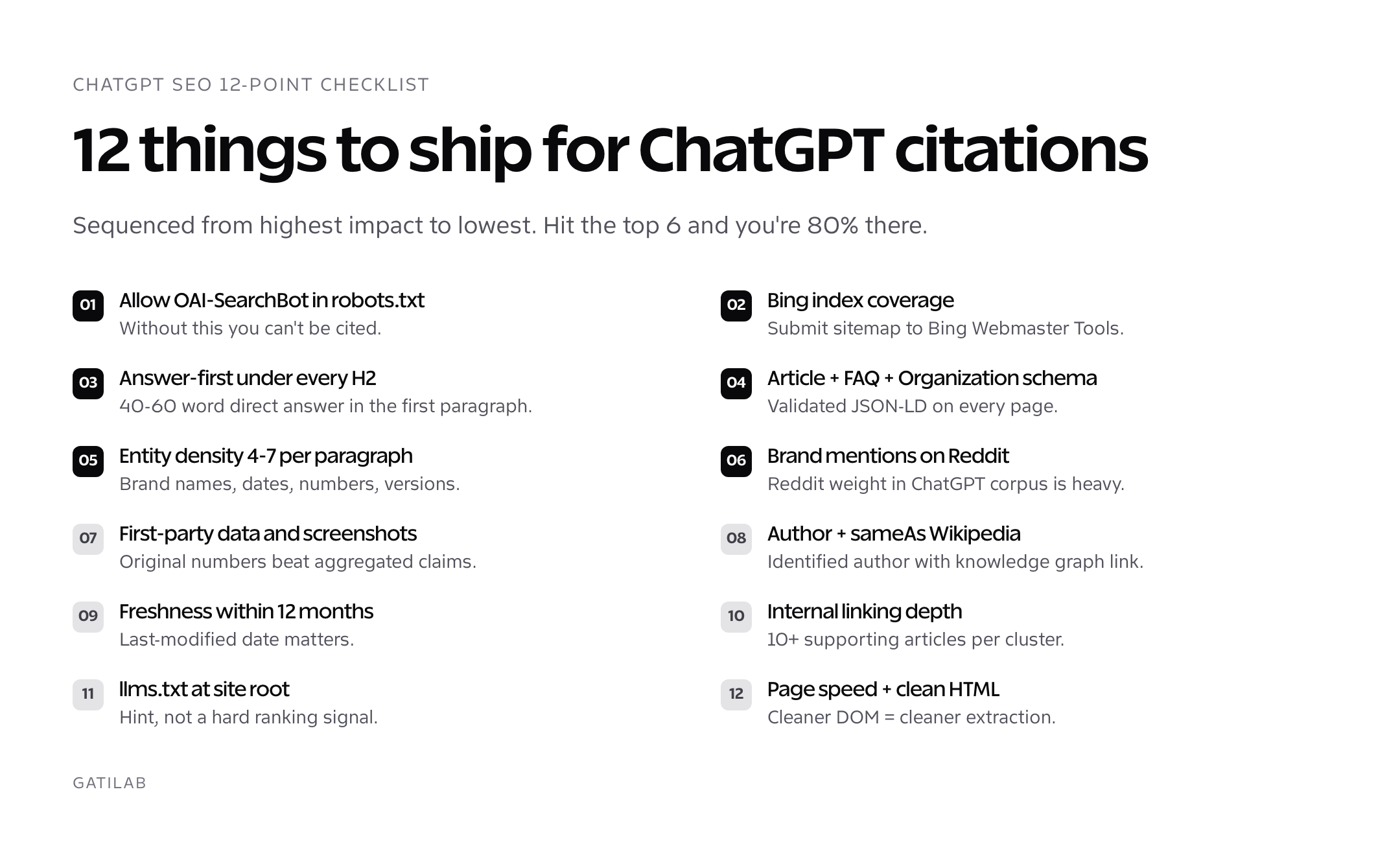
ChatGPT SEO rewards a different signal stack than Google. Bing index coverage matters more than your Google position, OAI-SearchBot access is non-negotiable and brand mentions across the web shape whether the model recognizes you at all. This guide covers the full playbook, from crawler access to a 30-day sprint.
Want this handled for you? Gatilab’s AI search optimization service implements everything in this guide and tracks your citations month by month.
How ChatGPT Search Differs From Google
OpenAI says ChatGPT search uses third-party search providers along with content from its partners, and its own crawler, OAI-SearchBot, decides which sites can be shown in search answers. Microsoft announced Bing as the default search experience in ChatGPT in 2023. So Bing coverage, not your Google position, is the first thing to check. A site that ranks well on Google but is thin in Bing’s index gives ChatGPT less to work with. That grounding asymmetry is the single biggest mental shift required for ChatGPT SEO.
Two other structural differences:
- Citations sit inside the answer. ChatGPT links sources next to the claims they support and lists them in a Sources panel. A user who clicks through has already read a summary, so they arrive with a clear intent.
- Conversation context shapes the answer. OpenAI says ChatGPT considers the full context of your chat on follow-up questions. A query about “WordPress hosting” followed by “…for ecommerce” can change which sources appear. Static rank trackers can’t simulate this.
How ChatGPT Picks Citations
OpenAI hasn’t published how ChatGPT ranks sources, so treat any detailed pipeline diagram with suspicion. What is known: results come from third-party search providers, partner content and pages OAI-SearchBot is allowed to crawl, and the answer attaches each citation to the claim it supports.
What that means in practice:
- Answers usually draw on several sources. Pages that complement each other can be cited together, so you don’t need to be the only answer to earn a citation.
- Community and reference sites compete for the same slots. Forum threads and reference pages often open with a direct answer, which makes them easy to quote.
- Niche specialist sites can beat mainstream publishers on technical queries when they answer the question more directly and specifically.
Source Quality Signals That Win Citations
Five signals do most of the work in ChatGPT SEO. Get all five right on your top 20 pages before you spend time on anything else.
1. Bing index health. Submit your sitemap to Bing Webmaster Tools. Verify ownership. Audit Bing’s crawl errors monthly. A page missing from Bing’s index loses one of the main routes into ChatGPT search. This is foundational. Plenty of SEO teams live in Google Search Console and never log into Bing.
2. Schema markup completeness. Article, FAQPage, HowTo, and Organization JSON-LD on every page. Validated. Without errors. The reranker uses schema as a structural map of what the page answers and which entities it covers. My FAQ schema guide walks through the exact JSON-LD payload that survives validation.
3. Freshness signal. Keep evergreen pages current and update them when facts change. Review them quarterly. Keep datePublished and dateModified in Article schema accurate, and never bump a date without a real update.
4. Brand presence in the training corpus. Language models learn from large amounts of public web text, so a brand that’s discussed often in community threads, reference sites, news and podcasts is easier for them to recognize. Earn unlinked mentions on Reddit threads in your niche. Get cited in podcast transcripts. Pitch yourself as a quoted expert on round-up posts.
5. Answer-first paragraph structure. Direct answer in the first 40-60 words under each H2. Specific numbers. Named entities. No throat-clearing. This is the biggest on-page lever and the one most articles fail.
Structuring Content for ChatGPT Citations
Restructure every page so each H2 section can stand alone as a self-contained answer. ChatGPT’s extractor reads sections, not whole pages. If section three of your article has the best answer to the query, the model will cite section three regardless of how the rest of the page reads.
Concrete pattern that works:
- H2 = a question or claim. “How does ChatGPT Search work?” or “OAI-SearchBot controls ChatGPT search visibility.” Both formats are extractable.
- First paragraph = direct answer. 40-60 words. Specific. Loaded with entities.
- Second paragraph = supporting evidence. Numbers, dates, named tools, named people.
- Third paragraph = nuance or counterexample. This is where you signal expertise. ChatGPT often cites the nuance paragraph when answering complex queries.
- List or table for enumerated claims. ChatGPT extracts list items more reliably than buried prose.
Avoid heavy formatting that fragments the prose. Pull-quotes, fancy callouts, and decorative blocks confuse the extractor. Clean HTML with proper headings, paragraphs, lists, and tables wins.
Brand Mention Strategy for ChatGPT
Nobody outside OpenAI knows exactly how sources are weighted. Mentions in widely read, frequently discussed places are still the safest bet, because they make your brand part of the conversation the model learns from and searches.
Where to focus brand-mention work:
- Reddit. Active subreddit comments mentioning your brand by name in helpful contexts. Don’t astroturf. Earn mentions by being genuinely useful in threads.
- Wikipedia. If you can earn a mention in a relevant Wikipedia article or get an entry for your brand, models get a much clearer picture of who you are.
- News sites and major publications. Earned media in TechCrunch, Wired, Search Engine Land. Each mention compounds.
- YouTube transcripts. Get on podcasts and shows where your brand gets named on camera. Spoken mentions end up in transcripts and show notes.
- GitHub README files. If you ship code, get it linked from related repos. Developers check READMEs first when they compare tools.
- Stack Overflow answers. Mentions in accepted answers reach developers at the moment they pick a tool.
llms.txt and the OpenAI Crawlers
OpenAI documents its crawlers on its bots page. The three that matter here are GPTBot (content that may be used for model training), OAI-SearchBot (search results in ChatGPT) and ChatGPT-User (certain user actions in ChatGPT and Custom GPTs). Each has its own user agent and robots.txt rule, and OpenAI says robots.txt changes can take about 24 hours to take effect.
robots.txt configuration to allow all three:
| User-agent | What it powers | Recommended setting |
|---|---|---|
| GPTBot | Future model training data | Allow if you want long-term ChatGPT prior |
| OAI-SearchBot | ChatGPT Search grounding index | Allow always for ChatGPT SEO |
| ChatGPT-User | On-demand browsing in chat | Allow always |
llms.txt is a proposed file that summarizes a site for language models. OpenAI’s publisher FAQ doesn’t mention it, so treat it as optional. The file costs nothing to ship. Include your pillar pages, knowledge-base articles, and a one-line description of who you serve.
How to Read a Citation Probe
The fastest way to learn what ChatGPT cites in your niche is to look. Run your target queries and, for each answer, note:
- Which domains are cited, and in what order
- Whether the cited page answers the question in its first paragraph
- Whether the source is a forum thread, a vendor page, documentation or an independent blog
- How many named tools, versions or numbers the cited passage contains
Look for the pattern behind the citations instead of the size of the sites. If small pages with direct answers and named entities keep appearing ahead of bigger sites, structure is the lever to pull on your own pages.
Measuring ChatGPT SEO
Track citation rate by query weekly. Manually probe ChatGPT Search with your top 20 target queries every Monday and log which domains get cited and where you rank. Set up an alert on any week where your citation rate drops more than 20%.
Tools that automate ChatGPT citation tracking:
- Profound: tracks which sources ChatGPT, Perplexity, Gemini, Copilot, and Google AI Overviews cite for your prompt list
- Otterly.AI: monitors ChatGPT, Perplexity, Gemini, Copilot, AI Overviews, and AI Mode, with brand coverage charted over time
- Semrush AI Visibility Toolkit: prompt tracking for ChatGPT and Google AI Mode inside Semrush, sold as a paid toolkit on top of the core plans
- Manual probe: costs $0, takes 30 minutes weekly, builds intuition no tool replaces
ChatGPT adds utm_source=chatgpt.com to referral links, according to OpenAI’s publishers and developers FAQ. Filter your GA4 acquisition reports on that source to see ChatGPT-driven traffic.
ChatGPT SEO Mistakes That Tank Citation Rate
Five mistakes hold back citation rate more than anything else. Each one is fixable in a day or two.
- Blocking GPTBot or OAI-SearchBot in robots.txt. OpenAI says sites that opt out of OAI-SearchBot won’t be shown in ChatGPT search answers. Some publishers do this for content protection. If you want ChatGPT SEO, allow them.
- Ignoring Bing Webmaster Tools. Pages not in Bing’s index can’t be cited even if they rank #1 on Google.
- Generic AI-generated content. Pages that repeat what every other page says give the model no reason to cite them. Original data, examples and judgment do.
- Vague language without entities. “Many SEO experts recommend…” cites no one. “OpenAI’s GPTBot, OAI-SearchBot and ChatGPT-User each follow their own robots.txt rule” names three concrete entities.
- Burying answers below the fold. If your H2 is followed by 200 words of context before the answer, you don’t get cited. The answer must be in the first paragraph.
30-Day ChatGPT SEO Sprint
Run this sprint over 30 days, then compare citations on your probed queries against the baseline from week three.
- Days 1-2: Audit robots.txt, allow GPTBot, OAI-SearchBot, ChatGPT-User. Submit sitemap to Bing Webmaster Tools.
- Days 3-5: Pick 10 highest-traffic pages. Rewrite first paragraph under every H2 to 40-60 word direct answer with 4-7 entities.
- Days 6-9: Add or upgrade Article + FAQPage + Organization schema. Validate every page with Schema.org’s validator.
- Days 10-15: Pitch 5 podcasts, 5 round-up posts, 5 Reddit threads where your brand should be mentioned. Aim for 10 unlinked brand mentions in the corpus.
- Days 16-20: Run citation probe on top 20 queries. Log baseline citation rate. Note which competitors are getting cited and study their structure.
- Days 21-25: Ship llms.txt. Update XML sitemap. Verify all top pages render in clean HTML without JavaScript-heavy paywalls.
- Days 26-30: Re-probe top 20 queries. Compare to baseline. Document the lift and the remaining gaps.
Bing Webmaster Tools: The ChatGPT SEO Foundation Nobody Touches
Plenty of SEO teams have never logged into Bing Webmaster Tools, and for ChatGPT SEO that’s an expensive gap. Bing’s index is one of the main routes into ChatGPT search, so Bing crawl health deserves the same attention as Google’s, however well a page ranks on Google.
Bing Webmaster Tools is free. Setup takes 15 minutes. Once verified, you get crawl error reports, an indexed-pages count, query data showing which queries surface your URLs, and the ability to submit URLs manually for re-crawl. The dashboard interface looks dated compared to Google Search Console but the data underneath matters more for ChatGPT search.
What to check on day one of any ChatGPT SEO audit:
- Indexed pages count. Compare against your sitemap. A large gap means Bing is missing meaningful coverage.
- Crawl errors. Bing’s crawler is stricter than Googlebot on certain edge cases (complex JS, slow TTFB, malformed robots directives). Fix the errors before anything else.
- Top queries. Bing’s query report often surfaces queries you don’t rank for on Google. These are direct ChatGPT SEO opportunities.
- IndexNow integration. Bing supports IndexNow, a protocol for telling search engines about new and changed URLs right away. Several WordPress SEO plugins can send IndexNow pings, so enable it if yours does.
- Backlink data. Bing’s backlink report is free and worth comparing with your paid tools during a brand mention audit.
Comparing ChatGPT SEO to Other LLM Engines
ChatGPT SEO shares foundations with Perplexity SEO and AI Overviews ranking but the weights differ. Understanding which engine cares about which signal lets you prioritize work. Here’s how the engines differ on the major signals.
Index source matters. ChatGPT search uses third-party search providers, with Bing as its announced default, plus pages OAI-SearchBot can crawl. Google AI Overviews draw on Google’s own index. Bing work helps ChatGPT, while AI Overviews depend on Google indexing.
Brand mention weight. Each engine leans on a different mix of sources, and the mix changes as products update. Track where each engine’s citations come from in your niche instead of assuming one strategy transfers. Community presence that helps in ChatGPT may matter less for AI Overviews, which rely on Google Search’s normal ranking systems.
Schema sensitivity. Schema helps every engine understand a page, but none of them requires it. Google says there’s no special schema.org structured data needed to appear in AI Overviews or AI Mode. Treat schema as a clarity aid and keep the visible content strong.
Practical sequence: ship the universal fundamentals (answer-first structure, schema, freshness, entity density), then layer engine-specific work. ChatGPT-specific moves include Bing optimization and Reddit brand presence. Perplexity-specific moves include citation-friendly statistics blocks and academic-style citations. For AI Overviews, standard Google SEO and clear authorship do the work.
ChatGPT SEO for Different Content Types
Different content types win ChatGPT citations through different structural patterns. The answer-first principle holds across all of them, but the supporting structure changes. Knowing which pattern matches which content type saves a lot of rewriting.
How-to articles. Use HowTo schema, numbered step lists, and short procedural paragraphs. ChatGPT extracts ordered steps reliably. Each step should be one action verb plus one object plus one specific number or setting. Tutorials with vague steps (“configure your settings”) get ignored. Tutorials with specific steps (“set the cache TTL to 3600 seconds in WP Rocket settings”) get cited.
Listicles and roundups. Use clear H3 per item, short verdict paragraph, then specific data table. ChatGPT loves listicles when each item is a self-contained mini-answer. The pattern: H3 with the tool name, one-line verdict (“FlyingPress is the best caching plugin for shared hosting”), then 2-3 specific facts (price, key feature, compatibility). The Gatilab SEO tools roundup follows this pattern.
Comparison pages. Use HTML comparison tables with clear feature-by-feature rows. ChatGPT extracts table cells well. Pair the table with a 50-word summary verdict at the top of the page. Avoid “both are great” hedging. ChatGPT cites pages that pick a side and explain why.
Definitional content. Use a 1-2 sentence definition in the first paragraph followed by a longer explanation. ChatGPT often cites the opening definition verbatim. Format: “X is Y. It is used for Z.” Keep it lean. Long winding definitions don’t get extracted.
Data-heavy posts. Lead with the headline number. “Lossy WebP images are 25-34% smaller than comparable JPEGs” beats “WebP images are usually smaller.” A specific number in the first sentence gives the model something concrete to quote and attribute. Original data outperforms aggregated claims because the model can attribute the number to your URL with high confidence.
ChatGPT SEO FAQs
What is ChatGPT SEO?
ChatGPT SEO is the practice of optimizing content so ChatGPT search cites your domain inside its inline citations and Sources panel. It focuses on Bing index coverage, OAI-SearchBot access, schema markup, answer-first paragraphs and brand mentions across the web.
How does ChatGPT Search index the web?
OpenAI says ChatGPT search uses third-party search providers and partner content, and Microsoft announced Bing as its default search experience. OpenAI’s own crawler, OAI-SearchBot, also needs access: sites that opt out of it won’t be shown in ChatGPT search answers.
Should I allow GPTBot in robots.txt?
Allow OAI-SearchBot if you want ChatGPT search to cite you. GPTBot collects content that may be used to train OpenAI’s models, so allowing it is a separate choice about training. ChatGPT-User handles certain user actions in ChatGPT and Custom GPTs.
How many sources does ChatGPT cite per answer?
It varies by query, and OpenAI doesn’t publish a fixed number. Answers often draw on several sources, so pages that complement each other can be cited together.
Does ChatGPT use Google’s index?
OpenAI describes its search sources as third-party search providers plus partner content, and Microsoft announced Bing as ChatGPT’s default search experience. Bing presence is foundational for ChatGPT SEO, so check your Bing coverage even if you rank well on Google.
How important is Reddit for ChatGPT SEO?
It helps. Reddit threads are a common source type in AI answers, and earned brand mentions in active subreddits make your brand easier for models to recognize. Don’t astroturf: earn mentions by being useful.
How long does ChatGPT SEO take to show results?
On-page and crawler fixes can show within a few weeks, once pages are recrawled. OpenAI says robots.txt changes take about 24 hours to apply. Brand-mention density takes months, because it builds up across the web.
Can I track ChatGPT citations?
Yes. Profound, Otterly.AI and the Semrush AI Visibility Toolkit track AI citations for a prompt list. Manual probing with your top 20 queries also works. ChatGPT adds utm_source=chatgpt.com to referral links, so GA4 can show the traffic your citations send.
Does llms.txt help ChatGPT SEO?
Don’t count on it. OpenAI’s publisher guidance doesn’t mention llms.txt, so it won’t move citations on its own. Ship it if you like, since it costs nothing, but schema and answer-first structure matter more.
What’s the biggest ChatGPT SEO mistake?
Blocking OAI-SearchBot. If you block the crawler, you opt out of ChatGPT search answers. The second-biggest mistake is ignoring Bing Webmaster Tools, since Bing’s index is one of the main routes into ChatGPT search.
Pair this guide with the broader LLM SEO playbook, the AI Overviews SEO guide, and the SaaS SEO strategy guide if you’re shipping in B2B. The patterns reinforce each other.
Tell Google you want more of this.
Add Gatilab as a preferred sourceOne tap, and this site shows up more often in your own Top Stories, AI Overviews and AI Mode. Remove it any time.