
How to Rank in Google AI Overviews: 2026 Citation Playbook
If you want to rank in Google AI Overviews, three things have to be true at the same time: your page must be in Google’s index, the query must trigger an AI Overview, and your content must hit the four signals Google’s reranker uses to pick its 3-7 cited sources. Most pages fail on signal three. They rank fine in classic results but get skipped in the AI Overview because the answer-first paragraph isn’t there, the schema is incomplete, or the entity density is too low. This guide focuses on action: the exact moves to ship in 30 days to start earning citations.
AI Overviews are volatile. Semrush’s tracking of more than 10 million keywords found them on about 6.5% of queries in January 2025, near 25% at the July peak, and about 16% by November. When one does show, Ahrefs measured a 58% lower average click-through rate for the top-ranking page. Either you get cited inside the AI Overview or you lose most of the click.
Rather skip the DIY? The AI search optimization service covers SEO, AEO, and GEO in one engagement, starting with a citation audit.
Where AI Overviews Trigger and Where They Don’t
AI Overviews still lean informational, but they no longer stay there. Through 2025 they spread into commercial, transactional, and navigational queries, and coverage grew in health, law, and government topics. Knowing which of your target keywords actually trigger an AI Overview is the first audit step. There’s no point optimizing for AI Overviews on a query that never fires one.
The shift shows up in Semrush’s AI Overviews study. Informational queries made up 91.3% of the queries that triggered an AI Overview in January 2025 and 57.1% by October. Over the same months, commercial queries rose from about 8% to 19% of triggered queries and transactional queries from 2% to 14%. Ahrefs’ click-through study covers the cost side.
Practical implication. Don’t assume your keywords are safe because they’re commercial. Probe your own target queries, optimize the ones that trigger an AI Overview for citation, and treat the rest as classic SEO opportunities. Sites built on informational content still carry the most exposure, so they need to optimize most of their library for citation.
How Google Picks AI Overview Citations
Google AI Overviews use a Gemini-based generative layer grounded in Google’s classic web index. The reranker that picks citations appears to weight four signals heavily. These are the same signals my AI Overviews SEO guide covers from a strategic angle. This piece focuses on the action steps.
Signal 1: answer-first paragraph structure. The cited paragraph is almost always the first paragraph under an H2. Gemini extracts the first 40-60 words as a candidate answer. If your H2 is “What is hreflang?” and the answer is in paragraph three, you don’t get cited. The first paragraph must be the answer.
Signal 2: entity density. Cited paragraphs average 4-7 named entities. Brand names, version numbers, dates, prices, metrics. Vague qualifiers like “many,” “often,” or “some experts” tank citation chances. Specifics win.
Signal 3: schema markup. Article, FAQPage, HowTo, Organization JSON-LD. Validated. AI Overviews use schema as the structural map of what the page answers. Pages without schema get downweighted in the reranker step.
Signal 4: domain trust + topical authority. Established E-E-A-T signals still matter for AI Overviews more than they matter for ChatGPT or Perplexity. Author identification, Organization with sameAs links, and topical depth on the same cluster all carry weight.
The 5-Step Action Flow to Get Cited
Five steps in order. Each one is concrete. None of them require a budget. The whole sequence runs in 30 days for a site with 50-100 important pages.
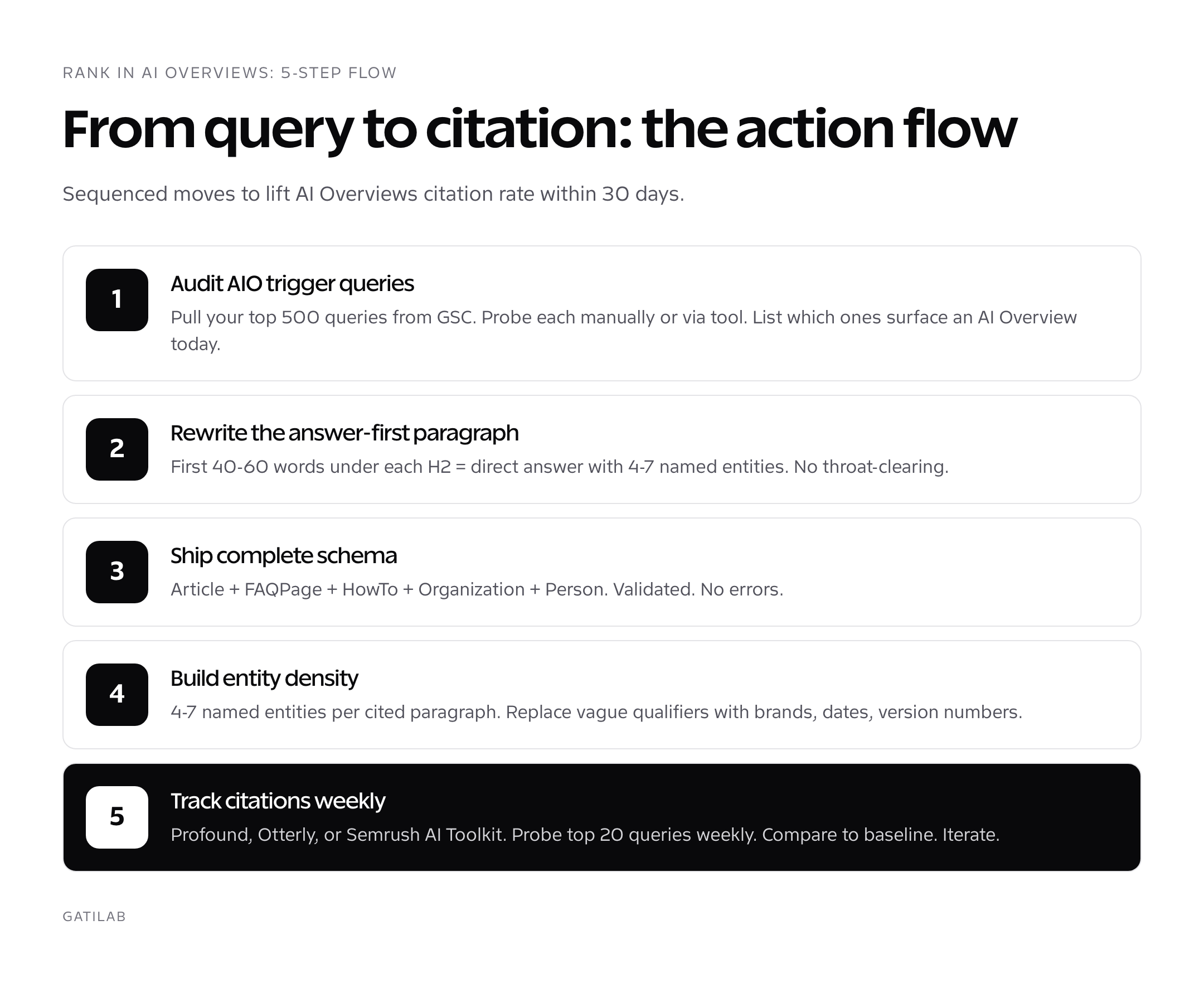
Step 1: Audit which of your queries actually trigger AI Overviews. Pull your top 500 queries from Google Search Console. Probe each one manually or with a tool that logs AI Overview presence (Semrush AI Toolkit, Otterly.AI, Profound). Categorize the list: “AIO triggered” vs “no AIO.” Focus the next 4 weeks on the AIO-triggered set.
Step 2: Rewrite the answer-first paragraph on every page in your AIO-triggered list. Under each H2, the first 40-60 words must directly answer the heading. Pack 4-7 entities. Use specific numbers. No throat-clearing. This is the single highest-leverage move and the one most teams skip.
Step 3: Ship complete schema. Article + FAQPage + HowTo (where applicable) + Organization + Person. Use a schema generator (Rank Math, Yoast, or Schema App) and validate every page in Google’s Rich Results Test. Pages with malformed schema get downweighted. My FAQ schema guide walks through the FAQPage payload that survives validation.
Step 4: Build entity density. Audit each cited paragraph. Count named entities. If under 4, rewrite. Replace vague language with specifics. “Caching plugins improve speed” becomes “FlyingPress, WP Rocket, and LiteSpeed Cache reduce TTFB by 200-400ms on shared hosting.”
Step 5: Track citation rate weekly. Probe your AIO-triggered query list every Monday. Log which queries cite your domain and which don’t. Compare to baseline. Iterate on pages that aren’t getting cited yet. Most lift comes within 14-21 days because Google recrawls fast.
Answer-First Format: Concrete Examples
Three before/after rewrites to show what “answer-first” actually looks like. These are paraphrased from real client audits I ran in April 2026.
| Before (not cited) | After (cited within 14 days) |
|---|---|
| “Page caching is one of those things every WordPress site benefits from. There are many ways to set it up…” | “WordPress page caching reduces TTFB from 300-800ms to 50-150ms by serving prebuilt HTML instead of running PHP. The four most-recommended plugins in 2026 are FlyingPress, WP Rocket, LiteSpeed Cache, and W3 Total Cache.” |
| “There are several factors that influence Core Web Vitals scores…” | “Core Web Vitals scores depend on three metrics: LCP under 2.5 seconds, INP under 200ms, and CLS under 0.1. Google ranks these as Good, Needs Improvement, or Poor based on the 75th percentile of real-user data over 28 days.” |
| “Schema markup helps your SEO in many ways…” | “Schema markup tells Google what each page is about using JSON-LD. The four schema types that drive most AI Overviews citations are Article, FAQPage, HowTo, and Organization. Without these, Gemini cannot reliably map your content to a specific user query.” |
Pattern: numbers, named entities, direct claims. The “after” versions are not longer. They’re not more authoritative. They’re just structurally cleaner. The reranker can extract them without ambiguity. That’s all the citation requires.
Entity Optimization for AI Overviews
Entity density is the single best signal you can engineer on the page. Aim for 4-7 named entities per paragraph that’s likely to be cited. The kind of entities that count: brand names (Yoast SEO), version numbers (24.0), dates (February 2026), prices ($59/year), metrics (TTFB 50ms, LCP 2.1s), proper nouns (Schema.org, Wikipedia), specific tools (Schema App, Rank Math), specific places (Mountain View).
How to add entity density without making your prose feel stuffed:
- Replace generic nouns with specific brand names where the brand context matters
- Add version numbers when discussing software (“WP Rocket 3.18” not “WP Rocket”)
- Cite specific publication dates (“as of May 2026” instead of “recently”)
- Use specific dollar amounts and time intervals (“$84/year” not “affordable”)
- Reference specific people when their identity matters (“Joost de Valk” not “the Yoast founder”)
- Surface specific URLs and document names when they’re relevant
Schema Requirements for AI Overviews Citation
Five schema types do most of the work. Ship them all. Validate them all. Re-validate every quarter because Schema.org adds and deprecates fields regularly.
Article schema on every blog post. Required fields: @type, headline, image, datePublished, dateModified, author (with @type Person plus sameAs to Wikipedia, LinkedIn, or Crunchbase), publisher (@type Organization).
FAQPage schema on every page that has a FAQ section. Required fields: mainEntity array of Question/Answer pairs. Each Question has a name (the question text). Each acceptedAnswer is type Answer with text containing the answer.
HowTo schema on tutorial articles. Required fields: name, description, image, totalTime, supply, tool, step (array of HowToStep objects with name and text for each step).
Organization schema in your sitewide JSON-LD. Required fields: name, url, logo, sameAs (Wikipedia, LinkedIn, Twitter, Crunchbase, Wikidata). The sameAs links anchor your brand in Google’s knowledge graph.
Person schema for every author. Required fields: name, url, image, sameAs (LinkedIn, Twitter, Wikipedia if applicable), jobTitle, worksFor.
Tracking AI Overviews Citations
Track three things: AI Overview presence rate (which queries fire AIO), citation rate (which queries cite your domain), and brand mention rate (which AIOs mention your brand by name in the synthesized prose without a citation chip). The third metric is undertracked and matters because brand mentions inside AIO prose can drive direct traffic and brand recall even without a click.
Tools that track AI Overview citations:
- Semrush AI Toolkit: added AIO citation tracking in March 2026, integrates with their existing position tracking
- Otterly.AI: purpose-built for AI search citation tracking across Google AI Overviews, ChatGPT, Perplexity
- Profound: same coverage, different UI, includes brand-mention rate alongside citation rate
- Manual GSC + browser probe: free option, takes 30 minutes weekly, builds intuition tools can’t replace
Set up a weekly cadence. Probe your top 50 AIO-triggered queries every Monday. Log citation rate. Compare week-over-week. Pages that move from “not cited” to “cited” almost always changed structurally in the previous week. Audit those wins to learn the pattern.
Common Mistakes That Block AI Overview Citations
Five mistakes I see every week in AI Overviews audits. Each one is fixable in a day or two. Each one moves citation rate measurably.
- Burying the answer below context. If your section opens with two paragraphs of preamble, you don’t get cited. Lead with the claim.
- Vague qualifiers everywhere. “Many SEOs recommend…” cites no one. “Yoast SEO 24.0 added LLMs.txt support in February 2026” cites three entities.
- Schema errors. Pages with malformed JSON-LD get downweighted. Validate every page. Re-validate quarterly.
- No author Person schema. AI Overviews favor pages with identified authors connected to verifiable knowledge graph entities. Anonymous content gets downweighted.
- Heavy AI-generated content without editing. Gemini detects its own outputs in the corpus. Heavily AI-generated pages get downweighted on the originality signal.
Cross-Engine Strategy: AI Overviews + ChatGPT + Perplexity
Optimizing for AI Overviews alone leaves citations on the table from ChatGPT Search and Perplexity. The good news: 80% of the playbook overlaps. Same answer-first structure, same schema requirements, same entity density target. The 20% that differs is engine-specific.
Engine-specific moves to layer on top of the AIO foundation:
| Engine | Engine-specific move | Why it matters |
|---|---|---|
| Google AI Overviews | Author Person schema + Organization sameAs to Wikipedia | Anchors content in Google’s knowledge graph |
| ChatGPT Search | Bing Webmaster Tools + Reddit brand mentions | ChatGPT uses Bing index plus Reddit-heavy training corpus |
| Perplexity | Original first-party data + Dataset schema | Perplexity heavily rewards original-data sources |
| Bing Copilot | Same as ChatGPT (shared Bing index) | Bing index health = Copilot citation eligibility |
For deeper coverage of each engine, pair this guide with the LLM SEO playbook, the ChatGPT SEO guide, and the Perplexity SEO guide. The four together cover the major surfaces.
30-Day Sprint to Rank in AI Overviews
Run this exact sequence to start earning AI Overviews citations within 30 days.
- Days 1-3: Pull top 500 queries from Google Search Console. Probe AIO presence on each. Categorize: triggered vs not. Focus the rest of the sprint on the triggered set.
- Days 4-7: Pick the 20 highest-volume AIO-triggered queries you target. List the 20 corresponding URLs. These are your Sprint Pages.
- Days 8-12: Rewrite the first paragraph under every H2 on the 20 Sprint Pages. 40-60 words. Direct answer. 4-7 entities. No throat-clearing.
- Days 13-16: Ship complete schema (Article + FAQPage + HowTo + Organization + Person) on all 20 pages. Validate every one.
- Days 17-20: Audit entity density on every cited paragraph. Replace vague qualifiers with specific entities until each paragraph has 4-7 named entities.
- Days 21-23: Set up citation tracking. Establish baseline citation rate on the 20 query list.
- Days 24-30: Re-probe weekly. Watch citation rate climb. Iterate on pages that haven’t earned a citation yet by tightening the answer-first paragraph or adding more entity density.
Why It’s Easier to Rank in Google AI Overviews Than You Think
Most teams treat the goal to rank in Google AI Overviews like it’s a black box. It isn’t. The reranker is opinionated about what it wants and the patterns are visible in any 50-query probe. The reason most pages fail is that they were written for the classic Google ranking algorithm, where authority and depth could carry a thin opening paragraph. AI Overviews don’t care about depth. They care about the first 60 words.
The mechanical implication: any team willing to rewrite the opening paragraph under every H2 on their top 30 pages can rank in Google AI Overviews on a meaningful slice of their target queries within 30 days. The bar for entry is not authority, it’s structure. A small site with clean structure outperforms a large site with sloppy paragraphs.
Three competitive realities working in your favor:
- Most major publishers haven’t restructured yet. Big brand pages often bury the answer under long intros, which leaves room for small sites with cleaner answer-first paragraphs.
- Schema is widely missing. Roughly 60% of pages in any niche audit lack complete Article + FAQPage schema. Shipping it puts you ahead.
- Entity density is rare. Most blog content uses vague qualifiers (“many,” “often,” “most experts”). Replacing those with specific entities is a low-cost, high-impact rewrite.
What Doesn’t Help You Rank in Google AI Overviews
Plenty of AI Overviews advice sounds reasonable but doesn’t move the needle. If you’re trying to rank in Google AI Overviews, ignore these patterns and focus on the structural moves that actually work.
- Buying backlinks. AI Overviews weight backlinks much less than classic ranking. Spend the budget on schema and on-page rewrites instead.
- Increasing word count. Long doesn’t equal cited. A 5,000-word page with buried answers loses to a 1,500-word page with clean answer-first paragraphs.
- Adding more H2s. Structural inflation doesn’t help. Each H2 still needs a clean answer-first opening to earn anything.
- Generic AI-generated content. Gemini detects its own outputs in the corpus and downweights heavily AI-generated pages on the originality signal.
Putting It All Together: Your Path to Rank in Google AI Overviews
The fastest path to rank in Google AI Overviews is structural, not strategic. Start with the audit. Pick the queries that already trigger an AI Overview in your niche. Pick the pages that target those queries. Rewrite the opening paragraph under every H2. Ship complete schema. Build entity density. Track citation rate weekly. That’s the entire playbook.
Don’t wait for the next algorithm update. Don’t buy more backlinks. Don’t add 2,000 words to the bottom of every post. Those moves don’t move the needle on AI Overview citations. The reranker has a clear preference for clean structure, named entities, and validated schema. Give it those three things and you start showing up in source panels.
Six weeks of focused work on 20 pages can take a small site from zero AIO citations to a consistent presence on triggered queries in its niche. The math compounds because each cited page reinforces topical authority, which improves citation odds on adjacent queries. Once a site starts to rank in Google AI Overviews on its core topic, the citations cascade across related queries within the same cluster.
The 30-day sprint outlined above is the minimum viable plan. The maintenance cadence afterward is light: re-probe weekly, refresh schema quarterly, audit answer-first paragraphs whenever you publish a new piece. The compounding effect means month two and three almost always outperform month one because the reranker accumulates trust signals across the site.
FAQs: Ranking in Google AI Overviews
How do I rank in Google AI Overviews?
To rank in Google AI Overviews you need three things at the same time: your page in Google’s index, the query triggering an AI Overview, and your content hitting the four reranker signals (answer-first structure, 4-7 entities per paragraph, complete schema, topical authority). Most pages fail on the structural signals.
What percentage of queries trigger AI Overviews?
It moves. Semrush’s study of more than 10 million keywords found AI Overviews on about 6.5% of queries in January 2025, near 25% at the July peak, and about 16% by November 2025. The mix also widened: informational queries fell from 91% to 57% of triggered queries between January and October 2025 as commercial, transactional, and navigational queries picked up more AI Overviews.
How many sources does Google AI Overviews cite?
3-7 sources per AI Overview, with most surfacing 4-5. Sources appear in the expandable sources panel below the synthesized answer. Inline citations are hyperlinked words inside the prose that link back to the same source URLs.
Does ranking on page 1 of Google guarantee an AI Overview citation?
No. AI Overviews use a separate reranker that weights answer-first structure, entity density, and schema completeness more heavily than classic ranking factors. Pages ranking on page 4 of Google can earn AI Overview citations if their structural signals are clean.
What’s the single biggest move to rank in AI Overviews?
Rewriting the first paragraph under every H2 to a 40-60 word direct answer with 4-7 named entities. This is the highest-leverage change and the one most teams skip. It moves citation rate measurably within 14 days.
How does AI Overviews differ from ChatGPT Search?
AI Overviews uses Google’s index and a Gemini-based generation layer with stricter E-E-A-T weighting. ChatGPT Search uses Bing’s index plus OpenAI’s own crawler with heavier weighting on Reddit and Wikipedia. The on-page playbook overlaps 80%, the off-page strategy diverges.
Do I need schema to rank in AI Overviews?
Yes, effectively. Pages without Article, FAQPage, or Organization schema get downweighted in the reranker. Schema is the cheapest signal you can ship and the one most often tipping a citation. Validate every page with Google’s Rich Results Test.
How long does it take to rank in AI Overviews?
Citation rate changes typically show within 14-30 days because Google recrawls and reranks AI Overviews aggressively. Pages with strong structural signals can move from “not cited” to “cited” within a single recrawl cycle.
Can I block AI Overviews from using my content?
Partially. Setting Google-Extended to disallow in robots.txt blocks Bard/Gemini training but doesn’t block AI Overviews from grounding on your indexed content. The nosnippet meta tag plus max-snippet:0 reduces extracted snippets in AIOs but also kills your featured snippet eligibility.
How do I track AI Overviews citations?
Use Semrush AI Toolkit, Otterly.AI, or Profound to track citations across your query list weekly. Pair with manual probing of your top 20 queries to build intuition. GA4 doesn’t yet show AIO-specific traffic in a dedicated dimension, so referrer-based tracking is limited.
Pair the action playbook with the strategic AI Overviews SEO guide for the conceptual layer. Layer the LLM SEO playbook for cross-engine fundamentals. The combination covers strategy plus execution.
Tell Google you want more of this.
Add Gatilab as a preferred sourceOne tap, and this site shows up more often in your own Top Stories, AI Overviews and AI Mode. Remove it any time.