
Best AI Visibility Tools
The best AI visibility tools solve different measurement jobs. DataForSEO is the strongest raw-data option, Semrush gives an SEO team the cleanest all-in-one workflow, OtterlyAI is the easiest low-cost prompt tracker, Ahrefs Brand Radar is built for large-scale discovery and ZipTie combines monitoring with content recommendations.
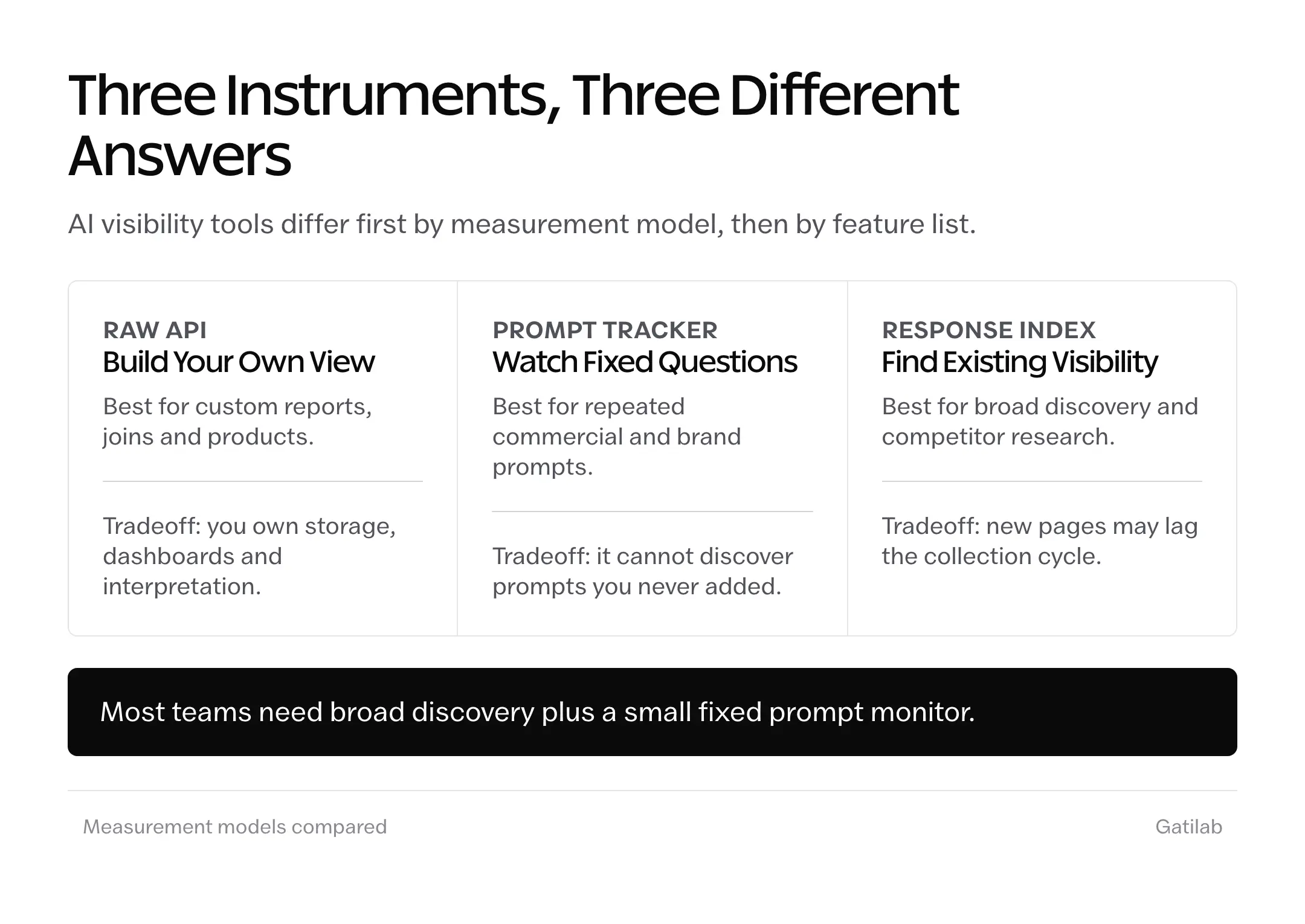
Those products are not interchangeable. Some run a prompt list every day. Some search an existing index containing hundreds of millions of answers. An API gives you data without giving you a finished report. Buying the wrong model is like paying for a telescope when the job needs a security camera. Both can see far away. Only one watches the same door every night.
AI visibility has at least 4 measurable parts:
- brand mentions inside answers;
- linked citations to your domain;
- the prompts and topics where you appear;
- the business outcomes that follow.
The existing AI citations guide explains the difference between a mention and a citation. This comparison focuses on the instruments used to measure them.
Quick Comparisons
Prices below are the lowest public paid entry points checked against vendor pages on August 24, 2026. Annual billing conditions matter, so the monthly figure is not always the amount charged month to month.
| Tool | Best Fit | Entry Price | Included Tracking | Main Coverage | API Or MCP |
|---|---|---|---|---|---|
| DataForSEO | Agencies, developers and custom reporting | $0.10/request + $0.001/row | Usage based | Indexed ChatGPT and Google AI Overview mentions; live responses from ChatGPT, Gemini, Claude and Perplexity | API and MCP |
| Semrush AI Visibility Toolkit | SEO teams wanting one interface | $99/month per domain, billed annually | 25 tracked prompts | ChatGPT, Google AI, Gemini and Perplexity | API |
| OtterlyAI | Small teams and straightforward prompt tracking | $29/month | 15 prompts, checked daily | ChatGPT, Google AI Overviews, Perplexity and Copilot; more engines as add-ons | API and MCP from Standard |
| ZipTie | Teams wanting monitoring plus content recommendations | $69/month | 500 AI-search checks | Google AI Overviews, ChatGPT and Perplexity | Product workflow |
| Ahrefs Brand Radar | Large-scale discovery and competitive research | $199/month for 1 platform | Large indexed dataset; custom prompts priced separately | AI Overviews, AI Mode, ChatGPT, Copilot, Gemini and Perplexity | API |
The table exposes the first decision: prompt count and check count are not the same unit. One prompt checked across 4 engines every day can consume about 120 checks in a 30-day month.
How AI Visibility Tools Differ
The category uses one label for 3 different measurement systems.
Prompt trackers run your chosen questions repeatedly. They are useful for a fixed commercial set such as “best CRM for a 20-person sales team.” OtterlyAI, ZipTie and Semrush Prompt Tracking fit here.
Response indexes collect a much larger set of search-backed prompts before you arrive. They show what already exists without waiting weeks for a custom tracking history. Ahrefs Brand Radar and DataForSEO LLM Mentions fit here.
Raw APIs return structured responses, sources and metrics for your own reporting system. DataForSEO is the clearest example. Ahrefs and some higher product tiers also expose APIs.
A business usually needs 2 views: a broad discovery index to find unknown opportunities and a fixed prompt set to monitor the questions tied to revenue. One tool can supply both, but the distinction should stay visible in the report.
Best AI Visibility Tools
DataForSEO
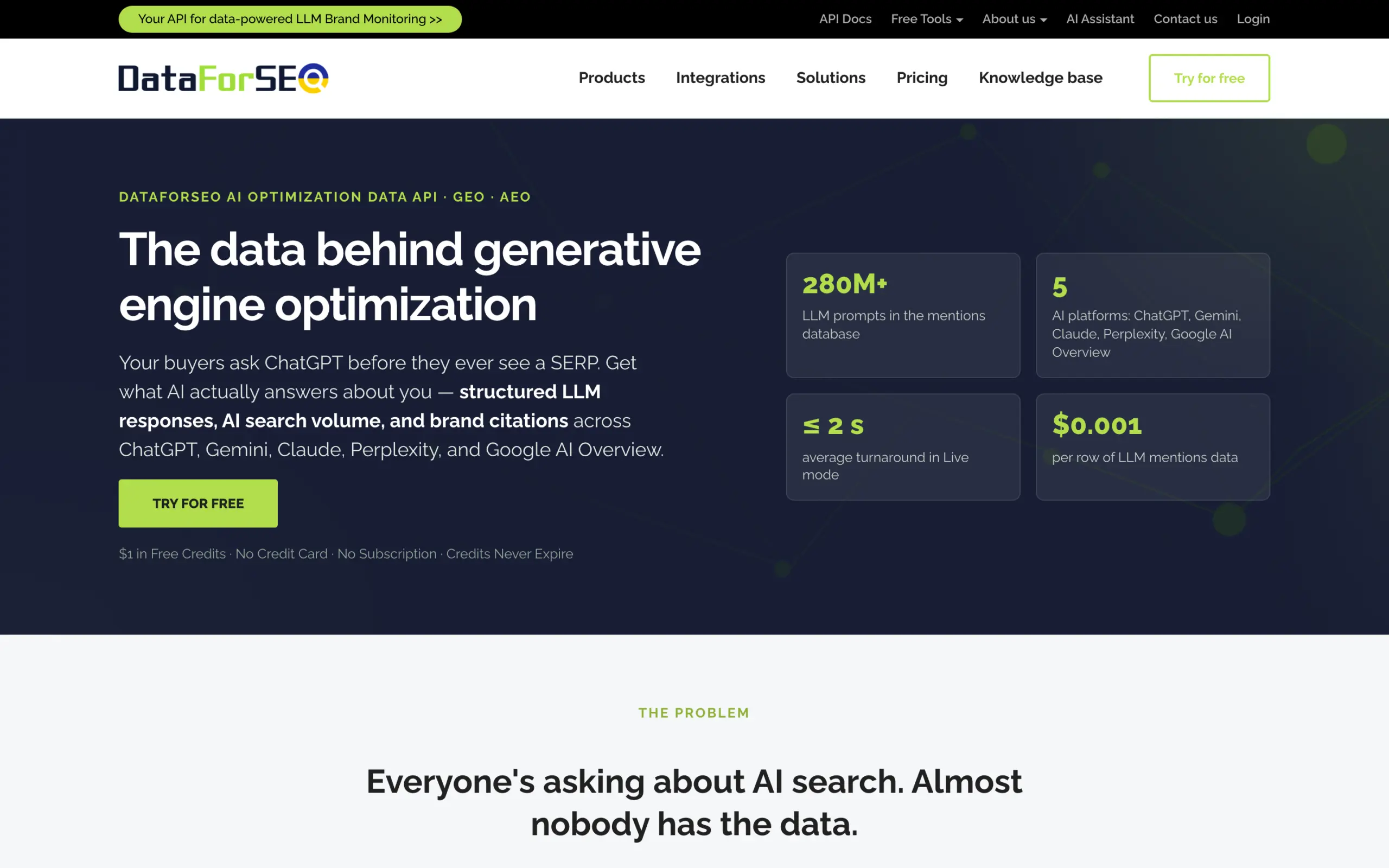
DataForSEO is the best fit when you need raw AI-search data inside a custom report, product or agency workflow. It sells the underlying rows rather than a seat-based dashboard.
The AI Optimization API pricing is usage based:
- LLM Mentions costs $0.10 per request plus $0.001 per returned row.
- AI Keyword Data costs $0.0001 per keyword.
- LLM Scraper starts at $0.0012 per results page in the standard queue.
- LLM Responses starts at $0.0006 per task plus the model charge.
- The minimum top-up is $50, credits do not expire and the earlier monthly commitment was removed in July 2026.
The suite is broader than one endpoint. LLM Mentions searches an indexed set of ChatGPT and Google AI Overview responses. LLM Responses sends live prompts to ChatGPT, Gemini, Claude or Perplexity. LLM Scraper captures rendered ChatGPT and Gemini results. AI Keyword Data supplies estimated AI-search demand.
That separation is useful because a citation report should not quietly mix historical index data with a live model run.
The cost can be tiny or surprisingly large depending on row volume. A target-metrics request returning only an aggregate may cost about $0.10. A detailed search returning 1,000 rows adds another $1.00. The API is inexpensive when the questions are precise and wasteful when every endpoint is treated like an export button.
Choose DataForSEO when:
- you need white-label data;
- you want to combine AI citations with Search Console or analytics data;
- you are building a repeatable agency report;
- you need exact source URLs and answer text;
- you can maintain the reporting layer yourself.
The limitation is equally clear. DataForSEO gives you structured material, not a polished strategy interface. A marketer who wants to log in and see 5 priorities will have to build that view or pay someone to build it.
Semrush AI Visibility Toolkit
Semrush is the cleanest choice for an SEO team that already wants keyword research, site auditing and AI visibility under one account. Its AI product is priced per domain rather than by raw API row.
The Semrush AI Visibility plan costs $99 per month per domain when billed annually. The Base plan includes:
- 25 custom prompts tracked daily;
- 1 domain for Brand Performance;
- mentions from ChatGPT, Google AI, Gemini and Perplexity;
- 300 AI Analysis reports per day;
- 1,000 Prompt Research queries per day;
- AI-search site-audit checks for up to 100 pages;
- 10 CSV exports per day.
Additional limits are not cheap. Semrush lists another domain at $99 per month and another 50 tracked prompts at $60 per month. A small agency tracking 5 clients would therefore outgrow the headline price quickly.
The product’s advantage is not the lowest unit cost. It is connection. A prompt gap can move into competitor research, page auditing, keyword data and an ordinary SEO workflow without exporting 4 files.
Choose Semrush when:
- the team already uses Semrush;
- 1 or 2 domains matter more than a large client portfolio;
- prompt research and site auditing need to sit together;
- the buyer wants a finished interface rather than an API project.
The limitation is the per-domain model. Paying $99 for each additional domain turns an agency portfolio into a multiplication problem rather quickly.
OtterlyAI
OtterlyAI is the easiest entry point for a small team that wants daily prompt tracking without buying a full SEO suite.
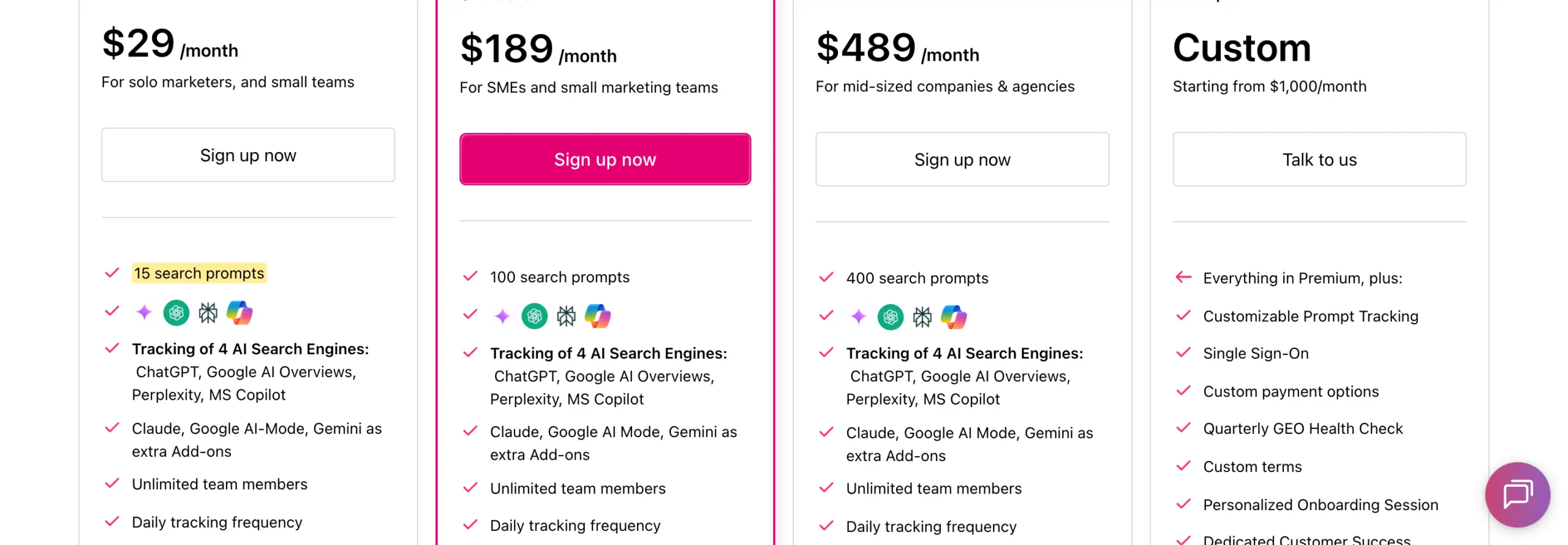
The OtterlyAI pricing page lists 3 main tiers:
| Plan | Monthly Price | Prompts | Base Engines | Integration Access |
|---|---|---|---|---|
| Lite | $29 | 15 | 4 | Dashboard |
| Standard | $189 | 100 | 4 | API, MCP and Agent Analytics |
| Premium | $489 | 400 | 4 | Higher-volume team use |
The 4 base engines are ChatGPT, Google AI Overviews, Perplexity and Microsoft Copilot. Claude, Google AI Mode and Gemini are add-ons. The vendor lists daily tracking and unlimited team members across its public plans.
The unit arithmetic is useful. Lite costs about $1.93 per tracked prompt per month. Standard drops that to $1.89, while Premium drops it to about $1.22. That is not the cost of one model response. Each prompt is checked repeatedly across the included engines.
Choose OtterlyAI when:
- you need a small fixed prompt set;
- daily monitoring matters;
- several teammates need access;
- country and language coverage matter;
- the team does not need a backlink index or traditional rank tracker in the same product.
The limitation is expansion cost. A team that starts with 15 prompts and then adds every product, market and funnel stage can jump from $29 to $189 before the prompt library feels complete.
ZipTie
ZipTie is the best fit when prompt monitoring needs to feed a content-improvement workflow rather than stop at a chart.
The ZipTie pricing page lists:
| Plan | Monthly Price | AI Search Checks | Data Summaries | Content Optimizations |
|---|---|---|---|---|
| Basic | $69 | 500 | 5 | 10 |
| Standard | $99 | 1,000 | 50 | 100 |
| Pro | $159 | 2,000 | 100 | 200 |
All 3 plans cover Google AI Overviews, ChatGPT and Perplexity. The vendor also lists a 14-day trial with 75 checks.
The cost per included check falls with volume:
- Basic: 13.8 cents per check;
- Standard: 9.9 cents per check;
- Pro: about 8 cents per check.
That check allowance needs to be translated into a prompt plan. At 3 engines and daily tracking, 10 prompts can consume about 900 checks in a 30-day month. Standard is therefore closer to a 10-prompt daily plan than a 1,000-prompt plan.
Choose ZipTie when:
- 3 core engines are enough;
- content recommendations matter beside tracking;
- the team wants predictable check-based pricing;
- a compact workflow is more useful than a huge discovery index.
The limitation is platform breadth. Teams that need Claude, Gemini, Copilot or Google AI Mode will need another source.
Ahrefs Brand Radar
Ahrefs Brand Radar is the strongest large-scale discovery product in this group. It is built to search a huge existing response index, compare brands and connect AI visibility with web, YouTube, Reddit and TikTok discovery.
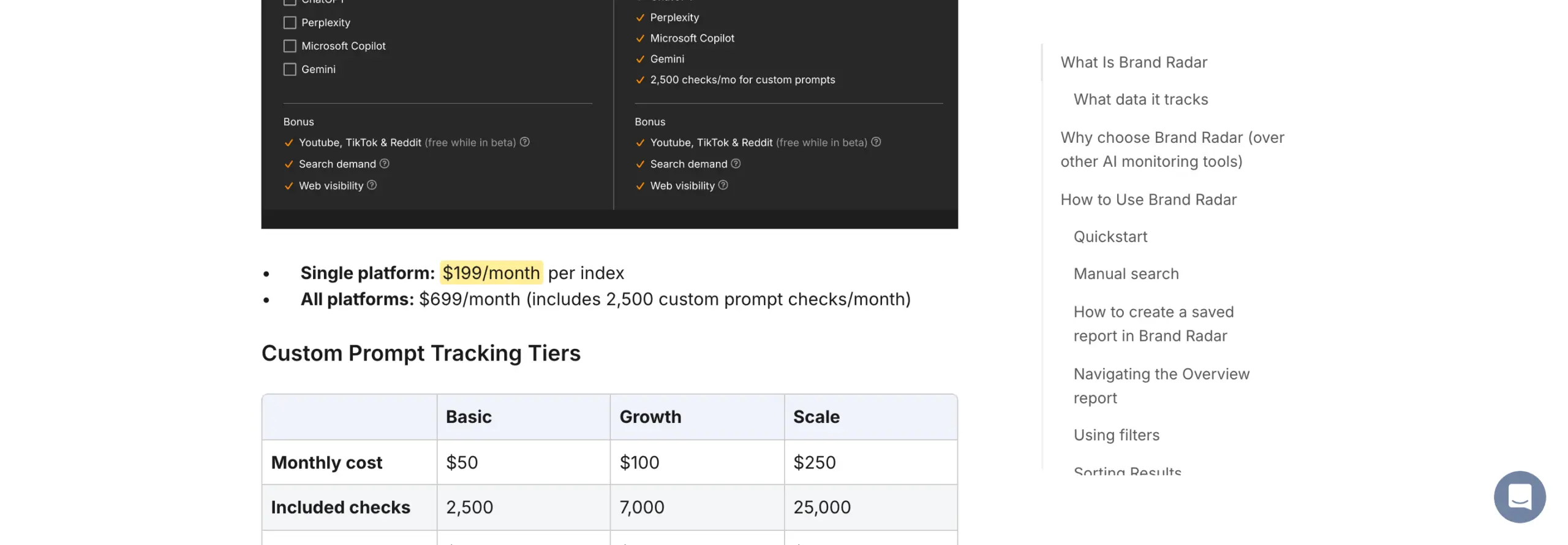
Ahrefs says Brand Radar covers 473 million-plus monthly prompts across AI Overviews, AI Mode, ChatGPT, Copilot, Gemini and Perplexity. Its Brand Radar documentation lists 2 different cost layers:
- $199 per month for one AI platform index;
- $699 per month for all platforms, including 2,500 custom prompt checks;
- custom prompt packages from $50 for 2,500 checks, $100 for 7,000 and $250 for 25,000;
- overages from 2 cents down to 1 cent per check, depending on tier.
Brand Radar counts mentions, citations, impressions and AI share of voice. The indexed view has no setup delay, while custom prompts provide the smaller recurring monitor.
This is the product to choose when the question is “Where are we already present across a category?” rather than “What happened to these 20 prompts today?”
Choose Ahrefs when:
- broad competitive discovery justifies the cost;
- AI data needs to sit beside Ahrefs SEO and backlink data;
- the team needs indexed history before setting up custom prompts;
- unlimited domain research matters more than a low entry price.
The limitation is price. All-platform access at $699 per month is more than 24 OtterlyAI Lite subscriptions. The comparison is not entirely fair because the products measure different things, but the budget difference is hard to miss.
Cost At A Practical Scale
Headline pricing becomes clearer when applied to one monitoring design: 25 prompts, 4 engines, checked daily for 30 days. That design produces 3,000 prompt-engine checks per month.
| Tool | How The Example Fits | Approximate Public Price Boundary |
|---|---|---|
| DataForSEO | Live-response cost depends on models and tokens; indexed mention research priced by request and row | Usage based |
| Semrush | 25 prompts are included; coverage follows the plan’s supported engines | $99/month per domain, billed annually |
| OtterlyAI | Lite is too small; Standard includes 100 prompts | $189/month |
| ZipTie | Pro includes 2,000 checks, below the 3,000-check example | Above $159 or a custom plan |
| Ahrefs | Basic custom prompts include 2,500 checks; another 500 are overage | $50 plus about $10 overage for prompt tracking alone |
The table does not name a universal cheapest tool because the measured object changes. Ahrefs custom prompts do not include the full all-platform discovery index at $50. DataForSEO live-response charges vary by model. Semrush includes a wider SEO workflow around its prompt limit.
Matched units first. Price second.
Metrics That Matter
A tool should expose enough detail to answer these questions:
- What percentage of eligible answers mention the brand?
- Which prompts produce the mention?
- Which competitors appear in the same answers?
- Which domains and pages are cited?
- Is the brand named even when its website is not cited?
- Does source position change over time?
- Which markets and languages are weak?
- Are commercial prompts weaker than informational prompts?
- Can the raw responses and source URLs be exported?
- Can the data be joined to analytics or Search Console?
A single “AI visibility score” is not enough unless the formula, denominator and prompt set are visible. Otherwise the score cannot be reproduced and cannot be compared with another provider’s number.
What Quietly Ruins Tool Selection
Buying by engine count assumes every engine matters equally. A B2B company may care more about ChatGPT and Google AI than 4 smaller platforms combined.
Tracking only brand prompts produces a comfortable report. It says little about discovery because the user already knew the brand before asking.
Ignoring location makes the result look global when it came from one market. This matters for Google AI Overviews and local services.
Treating a prompt as a check hides the multiplication. Prompts × engines × locations × frequency is the billable workload.
Buying recommendations before trustworthy measurement reverses the order. A tool should show the source and answer behind its advice.
Keeping every prompt forever turns the tracker into an attic. Prompts should remain because they represent a decision, not because somebody added them during setup.
The Limits
No AI visibility tool sees every response shown to every user. Models are non-deterministic, personalization and location can change results and providers use different prompt sources.
Large indexes answer broad discovery questions but may lag a newly published page. Custom prompt trackers give current repeated measurements but can miss questions you never thought to add. APIs offer flexibility but shift dashboard, storage and interpretation work onto your team.
And none of these products proves that a citation caused a sale. That requires analytics, sales evidence and careful attribution beside the visibility data.
Which AI Visibility Tool Should You Choose?
Choose DataForSEO when the data needs to enter your own system. Choose Semrush when an existing SEO team wants one connected interface. Choose OtterlyAI for a small, fixed prompt set. Choose ZipTie when content recommendations are part of the job. Choose Ahrefs Brand Radar when broad competitive discovery is worth $199 to $699 per month.
For most small teams, OtterlyAI is the sensible starting point. For an agency building repeatable client reporting, DataForSEO offers the better long-run economics if the reporting layer already exists.
The tool should follow the question you need answered. A bigger dashboard cannot repair a vague measurement plan.
Tell Google you want more of this.
Add Gatilab as a preferred sourceOne tap, and this site shows up more often in your own Top Stories, AI Overviews and AI Mode. Remove it any time.