
AI Visibility Audit: Checklist, Metrics, and Report Template
An AI visibility audit measures whether answer engines can access your content, whether they mention your brand, which pages they cite and whether that visibility leads to a useful business outcome.
Referral traffic alone cannot answer those questions. Many AI answers mention a business without sending a click. Others cite a page without naming the company behind it. A useful audit keeps those events separate instead of compressing them into one visibility score.
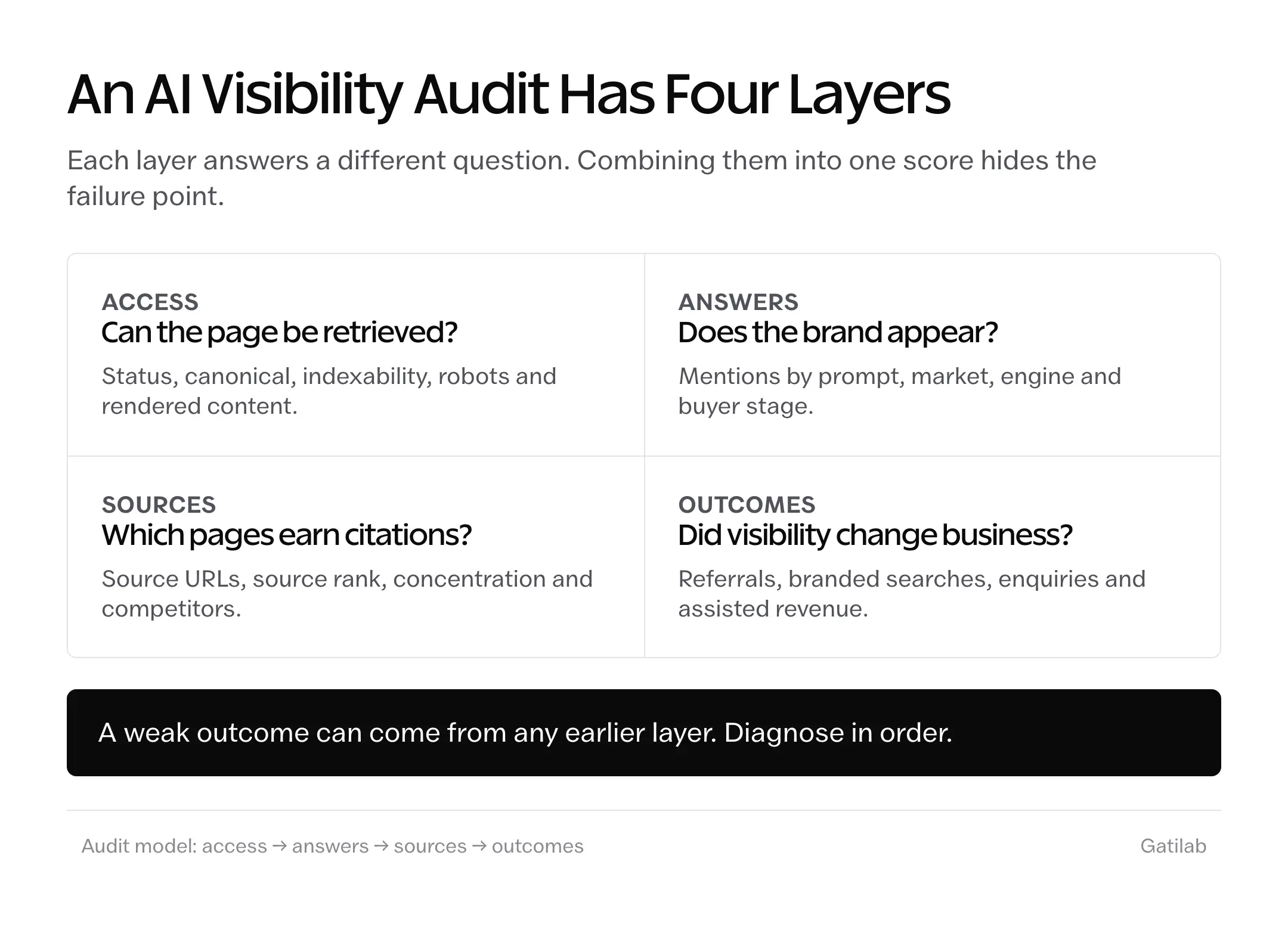
The working model has 4 layers:
- Access: can retrieval systems reach the pages that matter?
- Answers: does the brand appear in relevant AI responses?
- Sources: which domains and URLs are cited as evidence?
- Outcomes: do citations or mentions influence branded searches, visits, leads or revenue?
Everything else is a view of one of those layers.
Audit Scope
The audit should begin with a fixed question set, defined markets and named platforms. Without those boundaries, 2 reports can disagree while both are correct.
Record these inputs before collecting a number:
| Input | Example |
|---|---|
| Brand | Gatilab |
| Domain | gatilab.com |
| Brand variants | Gatilab, Gati Lab, gatilab.com |
| Markets | India and United States |
| Language | English |
| Platforms | Google AI Overviews, ChatGPT, Gemini, Claude, Perplexity |
| Query groups | Category, problem, comparison, brand, implementation |
| Measurement date | August 24, 2026 |
| Comparison period | Previous month or fixed baseline |
A global prompt run and an India-specific prompt run are not substitutes. ChatGPT can produce a different answer by location, model and web-search state. Google AI Overviews are even more tightly tied to the market where the search runs.
The denominator decides the result.
Query Set
A good prompt library follows the buyer’s decision instead of converting a keyword export into questions mechanically. The same topic should be tested at different stages.
For an AI-search agency, the query groups may look like this:
Category Queries
- What is AI search optimization?
- What is generative engine optimization?
- How is AEO different from SEO?
Problem Queries
- How do I find out whether ChatGPT cites my website?
- Why does Google AI Overview cite competitors instead of my site?
- How can a local business appear in ChatGPT recommendations?
Comparison Queries
- Best AI visibility tools for an agency
- DataForSEO vs Ahrefs Brand Radar for AI citations
- Semrush AI Visibility vs OtterlyAI
Commercial Queries
- Best AI search optimization agencies
- AI visibility audit service
- Generative engine optimization services
Brand Queries
- What is Gatilab?
- Is Gatilab a good SEO agency?
- Gatilab AI search optimization reviews
The audit needs enough prompts to expose a pattern but not so many that nobody can review the answers. Start with 25 to 50 prompts across the groups, then increase the set only when the added prompts represent a different decision.
Access Audit
AI visibility starts with ordinary search eligibility and retrieval access. No schema block can rescue a page that returns an error, hides its main content or blocks the retrieval agent that needs it.
The access check should cover:
- HTTP status and redirect destination;
- canonical URL;
- indexability and snippet eligibility;
- robots.txt rules;
- CDN and firewall behavior;
- rendered main content;
- internal links to the page;
- publication and modification dates;
- relevant structured data;
- server or CDN evidence that retrieval agents receive successful responses.
Search and training controls are different. OpenAI documents OAI-SearchBot for search discovery, ChatGPT-User for user-triggered visits and GPTBot for model training. Google says normal Search controls govern AI Overviews and AI Mode, while Google-Extended controls separate Gemini and Vertex uses rather than Google Search inclusion.
Blocking training does not require blocking search. Treating every AI user agent as one thing is the fastest way to make a policy you did not mean to create.
Mention Metrics
A mention counts when the brand appears in an AI answer. It should be measured at the answer level, not by counting every repetition of the brand inside one response.
Use these formulas:
Mention rate = answers mentioning the brand / eligible answers
Category mention share = brand mentions / mentions of all tracked brands
Weighted mention score = sum of mention rate × prompt weight
Prompt weighting should reflect business importance. A brand mention for “best local SEO agency” deserves more weight than a mention for “what is a meta description” when the business sells local SEO.
Keep the weighting table visible:
| Query Group | Suggested Weight |
|---|---|
| Brand | 1 |
| Informational category | 1 |
| Problem | 2 |
| Comparison | 3 |
| Commercial | 4 |
The exact weights can change. Hiding them cannot.
Citation Metrics
A citation is a linked source used in the answer. It is not the same as a brand mention, and it is not the same as a search result the model retrieved but left unused.
The DataForSEO LLM Mentions documentation makes this distinction explicit: sources are cited or relied upon in the final answer, while search_results include retrieved pages that may never be cited.
Measure citations with several views:
- Cited-answer count: answers containing at least 1 link to the domain.
- Citation instances: individual cited URLs from the domain.
- Unique cited pages: canonical URLs receiving at least 1 citation.
- Top-3 source rate: citations ranked 1 to 3 in the answer’s source list.
- Commercial citation rate: commercial answers citing the domain divided by all eligible commercial answers.
- Citation concentration: citations earned by the leading page divided by all domain citations.
Top-3 source rate = citations ranked 1 to 3 / all citation instances
Citation concentration = citations to the leading page / all citation instances
Concentration is the quiet risk. A site with 100 citations from 1 page is less resilient than a site with 60 citations spread across 20 relevant pages.
Worked Example
The August 24, 2026 Gatilab AI citation benchmark provides a useful worked case. The underlying DataForSEO snapshot covered Google AI Overviews in India and the United States plus ChatGPT in the United States.
| Metric | Result |
|---|---|
| Answers citing gatilab.com | 94 |
| Citation instances | 95 |
| Unique cited pages | 18 |
| Google India citations | 46 |
| Google US citations | 29 |
| ChatGPT US citations | 20 |
| ChatGPT top-3 source rate | 95% |
| Commercial answers reviewed | 152 |
| Commercial answers citing Gatilab | 0 |
The top-line number looks healthy until it is split by intent. Gatilab has editorial citation authority. The 152-answer commercial sample found no citation for SEO agency, local SEO, WordPress development, GEO, AEO or AI-search service queries.
That is a different diagnosis from “AI visibility is good.”
Page Audit
The page-level view explains why the brand-level number moved. For every cited URL, record:
- citation count;
- source rank;
- associated prompts;
- answer passage supported by the citation;
- page type;
- publication and modification date;
- organic ranking for the same query where available;
- internal links to the related commercial destination;
- whether the answer names the brand or only links the domain.
A cited page should then be placed into one of 4 buckets:
| Bucket | Meaning | Action |
|---|---|---|
| Protect | Repeated citations with strong placement | Refresh facts carefully and avoid changing the intent casually. |
| Improve | Repeated citations with weak source rank | Strengthen evidence, answer blocks and source quality. |
| Expand | One page wins a cluster with missing adjacent questions | Add distinct spokes that solve different queries. |
| Consolidate | Multiple pages answer the same question | Choose one owner and preserve useful material through a controlled merge. |
The Gatilab benchmark puts /best-blogs-in-india/ in Protect. It puts /amp-seo/ in Improve because it earned 7 US Google citations at an average source rank of 9.86. The 2 Instagram click-identification pages belong in Consolidate because both appeared for overlapping questions.
The bucket tells you what to do. A visibility score does not.
Competitor Audit
Competitor analysis should focus on the pages shaping answers, not only the brands named in them.
For each query group, collect:
- most-mentioned brands;
- most-cited domains;
- most-cited pages;
- content type;
- evidence type;
- recurring third-party sources;
- source rank;
- freshness;
- structured comparison elements;
- gaps that no cited page answers properly.
Suppose 10 “local SEO tools” answers repeatedly cite BrightLocal’s pricing page, a Semrush feature page and a Reddit discussion. Copying the article structure will not create an advantage. The useful move is identifying what the cited set is missing, such as per-location cost at 25 locations or the difference between a geo-grid credit and a tracked keyword.
That missing comparison becomes the content brief.
Outcome Metrics
AI referrals are useful but incomplete. A user can see a recommendation in ChatGPT, search the brand on Google and convert during a session attributed to organic search. Another user can type the domain directly. The AI interaction disappears from last-click analytics.
Track outcomes in layers:
- referral sessions from known AI sources;
- landing pages used by AI referrals;
- engaged sessions and return visits;
- enquiries, purchases or affiliate clicks from AI referrals;
- branded-search growth;
- direct-traffic movement around major citation gains;
- assisted conversions where the user reports AI discovery;
- sales-call or form responses naming ChatGPT, Gemini, Perplexity or Google AI.
Do not assign causality from timing alone. A rise in branded search after a citation gain is a useful lead, not proof that the citation caused it.
Report Template
The audit report should be short enough that a decision-maker can see the gap before the methodology buries it.
AI Visibility Audit
Brand and domain: [name and domain]
Markets and platforms: [defined scope]
Measurement date: October 25, 2026
Current position
- Mention rate: [x/y and percentage]
- Citation rate: [x/y and percentage]
- Commercial citation rate: [x/y and percentage]
- Unique cited pages: [count]
- Top-3 source rate: [percentage]
- Leading cited page: [URL and concentration]
Largest gap
[One sentence naming the query group and winning competitors.]
Priority actions
- [Access fix]
- [Page improvement]
- [New evidence asset]
- [Third-party presence]
- [Measurement follow-up]
The report works because every percentage keeps its numerator and denominator. “Visibility: 67” without a public formula is a decorative number wearing a tie.
What Quietly Ruins An Audit
Testing only brand prompts makes the report look better than the market reality. A buyer asking for the brand by name has already crossed the hardest discovery step.
Mixing locations hides where the brand is absent. A global score can average one strong market with 5 weak ones and call the result stable.
Counting retrieved search results as citations inflates the source footprint. The model may have seen the page and decided not to use it.
Changing prompts every month destroys the trend. New exploratory prompts are useful, but the baseline set has to stay fixed.
Treating traffic as the only outcome ignores unclicked discovery. Treating mentions as revenue makes the opposite mistake.
Optimizing the score instead of the business creates busywork. A higher mention rate for low-intent prompts does not fix zero visibility when a buyer asks for an agency.
The Limits
No AI visibility audit can observe every model, session, personalization layer or unlinked influence. Model responses are non-deterministic, platform coverage differs by provider and prompt datasets are samples.
The audit also cannot prove causality between a citation and a later direct or organic conversion without user-level evidence that usually does not exist. It can show timing, association and a plausible path. It should not turn those into certainty.
And an audit cannot manufacture authority. It can show that competitors are cited because they publish original pricing data, case evidence or a better comparison. The missing work still has to be done.
What The Audit Should Change
An AI visibility audit should end with a small number of page, entity and measurement decisions. If it ends with 70 colored charts and no named action, it is reporting theater.
The useful question is not “What is our AI visibility score?” It is “Which buyer questions exclude us, which sources shape those answers and what evidence would give us a legitimate place in them?”
That question can be acted on.
Tell Google you want more of this.
Add Gatilab as a preferred sourceOne tap, and this site shows up more often in your own Top Stories, AI Overviews and AI Mode. Remove it any time.