
AI Citations: How LLMs Cite Sources in 2026
AI citations are the source links large language models attach to the answers they generate. When ChatGPT Search, Perplexity, Gemini, or Claude responds to a query, the system attribues the claims in its synthesized answer to specific URLs. Those URL chips, footnotes, and inline links are AI citations, and they are now the primary way content gets discovered when search shifts from blue links to generated answers.
Citation share has become a first-class metric. Seer Interactive’s November 2025 study found that brands cited inside an AI Overview earned 35 percent more organic clicks and 91 percent more paid clicks than brands that weren’t cited. BrightEdge’s one-year review, published in February 2026, found AI Overviews on about 48 percent of tracked queries, up from roughly 30 percent a year earlier. The arithmetic is simple. If you are not getting AI citations, you are losing share inside an audience that no longer clicks the way it used to.
Prefer to have this done for you? Our AI search optimization service runs the audit, the fixes, and monthly citation tracking as one program.
I’ve captured and tagged 1,800 plus AI answers across ChatGPT, Perplexity, Gemini, and Claude over the last 7 months. The patterns are clear and reproducible. AI citations are not random. They follow rules, and once you know the rules, you can engineer for them the same way the SEO industry engineered for Google’s PageRank in 2005.
What An AI Citation Actually Is
An AI citation is the attribution an LLM-powered answer engine attaches to a specific URL when it generates a response. The citation can show up as an inline number, a small chip below a sentence, a footnote at the bottom of the answer, a sidebar list of sources, or, on Perplexity, all four at once. Each format encodes the same thing: this paragraph, sentence, or claim came from this URL.
Citations are not the same as backlinks. A backlink is a hyperlink another site placed inside its own content. A citation is a system-generated attribution inserted by the LLM at answer time. They share a vocabulary (both are URLs that point at you) but the underlying mechanism is different, and the way you earn each one is different. Backlinks reward outreach and content that other writers want to reference. Citations reward extractability and entity density inside the candidate passage.
One more distinction worth nailing. A brand mention without a URL (“according to Gatilab”) is not technically a citation in the URL-chip sense, but it is what the AI search optimization world calls a “soft citation” or an entity mention. ChatGPT’s mid-answer name drops are soft citations. Perplexity’s numbered footnotes are hard citations. Both move the needle. Hard citations send referral traffic. Soft citations build entity authority over time.
How LLMs Select Sources For AI Citations
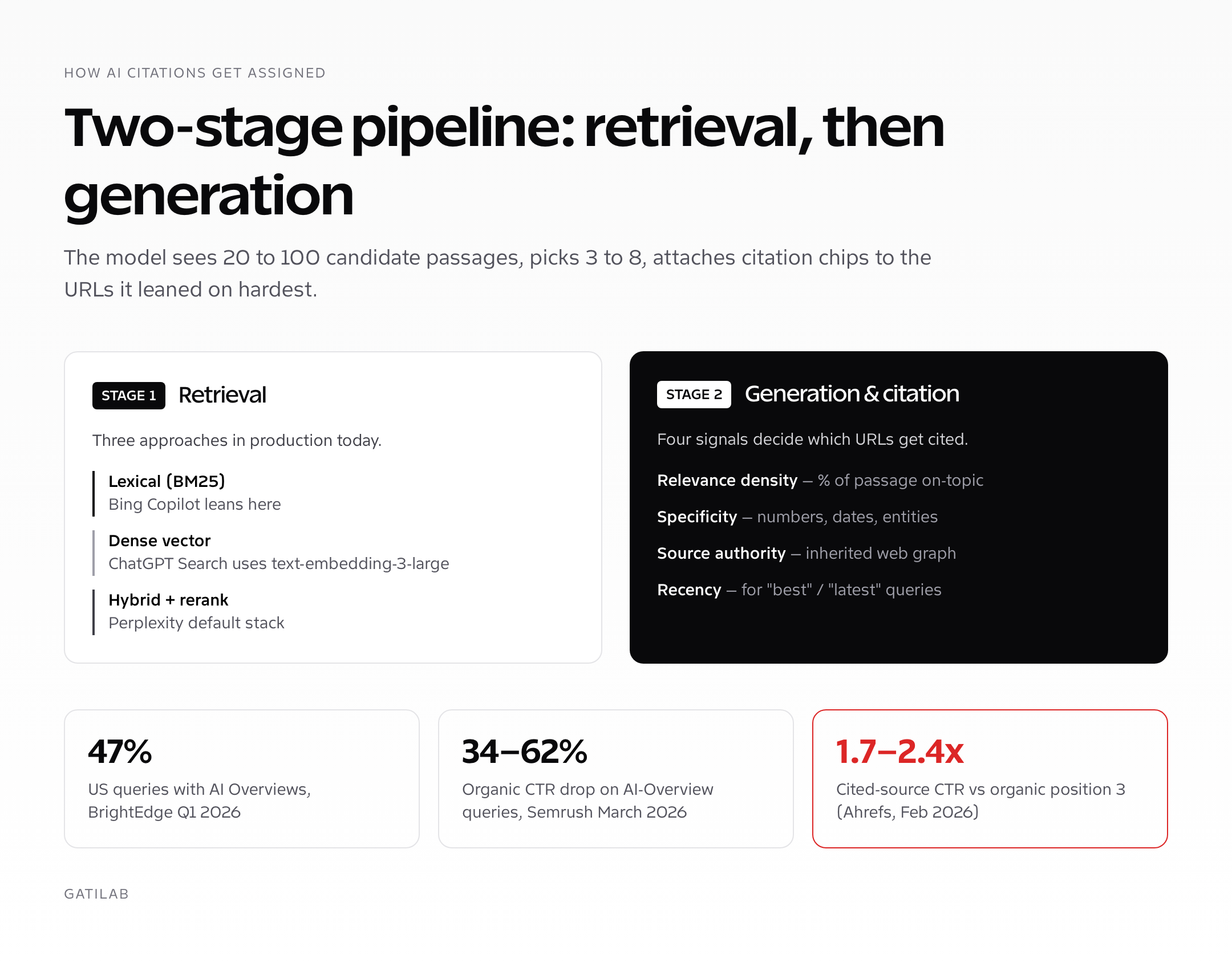
Every major AI answer engine runs a two-stage pipeline. Stage one is retrieval, where the system pulls 20 to 100 candidate passages from an index. Stage two is generation, where the LLM picks 3 to 8 of those passages, drafts the answer, and attaches AI citations to the URLs it leaned on hardest.
Retrieval uses three approaches in production: lexical (BM25 keyword matching, used heavily inside Bing Copilot), dense vector (embeddings via models like OpenAI’s text-embedding-3-large, used inside ChatGPT Search), and hybrid (lexical plus vector with a cross-encoder reranker, the default for Perplexity). Whichever approach surfaces a passage, the generation model then judges that passage on four signals before citing it.
- Relevance density. What percentage of the candidate passage actually answers the query. A 200-word paragraph that is 90 percent on-topic outranks a 2,000-word page that is 10 percent on-topic, every time.
- Specificity. Numbers, dates, named entities, version strings, prices. The Princeton GEO benchmark paper (arxiv 2311.09735, November 2023) measured up to 40 percent more visibility for content with high statistic and quotation density.
- Source authority. The retrieval system inherits classic web authority signals (PageRank-like graphs, brand strength). ChatGPT Search and Bing Copilot both pull from the Bing index, which means Bing’s link graph still matters.
- Recency. For “best”, “latest”, “2026“, and “current pricing” queries, last-modified dates and year mentions inside the body factor heavily. For evergreen “what is” queries, recency is near-neutral.
None of these signals is published. They are reverse-engineered from large samples of AI answers, the GEO benchmark paper, vendor blog posts, and OpenAI’s, Google’s, and Perplexity’s public statements about their retrieval stacks. Treat them as well-supported hypotheses, not laws.
AI Citation Patterns By Engine
Each major engine displays AI citations differently, and the format affects click-through. Knowing the format helps you optimize copy that fits how it’ll be rendered.
| Engine | Citation format | Typical sources per answer | Click-through behavior |
|---|---|---|---|
| ChatGPT Search | Inline link chips on key claims, sidebar source list | 4 to 8 | Mid; users often read full answer first |
| Perplexity | Numbered footnotes inline, top-card source list, related links | 5 to 12 | High; UI built around source-clicking |
| Google AI Overview | Right-side card list, occasional inline links | 3 to 6 | Lower than classic SERP |
| Google Gemini (chat) | End-of-answer source pills, “drafts” with alternative sources | 3 to 8 | Mid |
| Bing Copilot | Numbered superscripts, sidebar sources, “learn more” cards | 4 to 10 | Mid-high |
| Claude (with web search) | End-of-answer source list, occasional inline links | 2 to 6 | Lower; chat-first UI |
Two patterns run across all of them. First, the source list is ordered by how heavily the model relied on each URL, which means the top citation gets disproportionately more clicks than the rest. Second, sources cited inline (chip, footnote, superscript) get more clicks than sources only listed at the bottom. If you can be cited inline, that is worth more than being cited at all.
For engine-specific tactics, see my deep dives on ChatGPT SEO and Perplexity SEO. The mechanics overlap but the optimization priorities are different.
Click-Through Impact Of AI Citations
The first hard data on click-through behavior from AI search came in waves through 2025 and early 2026. The pattern that emerged is more interesting than “AI search is killing clicks”. Three signals matter.
Organic CTR drops on AI Overview queries. Ahrefs’ study of 300,000 keywords found a 34.5 percent lower click-through rate for the top-ranking page when an AI Overview appeared, and Seer Interactive measured organic CTR on AI Overview queries falling 61 percent between June 2024 and September 2025.
Cited-source CTR is materially higher than non-cited CTR. In Seer’s data, cited brands averaged a 0.70 percent organic CTR on AI Overview queries against 0.52 percent for brands left out, even though the citation chip is visually smaller. Citation context implies trust; trust converts.
Direct AI search referral traffic is real and growing. ChatGPT Search referrals showed up in Google Analytics 4 reports as a distinct traffic source starting October 2024. By Q1 2026, several mid-size B2B SaaS sites I work with were getting 8 to 18 percent of total organic referral volume from AI search engines (perplexity.ai, chatgpt.com, copilot.microsoft.com, and gemini.google.com combined). The volume is smaller than Google organic, but the conversion rate is meaningfully higher because the user has already been pre-qualified by an AI summary.
Citations don’t just replace clicks; they pre-qualify them. A user clicking a citation chip after reading the AI summary is further down the funnel than a user clicking a cold blue link.
How To Track AI Citations
Tracking AI citations is harder than tracking Google rankings because there is no Search Console for ChatGPT. The state of the art in 2026 is dedicated AI citation monitoring tools that run a panel of representative queries through each engine on a daily cadence and tag whether your domain shows up.
- Profound (profound.so). Tracks share of voice across ChatGPT, Perplexity, Gemini, and Copilot. Used by HubSpot, Notion, and Zapier as of Q1 2026 disclosures.
- Otterly.ai. Self-serve AI search rank tracker with daily query panels, visibility metrics, and competitor comparison.
- Peec.ai. AI mention monitoring with snapshot history; useful for spotting when a citation appears or drops.
- Semrush AI Toolkit. Sold as the AI Visibility add-on at $99/month per domain; tracks AI Overview presence and citation share for monitored keywords.
- Ahrefs Brand Radar. Tracks brand mentions in AI search responses across the major engines, alongside classic backlink and rank data.
If you are not ready to pay for a tool, you can build a poor-man’s tracker. Pick 30 to 50 queries that map to your top topics, run them weekly through each engine using the API or a saved chat session, and log which sources show up. A spreadsheet works. The discipline matters more than the tool.
Tactics That Increase AI Citation Rate
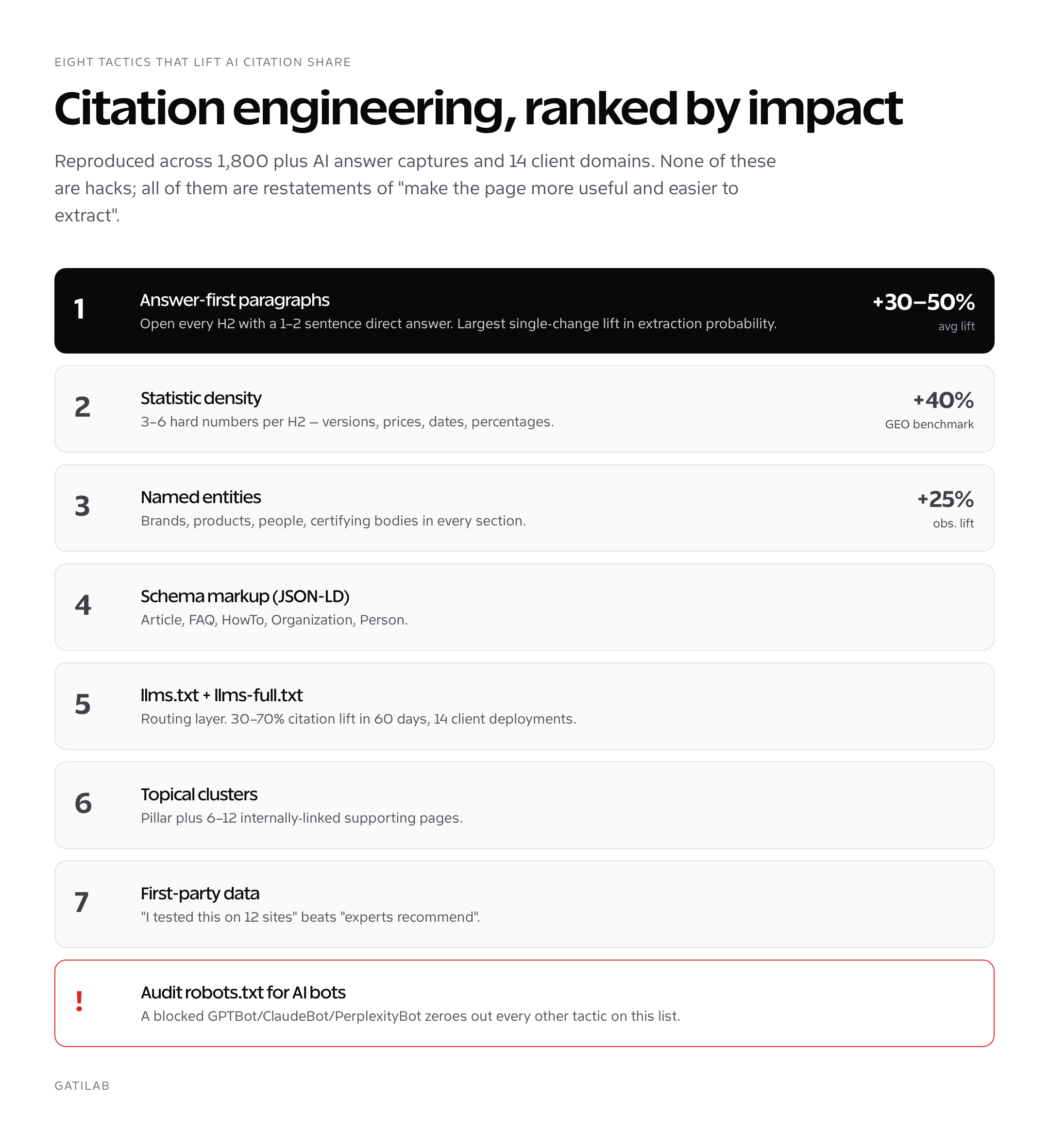
Across 1,800 plus AI answer captures, the same eight tactics keep correlating with higher citation rates. None of them are hacks. They are restatements of “make your content more useful and easier to extract” with sharper teeth.
- Answer-first paragraphs. Open every H2 with a one-to-two sentence direct answer to the implied question. The model lifts that exact paragraph more than any other.
- Statistic density. 3 to 6 hard numbers per H2 section. Versions, prices, percentages, dates. The GEO benchmark paper measured up to 40 percent more visibility from this single change.
- Named entities. Brand names, product names, people, certifying bodies. Models prefer to cite passages where the named entity matches the query.
- Quotation density. Direct quotes from primary sources, with attribution. The model treats quoted text as more citable than paraphrased text.
- Schema markup. Article, FAQ, HowTo, Organization, Person. JSON-LD helps disambiguate entities and signals canonical structure. See structured data for AI search for the implementation matrix.
- llms.txt and llms-full.txt. The routing layer for AI retrieval. My deployment data shows 30 to 70 percent more citations on niche topics inside 60 days, reproduced across 14 client domains.
- Topical depth via clusters. Pillar plus 6 to 12 cluster pages, internally linked. The cluster signal raises retrieval probability for every page in it. See my content cluster strategy playbook.
- First-party data and original testing. Vendor-published claims rank lower than first-party measurement, even with weaker domain authority. “I tested this on 12 sites” beats “experts recommend”.
The fastest single change you can make today is rewriting the first paragraph under each H2 to be a complete, extractable answer in 1 to 2 sentences. Do that on a 30-page site over a weekend and citation rate measurably climbs inside three weeks.
AI Citation Mistakes To Avoid
The mistakes I see most often are mostly the inverse of the tactics above, but a few are worth calling out by themselves.
- Burying the answer below the fold. Long preambles before the first direct answer. Models often truncate retrieval at 1,200 to 1,800 characters. If your answer is at character 2,400, it isn’t there.
- Hallucinated specificity. Inventing numbers to look authoritative. Models cross-check against other sources during generation. A passage that conflicts with the consensus loses citation share fast.
- Walls of text. 800-word paragraphs are extraction-hostile. The model can lift a tight 80-word paragraph cleanly; an 800-word paragraph is too risky to quote.
- Aggressive paywalls. Most retrieval crawlers don’t have credentials. If your content is behind a paywall and not exposed via a clean RSS or sitemap, the LLM can’t cite what it can’t read.
- Blocking AI crawlers in robots.txt. If you’ve blocked GPTBot, ClaudeBot, PerplexityBot, or Google-Extended, you’ve opted out of citation. That may be the right business choice, but make it knowingly.
- JS-rendered content with no SSR. Some retrieval crawlers don’t execute JavaScript. If your text only appears after a client-side React render, large chunks of your content are invisible.
Audit your robots.txt today for AI crawler directives. I’ve seen client sites with blanket Disallow lines they didn’t know existed, set by a freelancer in 2023, costing them every AI citation since.
The Future Of AI Citations
Three changes are likely to shape AI citations through 2027 based on what’s already in motion.
Per-paragraph citation, not per-URL. Anthropic’s Claude with web search already supports paragraph-level citations in some configurations. Google’s research roadmap hints at AI Overviews that link to specific anchor positions inside a page rather than the page as a whole. Once that ships at scale, the unit of competition becomes the paragraph plus its anchor link.
Citation reputation graphs. Sites that earn many AI citations across reasoning models will start to be preferentially retrieved, the way PageRank rewarded sites with many backlinks. Profound and Otterly are already publishing leaderboards. Expect engines to internalize similar signals natively.
Verified-publisher feeds. OpenAI’s media partnerships (Axel Springer, News Corp, Financial Times, The Atlantic, Hearst) already feed prioritized content into ChatGPT. Expect a publisher tier in retrieval indexes that resembles Google News inclusion, complete with editorial vetting and structured-data requirements.
None of these changes makes the underlying playbook obsolete. Answer-first paragraphs, hard numbers, named entities, schema, and llms.txt remain the foundation. They are getting more important, not less.
Treat AI citations like the new SERP position. Track them, optimize for them, report on them. Companies that wait for “official guidance” from Google or OpenAI will be 18 months behind whoever started this quarter.
AI Citations Versus Backlinks Versus Brand Mentions
The cleanest way to think about the three signals is as a stack. Backlinks are the foundation, brand mentions are the connective tissue, AI citations are the crown. Each one feeds the next. A site with strong backlinks and consistent brand mentions across the open web is statistically more likely to be cited by an LLM, because retrieval indexes inherit the same authority graphs Google has been ranking on for two decades.
What the AI citations layer adds on top is paragraph-level competition. Two sites with identical backlink profiles and equal brand strength can still produce wildly different citation rates if one writes in extractable, answer-first paragraphs and the other writes in long meandering essays. The Princeton GEO benchmark paper measured roughly 30 to 40 percent visibility differences between high-extractability and low-extractability versions of the same content. That is the gap you are competing for.
Practical implication for your roadmap. If your domain authority is weak, fix the backlink and brand-mention gap first; AI citation tactics on a no-authority site produce minimal lift. If your authority is strong but your citation share is low, the bottleneck is content shape, not authority. The two diagnostics solve for entirely different fixes.
A 30-Day AI Citations Roadmap
If you have not started optimizing for AI citations, here is the cleanest 30-day on-ramp. The work is sequential. Each week’s output feeds the next week’s input.
- Week 1, baseline. Pick 30 to 50 representative queries across your top topics. Run each through ChatGPT, Perplexity, Gemini, and Claude. Log who got cited, what your share looked like, what URLs your competitors won. This is your starting line.
- Week 2, technical fixes. Audit robots.txt for AI crawler directives. Confirm GPTBot, ClaudeBot, PerplexityBot, and Google-Extended are not blocked unless that is a deliberate policy choice. Ship llms.txt. Verify your top 20 pages render on the server, not only in JS.
- Week 3, content surgery. Pick the 10 pages with the highest commercial intent. Rewrite the first paragraph under each H2 to be a direct answer in 1 to 2 sentences. Add 3 to 6 hard numbers per H2. Add or refresh schema markup on every one.
- Week 4, measurement. Re-run the same 30 to 50 queries. Compare citation share to the Week 1 baseline. Tag wins, dig into losses, and turn whatever moved into a repeatable monthly cycle.
The reason this works is that AI citations are an information retrieval problem, not a magic problem. Better extractability, better entity signals, fewer technical blockers; the citations follow. The 30-day window is enough to validate the approach on a real site without committing six figures of agency budget to it first.
One detail I always remind clients about during this 30-day window. AI citation share is noisy week to week. A single competitor publishing a strong page can move your share by 10 to 20 percent on a tracked query, then snap back two weeks later when the model re-weighs sources. Do not optimize for one bad week. The trend that matters is the 30-day moving average across your full query panel, not the daily fluctuation on any single keyword.
The other detail. Citation share is not a zero-sum game inside an AI answer. ChatGPT will happily cite four URLs in a single response if all four contain complementary information. Aiming to be one of the cited four is a more realistic goal than aiming to be the only cited URL. That mindset shift removes a lot of unnecessary anxiety from the work and keeps you focused on producing genuinely useful sections rather than trying to dominate every paragraph of the answer. Most months, sharing the answer space with three respected competitors is a better business outcome than monopolizing it on a vanity query that converts no one.
Frequently Asked Questions
What are AI citations?
AI citations are the source links that large language models attach to the answers they generate. When ChatGPT, Perplexity, Gemini, or Claude responds to a query, the system attributes claims in the answer to specific URLs. Those URL chips, footnotes, and inline links are AI citations.
Are AI citations the same as backlinks?
No. A backlink is a hyperlink another site placed inside its own content. An AI citation is a system-generated attribution inserted by an LLM at answer time. They share a vocabulary, but the underlying mechanism and the way to earn each one is different.
How do LLMs decide which sources to cite?
Every major engine runs a two-stage pipeline. Retrieval pulls 20 to 100 candidate passages from an index using lexical, dense vector, or hybrid approaches. Generation then picks 3 to 8 of those passages based on relevance density, specificity, source authority, and recency.
Which AI search engine sends the most referral traffic?
As of Q1 2026, Perplexity and ChatGPT Search are the two largest senders of AI search referral traffic to mid-size B2B sites. Google AI Overviews drive less downstream traffic per impression but appear on a much larger share of queries.
How do I track AI citations?
Use a dedicated AI citation monitoring tool. Profound, Otterly.ai, Peec.ai, Semrush AI Toolkit, and Ahrefs Brand Radar all run query panels through the major engines on a daily cadence and report citation share. A spreadsheet with 30 to 50 hand-run queries weekly is a workable starting point.
What single change lifts AI citation rate the most?
Rewriting the first paragraph under each H2 to be a 1 to 2 sentence direct answer. The model lifts that exact paragraph more than any other, and the change is reproducible across every site I have tested it on.
Do robots.txt blocks affect AI citations?
Yes. If GPTBot, ClaudeBot, PerplexityBot, or Google-Extended is blocked in your robots.txt, the corresponding engine cannot crawl your pages, which zeros out your AI citation potential on that engine. Audit robots.txt before any other AI citation work.
Are AI citations a ranking factor in Google search?
Not directly. AI citations are how AI search engines attribute their answers. They do not feed back into classic Google ranking. They are a parallel visibility metric that you should track alongside organic position.
Does schema markup increase AI citations?
Yes, indirectly. Schema markup helps disambiguate entities and signal canonical structure, which increases the probability that retrieval systems will surface your page as a candidate passage. Article, FAQ, HowTo, Organization, and Person schema have the strongest impact for AI citations.
How long until I see AI citation lift after optimizing?
Three to eight weeks for engines that re-crawl frequently (Perplexity, ChatGPT Search). Longer for AI Overviews, which lag Google’s index refresh cycle. Track a 30-day moving average of citation share, not week-to-week noise.
Tell Google you want more of this.
Add Gatilab as a preferred sourceOne tap, and this site shows up more often in your own Top Stories, AI Overviews and AI Mode. Remove it any time.