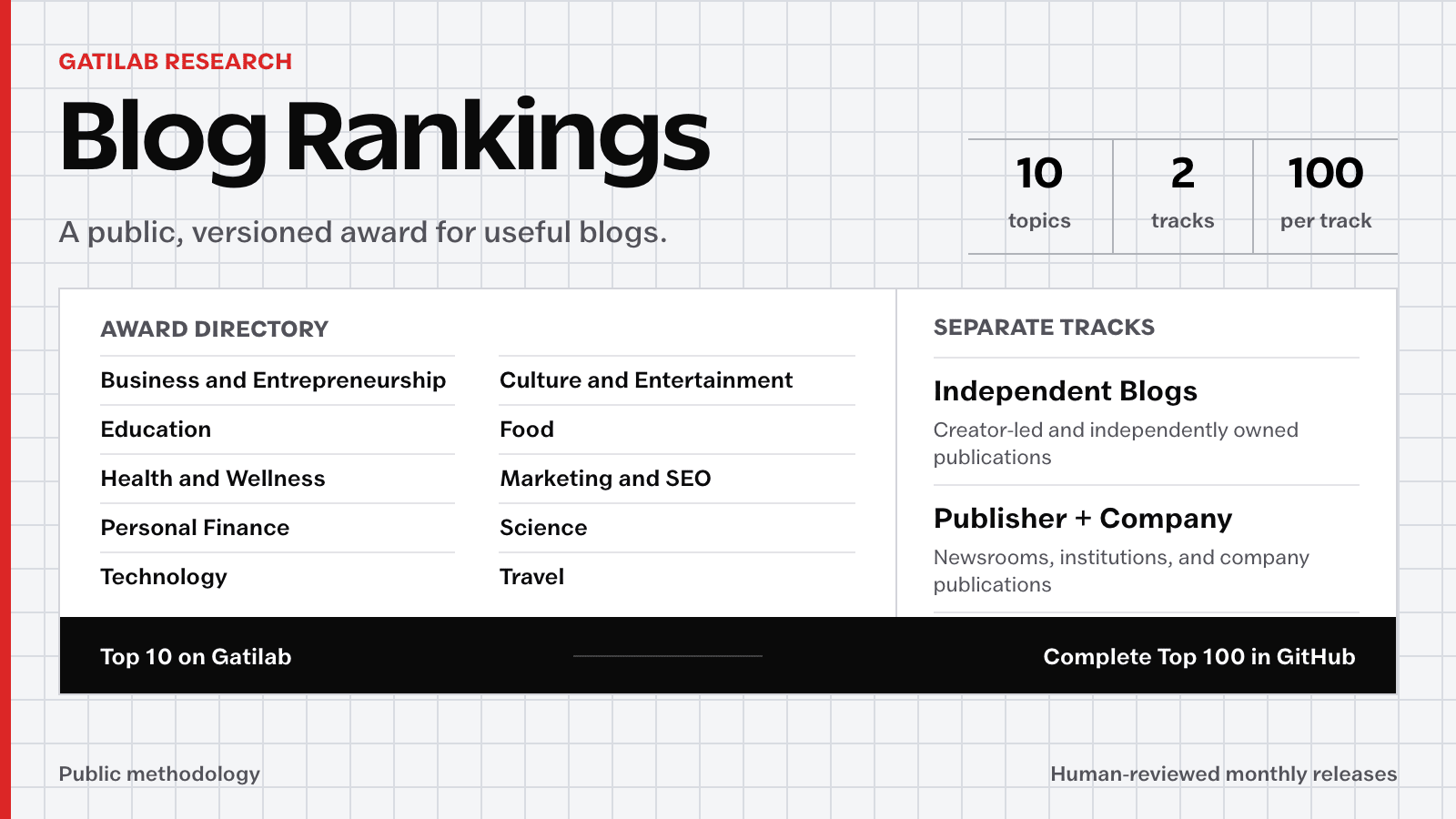
Gatilab Blog Rankings
Gatilab blog rankings compare publications through four signals: search reach, publishing activity, topical depth, and editorial continuity. The goal is not to turn taste into a decimal; it is to make a recommendation inspectable.
A publication can have a large archive and still be a weak current follow. A smaller specialist can publish less often and still be the best source for one job. Status, evidence, and limitation matter more than a traffic number presented without context.
Gaurav Tiwari’s blogs and creators hub handles editorial reading guides. This research hub handles publication status and methodology so the two sites do not publish duplicate answers.
Table of Contents
Current rankings and category coverage
Six category analyses are complete: Indian publications, technology, WordPress, digital marketing, SaaS, and copywriting. The other categories remain research summaries here until their evidence supports a standalone page.
| Category | Gatilab coverage | Research focus | Editorial counterpart |
|---|---|---|---|
| Indian publications | 11 best blogs in India | Active publication analysis | Indian bloggers |
| Technology | Technology blog rankings | Reach, activity, specialist depth | Tech news websites |
| WordPress | WordPress blog rankings | Official, independent, and product-led sources | WordPress blogs |
| Digital marketing | Digital marketing blog rankings | SEO, paid media, analytics, social, and content | Digital marketing blogs |
| SaaS | SaaS blog rankings | Product, growth, sales, retention, and SaaS SEO | SaaS blogs |
| Copywriting | Copywriting blog rankings | Activity and educational depth | Copywriting blogs |
| Personal blogs | Category watch | Individual voice, format, and continuity | Personal blog examples |
| Personal finance | Category watch | Authorship, sourcing, regulation, and freshness | Personal finance blogs |
| Dad creators | Category watch | Subject focus and current publishing | Dad bloggers |
| Indian travel | Category watch | Destination depth and recent field evidence | Indian travel bloggers |
| Sports | Category watch | Sport specialization, reporting, and analysis | Sports blogs |
| Creator businesses | Category watch | Business model, continuity, and audience ownership | Successful blogger profiles |
How the ranking method works
The model uses four weighted components. Traffic remains directional because third-party tools estimate visits. Publishing activity, depth, and continuity keep the model from rewarding an old brand merely because its archive is large.

- Search reach, 35%: a dated directional measure of discoverability, never an audited visitor count.
- Publishing activity, 25%: recent dated work from a feed, story index, sitemap, or visible archive.
- Topical depth, 20%: reporting, expertise, category coverage, and useful original explanation.
- Continuity, 20%: accountable ownership or editors, stable publishing, and commercial transparency.
Exact composite scores are withheld when the public inputs cannot support them. The visible status and limitation should remain useful even when a traffic estimate changes.
What the data can and cannot say
- It can show: whether a site is reachable, whether dated work is recent, what subject it covers, and which commercial model is visible.
- It can compare: categories, publishing cadence, editorial specialization, and current usefulness.
- It cannot prove: private revenue, exact visitors, subscriber engagement, or a reader’s trust from public data alone.
- It cannot replace: reading the publication, checking the original source, or applying subject-matter judgment.
- It should preserve history: a closed or slower publication stays in the dataset even when it leaves an active ranking.
Category research notes
The same method needs different evidence by category. A release-note publication, a paid newsroom, a recipe archive, and a personal essay blog should not be forced into one generic quality score.
- WordPress and technology: separate official sources, independent reporting, product companies, tutorials, reviews, and community discussion.
- Digital marketing and SaaS: separate first-party product education from independent analysis and customer-acquisition content.
- Copywriting: prioritize teaching depth, named examples, and durable principles over high-volume generic advice.
- Finance and health: add credentials, sourcing, regulation, and harm-sensitive freshness checks.
- Personal, parenting, travel, and creator categories: use authorship, specificity, format, and continuity instead of forcing a traffic race.
Frequently asked questions
How does Gatilab rank blogs?
Gatilab weights search reach at 35 percent, publishing activity at 25 percent, topical depth at 20 percent, and editorial continuity at 20 percent. A limitation and status check sit beside the numerical inputs.
Are blog traffic figures exact?
No. Third-party traffic tools estimate visits and can disagree. Gatilab treats search reach as a directional input and does not present an estimate as an audited audience count.
Why are some old publications still listed?
A slower, closed, or redirected publication remains part of the research history. It can move out of an active ranking without being deleted from the dataset or editorial record.
What is the difference between this hub and Gaurav Tiwari’s guides?
Gatilab owns publication research, activity, and ranking methodology. Gaurav Tiwari’s guides help readers choose creators and publications by topic, use case, and editorial fit.
Which blog ranking is complete now?
The Indian publications, technology, WordPress, digital marketing, SaaS, and copywriting analyses are complete. Other categories remain summarized here until each standalone page has enough verified evidence to support publication.