
LLM SEO: How to Rank in ChatGPT, Perplexity, and AI Search 2026
LLM SEO is the practice of optimizing content so large language models cite your domain inside generated answers in ChatGPT Search, Perplexity, Google AI Overviews, and Microsoft Copilot. It’s a different game from classic SEO. You’re not chasing position one anymore. You’re chasing the citation chip, the brand mention inside the synthesized answer, or the source card in the answer panel. Get cited and you keep traffic. Miss the citation and the AI engine answers without you while users never land on your site.
Four habits give a page the best chance of being cited: answer each H2 in the first 40-60 words, name specific entities instead of hedging, build brand mentions across the web and ship clean Article, FAQ and Organization schema. First-party data and specific, quotable claims do more of the work than raw domain authority.
Rather skip the DIY? The AI search optimization service covers SEO, AEO, and GEO in one engagement, starting with a citation audit.
What LLM SEO Actually Is
LLM SEO is search engine optimization for large language models. Instead of optimizing pages for Google’s traditional ranking algorithm, you optimize for the retrieval and generation layer that powers ChatGPT Search, Perplexity, Google AI Overviews, Microsoft Copilot, and Gemini. The output isn’t a blue link on a SERP. It’s a paragraph of synthesized text with citation chips that link back to whichever sources the model decided to attribute.
Three concrete things change. First, the unit of ranking is the paragraph or claim, not the page. Models extract specific sentences and attribute them to URLs. Second, off-page signals matter more than on-page tweaks. Brand mentions across the training corpus shape which domains the model already trusts. Third, structure matters more. Clean headings, direct answers and accurate schema make a page easier to parse, though Google says there’s no special structured data required for its AI features.
The companion piece on Google AI Overviews covers the AI Overview side specifically. This guide focuses on the other LLM engines: ChatGPT Search, Perplexity, and Microsoft Copilot. Most of the patterns transfer across engines because they share the same retrieval-augmented-generation architecture under the hood.
How LLMs Index and Retrieve Sources
LLM search engines don’t crawl and rank in the way Google’s classic engine does. They use retrieval-augmented generation. At query time, the engine fetches a candidate set of URLs from a grounding index, reranks them on quality and relevance signals, then feeds a small set into the generative model as context. The model writes the answer and attaches inline citations to whichever URLs it pulled from.
The grounding index varies by engine. OpenAI says ChatGPT search uses third-party search providers, Microsoft announced Bing as its default search experience, and OpenAI’s own OAI-SearchBot controls which sites appear. Perplexity runs PerplexityBot to surface and link sites in its search results. Google AI Overviews draw on Google’s own index, and Microsoft Copilot answers come from Copilot Search in Bing.
No engine publishes its exact retrieval and reranking weights, so treat precise pipeline numbers with suspicion. The useful model is simple: a page has to be in the index, match the query closely and contain a passage clean enough to quote.
Practical takeaway: if your page is in the grounding index, has clean schema, and packs entities into the paragraph that matches the query, you give it the best chance at every stage.
Why LLMs Cite Some Sources and Skip Others
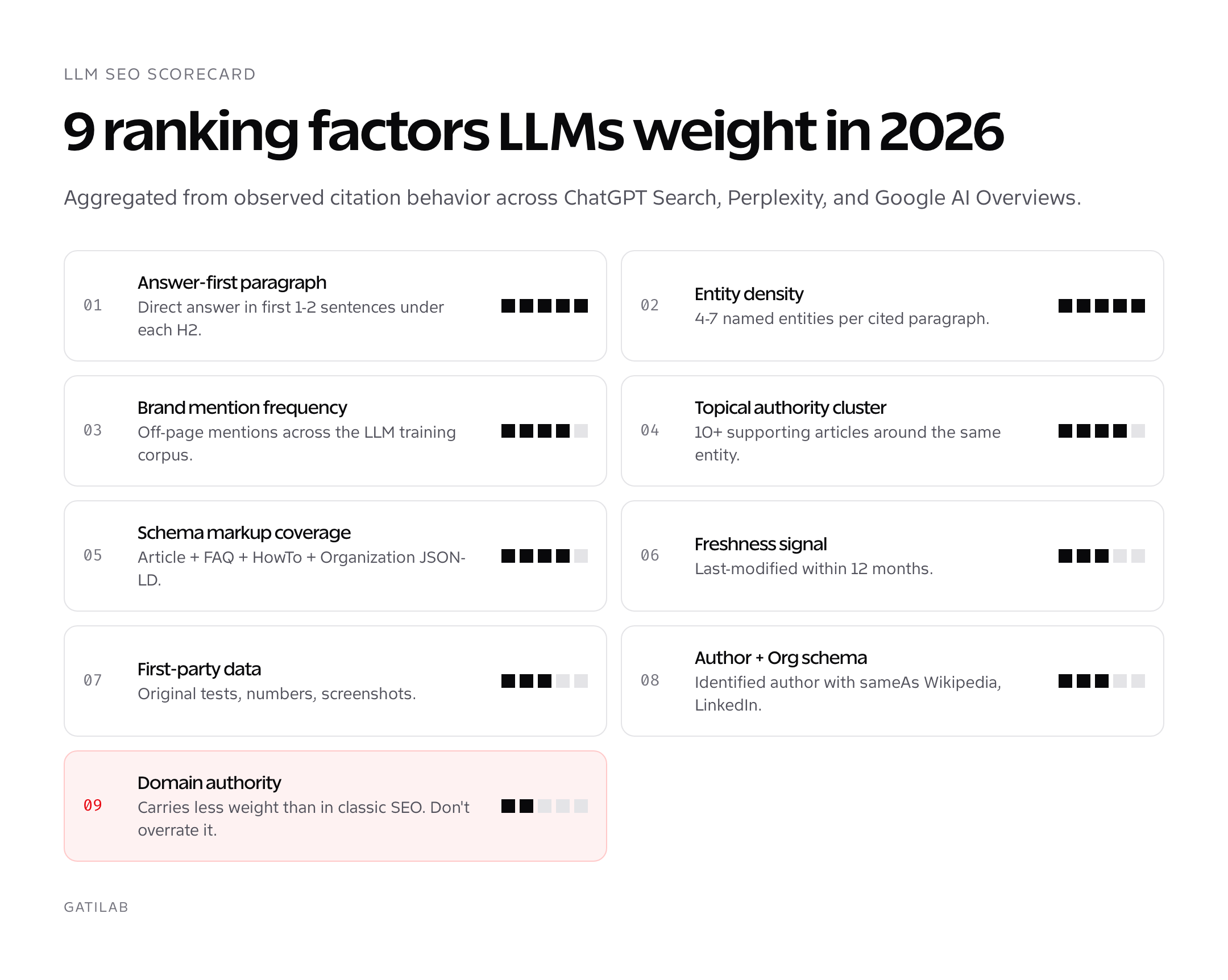
LLMs cite the source that provides the cleanest, most extractable claim with the most named entities. Three signals do most of the work.
Extractability. The cited paragraph is almost always the first paragraph under a heading and answers the heading directly in the first 1-2 sentences. A paragraph that buries the answer in sentence five is hard to quote, so an answer-first competitor has the edge even against a more authoritative page.
Entity density. A citable paragraph names things: brands, version numbers, dates, prices, metrics and proper nouns. “Jeremy Howard proposed llms.txt on September 3, 2024″ names three entities. “Some people now suggest AI files” names none. The first is quotable. The second gives a model nothing to attribute.
Brand mention frequency in the training corpus. Models learn which names matter from how often a brand is mentioned across the open web, Reddit, news sites, podcasts, and YouTube transcripts. A brand that’s widely discussed has an advantage over one that isn’t, even with identical on-page SEO. This is why digital PR and brand-building feed LLM SEO directly.
Topical Authority for LLMs
Topical authority matters for LLM SEO. A site with deep coverage of one subject gives an engine many related pages to draw on, while a site spread across dozens of unrelated topics gives it a thin, scattered footprint for any single query.
Build clusters around 3-5 core topics, not 30. Each cluster needs one pillar piece (3,000+ words, comprehensive), 8-15 supporting articles (specific subtopics), and dense internal linking. The pattern that works for Google’s E-E-A-T also works for LLM SEO: depth signals expertise and expertise signals citability.
For a deeper walkthrough on cluster construction, the content cluster strategy guide covers a 5-pillar framework. Pair it with the SaaS SEO guide if you’re working in B2B.
- Pick 3-5 topics where you can credibly own the conversation
- Build one 3,000+ word pillar per topic
- Ship 8-15 supporting articles around each pillar
- Internal-link aggressively between cluster members
- Cite first-party data, original tests, or unique angles in every piece
Brand Mention Density: The Off-Page Signal That Matters Most
Brand mentions across the open web are the LLM SEO signal most people underrate. A brand that shows up often in trustworthy contexts, next to phrases like “recommended by” or “according to,” is easier for a model to recognize and associate with a topic.
This is why backlinks still matter for LLM SEO, but they matter for a different reason than they matter for Google. A backlink isn’t valuable because of the link equity. It’s valuable because the page mentioning your brand becomes part of the public web that models learn from and search. A mention in a respected publication carries far more weight than one in a low-quality directory.
Action items:
- Earn unlinked brand mentions on news sites, podcasts, and YouTube transcripts
- Get mentioned in Reddit threads in your niche, where people ask for recommendations
- Pitch yourself as a quoted source on round-up posts and trend pieces
- Run digital PR campaigns with original data, since data is more citation-prone than opinion
- Encourage user-generated mentions (case studies, course completions, testimonials with full brand name)
Schema Markup for LLM SEO
Ship four schema types on every article: Article, FAQPage, HowTo (where applicable), and Organization with sameAs references. JSON-LD is cheap to ship and makes a page’s structure explicit. It’s a clarity aid, not a requirement: Google says AI Overviews need no special schema, and visible content still does the heavy lifting.
The FAQ schema guide covers the FAQPage implementation in depth. The TL;DR for LLM SEO purposes:
- Article schema: author, datePublished, dateModified, headline, image. This is the structural backbone of the page’s markup.
- FAQPage schema: every question-answer pair on the page. Direct citation surface. The questions become potential queries the engine can match.
- HowTo schema: for tutorials. Step structure becomes extractable list of operations.
- Organization schema: name, url, logo, sameAs (Wikipedia, LinkedIn, Twitter, Crunchbase). Establishes entity identity across the LLM’s knowledge graph.
Validate every page with Google’s Rich Results Test plus Schema.org’s validator. A common schema error is a typo in @type values. “@type”: “FAQPage” not “@type”: “FAQ Page”.
LLM-Ready Content Structure
Restructure every article so the answer to each H2 sits in the first 40-60 words of that section. This is the single highest-ROI change you can make for LLM SEO. Models extract the opening paragraph almost mechanically. If your H2 is “What is hreflang?” and your first paragraph is 100 words of context before the actual answer, you don’t get cited. The answer must come first.
Inverted pyramid by default: claim, then evidence, then context. Wrap every claim in a sentence the model can lift verbatim without losing meaning. Use specific numbers, version strings, dates, and prices. Avoid vague qualifiers like “many,” “often,” or “some experts say.”
Self-test: for each H2 in your article, can the first paragraph stand alone as a 40-60 word answer to the heading? If yes, you’re LLM-ready. If no, rewrite.
| Old SEO structure | LLM-ready structure |
|---|---|
| H2 followed by intro context, then answer in paragraph 3 | H2 followed by direct answer in first 1-2 sentences |
| Vague qualifiers (“often,” “many,” “some”) | Specific entities (brands, versions, dates, numbers) |
| Long discursive paragraphs | Short paragraphs, 1-4 sentences max |
| Stories and analogies up front | Claim first, story second |
| SEO-stuffed headings | Question-form or claim-form headings |
Measuring LLM SEO Performance
Track three things: citation rate by query, branded-mention surface in synthesized answers, and referral traffic from LLM user agents. Classic ranking trackers don’t help you here. Use a tool that probes LLMs directly with your target queries and logs which domains get cited.
Tools worth trying:
- Profound and Otterly.AI: track citations across ChatGPT, Perplexity, and AI Overviews on a query list you set
- Semrush AI Visibility Toolkit: tracks brand mentions and cited sources across AI platforms, filterable by platform, source, and intent
- Ahrefs Brand Radar: tracks your brand’s visibility across AI answers, YouTube and Reddit
- Manual probing: query each engine weekly with your top 20 target questions, log citations in a spreadsheet
Referral traffic from AI answers is easy to miss. ChatGPT adds utm_source=chatgpt.com to referral links, according to OpenAI’s publishers and developers FAQ. Filter your GA4 acquisition reports on chatgpt.com and perplexity.ai to see the AI traffic you’re already getting.
Cross-check with the broader AI Overviews SEO guide for the Google AI Overviews-specific measurement workflow.
Common LLM SEO Mistakes to Avoid
Most LLM SEO advice you’ll read online is wrong because it’s extrapolated from classic SEO playbooks. Avoid these patterns.
- Blocking AI search crawlers in robots.txt. OpenAI says sites that opt out of OAI-SearchBot won’t be shown in ChatGPT search answers, and PerplexityBot is how Perplexity surfaces sites. GPTBot and Google-Extended are different: they control model training, and Google says Google-Extended does not affect inclusion in Google Search. Allow the search crawlers if you want citations, and decide on the training crawlers separately.
- Treating llms.txt as a magic bullet. The llms.txt file is a useful hint, but no major engine documents it as a ranking signal. Ship it, but don’t expect it to move citations on its own.
- Stuffing pages with generic AI-generated content. Pages that repeat what every other page says give an engine no reason to cite them. Original data, examples and judgment do.
- Ignoring author and Organization schema. Without identified authors and verified Organization entities, the engine can’t connect your content to a citable knowledge-graph node.
- Optimizing only for Google AI Overviews. ChatGPT Search and Perplexity have different ranking weights. A page that ranks well in AI Overviews may not get cited in Perplexity. Test against each engine you care about.
30-Day LLM SEO Action Plan
The work is concrete: restructure top pages, ship missing schema, sharpen entity density and audit your brand mention surface. Here’s a 30-day sequence.
- Days 1-3: Audit your 10 highest-traffic pages for answer-first structure. Rewrite the opening paragraph under each H2 to a 40-60 word direct answer.
- Days 4-7: Add or upgrade Article, FAQPage, and Organization schema on those 10 pages. Validate each one with Rich Results Test.
- Days 8-12: Pack 4-7 named entities into every paragraph that answers a likely query. Replace vague qualifiers with specifics.
- Days 13-20: Run brand-mention audit. List 20 places you should be mentioned but aren’t. Pitch 5 podcasts, 5 round-up posts, 5 expert quotes, 5 Reddit threads.
- Days 21-25: Ship llms.txt, update sitemap to include all schema-marked pages, verify GPTBot and PerplexityBot aren’t blocked.
- Days 26-30: Set up citation tracking. Probe ChatGPT Search and Perplexity with your top 20 target queries. Log baseline. Re-probe weekly.
The bottom line: LLM SEO rewards specificity, structure, and brand presence. Stop chasing rankings and start chasing citations. The site that wins the answer-first paragraph wins the engine.
How to Read LLM Citation Patterns
The fastest way to learn what AI engines cite in your niche is to look. Run your target queries in ChatGPT Search and Perplexity and, for each answer, note:
- Which domains are cited, and in what order
- Whether the cited passage answers the question in its first sentence or two
- Whether the source is a forum thread, documentation, a vendor page or an independent blog
- How many named entities the cited passage contains
Comparison queries such as “Kinsta vs WP Engine performance benchmarks” are a good test, because data-heavy formats like tables and spreadsheets compete with polished blog posts there.
Look for the pattern behind the citations rather than the size of the sites. If answer-first passages and unconventional formats such as forum threads, README files and transcripts keep appearing ahead of bigger sites, structure is the lever to pull on your own pages. Don’t optimize for Google’s playbook and assume it transfers.
llms.txt: What It Does and Doesn’t Do
llms.txt is a proposed convention that Jeremy Howard published on September 3, 2024. It’s a markdown file at the site root that lists key URLs for an LLM crawler to ingest. The format is simple: a title, a description, and a structured list of the most important pages with one-line summaries each. Think of it as a sitemap optimized for language models rather than for Googlebot.
What llms.txt actually does: gives AI tools and agents a curated entry point to your most important content. It isn’t a ranking signal. Google says you don’t need AI text files to appear in AI Overviews or AI Mode, and OpenAI’s publisher guidance doesn’t mention it.
What llms.txt does not do: replace your sitemap, force any engine to rank you higher, fix crawlability problems caused by JavaScript rendering, or substitute for proper schema markup. It’s complementary, not foundational.
Ship it if you like. The cost is low (one markdown file). A good llms.txt has 5 sections at minimum:
- Site title and one-sentence description of what the site is and who it serves
- List of pillar pages with one-line summaries each
- List of high-value supporting articles by topic cluster
- Link to your XML sitemap and your knowledge-base pages
- Optional: contact information and content licensing terms
Treat any lift from llms.txt as a side effect of clearer entry points to your pillar content, not a ranking boost. If you measure it, compare citation rates on the same probed queries before and after, and expect a small effect at best.
LLM SEO FAQs
What is LLM SEO?
LLM SEO is the practice of optimizing content so large language models like ChatGPT, Perplexity, Google AI Overviews, and Microsoft Copilot cite your domain inside their generated answers. It focuses on citation rate rather than ranking position.
Is LLM SEO different from regular SEO?
Yes. Regular SEO targets blue links on a SERP. LLM SEO targets citations inside synthesized answers, where answer-first structure, specific entities and brand mentions carry more weight. Classic SEO still matters, because engines can only cite pages they can find.
How do LLMs decide which sources to cite?
LLM search engines use retrieval-augmented generation. They pull candidate pages from a search index, then the model writes an answer and cites the sources that support its claims. No engine publishes its exact weights, so focus on being indexed, answering directly and naming specific entities.
Should I block GPTBot or PerplexityBot?
Don’t block the search crawlers if you want citations. OpenAI says sites that opt out of OAI-SearchBot won’t appear in ChatGPT search answers, and PerplexityBot is how Perplexity surfaces sites. GPTBot controls OpenAI model training, which is a separate choice you can make based on your content protection needs.
Does llms.txt help LLM SEO?
Don’t count on it. Google says you don’t need AI text files to appear in AI Overviews, and OpenAI’s publisher guidance doesn’t mention llms.txt. Ship the file if you like, since it’s cheap, but answer-first structure and clear content matter far more.
How long does LLM SEO take to show results?
On-page fixes can show within a few weeks, once engines recrawl the pages. Brand mention density takes months, because it builds up across the web.
What’s the most important LLM SEO ranking factor?
Answer-first paragraph structure. The first 40-60 words under each H2 must directly answer the heading. This is the single highest-leverage change for LLM citation rate, ahead of schema, backlinks, or domain authority.
Do backlinks still matter for LLM SEO?
Yes, but for a different reason than they matter for Google. A link usually comes with a brand mention on a page that models can learn from and search engines can surface. Quality and context matter more than link equity.
How do I track LLM SEO citations?
Use Profound, Otterly.AI or the Semrush AI Visibility Toolkit to track target prompts across ChatGPT, Perplexity and AI Overviews. Log citation rate by query and brand mention rate inside synthesized answers. GA4 also shows AI-driven traffic: ChatGPT tags referral links with utm_source=chatgpt.com, and Perplexity traffic shows as perplexity.ai.
Which schema types matter most for LLM SEO?
Article, FAQPage, HowTo, and Organization. Article gives the page a canonical entity. FAQPage creates extractable question-answer pairs. HowTo structures procedural content. Organization (with sameAs links to Wikipedia, LinkedIn, Crunchbase) anchors your brand in the knowledge graph.
Ready to put this into practice? Start with the answer-first rewrite, then layer schema, then build brand mention density. The companion guides on AI Overviews SEO, SEO for startups, and voice search optimization deepen specific pieces of the playbook.
Tell Google you want more of this.
Add Gatilab as a preferred sourceOne tap, and this site shows up more often in your own Top Stories, AI Overviews and AI Mode. Remove it any time.