
Content Creation Companies: How to Vet One Before You Sign
Hiring content creation companies is mostly guesswork from the outside. The sites look alike, the case studies all show the same rising line, and the pricing page says request a quote. What you’re actually buying is a process you can’t see: who writes, who edits, who checks the facts, and what happens in month 4 when the one writer who understood your product moves to another account.
Buyers usually miss in one of two directions. One group signs a 12-month retainer off a good pitch deck, then learns in month 5 that their account writer rotates every 6 weeks and has never worked in their category. The other group refuses to pay above marketplace rates, collects 40 articles that read like a summary of page 1, and concludes that content marketing doesn’t work.
Both groups judged the samples. Neither judged the system that produced them.
Types of Content Creation Companies
Content creation companies aren’t one category. They’re five, and they price, staff, and behave differently enough that hiring the wrong type costs you a quarter before anyone notices. Sort your shortlist into these buckets before you compare a single proposal.
Full-Service Content Marketing Agencies
Strategy, research, writing, editing, design, distribution, and reporting under one contract. WebFX, Brafton, and Thrive Agency sit here. Breadth claims vary more than the category label suggests: WebFX advertises 65+ content types on its own service page, while Brafton’s published content catalog covers 18. Neither number is an industry standard, and neither tells you what that team has actually shipped for a company like yours in the last year.
A long menu on a service page is inventory, not capability.
When it fits: you have budget but no headcount, and you want one partner owning the program instead of stitching three vendors together. If you mostly need someone to design the program and hand it back, a content marketing consultant costs less and moves faster.
SEO-Focused Content Agencies
Content as the acquisition channel. These teams open with keyword research, SERP analysis, and competitive gaps, then build pages designed to earn traffic that converts rather than traffic that flatters a dashboard.
The specialists advertise different mechanisms. Siege Media reports roughly $7.4 million a month in client traffic value on its own service pages, which the agency works out to $86.9 million a year. Grow and Convert coined Pain Point SEO, aiming at bottom-of-funnel queries that produce signups, and builds its article arguments from recorded 60 to 90 minute interviews with a client’s product, sales, and customer success people. Ten Speed, started in 2020 by two former Sprout Social operators, works almost entirely in B2B SaaS and puts unusual weight on publishing workflow.
Those traffic-value figures are self-published, not audited, so read them as a scale signal and nothing more.
When it fits: SaaS content marketing programs where organic has to produce pipeline, not impressions.
Thought Leadership and B2B Content Agencies
Expert-driven work for technical audiences: subject matter expert interviews, original research, and arguments a competitor cannot copy by rewriting your post. Animalz, Omniscient Digital, and Column Five are the names that show up on most shortlists. Animalz started in New York in 2015 with a mix of ex-lawyers, neuroscientists, and researchers who moved into content marketing, and its client logo set includes Google, Airtable, and Amazon.
When it fits: fintech, developer tools, and enterprise SaaS, where one well-argued piece moves more pipeline than 10 keyword pages.
Content Marketplaces and Managed Platforms
Software plus a vetted freelance bench. ClearVoice, which Fiverr acquired in February 2019 and has run as a standalone subsidiary since, matches brands to writers through VoiceGraph, its own matching engine that indexes published work history and subject depth. Contently and Scripted run a similar model.
When it fits: you need steady volume with basic quality control and no appetite for managing 8 freelancers yourself. What you give up is the strategist who argues with your brief.
AI-Assisted Content Services
The newest bucket, and the one where the label hides the most variation. BrandWell (the August 2024 rebrand of Content at Scale), Jasper, and Writer sell AI-first production with different amounts of human oversight attached. Some are tools you operate yourself. Others are services with an editor somewhere in the loop, and the contract rarely says where.
Ask where.
When it fits: high volume, low stakes, and an in-house editor who will genuinely read every piece. When it fails: regulated categories, original research, and any business where the voice is part of the product.
What Content Creation Companies Actually Cost
Almost nobody in the categories above publishes a rate card. Siege Media, Animalz, Ten Speed, Omniscient, and Column Five all route pricing through a sales call, and the specific numbers circulating in comparison posts usually come from competitors with a reason to make a rival look expensive.
So read the table below for what it is. These are the bands Gatilab sees when a client forwards a quote for a second opinion, not published prices, and a quote outside a band isn’t automatically wrong.
| Engagement | Typical quoted band | What is usually inside it |
|---|---|---|
| Full-service retainer | $5,000 to $20,000/mo | Strategy, production, design, distribution, reporting |
| SEO-led retainer | $8,000 to $25,000/mo | Keyword and SERP work, briefs, production, internal linking, reporting |
| Thought leadership retainer | $10,000 to $30,000/mo | SME interviews, original research, executive co-authoring |
| Marketplace or managed platform | $2,000 to $15,000/mo | Matched writers, light editing, platform fee |
| AI-assisted service | $500 to $5,000/mo | Volume production, variable human review |
| Blog post, about 1,000 words | $100 to $500 | One article, desk research, basic optimization |
| Long-form article, 2,000+ words | $500 to $2,000 | SME interview, original angle, graphics, SEO work |
| Freelance hourly | $75 to $250/hr | Task-based production, no strategy layer |
Two quotes inside the same band can still be 5x apart on what arrives. The band tells you which category you’re talking to. It doesn’t tell you what lands in your CMS.
The clearest way to see that gap is at the two ends of the per-article market.
What $100 buys:
1,000 words, desk research drawn from page 1 of the SERP, the keyword in the H1, no interviews, no original data, and a model somewhere in the middle that nobody disclosed.
What $2,000 buys:
2,000 words built on a recorded interview with somebody who does the job, at least one number that is not already published elsewhere, a custom graphic, an internal linking plan, and an editor who sent the draft back once before you saw it.
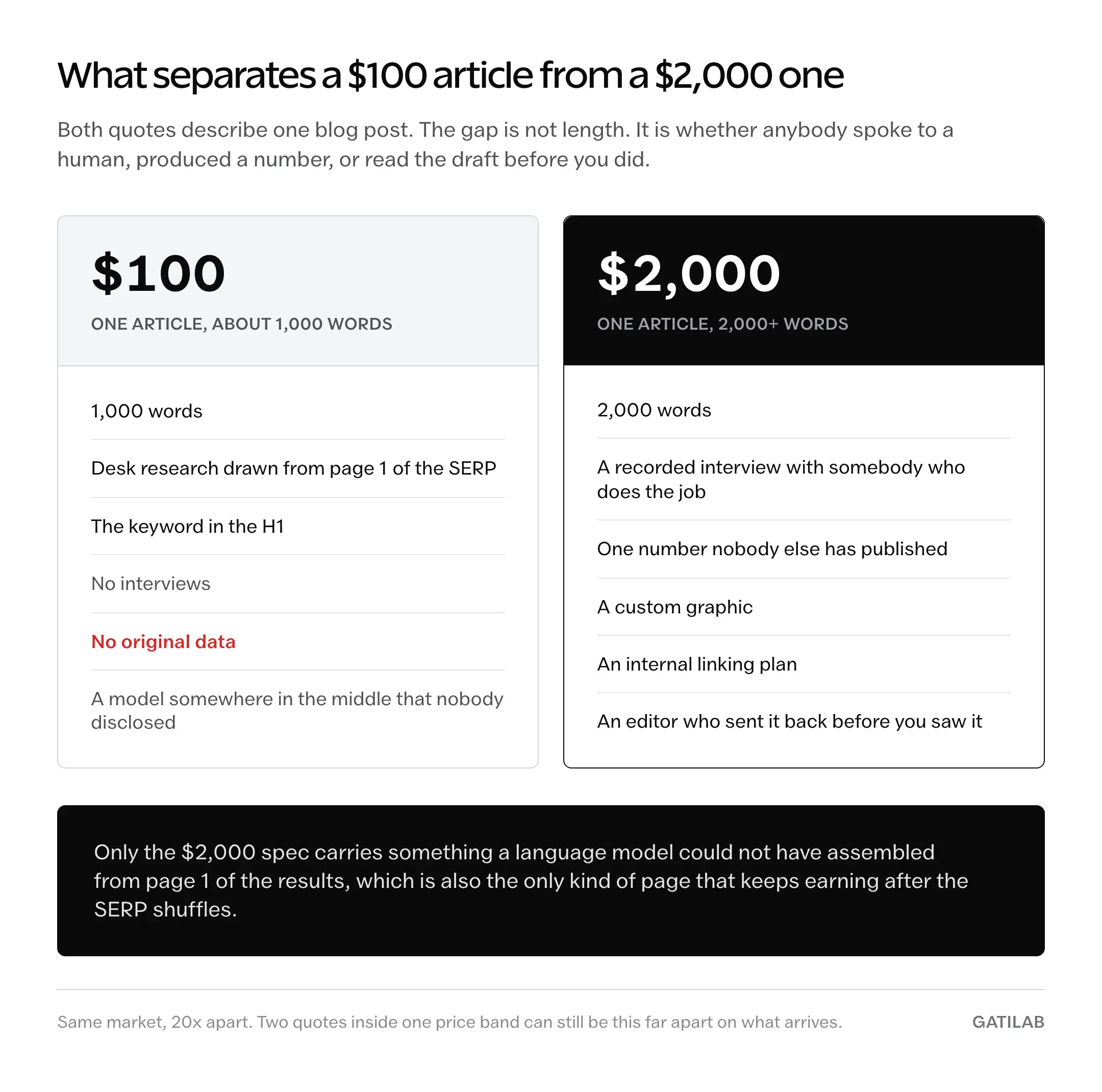
Same market, 20x apart. The second one is the only one carrying information a language model could not have assembled from the first page of results, which is also the only kind of page that keeps earning after the SERP shuffles. If you want the deliverable list written down before you compare quotes, our breakdown of content marketing SEO services and pricing itemizes it.
How to Vet a Content Company
Five steps, in this order. The order is the point: each step is cheap enough to fail fast before the next one costs more.
Read their blog, not their case studies. A case study is written to sell. A blog is written on the same budget and under the same editorial rules they will apply to you. If their own posts have no opinions, no named tools, and no numbers, that is the ceiling of what you are buying.
Ask for 3 samples in your category, published in the last 6 months. Not the portfolio. Your category, recent. A team that can’t produce three is either new to your market or showing you work that predates the current staff.
Buy a paid test article. Give them a real brief on a topic you actually need, and pay for it, usually $300 to $500. Paying changes the incentive: a free sample gets their best writer, a paid one gets the writer you will be assigned. Judge it on three things. Does it read as though a person made choices? Are the claims specific enough to check? Would you publish it without rewriting the middle?
Ask the questions that make a salesperson uncomfortable. These five, in writing, before any contract moves.
Who writes my content, by name, and can I speak with them directly?
Where does AI enter your process, and what does a human do after it?
How many revision rounds are included, and what happens if I reject a first draft outright?
What is the notice period, and is there an early termination fee?
Which current client is closest to my business, and may I call them?
The answers matter less than the hesitation. A company with a real process answers all five without checking with anyone.
Call 2 references and ask what the agency does badly. Not the testimonials page. Actual people, on the phone, with one required question: what is the one thing this team handles poorly? Everyone handles something poorly. A reference who can’t name anything is a reference who was coached.
Some signals end the conversation before step 3:
- Guaranteed rankings, in any wording. Nobody controls the ranking.
- No writer names, and no route to speak with the writer.
- Grammar errors, broken links, or 2-year-old posts on their own site.
- A 12-month commitment demanded before a paid test piece.
- An editorial process described only as experienced writers.
- Measurable results promised inside 60 days.
That last one is worth naming plainly. Google’s own guidance refuses to put a number on it and says changes can take anywhere from a few hours to several months. Across the programs Gatilab reviews for clients, meaningful organic movement from new content usually appears somewhere in months 3 to 6, and a company selling a shorter certainty is selling the certainty rather than the result.
Walk away.
The AI Question Every Content Company Now Answers
Your agency uses AI. SurveyMonkey’s marketing research puts the share of marketers using AI somewhere in their day-to-day roles at 88%, with 60% using it every day. Grand View Research values the generative AI content creation market at $14.8 billion in 2024 and projects $80.1 billion by 2030 at a 32.5% compound rate, while MarketsandMarkets reads the same market at $21.53 billion in 2025 and $77.22 billion in 2030. When two research firms disagree by nearly $7 billion on a single year, treat the trend as real and the decimals as decoration.
So the useful question is not whether they use it.
It is what happens to the draft after the model finishes.
Google’s helpful content guidance is the cleanest standard to hold a vendor to, partly because it belongs to the publisher rather than to an agency defending its margin. It asks who made the content, how it was made, and why, and it treats automation aimed mainly at manipulating rankings as a spam problem. Put that document in the brief and the AI conversation stops being a matter of taste.
Four things still sit outside what a model can produce on its own.
Original research. A model can’t call your customer, sit with your product manager, or run the test that produces a number nobody has published. It summarizes what already exists. That gap is the whole basis of information gain, and it’s why interview-led agencies charge what they charge.
Voice. A model can copy tone from a sample in one prompt. Voice is different: it’s the accumulated pattern of positions, refusals, and preferences that makes writing recognizable, and it has to be decided by someone with authority to be wrong in public. Agencies worth the retainer spend the first weeks extracting yours before writing anything.
Strategic judgment. Which topics to cover, which to refuse, when to take the contrarian side, and what to publish first so the second piece has somewhere to link. Those calls need your pipeline, your competitor’s soft spots, and your CEO’s actual opinion. None of that is in the training data. If part of the goal is being cited in AI answers rather than only ranking, LLM SEO changes which of those calls matter.
Relationship content. Customer stories, expert roundups, executive bylines, and case studies all depend on somebody maintaining a relationship long enough to get the raw material. A model can format the transcript. It can’t get the meeting.
AI does handle real work well: first drafts of routine pages, outline generation, research summaries, social variations, meta descriptions, and alternate headlines for testing. A company using it there and editing hard afterward is being efficient with your money. A company shipping final drafts a human skimmed is charging human rates for machine output, which is the actual failure mode worth writing into the contract.
What Belongs in the Contract
Most engagements that go sideways were underspecified, not badly staffed. These six items are the ones worth arguing about before signature, because every one of them is expensive to renegotiate later.
- Full intellectual property transfer on payment. No shared rights, no portfolio license, no usage carve-out.
- A specific revision count. 2 rounds is the working standard.
- Deliverable specs precise enough to dispute: word range, internal link count, research requirements, named SEO targets.
- 30-day cancellation notice. A 90-day notice period or an early termination fee is lock-in wearing a legal costume.
- An AI disclosure clause naming the tools and the human step that follows them.
- Written benchmarks at 90 and 180 days, agreed before work starts.
Unlimited revisions is the clause that reads generous and behaves badly. It pays the vendor to ship a rough first draft and let your team edit it into shape, which quietly converts your salary into their margin. Two rounds pushes the quality upstream, where fixing it is cheaper for everyone.
Cap it.
The 90-Day Scorecard
Most agencies ask for 6 months before you judge anything. Half of that request is fair, because ranking genuinely takes time. The other half is a stalling window, and you can close it by scoring the parts that are already visible.
- 30 days, process. On-time delivery, a visible editorial workflow, drafts that improve after feedback, and questions about your business that a competitor could not have asked.
- 60 days, craft. Read all 8 to 10 pieces end to end. Are the claims specific and checkable? Is anything in there you could not have written from the first page of Google?
- 90 days, early signals. Pages indexed in Search Console, first positions even on page 3, and impressions climbing on the target queries.
- 180 days, business outcomes. Organic sessions attributable to the new pages, leads from content assets, and pipeline your sales team credits to a specific article.
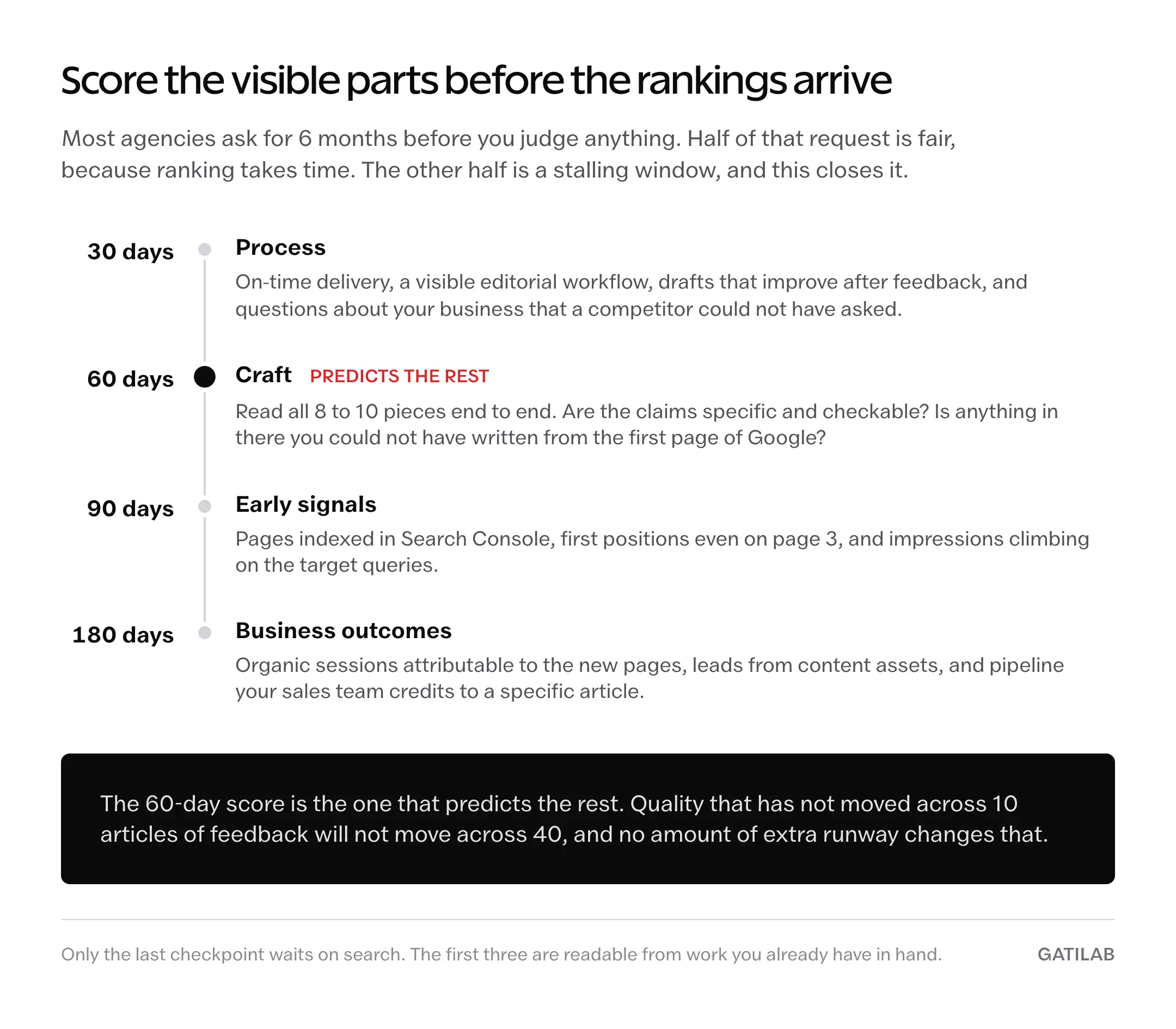
The 60-day score is the one that predicts the rest. Quality that has not moved across 10 articles of feedback will not move across 40, and no amount of extra runway changes that. Decide how you will count the 180-day number before month 1, because retrofitting attribution to defend a decision is how programs get renewed on feeling; our guide to measuring content marketing ROI covers the counting.
The Limits
This process filters for craft and process quality. It can’t tell you whether the writer who won you over will still be on your account in month 7, because agency turnover is the most common failure mode in the category and nobody publishes their numbers. The strongest move available is a named writer written into the contract plus a notification clause when that changes. It’s a partial fix, and it’s the only one on offer.
It also can’t fix a positioning problem. A team writing well about a product nobody can describe in one sentence produces good writing that converts at close to zero, and you’ll spend 2 quarters blaming the writing. Fix the sentence first.
And it does not create internal capacity. Every engagement needs one person on your side who approves briefs, books SME time, and answers questions inside 48 hours. Without that person, the best vendor on your shortlist produces late, generic work, and the invoice still arrives on time. That gap is a content operations problem on your side, not a vendor problem, and switching agencies will not touch it.
What Quietly Ruins a Content Retainer
None of these look like mistakes while they are happening. All of them show up in the month 6 review as the vendor’s fault.
Approving briefs by not replying. Silence reads as consent on the other end, so the brief ships, the article comes back aimed at the wrong reader, and the revision rounds you paid for get spent correcting a decision you never actually made.
Handing over a brand guide instead of a person. A PDF describes the voice. A 30-minute call with your best salesperson supplies the objections, the phrases customers really use, and the three things your product does not do, which is the material writers cannot invent and will otherwise guess at.
Changing the target every month. New keyword list in January, new audience in February, new format in March. Each pivot resets the compounding you were paying for, and you get billed for the restart at full rate.
Reporting on pageviews because they move first. Traffic responds in weeks and means little on its own. Pipeline responds in quarters and settles the renewal. A team that reports the fast number stops asking about the slow one, usually right up until the budget review.
Buying more volume when the real problem is distribution. Ten more articles into a site with no email list, no internal linking plan, and no promotion produces 10 more pages nobody reads. Fixing the pipes and repurposing what you already published costs less than another 10 briefs.
Staying with a weak vendor because switching feels expensive. It is expensive: 4 to 6 weeks of onboarding and a quarter of lost momentum. Another 6 months of content nobody reads costs more, and it compounds in the wrong direction.
Switch.
Final Remarks
Content creation companies are hard to compare because the thing you’re paying for never appears in the portfolio. You’re paying for the judgment that picked this topic over the 40 others, found the one person worth interviewing, and cut the section that would have padded the word count. Portfolios show only the wins. Sales calls show the person least likely to touch your account.
So stop trying to grade the output from the outside and start pricing the process. A $500 test article and 2 honest reference calls will teach you more than 3 hours of proposals, and both are recoverable if the answer is no.
Spend the $500 first.
Tell Google you want more of this.
Add Gatilab as a preferred sourceOne tap, and this site shows up more often in your own Top Stories, AI Overviews and AI Mode. Remove it any time.