
Best Content Marketing Courses & Certifications in 2026 (Honest Rankings)
Most content marketing courses are worth exactly what the free ones cost. That’s not cynicism, it’s a buying guide in one sentence: start with HubSpot Academy’s free certification, add Semrush Academy’s free courses for the SEO layer, and only pay for the Content Marketing Institute’s $1,395 certification if an employer needs the credential or is covering the bill. Everything else on the market sits between those poles, and this guide sorts it honestly.
Context for my bias: I hire and train content people, and I’ve watched certifications matter in exactly two situations (agency bios and corporate L&D budgets) while portfolios mattered in every situation. So the reviews below score each course on what it teaches, not the paper it prints. Prices checked July 2026; course platforms change pricing quietly, so treat anything older you read elsewhere as suspect.
The Quick Comparison
Seven credible content marketing courses and certifications, sorted by what you pay. The verdict column is the one-line version of each review below:
| Course / cert | Price | Time | Verdict |
|---|---|---|---|
| HubSpot Content Marketing Certification | Free | ~8.5 hrs | The default starting point |
| Semrush Academy (content + SEO tracks) | Free | 2-5 hrs each | Best free SEO-for-content layer |
| Google Digital Garage fundamentals | Free | ~40 hrs | Broad digital base, light on content depth |
| UC Davis: Strategy of Content Marketing (Coursera) | $59/mo (auditable free) | ~19 hrs | Most rigorous theory; audit it |
| Digital Marketing Institute content course | $445 | ~10 hrs | Fine credential, thin vs free rivals |
| CMI/AMA Content Marketing Certification | $1,395 | ~15 hrs | The industry credential, employer-funded |
| LinkedIn Learning content paths | $39.99/mo | varies | Good refreshers, weak as a spine |
Best Free Content Marketing Course: HubSpot Academy
The HubSpot Content Marketing Certification is the best zero-cost entry into the discipline, and for most people it’s enough. Roughly 8.5 hours covering strategy, storytelling, topic clusters, repurposing, and measurement, with an exam and a certificate that renews periodically. It exists to sell HubSpot’s worldview (and eventually its software), which is a fair trade at this price.
What it won’t give you: hands-on SEO mechanics or the judgment layer, which topics, in what order, against which competitors. The first gap is fixable with the free Semrush Academy tracks. The second gap is experience-shaped; no course fills it, though my SEO content strategy framework is the working version of what that judgment looks like in practice.
Best Paid Certification: CMI/AMA (If Someone Else Pays)
The Content Marketing Institute certification, run with the American Marketing Association, is the industry’s name-brand credential: about 15 hours, $1,395, with a $100 AMA member discount. The material is genuinely strategic (documented strategy, audience research, measurement design), and it’s the one cert that reliably registers on a marketing résumé, because CMI has run the field’s benchmark research for over a decade.
Whether it’s worth $1,395 of your own money is a different question, and my answer is no for freelancers and founders. The knowledge inside overlaps heavily with what CMI publishes free, and $1,395 buys a lot of proof-of-work instead: two months of a serious tool stack, or the paid distribution to make one flagship piece rank (the compounding math in my content marketing ROI guide shows why distribution dollars outwork credential dollars). Corporate marketers with an L&D budget: take it, the credential travels well internally.
The Rigorous Sleeper: UC Davis on Coursera
The Strategy of Content Marketing course from UC Davis is the most academically serious option on the list: about 19 hours on frameworks, ecosystems, and the writing craft, taught as an actual university course rather than a product tour. Coursera charges $59/month, but the audit option makes all the learning material free; you pay only if you want the certificate.
Audit it. The certificate carries less market weight than HubSpot’s (odd but true; recruiters recognize logos, not rigor), so the paid tier buys you little. The lectures, though, will make you a sharper strategist than any vendor academy on this list.
The Other Content Marketing Courses, Fast
The remaining options each have a narrow right buyer, and outside that buyer they’re a worse version of something above:
- Google Digital Garage (free, ~40 hrs): the broad digital-marketing base for a true beginner. Content is one module among many; take it before a career switch, skip it if you just need content skills.
- Digital Marketing Institute ($445, ~10 hrs): a legitimate credential body, but the content course specifically competes with free rivals that teach the same material. Pay only if your employer already uses DMI’s framework.
- LinkedIn Learning ($39.99/mo): excellent for targeted refreshers (a weekend on email, an evening on analytics) and useless as a spine, because paths lack sequencing discipline. Use the free month, binge deliberately, cancel guilt-free.
- University certificates ($2,000-$15,000): extension-school content marketing certificates price like credentials and trade like coursework. Unless a specific employer names one, the CMI cert does the same résumé work for a fraction.
What Certifications Actually Do for Your Career
Certifications get you past filters; portfolios get you hired. That’s the whole mechanism, and knowing it changes how much you should invest. Where certs genuinely move outcomes:
- Agency bios and proposals: logos reassure clients who can’t evaluate craft. This is why agencies pay for team certifications; it’s marketing, and it works.
- Corporate ladders: L&D-funded certs signal initiative in promotion files. Free money, take it.
- Career switchers with empty portfolios: a cert is a placeholder proof-of-seriousness until three real pieces exist. Then it stops mattering.
Where they don’t: freelance rates (clients pay for outcomes and samples), startup hiring (founders want receipts), and actual skill (courses compress knowledge, but judgment comes from shipping against the standards in my content marketing best practices ranking, and from watching what happens after publish).
The Self-Directed Curriculum That Beats Any Single Course
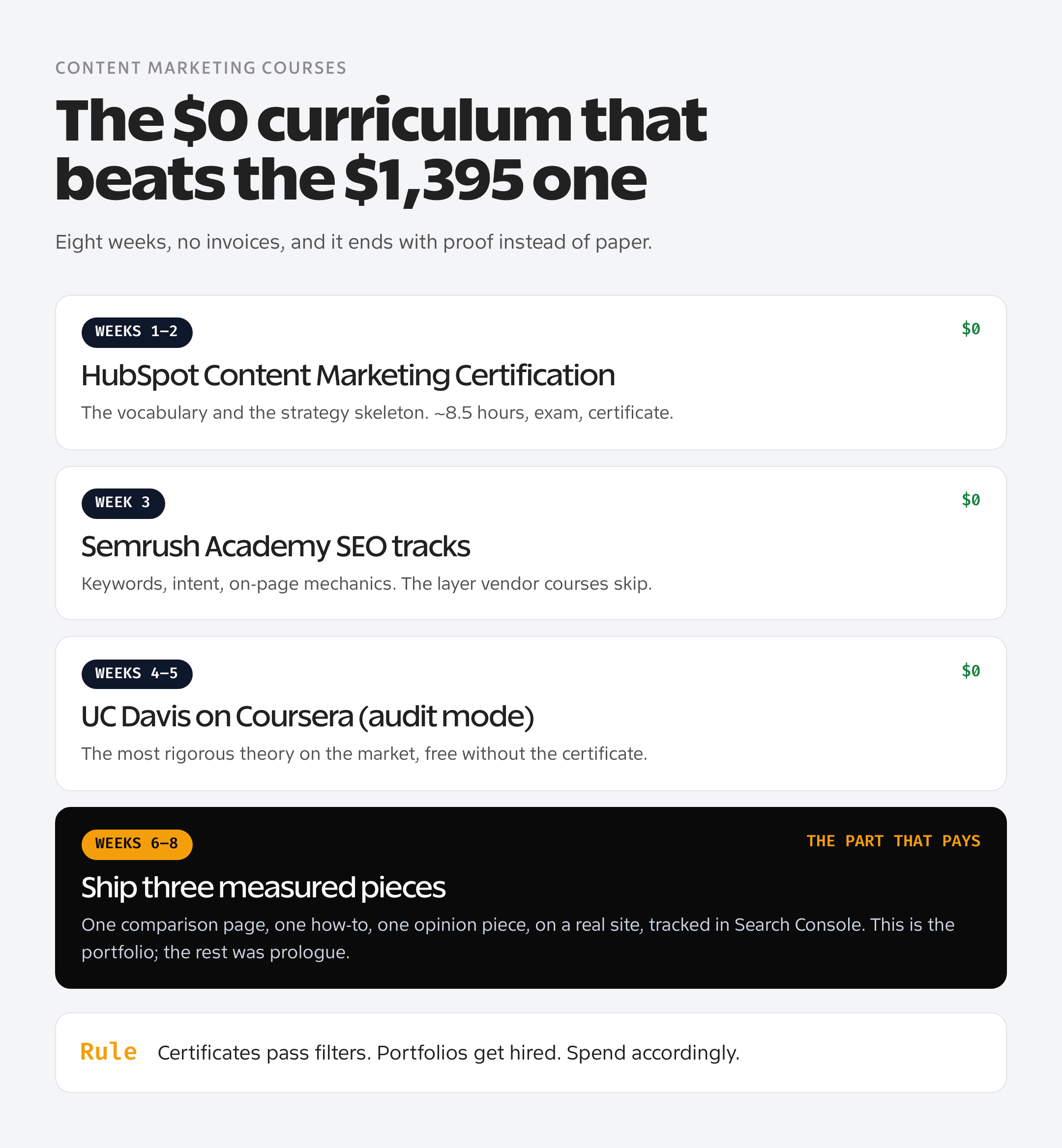
If I were training a new content marketer today with $0 and eight weeks, this is the sequence, and it outperforms any single paid program in this content marketing courses roundup because it ends with proof instead of paper:
- Weeks 1-2: HubSpot Content Marketing Certification (free) for the vocabulary and the strategy skeleton.
- Week 3: Semrush Academy’s content-focused SEO tracks (free) for keywords, intent, and on-page mechanics.
- Weeks 4-5: audit the UC Davis Coursera course (free) at 2x speed for the strategic depth the vendor academies skip.
- Weeks 6-8: ship three real pieces for a real site (yours, a nonprofit’s, a friend’s business): one comparison page, one how-to, one opinion piece, each built answer-first and measured in Search Console.
Total cash outlay: zero. The three shipped pieces at the end are worth more in any hiring conversation than every certificate on this page combined… and if the shipping part is the part you’d rather buy than build, that’s precisely the gap a content marketing consultant or a production partner fills.
Content Marketing Courses & Certifications: FAQ
The enrollment-page questions, answered without the enrollment-page incentives:
What is the best content marketing course for beginners?
HubSpot Academy’s free Content Marketing Certification: about 8.5 hours covering strategy, clusters, repurposing, and measurement, with a recognized certificate. Pair it with Semrush Academy’s free SEO tracks and you have a stronger base than most paid programs deliver.
Are content marketing certifications worth it?
They’re worth it when someone else pays or when a filter demands one: agency bios, corporate promotion files, and career switches with empty portfolios. They don’t raise freelance rates or replace samples. Portfolios get people hired; certs get people past screens.
How much do content marketing courses cost in 2026?
Free (HubSpot, Semrush Academy, Google Digital Garage), subscription ($39.99/month LinkedIn Learning, $59/month Coursera with free audit), mid-range ($445 Digital Marketing Institute), and premium ($1,395 CMI/AMA certification, minus $100 for AMA members).
Is the HubSpot content marketing certification actually free?
Yes, completely: coursework, exam, and certificate. HubSpot funds it as top-of-funnel marketing for its software, which is why the examples lean HubSpot-shaped. The teaching quality is real regardless.
Is the CMI content marketing certification worth $1,395?
For corporate marketers on an L&D budget, yes; it’s the field’s most recognized credential. For freelancers and founders paying personally, no; the knowledge overlaps with CMI’s free research, and $1,395 spent on tools or distribution produces more career evidence.
Can I learn content marketing without any course?
Yes, and most good practitioners did. The free eight-week path: HubSpot cert, Semrush Academy, audit UC Davis on Coursera, then ship three measured pieces on a real site. The shipping is the education; the courses just compress the vocabulary.
Do employers care about content marketing certificates?
Screeners and HR filters sometimes do; hiring managers rarely. In agencies, team certs reassure clients. In startups, nobody asks. In enterprises, they help promotion paperwork. In every case, three strong published samples outweigh every certificate listed here.
The Honest Enrollment Advice
Take HubSpot’s free certification this week, add Semrush’s free tracks, audit UC Davis if you want the theory, and let the CMI credential wait for an employer’s card. Then stop collecting courses. The market pays for shipped, measured work, and every hour spent on a fourth certificate is an hour not spent building the portfolio that actually converts.
Courses teach the map. Publishing teaches the territory.
Tell Google you want more of this.
Add Gatilab as a preferred sourceOne tap, and this site shows up more often in your own Top Stories, AI Overviews and AI Mode. Remove it any time.