
Namecheap vs Bluehost: Pricing, Backups, and Who Each One Fits
Namecheap vs Bluehost usually comes down to one question: which one is still cheap in year 2? Namecheap is. Its Stellar plan renews at $55.88 a year, while Bluehost’s entry Starter plan renews at $9.99 a month, which is $119.88 across the same 12 months. But the cheaper invoice buys fewer sites and no automatic backups, and that trade decides more of this than the price gap does.
Most people shopping shared hosting get this wrong in 2 directions. The first group buys on the promotional price, forgets that the first invoice is the smallest one they will ever pay, and scrambles to migrate 12 months later. The second group reads a benchmark roundup, picks whichever host posted the prettiest millisecond chart, and never checks whether that test ran anywhere near their own readers.
The honest comparison lives in the renewal rate and the feature sheet, not the speed chart.
What Namecheap and Bluehost Cost
Compare renewal rates, not promotional ones. Promotional pricing at both companies moves with the campaign and the term you prepay, so a first-term figure tells you almost nothing about what the account costs to keep. Namecheap publishes its shared hosting renewal rates directly, and raised them for invoices issued on or after May 19, 2026. Bluehost publishes an introductory rate and a renewal rate side by side on its plan page.
Here is what each company currently publishes for its shared tiers.
| Plan | Published renewal rate | Sites | Storage | Automatic backups |
|---|---|---|---|---|
| Namecheap Stellar | $55.88/year | 3 | 20 GB SSD | Not included |
| Namecheap Stellar Plus | $85.44/year | Unlimited | Unmetered SSD | Daily, 25 GB backup cap |
| Namecheap Stellar Business | $128.88/year | Unlimited | 50 GB SSD | Daily, unlimited backup storage |
| Bluehost Starter | $9.99/month ($119.88/year) | 10 | 10 GB NVMe SSD | Weekly |
| Bluehost Business | $13.99/month ($167.88/year) | 50 | 50 GB NVMe SSD | Weekly |
| Bluehost eCommerce Essentials | $21.99/month ($263.88/year) | 100 | 100 GB NVMe SSD | Weekly |
Read the bottom of the Namecheap column and the top of the Bluehost one. Namecheap’s cheapest plan renews for less than half of Bluehost’s cheapest plan, and Namecheap’s most expensive shared tier still renews for less than Bluehost’s middle tier.
One caution about the plan names. Bluehost’s shared lineup is Starter, Business, and eCommerce Essentials, with an enterprise option quoted separately. The older Basic and Choice Plus names that fill most comparison articles are gone, and any article still quoting a $2.95 Basic plan against an $11.99 renewal is describing a product Bluehost no longer sells.
Cost Per Site Changes the Answer
The headline price favors Namecheap. The price per site does not, and that reversal is the single most useful thing in this comparison.
What the entry plans cost per year:
Namecheap Stellar: $55.88 a year, 3 sites, so $18.63 per site.
Bluehost Starter: $119.88 a year, 10 sites, so $11.99 per site.
If you host 1 site, Namecheap saves you $64 a year and the per-site math is irrelevant. If you host 5 or more, Bluehost’s entry plan is the cheaper cabinet, and you would need Namecheap’s $85.44 Stellar Plus to match the site count anyway.
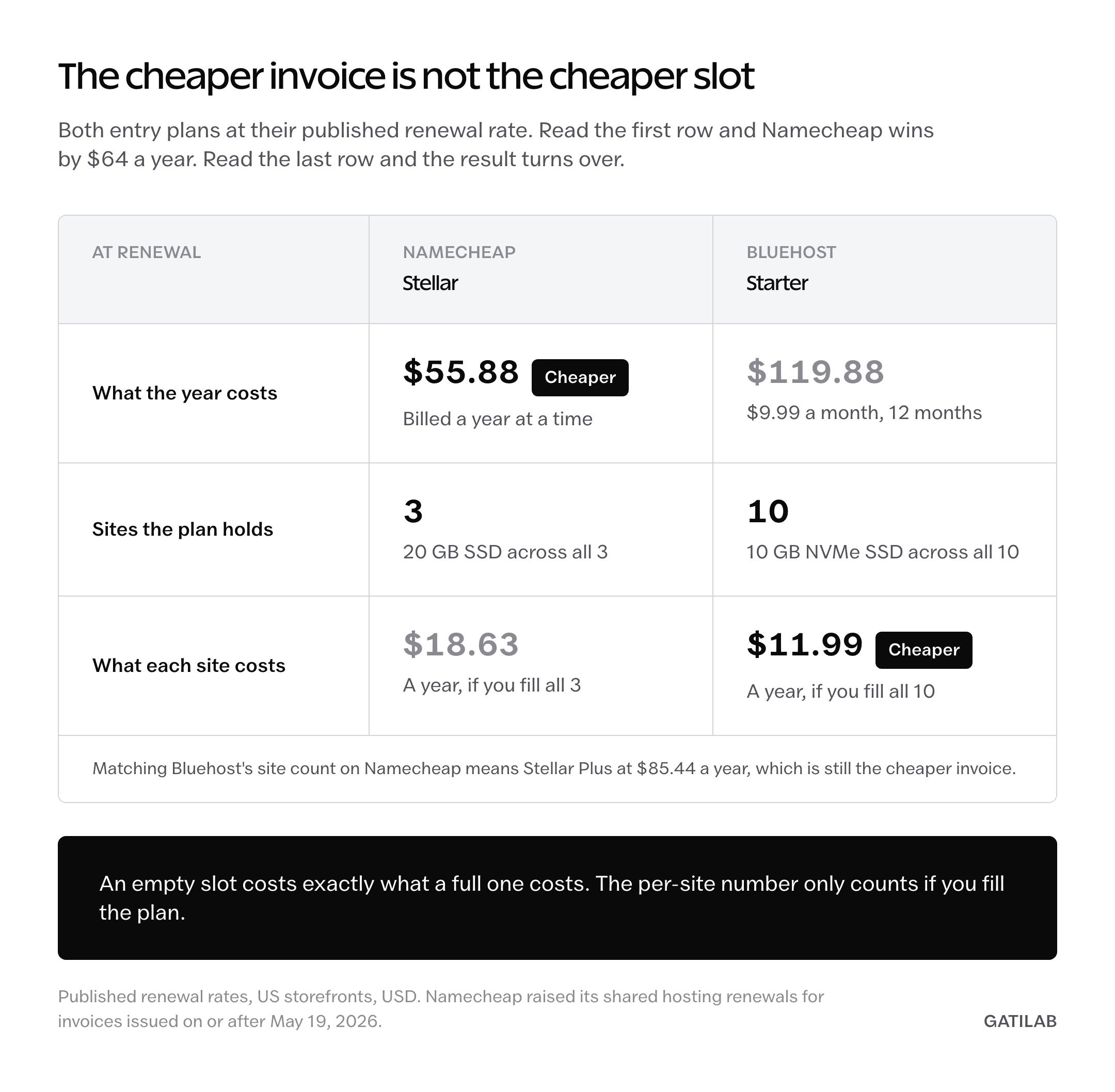
So the real question is not which host is cheaper. It is how many sites you are actually going to run in the next 2 years, answered honestly rather than aspirationally.
Most people overestimate.
Backups Are the Real Feature Gap
Namecheap’s AutoBackup tool is free, but only on Stellar Plus and Stellar Business. The entry Stellar plan does not include it. Bluehost lists weekly website backups on all 3 shared tiers, including the $9.99 Starter plan, along with a WordPress staging site and a free Let’s Encrypt certificate.
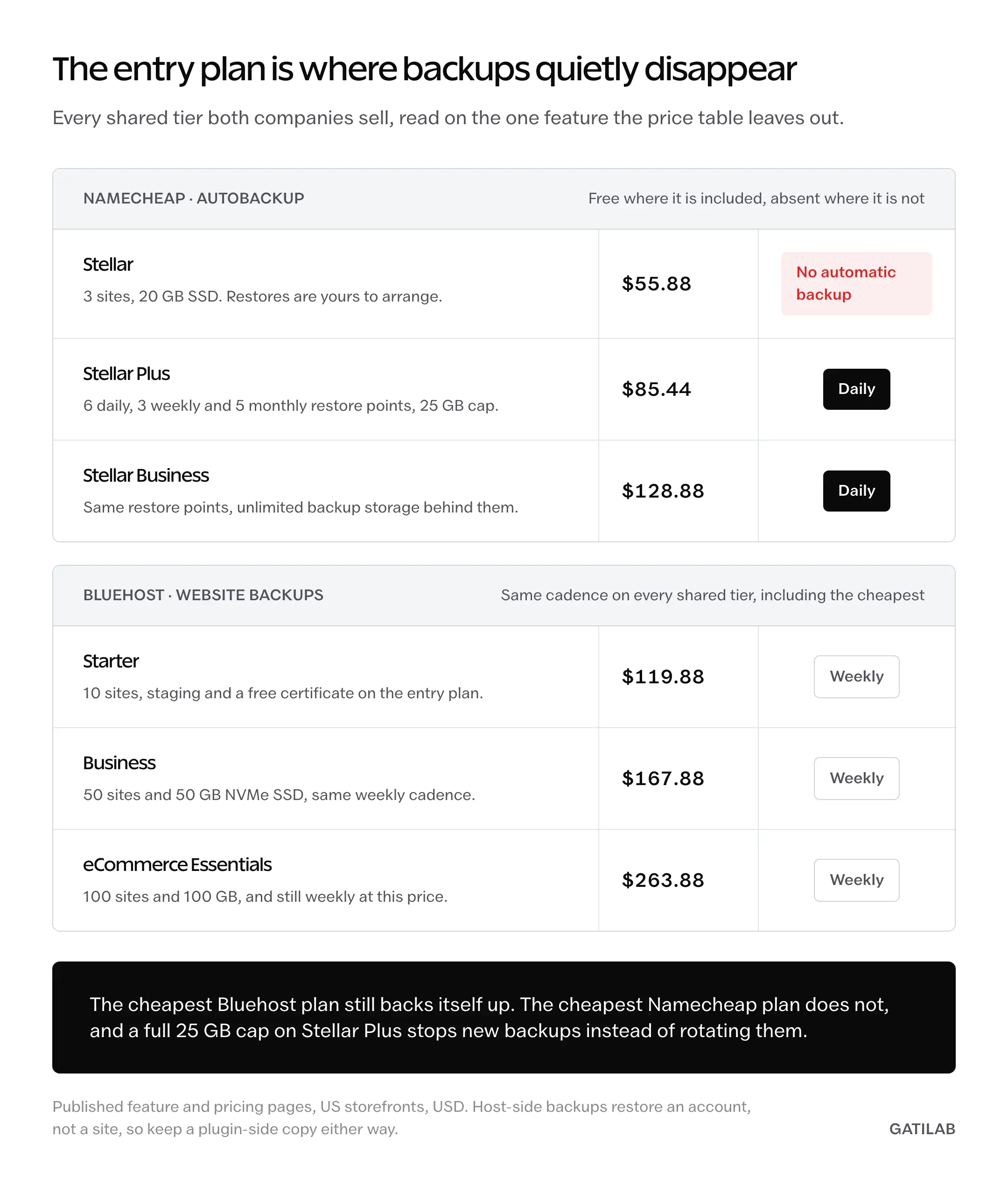
Where AutoBackup is included, the retention is genuinely good:
- 6 daily, 3 weekly, and 5 monthly restore points
- Full cPanel snapshots covering files, databases, email accounts, and settings
- 25 GB of backup storage on Stellar Plus, after which new backups stop until you free space
- Unlimited backup storage on Stellar Business
Daily beats weekly, so Namecheap wins this on the middle and top tiers and loses it outright at the entry tier. That storage cap on Stellar Plus is the detail worth writing down, because a backup that silently stops running is worse than no backup at all: you think you are covered.
Watch that cap.
Either way, host-side backups restore an account. Plugin-side backups restore a site, which is usually the thing you actually need at 2 a.m. Run one regardless of which host you pick, and keep your own copy of the certificate and DNS setup so a rebuild does not turn into a scavenger hunt. If a certificate is the part that trips you up, our walkthrough of how to renew an SSL certificate on cPanel and managed hosts covers the sequence.
Domains and Privacy
Namecheap was a registrar before it was a host, and the domain side still shows it. Domain privacy is free for life on eligible extensions, applied automatically at registration, renewal, transfer, and reactivation. That is not a first-year promotion that quietly starts billing in month 13.
Bluehost includes a free domain for the first year on every shared plan but does not publish its .com renewal or privacy pricing on its domains page, so you only see those numbers in the cart. Treat an unpublished renewal price as a number that can move.
The stronger move is to stop bundling at all. Register the domain wherever renewals are cheapest and transparent, host wherever the workload fits, and point the MX records at a mail provider that has nothing to do with either. Our breakdown of which free domain email routes are actually free covers the mail half. Separating the 3 services means a host migration is a DNS change, not a weekend.
The free domain is the cheapest hook in hosting. It costs the host about $10 and buys them your registrar business for years.
Register elsewhere.
What Decides Speed on a Shared Plan
Neither company publishes independently audited latency figures, and no neutral body benchmarks shared hosting on a schedule. The millisecond tables you find in hosting roundups are almost always run by someone with an affiliate relationship to the winner, on a single empty test install, from a single test location, on an unnamed date. Those conditions are not reproducible, so the numbers are not evidence.
What is knowable from the spec sheets is narrower and more useful. Bluehost lists NVMe SSD storage across its shared plans; Namecheap lists SSD. NVMe has more headroom on disk-bound work like a database-heavy WooCommerce query, though on a shared server that headroom is shared with every other tenant on the box.
The variables that actually move your time to first byte on a $10 plan are these:
- Distance between the server region and most of your readers
- Whether a page cache is serving HTML instead of PHP running per request
- PHP version and how many plugins execute on every page load
- Theme weight and the number of database queries per page
- How many neighbors are on the same shared server at your busiest hour
3 of those 5 are yours, not the host’s. That is why a lean install on the cheaper plan routinely beats a bloated one on the pricier plan, and why the theme you choose decides more of your speed than the hosting tier does at this price point.
Pick on price and features. Fix speed in the install.
The WordPress.org Recommendation
Bluehost is 1 of the 3 hosts listed on the official WordPress.org hosting page, alongside Pressable and Hostinger. Namecheap is not listed. That badge carries real weight with first-time buyers, so it is worth reading what the page says the listing is based on.
WordPress.org names its own criteria, including contributions to WordPress.org, size of customer base, ease of automatic install and upgrades, avoiding GPL violations, design, tone, historical perception, using the correct logo, and capitalizing WordPress correctly.
Read that list again. Roughly half of it measures the host’s relationship with the WordPress project and its brand conduct, not server performance. It is a reasonable signal that a company keeps PHP current and does not break the rules. It is not a latency test, an uptime audit, or a support benchmark, and treating it as one is how people end up disappointed by a host that technically earned its listing.
Who Should Pick Namecheap
Pick Namecheap when the budget is the binding constraint and you are comfortable in cPanel. A side project, a client staging playground, a personal blog, or a second site that only needs to exist all fit inside Stellar’s 3 sites and $55.88 a year without complaint.
It is also the better home for anyone holding a portfolio of domains, because free-for-life privacy across 10 or 20 names is money that compounds quietly.
Go to Stellar Plus rather than Stellar if the site matters at all. The extra $29.56 a year buys unlimited sites and the daily AutoBackup the entry plan leaves out, and one restore pays for a decade of it. Namecheap’s own shared hosting renewal pricing notice lists the current rates for every tier.
Who Should Pick Bluehost
Pick Bluehost when you are running several sites, or when the person maintaining the site is not you. 10 sites, weekly backups, and a staging environment on the entry plan is a genuinely different product from what Namecheap’s entry plan offers, and $11.99 per site per year is the cheaper number if you actually use the slots.
The staging site matters more than it looks on a spec sheet. Without one, every plugin update on a live client site is a small bet, and the WordPress-facing dashboard is easier to hand to a non-technical owner than raw cPanel. Bluehost’s shared hosting plans page lists what each tier includes.
Skip eCommerce Essentials. A store that justifies $263.88 a year has outgrown shared hosting and belongs on something with dedicated resources.
The Limits
This comparison is built on published pricing and feature pages, so it settles cost and included features and nothing else. It cannot tell you which host is faster for your readers, because neither company publishes reproducible latency data and the third-party charts that claim to are unverifiable. It cannot tell you whose support is better, because response times are anecdotal and vary by shift and queue.
Prices move, and 1 of these already has. Namecheap’s renewal rates changed for invoices issued on or after May 19, 2026, and Bluehost’s promotional rate depends on the term you prepay, so check both carts before you buy rather than trusting any table, including this one.
The bigger limit is the category. Shared hosting means your neighbors’ traffic spikes are your latency problem, and no plan on either list changes that. If a site is carrying revenue you would miss, the comparison you actually want is one tier up, closer to how the mid-range WordPress plans compare, or a managed platform with isolated resources.
What Quietly Ruins a Cheap Hosting Decision
Prepaying 3 years to chase the lowest monthly figure. It looks like the disciplined choice, and it locks you into a guess about a site you have not built yet, on a plan you cannot audit until the renewal lands.
Taking the free domain and leaving it at the host. The $10 saving is real and so is the friction later, when moving hosts also means arguing with a registrar about an auth code during the week your site is already down.
Buying the entry tier and assuming backups are part of it. On Namecheap Stellar they are not, and people discover this in the one conversation where the answer matters.
Comparing plans that no longer exist. Half the Namecheap vs Bluehost articles in search results still price Bluehost Basic and Choice Plus, which means the reader budgets for a product they cannot buy and lands on a checkout page that does not match anything they read.
Treating shared hosting as permanent. It is a good place to learn what a site needs and a bad place to still be sitting 3 years later, paying in slow pages for a decision nobody revisited.
Final Remarks
The framing that sells hosting is that you are choosing a company. You are not. You are choosing how much rent you pay for a slice of a server, and how much of the maintenance you are willing to do yourself in exchange for a smaller invoice.
Answered that way, it stops being close. Namecheap Stellar Plus at $85.44 a year is the cheaper serious plan for 1 to 3 sites you maintain yourself. Bluehost Starter at $119.88 a year is the better plan when you are running 5 or more sites, or handing one to someone who will never open cPanel.
The honest trade is that either choice is reversible for about a weekend of work, and both become the wrong answer the moment the site earns enough to justify better. Neither company will make or break what you are building.
Buy the cheaper one, keep your own backups, and spend the difference on what you publish.
Tell Google you want more of this.
Add Gatilab as a preferred sourceOne tap, and this site shows up more often in your own Top Stories, AI Overviews and AI Mode. Remove it any time.