
Content Marketing Consultant: What They Do, 2026 Rates, and When to Skip One
A content marketing consultant diagnoses why your content isn’t producing pipeline and hands you the prioritized plan to fix it, without taking over production. Rates in 2026 run $150 to $300 an hour for experienced independents, $3,000 to $10,000 for a strategy engagement, and $2,000 to $6,000 a month for ongoing advisory. Whether that’s a bargain or a waste depends entirely on one thing: whether your problem is actually strategy, because that’s the only thing a consultant sells.
I’ve been on both sides of this table, hiring specialists into client programs and being the consultant brought in to explain why 200 published posts produced 11 leads. So this guide is the unvarnished version: what a content marketing consultant actually does, what the engagement should deliver, what it costs, the red flags I’d run from, and the honest cases where you shouldn’t hire one at all.
What Does a Content Marketing Consultant Do?
A consultant’s job is diagnosis and direction: audit what exists, find why it underperforms, and sequence what happens next. The concrete deliverables a real engagement produces:
- Content audit: every URL scored for traffic, rankings, conversions, and decay, with a keep/refresh/consolidate/kill verdict.
- Gap and competitor analysis: which queries competitors own that you don’t, and which are winnable this year.
- Strategy document: target segments, topics mapped to funnel stages, the money-pages-first build order, and internal linking architecture.
- Measurement design: GA4 conversions, content groups, CRM source capture, and the monthly scorecard the team reports against.
- Team and process design: who writes, who edits, what a brief looks like, and the editorial standards that survive the consultant leaving.
What a consultant does not do: write your articles. Production is a different service with different economics (the subscription math is in my breakdown of content marketing as a service). The cleanest engagements keep the line sharp: consultants think, producers make, and one person on your side owns the handoff.
Consultant vs Agency vs CaaS vs In-House: Which Fits
The four ways to buy content help solve different problems, and mixing up ‘we need a strategy’ with ‘we need throughput’ is the most expensive confusion in this market:
| Consultant | Full agency | CaaS subscription | In-house hire | |
|---|---|---|---|---|
| Solves | Direction and diagnosis | Direction + production, outsourced | Throughput at fixed cost | Depth and ownership |
| Typical cost | $3K-$10K project or $2K-$6K/mo advisory | $5K-$20K/mo | $2.5K-$10K/mo | $70K-$130K/yr + ramp |
| Best when | Content exists but underperforms | No time, bigger budget | Strategy is set, production lags | Content is core to the company |
| Fails when | Nobody executes the plan | Strategy outsourced entirely, no internal owner | Bought before strategy exists | Hired before demand is proven |
| Commitment | 2-8 weeks typical | 6-12 month contracts | Monthly, pausable | Permanent |
The pattern behind good outcomes: buy diagnosis once, then buy production in whatever form matches your budget, with your own measurement keeping everyone honest. The scorecard from my content marketing ROI guide is exactly what that measurement layer looks like.
What a Good Consultant’s First 30 Days Look Like
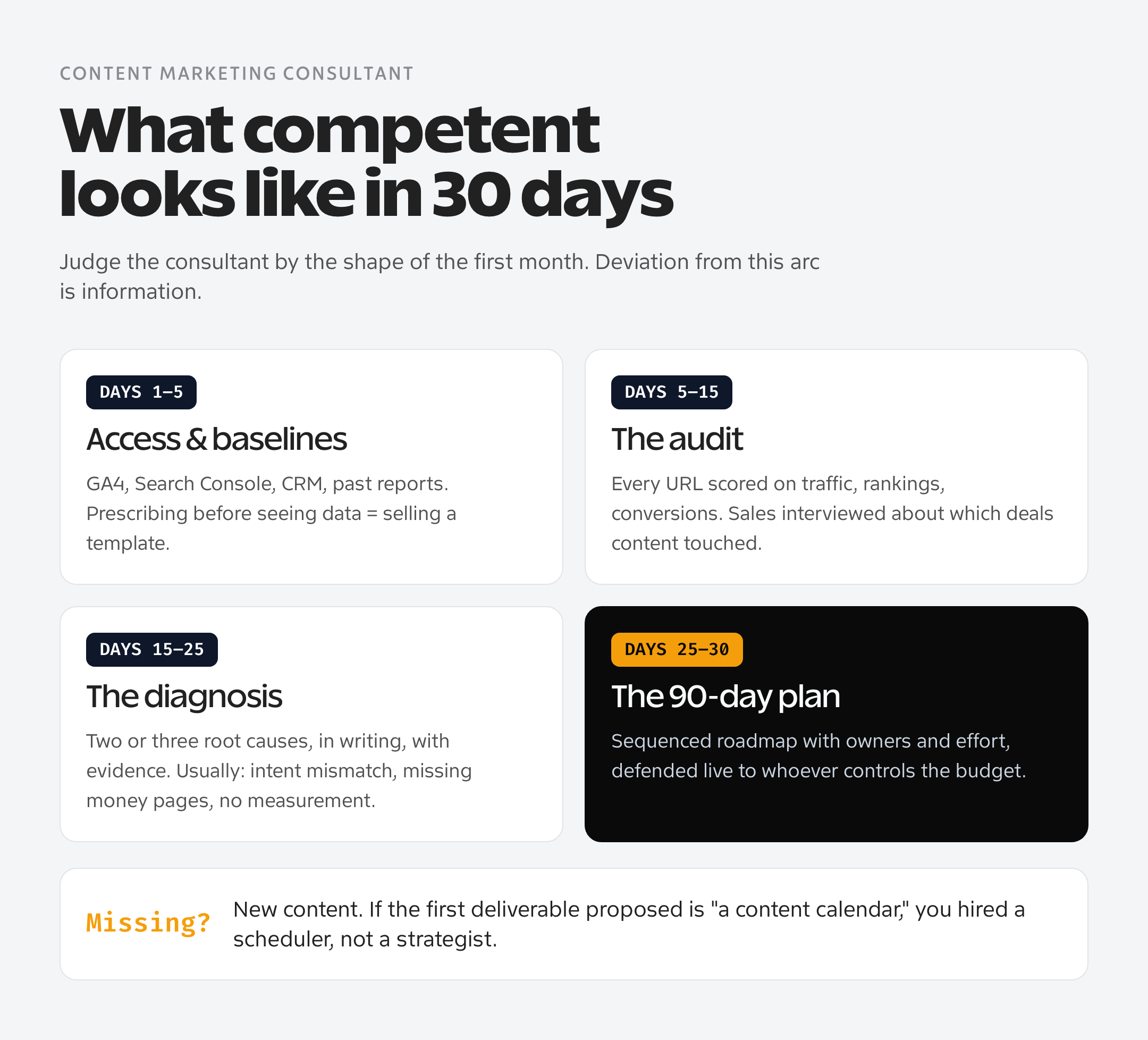
You can judge a content marketing consultant by the shape of their first month. The sequence below is what competent looks like; deviation from it is information:
- Days 1-5, access and baselines: GA4, Search Console, CRM, and past reports. A consultant who starts prescribing before seeing your data is selling a template.
- Days 5-15, the audit: full content inventory scored against traffic, rankings, and conversions, plus interviews with sales about which deals content actually touched.
- Days 15-25, the diagnosis: a written findings document with the two or three root causes (it’s almost always some combination of intent mismatch, missing money pages, and no measurement), each with evidence attached.
- Days 25-30, the plan: a sequenced 90-day roadmap with owners and effort estimates, presented to whoever controls the budget, with the consultant defending the priorities live.
Notice what’s missing: new content. If the first deliverable proposed is ‘a content calendar,’ you’ve hired a scheduler, not a strategist. Calendars are what practice 12 of my content marketing best practices ranking calls an input, and inputs don’t diagnose anything.
Content Marketing Consultant Rates in 2026
The market splits into three pricing shapes, and each buys a different relationship:
- Hourly ($150-$300): senior independents; below $100/hour usually signals a freelance writer rebranded as a strategist. Fine for spot advice, expensive for sustained work.
- Project ($3,000-$10,000): the audit-diagnosis-roadmap package above. The right first purchase for most companies, because it’s bounded, comparable, and produces an artifact you own.
- Monthly advisory ($2,000-$6,000): ongoing prioritization, briefs review, and quarterly re-planning. Worth it once execution is running and decisions arrive weekly; wasteful before then.
Two pricing notes from inside the market. First, big-name consultancies charge 2-4x those bands for the same deliverables with better slide design; you’re paying for the logo on the report. Second, anyone offering a free strategy ‘audit’ is running lead generation for a production retainer, which is fine, as long as you read the audit as a sales document and not a diagnosis.
Red Flags (From Someone Who Reviews These Engagements)
The failure modes are consistent enough to list. Walk away, or at least slow down, when you see:
- Guaranteed rankings or traffic numbers. Nobody controls Google. Honest consultants guarantee process and diagnosis quality, not positions.
- A pitch that prescribes before it audits. If the proposal names deliverables (’40 blog posts, 2 pillar pages’) before seeing your data, the plan was written for someone else.
- No sales-team contact in the plan. Content strategy built without asking sales which questions prospects raise is guesswork with a nicer font.
- Vanity-metric reporting. If the sample report leads with impressions and traffic instead of conversions and pipeline, that’s the accountability they intend to accept.
- No opinion about what NOT to do. Real strategy kills projects. A consultant who validates everything you’re already doing is selling comfort.
When You Shouldn’t Hire a Content Marketing Consultant
Skip the consultant in three situations, and spend the money elsewhere:
- You haven’t published anything yet. There’s nothing to diagnose. Start with a documented strategy you can build yourself (my SEO content strategy framework is the free version of that first engagement), publish for two quarters, then bring in outside eyes.
- The diagnosis is already obvious. If you have forty informational posts and zero comparison pages, you don’t need $8,000 to be told to build money pages. Build them.
- Nobody internal will own execution. A roadmap without an owner is expensive shelf decoration. Hire the owner first, even fractionally, then the strategist.
And one situation where you absolutely should: when content spend passes $5K a month and nobody can answer ‘what did that produce last quarter’ in pipeline terms. At that spend, a $6K diagnosis that redirects even 20% of the budget pays for itself inside a quarter.
Ten Questions to Ask Before You Sign
Interviews expose more than proposals, because proposals are rehearsed. These ten questions, asked live, sort strategists from schedulers in under an hour:
- “Walk me through the last engagement where your plan failed. What did you miss?” (Honest practitioners have a real answer ready. Vendors don’t.)
- “What would make you tell us NOT to invest more in content?” (Tests whether they can kill their own sale.)
- “Which of our current pages would you delete?” (Forces a live opinion on your actual site.)
- “How will you involve our sales team?” (No plan for this = strategy by guesswork.)
- “What does your measurement setup look like, tool by tool?” (Specifics here predict specifics everywhere.)
- “What happens in the handoff after the roadmap? Who executes?” (Checks whether they’ve thought past their own deliverable.)
- “What’s a realistic timeline to breakeven for a program like ours?” (Anything under six months is a red flag dressed as confidence.)
- “How do you use AI in your process, and where do you refuse to?” (2026’s competence question. Both halves matter.)
- “Can I talk to a client from two years ago?” (Not last month. Two years. Compounding takes time to verify.)
- “What do you need from us to not fail?” (Good consultants have a demanding list. That list is the engagement’s real price.)
One meta-signal across all ten: does the consultant push back on anything during the sales conversation? Someone agreeing with every premise you state is showing you exactly how the engagement will go. The best hire I ever made for a client opened with ‘your budget is wrong for what you’re asking’… and was right.
Content Marketing Consultant: FAQ
The questions buyers ask me before engagements, answered as I’d answer over coffee:
What does a content marketing consultant do?
They diagnose why content underperforms and produce the plan to fix it: content audit, competitor gap analysis, strategy document with build order, measurement design, and process design. They direct production but typically don’t write the content themselves.
How much does a content marketing consultant cost?
In 2026: $150-$300/hour for experienced independents, $3,000-$10,000 for an audit-and-roadmap project, $2,000-$6,000/month for ongoing advisory. Big-name consultancies run 2-4x those bands for comparable deliverables.
What’s the difference between a content marketing consultant and an agency?
A consultant sells diagnosis and direction; an agency sells direction plus production under one contract. Consultants fit when content exists but underperforms; agencies fit when you want the whole function outsourced. Buying strategy and production separately usually keeps both more accountable.
How do I know if a content marketing consultant is good?
Judge the first 30 days: data access and baselines first, then an evidence-backed audit, then a root-cause diagnosis, then a sequenced 90-day roadmap with owners. Red flags: prescribing before auditing, guaranteed rankings, vanity-metric reporting, and no contact with your sales team.
When should I hire a content marketing consultant?
When you’ve published consistently for 6+ months, results lag, and nobody internally can explain why in pipeline terms. Especially when content spend passes $5K/month without a measurable answer. Skip it if you haven’t started publishing or nobody will own execution.
Can a consultant guarantee SEO results?
No, and the honest ones say so. They can guarantee diagnosis quality, process, and prioritization logic. Anyone guaranteeing positions or traffic is pricing your hope, not their skill.
Should I hire a consultant or build in-house first?
Hire an internal owner (even fractional) before or alongside the consultant. Strategy without an execution owner becomes shelfware. The cheapest effective combo I see: one internal owner, one bounded strategy project, production bought as a service.
The Honest Close
A content marketing consultant is worth the money exactly when you have evidence of effort and an absence of results, because that gap is where diagnosis lives. Buy the bounded project before the retainer, demand the four-week arc above, and keep production separate so the strategy stays honest.
And if you read the red-flags list and recognized your current engagement in three of them… that feeling is the diagnosis. You just got it for free.
Tell Google you want more of this.
Add Gatilab as a preferred sourceOne tap, and this site shows up more often in your own Top Stories, AI Overviews and AI Mode. Remove it any time.