
Content Operations: The System That Scales Content Past Your First Writer
Content operations is the system that turns content from a series of heroic individual efforts into a repeatable production line: the workflow, roles, standards, and tooling that sit underneath every article, video, and campaign. Strategy decides what to make; content ops decides how it gets made, by whom, to what standard, on what schedule, without anyone burning out or anything shipping broken.
Nobody googles this term until it hurts. The trigger is always the same: output stalls somewhere between two and four content contributors, quality wobbles from piece to piece, and suddenly half of everyone’s week is status meetings about drafts. I’ve installed content ops for teams at exactly that stage, and this guide is the system that survives contact: the five components, the workflow stages with owners, the messaging framework that keeps twelve voices sounding like one, and the minimal stack that doesn’t require an ops hire.
What Is Content Operations?
Content operations (content ops) is the infrastructure layer of content marketing: the documented processes, role definitions, quality standards, and tools that govern how content moves from idea to published to refreshed. If content strategy is the architect’s drawing, content ops is the construction schedule, the trades, and the building inspector.
The discipline has five components, and weak programs are usually missing three of them:
- Workflow: the named stages a piece passes through, with entry/exit criteria for each.
- Roles: who ideates, briefs, writes, edits, approves, publishes, distributes, and measures. One name per verb.
- Standards: the brief template, style rules, messaging framework, and definition of done.
- Tooling: the calendar, the workflow tracker, the DAM/asset store, and the analytics stack.
- Cadence rituals: the weekly pipeline review and the quarterly refresh/prune cycle.
Do You Need Content Ops Yet? The Four Triggers
You need content operations when any of these four becomes a monthly occurrence, and not before. Premature ops is bureaucracy cosplay, and a solo writer with a checklist already has all the ops they need:
- The bus test fails: one person’s vacation stops all publishing, because the process lives in their head.
- Quality varies by author: readers can tell who wrote what, and not in a good way. That’s a standards gap, not a talent gap.
- Work in progress piles up: ten drafts at 80% while the calendar shows nothing shipped this week. Classic missing-workflow symptom.
- Nobody can answer ‘where is X?’: status lives in DMs, and finding the latest version of anything takes longer than editing it.
Two to four contributors is the usual tipping point. It’s also exactly the stage where teams consider outsourcing the whole function instead, which is a legitimate answer; the content marketing as a service model is essentially content ops rented by the month.
The Content Ops Workflow: Seven Stages, One Owner Each
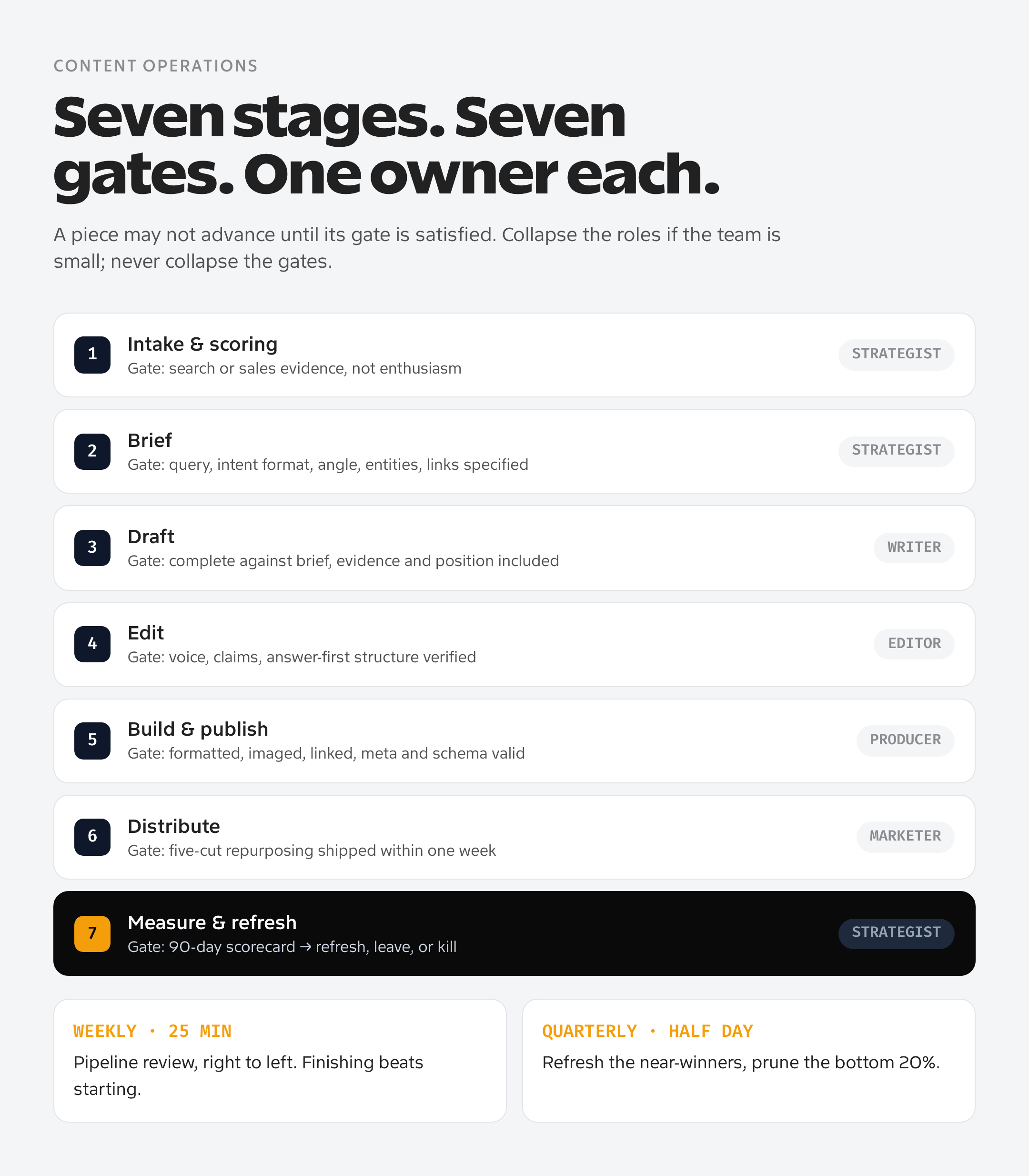
A working content pipeline has seven stages, and the discipline is entirely in the exit criteria: a piece may not advance until its stage-gate is satisfied. This is the workflow I install, with the gate that ends each stage:
| Stage | Owner | Exit gate |
|---|---|---|
| 1. Intake & scoring | Strategist | Idea has search/sales evidence, not just enthusiasm |
| 2. Brief | Strategist | Target query, intent format, angle, entities, internal links specified |
| 3. Draft | Writer | Complete against brief; evidence and position included |
| 4. Edit | Editor | Standards pass: voice, claims checked, structure answer-first |
| 5. Build & publish | Producer | Formatted, imaged, linked, meta set, schema valid |
| 6. Distribute | Marketer | Five-cut repurposing shipped within one week |
| 7. Measure & refresh | Strategist | Scorecard reviewed at 90 days; refresh/leave/kill decided |
Small teams collapse roles (one person can own three stages), but never collapse the gates. The gates are the operating system; the org chart is just who’s logged in. And stage 1 deserves its reputation as the highest-leverage gate: it’s where the best-practices discipline of proven-gaps-over-brainstorms gets enforced or lost.
The Messaging Framework: One Page That Prevents a Thousand Debates
A messaging framework is the document that makes twelve contributors sound like one company: the positioning statement, the three core messages with proof points, the tone rules, and the banned list. Without it, every draft relitigates what the company believes, and the editor becomes a bottleneck of taste instead of a checker of standards. Mine fits on one page:
- Positioning line: who we serve, what problem, why us, in one sentence a new writer can’t misinterpret.
- Three message pillars: the claims we make everywhere (e.g., ‘measurement before volume’), each with two proof points attached.
- Tone triangle: three adjectives with ‘this, not that’ examples. ‘Direct, not brusque. Evidenced, not academic. Confident, not salesy.’
- The banned list: phrases, superlatives, and competitor mentions we never use, so edits stop being arguments.
- Proof inventory: the numbers, clients, and results writers may cite, with sourcing. Stale proof is how credibility leaks.
This document does more for consistency than any style guide triple its length, because it encodes decisions, not preferences. Pair it with the strategy layer from my guide to creating a content marketing strategy and the two documents together onboard a new writer in a day.
The Minimal Content Ops Stack (No Ops Hire Required)
Tooling is the least important component and the one teams buy first. The stack below runs programs up to roughly 20 pieces a month, costs under $100, and every tool is replaceable:
- Workflow tracker: Notion, Airtable, or Trello with the seven stages as columns and the gates as checklists. The tool matters less than the rule that status lives here and nowhere else.
- Calendar: a view on the same database, never a separate document that can drift.
- Brief template: a form, so briefs are structurally complete before writing starts. Half of all editing pain is incomplete briefs.
- Asset store: one shared drive with a naming convention. Content ops fails at ‘final_v3_REAL.docx’ more often than anywhere glamorous.
- Analytics: GA4 + Search Console + a monthly scorecard sheet, wired as in my content marketing ROI guide.
Enterprise content ops platforms (Optimizely CMP, Contently, GatherContent and friends) earn their $1K-$5K monthly pricing at 50+ pieces a month across brands and regulatory review. Below that, they’re a very expensive way to avoid writing down your workflow.
Content Ops Metrics: Measure the Machine, Not Just the Content
Content metrics tell you if the output works; ops metrics tell you if the machine works. Four numbers, checked monthly, catch nearly every operational disease early:
- Cycle time: brief-to-published days, tracked per piece. Rising cycle time is the earliest signal of a broken stage.
- Throughput vs plan: shipped divided by planned. Chronic 60% means the plan is fiction; fix capacity or ambition.
- First-pass edit rate: share of drafts clearing edit without a major rewrite. Under 70% means briefs or standards are failing, not writers.
- Refresh ratio: refreshed pieces as a share of all production. Healthy mature programs run 25-40%; zero means you’re strip-mining new topics while winners decay.
The Two Rituals That Keep the Machine Honest
Process documents decay; rituals persist. Content ops needs exactly two recurring meetings, and both have fixed agendas short enough to survive busy quarters:
The weekly pipeline review (25 minutes, same day, same hour). Walk the board right to left, oldest stage first: what ships this week, what’s blocked and by whom, what enters the pipeline. Right-to-left matters, finishing beats starting, and reviewing newest-first is how boards fill with abandoned drafts. No content debates allowed; those go to the brief or the edit, where standards decide instead of opinions.
The quarterly refresh-and-prune (half a day). Pull the bottom 20% of pages by traffic and the top 10 near-page-one opportunities. Kill or consolidate the first group, refresh the second, and update the messaging framework’s proof inventory with the quarter’s new numbers. This ritual is also where marketing culture actually forms: a team that publicly retires its own weak work learns that standards are real, and that lesson transfers to every draft that follows. Culture isn’t the posters; it’s what the calendar repeats.
Content Operations: FAQ
The questions teams ask when they hit the scaling wall:
What is content operations?
The infrastructure layer of content marketing: documented workflow, role assignments, quality standards, tooling, and cadence rituals that govern how content moves from idea to published to refreshed. Strategy decides what; ops decides how, by whom, and to what standard.
What’s the difference between content strategy and content operations?
Strategy is direction: audiences, topics, build order, and goals. Operations is execution machinery: stages, gates, owners, templates, and tools. A strategy without ops produces sporadic heroics; ops without strategy produces consistent output nobody needed.
When does a team need content operations?
At two to four regular contributors, or when any of four triggers recur: publishing stops when one person is out, quality varies by author, drafts pile up at 80%, or nobody can locate current status without asking. Solo creators need a checklist, not an ops layer.
What roles does content ops include?
Eight verbs that need one name each: ideate, brief, write, edit, approve, publish, distribute, measure. Small teams give one person several verbs; the failure mode is a verb with no name or two names.
What is a messaging framework?
A one-page document with the positioning line, three message pillars with proof points, tone rules with this-not-that examples, a banned list, and a citable proof inventory. It’s how multiple writers sound like one company and how edits stop being philosophical debates.
What tools do I need for content operations?
Under 20 pieces/month: a workflow tracker (Notion/Airtable/Trello), a calendar view on the same database, a brief form, one shared asset drive with naming rules, and GA4 + Search Console. Under $100/month total. Enterprise platforms earn their keep past ~50 pieces/month or regulated review chains.
How do I measure content operations?
Four machine metrics monthly: cycle time (brief to published), throughput vs plan, first-pass edit rate (target 70%+), and refresh ratio (healthy: 25-40% of production). They diagnose the pipeline the way content metrics diagnose the output.
Where to Start Monday Morning
Don’t start with tools. Write the seven stages on a whiteboard, put one name next to each, define the exit gate for the two stages that hurt most (it’s almost always brief and edit), and run one piece through the full pipeline as a test. That’s an afternoon, and it will surface every real problem your future ops system needs to solve.
Content operations isn’t the exciting part of content marketing. It’s the part that decides whether the exciting parts happen twice.
Tell Google you want more of this.
Add Gatilab as a preferred sourceOne tap, and this site shows up more often in your own Top Stories, AI Overviews and AI Mode. Remove it any time.