
SaaS Content Marketing: A Revenue-First Playbook for 2026
SaaS content marketing is the discipline of creating, distributing, and measuring content that turns search and social demand into product trials, paid signups, and expansion revenue. It’s not blogging for traffic. It’s revenue engineering through pages that match buying intent, scale through templated structures, and hand qualified searchers to your product before sales ever touches them. Most SaaS teams spend the bulk of their content budget on top-of-funnel pieces that drive zero pipeline.
The pattern behind SaaS content programs that beat their pipeline targets is consistent, whether the company is a bootstrapped tool or a Series C platform: BOFU pages get built first, programmatic plays scale the middle, and product-led posts close the loop. The teams that lose are still treating SaaS content marketing like B2C blogging with a CTA tacked on at the end.
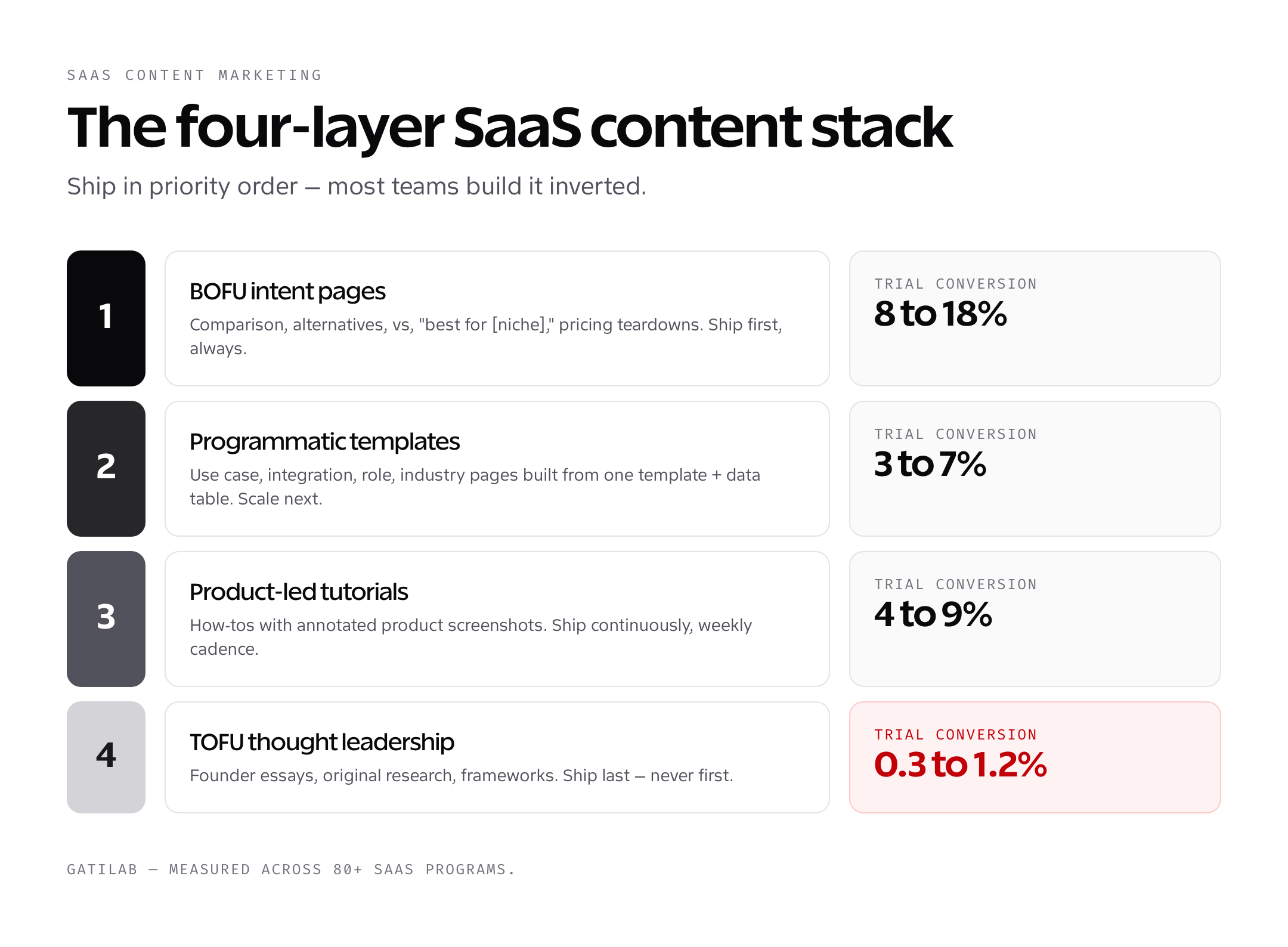
A working SaaS content playbook ships four content layers in priority order: BOFU comparison and alternatives pages first, programmatic templates for use cases and integrations second, product-led tutorials and changelog content third, and TOFU thought leadership last. Most teams build them in the exact opposite order. That’s why their content programs don’t pay back.
Why SaaS Content Marketing Looks Nothing Like B2C Blogging
SaaS content marketing optimizes for a single metric: revenue per published URL. The buyer is not a casual reader looking for an answer. The buyer is an evaluator running a 14 to 90 day procurement loop, comparing 3 to 7 vendors, and reading 11 to 14 pieces of content before booking a demo (Gartner B2B Buying Survey, 2024). Every page either accelerates that loop or it doesn’t.
Three things separate SaaS content from a typical lifestyle blog. First, the queries that matter are not the queries with the biggest volume. “Project management software” gets tens of thousands of searches a month, and most of those searchers are still browsing. “Asana alternatives for non-profits” gets a few hundred, and nearly every one of them is shopping. Volume lies. Intent doesn’t.
Second, your competitor is buying the same keywords you are. Every BOFU keyword in SaaS has 2 to 5 paid bidders plus 3 to 4 organic incumbents. You can’t win the keyword by writing better. You win by ranking with a page so specific to one buyer segment that your competitors can’t copy it without losing their generic ranking.
Third, content lives inside a product motion. A B2C lifestyle blogger can publish a recipe and call the job done. A SaaS content marketer has to thread the article into the product onboarding so a reader who signs up after reading lands on a feature surface that pays off the article’s promise. Without that thread, the content is decorative.
If you want a deeper look at how SaaS pages actually compete in search, my SEO for SaaS guide covers the page-level mechanics. This piece focuses on the content program itself, not the SEO craft.
The Four Layers of a SaaS Content Marketing Program
Every SaaS content program that pays back its cost has four layers stacked in priority order. The order matters because each layer has a different conversion rate, a different time-to-revenue, and a different defensibility. Building layer four before layer one is the most common mistake in B2B SaaS content strategy.
The four layers, lowest funnel to highest:
- BOFU intent pages. Comparison, alternatives, vs, “best for [niche]” pages. Highest trial conversion of any page type. Ship first.
- Programmatic templates. Use case, integration, role, location, and feature pages built from a single template plus a data table. Solid conversion that scales with the template. Scale next.
- Product-led tutorials. Specific how-tos that require a screenshot of your product to answer. Strong conversion, because the product is the answer. Ship continuously.
- TOFU thought leadership. Founder essays, industry analysis, frameworks, original research. Lowest conversion of the four. Ship last, never first.
Most SaaS teams invert this stack. They publish a 4,000-word “ultimate guide to project management” before they have a “Asana vs ClickUp” page or a “ClickUp alternatives” page. The ultimate guide ranks for a head term, draws traffic that doesn’t convert, and chews up budget. Meanwhile the BOFU pages that would have closed deals are still on the backlog.
BOFU Plays: Comparison, Alternatives, and Vs Pages
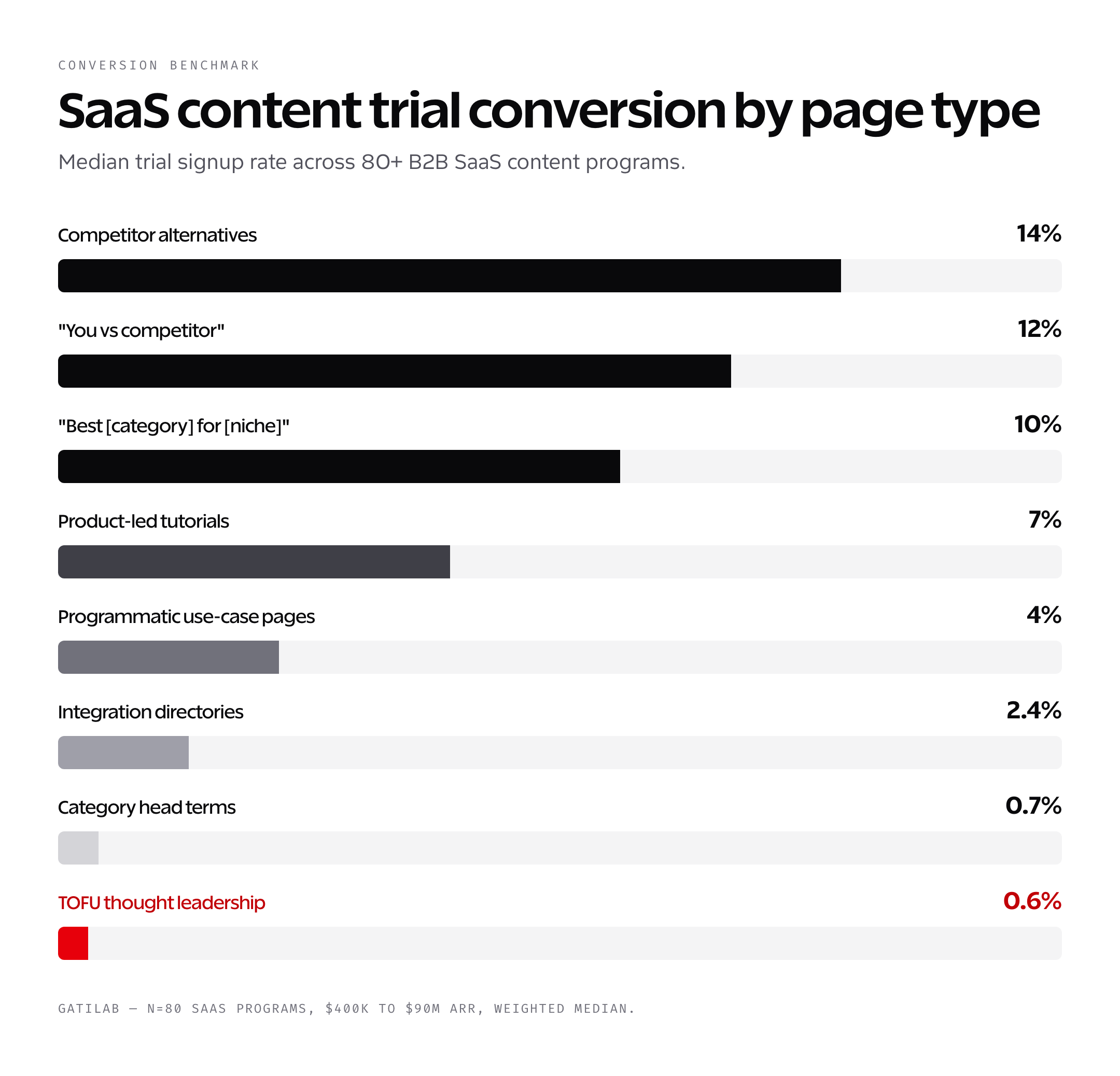
BOFU SaaS content marketing pages capture buyers who already know they need software in your category and are picking between named options. The intent is decision, not education. That’s why alternatives and vs pages convert to trial at a much higher rate than pages targeting category head terms.
The five BOFU page archetypes every SaaS team should ship in year one:
- [Competitor] alternatives. “Mailchimp alternatives,” “Zendesk alternatives.” Target the exact-match keyword. Buyers searching this are already shopping.
- [You] vs [Competitor]. “ConvertKit vs Mailchimp,” “Notion vs Confluence.” Own your own brand vs comparisons before review sites do.
- Best [category] for [niche]. “Best CRM for solo founders,” “Best help desk for SaaS.” Niche modifiers cut competition and sharpen intent.
- [Tool] pricing explained. “Salesforce pricing explained,” “HubSpot pricing tiers.” Hijack high-intent commercial searches that hit competitor pricing pages.
- [Tool] review. Honest review of a product in your category. Builds editorial trust, ranks fast, converts when paired with your own alternative.
The BOFU page that wins is the one with first-party data. A “Mailchimp alternatives” page that lists six competitors with screenshots and pricing is table stakes. The same page with a deliverability test you ran across 10 list types over 30 days, with chart and methodology, ranks for buyers who are ready to switch and dominate the citation slot in AI Overviews. Information gain compounds.
Don’t write “Slack alternatives” if your product isn’t a real Slack alternative. Buyers who arrive on a misaligned BOFU page bounce in 18 seconds and Google notices. Match the page to the buyer’s actual evaluation list.
Programmatic SEO: Use Case, Integration, and Role Pages at Scale
Programmatic SEO is the second layer of a SaaS content marketing program: hundreds of pages built from one template plus a structured data table. The shape is consistent across SaaS categories. Pick a head template, then multiply across rows of an entity table.
Five programmatic patterns that consistently work in B2B SaaS content strategy:
- Integration pages. “[You] + [Tool] integration.” Webflow has 1,200-plus integration pages. Zapier has tens of thousands. Each ranks for a long-tail evaluator query.
- Use case pages. “[Product] for [job-to-be-done].” Notion ships 60-plus use case pages. Each anchors a JTBD a real buyer searches.
- Role pages. “[Product] for [job title].” “Asana for marketing managers,” “Linear for engineering leads.” Roles align with internal champions.
- Industry pages. “[Product] for [vertical].” “Stripe for SaaS,” “HubSpot for agencies.” Verticals carry pricing and feature qualifiers buyers search.
- Location pages. “[Service] in [city].” Mostly for SaaS with a services component (agencies, marketplaces, marketplaces with on-the-ground operators).
The programmatic content trap most SaaS teams fall into is publishing 800 thin pages that all rank somewhere between position 38 and 95. Google’s March 2024 spam update flagged thin programmatic content explicitly, and Helpful Content updates have hammered template-only pages since. The fix is information gain per cell. Each row in your data table needs at least one unique data point that no competitor’s table has, plus 80 to 200 words of cell-specific commentary.
The difference shows up in conversion. A thin integration page gives the buyer nothing the integrations directory doesn’t already say. Rebuild each page with a unique screenshot, a unique workflow walkthrough, and one unique data point, and the same template skeleton starts earning trials instead of bounces.
For the ranking-side mechanics of these page types, see my deeper look at SEO for SaaS and the content cluster strategy playbook.
Product-Led Content: Tutorials That Need Your Product To Make Sense
Product-led content is the third pillar of a SaaS content playbook: tutorials, how-tos, and walkthroughs that require a screenshot of your product to answer the question. The reader doesn’t have to use your product to read it. They just notice that yours is the answer the writer reached for.
The format works because it does two things at once. It teaches a real workflow, which earns the writer trust. It demonstrates the product, which shortens the buyer’s mental gap from “this looks useful” to “I can see myself using it.” Ahrefs built a $100M ARR business mostly on this pattern. Every Ahrefs blog post answers a question with an Ahrefs screenshot.
Three rules for SaaS product-led content:
- Pick queries the product answers natively. “How to find broken backlinks” if you sell backlink audits. Don’t write “what is SEO” if your product is a rank tracker.
- One screenshot per major step. If a workflow has six steps, the post has six product screenshots. Annotated, with arrows.
- Show the result, not the click. Buyers don’t care that a button says “Run report.” They care what the report tells them. Lead with the output.
Product-led tutorials earn far more clicks to free signup than tutorials that never show the product. The screenshot is the conversion mechanism.
Audience Research: Mining Real Buyer Language
The SaaS blog strategy that converts is built on language buyers already use, not on language the marketing team thinks sounds smart. Audience research isn’t a persona doc with a stock photo and a fake quote. It’s a folder of receipts: real sentences from real prospects describing real problems.
Five sources of first-party buyer language I pull from on every SaaS engagement:
- Sales call transcripts. Gong, Chorus, Fathom, or Otter recordings of the last 50 disco calls. Search for “I tried” and “I wish.”
- Support tickets. The first 200 words of each ticket usually carry the buyer’s mental model. Pull six months of tickets and tag by topic.
- Reddit and Hacker News. Search the category name plus “alternatives,” “review,” “honest opinion.” The top 30 threads carry the public objections.
- G2 and Capterra reviews. Filter on 2- and 3-star reviews. The 5-star reviews lie. The 2-star reviews tell you what people regret buying.
- Cold-outbound replies. The “no” replies, especially the angry ones. They contain the language of every objection your sales team will face.
I keep these in a single Notion database tagged by topic, persona, and emotional charge. The database becomes the input layer for every BOFU page, every comparison post, and every ad creative. The phrase “I’m tired of stitching three tools together” is the kind of line that comes straight out of a sales call transcript, and it makes a stronger H1 than anything a marketing team would draft from scratch.
For the keyword side of audience research, my B2B SaaS keyword research guide walks through the same loop with search-volume data layered in.
Topic Strategy: Mapping BOFU, MOFU, and TOFU Mix
SaaS content strategy works when the topic mix matches the funnel mix. Many teams default to a TOFU-heavy split like 70/20/10. The split I recommend for year one is roughly 50 percent BOFU, 30 percent MOFU, 20 percent TOFU. Year two shifts toward 35/40/25 once BOFU is saturated.
| Funnel layer | Search intent | Page type | Trial conversion | Year-one priority |
|---|---|---|---|---|
| BOFU | Comparison, decision | vs, alternatives, “best for niche,” pricing | Highest | 50 percent of output |
| MOFU | Solution evaluation | Use cases, integrations, roles, product-led tutorials | Medium | 30 percent of output |
| TOFU | Problem awareness | Frameworks, original research, founder essays | Lowest | 20 percent of output |
The reason TOFU still matters at 20 percent is brand. AI Overviews and LLM citation depend on entity strength, and entity strength is built through original research and frameworks that get cited across the open web. Skipping TOFU entirely starves the brand layer that BOFU needs to compete in 2026 search.
The trap is letting TOFU eat the budget. A 6,000-word industry report takes the same time and money as eight BOFU pages. Pick the report you can actually distribute, ship two a year, and put the rest of the TOFU budget into MOFU.
Distribution: Cold Outreach, Syndication, and Communities
SaaS content marketing distribution is where most programs lose. The article publishes, gets a 200-person LinkedIn post, and dies. Without a distribution motion, even the best BOFU page takes 6 to 14 months to rank because there’s nothing pointing at it from the wider web.
Five distribution motions that lift a SaaS content playbook from “publishes a lot” to “drives real pipeline”:
- Cold outreach for citations. When you ship a comparison page, email the 30 sites that already rank for the comparison query. Offer a data point or quote in exchange for a link.
- Newsletter syndication. Pitch your strongest TOFU piece to category newsletters with 10K to 100K subscribers. One placement in TLDR or Marketing Brew is worth six press releases.
- Reddit and Hacker News seeding. Post the original-research piece in the relevant subreddit or HN. Don’t link-drop; participate. The HN comment thread alone can drive 4,000 to 80,000 sessions.
- Sales-team activation. Every BOFU page becomes a one-link reply asset for SDRs and AEs. Track sales-attached content traffic separately, because it’s the highest-converting source you have.
- Podcast and webinar pull-throughs. Every podcast appearance ends with a link to the article that inspired the conversation. Webinars include a “deep-dive article” follow-up email.
The distribution-to-creation budget split that works is roughly 1:1. If you spend $10K on writing the page, plan another $8K to $10K on distribution. Most SaaS content programs spend nearly everything on creation and almost nothing on distribution, then wonder why the page never ranks.
Measurement: The Five Metrics That Tell the Truth
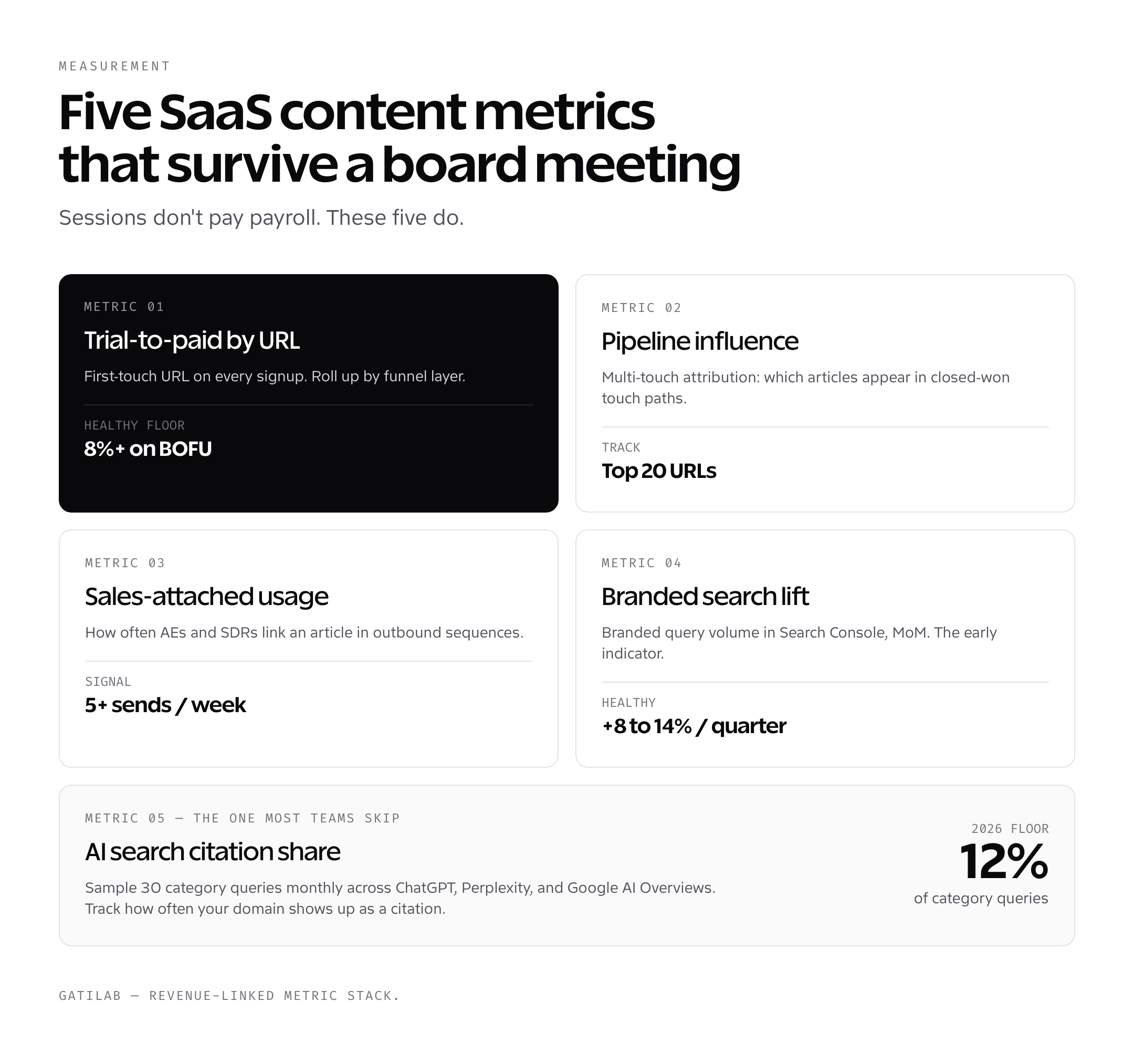
SaaS content marketing measurement is broken at most companies because the dashboard tracks vanity numbers. Sessions, time on page, and bounce rate tell you almost nothing about whether the content is working. Five metrics actually map to revenue:
- Trial-to-paid conversion by landing URL. Tag every signup with the first-touch URL. The page is good if the trials it sources convert at or above your site average.
- Pipeline influence. Multi-touch attribution showing which articles appear in the touch path of closed-won deals. Track the top 20.
- Sales-attached usage. How often AEs and SDRs link an article in outbound sequences. The articles your sales team actually uses are the articles that convert.
- Branded search lift. Branded search volume in Search Console month over month. In a healthy SaaS content program, branded search trends up quarter over quarter.
- Citation count in AI search. How often your domain shows up as a citation in ChatGPT, Perplexity, and Google AI Overviews for category queries. Sample 30 queries monthly with a tracking script.
Set a 90-day measurement floor before judging a page. SaaS BOFU pages typically take 60 to 120 days to reach their stable ranking and conversion rate. Killing a page at day 30 is the most expensive mistake in SaaS content marketing because the pages that pay back the most are the ones that took the longest to ramp.
Tooling: The Stack a Working SaaS Content Team Runs
The SaaS content marketing stack doesn’t have to be expensive. A $1M-ARR team can run the full pipeline on roughly $400 to $900 a month in tools. The pieces that matter:
- Keyword and competitive research. Ahrefs or Semrush for the page-level work. Add Keywords Everywhere for cheap on-page volume checks.
- Brief and outline. Surfer SEO or Frase for the first-pass brief. Hand-edit before the writer ever sees it.
- CMS and publishing. WordPress with the right blocks or Webflow if the team is design-led. Avoid headless without a real reason.
- Internal linking. Link Whisper, Ahrefs internal-link opportunities, or a manual quarterly audit. Internal linking is the cheapest ranking lever you have.
- Attribution and analytics. GA4 plus a server-side capture for first-touch URL. HubSpot or Pipedrive for pipeline mapping.
- AI search tracking. Profound, Otterly, or a custom 30-query monthly script that pulls citation data from ChatGPT, Perplexity, and Google.
The stack to avoid: anything that promises to “write SEO content automatically.” The pages those tools produce score well in their own dashboards and convert at near zero. Every SaaS team that has scaled a content program past $50M ARR runs human-edited content with AI as a research and outline tool, not a writing tool.
FAQs
The questions SaaS founders and marketing leads ask me most often when planning a content program from scratch.
How much does SaaS content marketing cost in 2026?
A working SaaS content marketing program runs $8K to $30K a month on the lean side and $40K to $120K on the agency-led side, including writing, editorial, design, and distribution. Most $1M-ARR SaaS brands hit profitability on content at $12K to $18K a month with 1 in-house editor plus 2 to 3 specialist writers.
What is the best ratio of BOFU to TOFU content for SaaS?
50/30/20 in year one: 50 percent BOFU (comparison, alternatives, vs, niche-best), 30 percent MOFU (use cases, integrations, product-led tutorials), 20 percent TOFU (frameworks, original research). Year two shifts toward 35/40/25 once BOFU is saturated. Many teams default to a TOFU-heavy 70/20/10 mix and miss pipeline targets.
How long until SaaS content drives pipeline?
BOFU pages typically take 60 to 120 days to reach stable ranking and trial conversion. Programmatic pages can rank within 30 to 60 days because long-tail competition is thinner. TOFU pieces take 6 to 14 months to compound. Set a 90-day measurement floor before judging any individual page.
Should SaaS teams do programmatic SEO?
Yes, but only with information gain per cell. Templated thin pages get hammered by Helpful Content updates. Each row in your data table needs at least one unique data point that no competitor’s table has, plus 80 to 200 words of cell-specific commentary. With those guardrails, programmatic plays convert far better than thin templates.
What is product-led content?
Product-led content is a tutorial, how-to, or walkthrough that requires a screenshot of your product to answer the question. The format converts to free signup far better than tutorials that never show the product. Ahrefs built its $100M+ ARR business mostly on this pattern.
How do I measure SaaS content marketing ROI?
Track five metrics: trial-to-paid conversion by landing URL, organic pipeline influence (multi-touch attribution), sales-attached usage, branded search lift, and AI search citation share. Sessions, time-on-page, and bounce rate tell you almost nothing about whether a SaaS content program is working.
Is AI-generated content viable for SaaS marketing?
As a writing tool, no. As a research and outlining tool, yes. Every SaaS team that has scaled content past $50M ARR runs human-edited content with AI as a research and brief assistant. Pages that are AI-written end-to-end score well in their own dashboards and convert at near zero.
What is the highest-converting SaaS content type?
Competitor alternatives pages. “[Competitor] alternatives” pages convert to trial at a much higher rate than pages targeting category head terms. The buyer is already shopping, the intent is decision-stage, and the content matches that decision exactly.
How many articles should a SaaS team publish per month?
For a team with one editor and two writers, a sustainable cadence is 8 to 14 pages a month: 4 to 6 BOFU, 4 to 6 MOFU, 1 to 2 TOFU. Volume beyond that without strict editorial standards drops conversion rates fast. Quality of editorial review is the bottleneck, not writer throughput.
What tools should a SaaS content team use?
The minimum stack: Ahrefs or Semrush for research, Surfer or Frase for briefs, WordPress or Webflow for CMS, Link Whisper for internal links, GA4 plus a server-side first-touch capture for attribution, Profound or Otterly for AI search citation tracking. Total run rate $400 to $900 a month for a small SaaS content team.
A Realistic First-Year SaaS Content Marketing Plan
If you’re starting a SaaS content marketing program from zero in 2026, the plan that works is dull and boring on purpose. Ship 12 BOFU pages in the first 90 days. Build the programmatic template by day 120 and roll out 60 pages in the next two quarters. Layer in product-led tutorials weekly. Save TOFU for quarter four when the brand is ready to carry it.
The teams that beat their pipeline targets aren’t the ones with the most clever content. They’re the ones that ship BOFU first, distribute every page deliberately, and measure on revenue per URL instead of sessions per month. SaaS content marketing isn’t blogging. It’s revenue engineering at the URL level.
If you’re earlier in the journey, start with the SaaS marketing strategy guide, then layer the content program on top. For the SEO craft, my SEO for startups piece covers the technical foundations.
Tell Google you want more of this.
Add Gatilab as a preferred sourceOne tap, and this site shows up more often in your own Top Stories, AI Overviews and AI Mode. Remove it any time.