
Content Repurposing: Turn One Article Into 10 Pieces
You published something good 6 months ago. It ranked for a week, pulled a few hundred visits, and now it sits in the archive doing nothing while you start the next one. Content repurposing is the fix everyone reaches for, and most of the advice about it is a list of formats with no way to decide which ones are worth your Tuesday.
Two failure modes show up over and over. One team repurposes nothing, treats every article as disposable, and pays full research cost on every new piece. The other repurposes everything, pushes the same argument onto 8 surfaces in the same week, and ends up with a calendar full of assets nobody asked for and no way to tell which ones earned anything.
Sort the formats by what they cost to produce, and most of the decision makes itself.
Content repurposing buys distribution, not ideas
The expensive part of an article is the thinking. Choosing the argument, checking the numbers, deciding what to cut, working out which objection has to be answered before the reader will keep going. That cost is already paid and it does not come back. What remains is production cost, and production cost varies enormously by format: a quote graphic and a 12-minute video draw on the same research and differ by roughly two orders of magnitude in effort.
So the honest framing is narrow. Repurposing is a production problem sitting on top of solved research, and the only real question is which productions are worth starting.
Some of the original work carries across formats cleanly:
- The argument itself, and the order you made it in
- Verified numbers, dates, prices, and named sources
- Examples and counterexamples that survived the first edit
- The objections you already answered, which most short formats skip entirely
Other things do not survive the move at all:
- Pacing. A paragraph that reads in 8 seconds takes 40 seconds to say out loud and does not fit a short clip.
- Scanning. Readers skip headings they do not need; listeners cannot skim audio without losing the thread.
- Links. Most feeds and every audio surface bury or strip them, so any version whose payoff is a link has no payoff.
- Intent. A reader arrived from a query and wanted this. A viewer arrived from a feed and owes you nothing.
Every format below is a bet that its production cost is smaller than the reach it opens. Price it accordingly.
Only repurpose what already earned attention
Thin sources make thin derivatives, and no format fixes that. A 600-word post has 1 idea in it, so a thread, a graphic, and a video built from it are 3 copies of the same sentence. Pick the source before you pick the formats, and use these tests:
- It performed on its own. Proven demand beats a hunch about demand, and the piece you enjoyed writing is rarely the piece that worked.
- It has parts. A guide with 6 or 7 sections that each stand alone gives you 6 or 7 derivatives. A single-argument post gives you 1.
- It carries specifics: numbers with sources, named tools, worked examples, a decision rule. Graphics, slides, and clips are made of specifics, not of transitions.
- The topic holds for at least a year. Anything pinned to a feature release or a policy change expires before the video is edited.
- The structure is clean. Clear H2s become chapters, slides, and standalone posts without a rewrite.
Build the shortlist from whatever you already use to judge performance rather than from memory. If you do not have that view yet, measuring content marketing ROI without fooling yourself is the prerequisite, because a content repurposing program aimed at the wrong 5 articles is just a more elaborate way to waste a quarter.
Order the formats by what they cost to produce
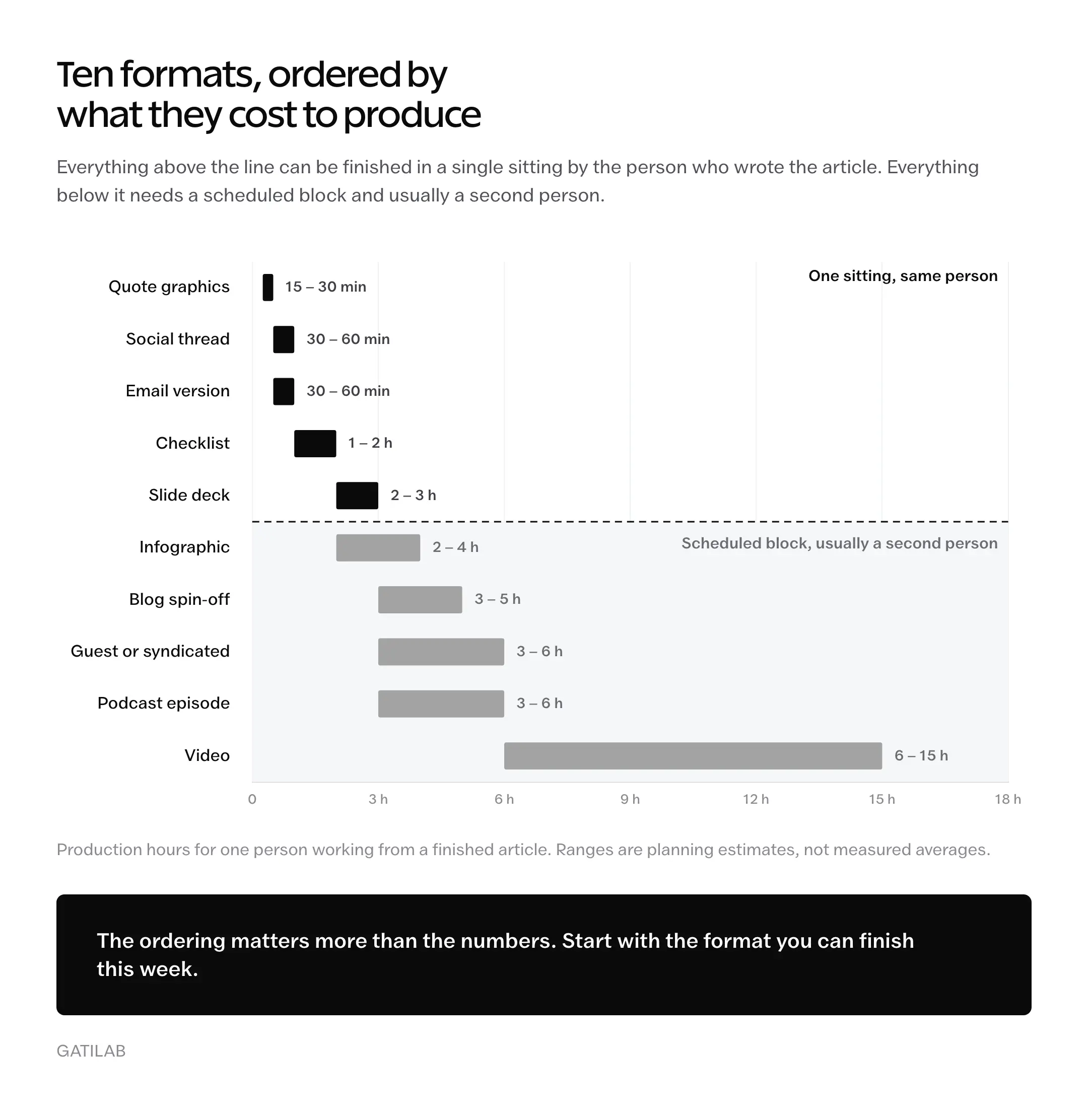
Here are the 10 formats a well-built article can support, sorted cheapest first. The hours are planning estimates for 1 person working from a finished article, not measured averages. Use them to decide the order, not to build a budget.
| Format | Rough production time | What it reaches that the article does not |
|---|---|---|
| Quote graphics | 15 to 30 min for a batch of 5 | Feed surfaces on the days you publish nothing |
| Social thread | 30 to 60 min | People who follow accounts, not sites |
| Email version | 30 to 60 min | Your list, which never sees your archive |
| Checklist or cheat sheet | 1 to 2 hours | Readers who want the actions without the argument |
| Slide deck | 2 to 3 hours | Webinar, training, and client-education audiences |
| Infographic | 2 to 4 hours | Embeds, saves, and link-earning surfaces |
| Blog spin-off | 3 to 5 hours each | Queries the pillar page cannot rank for |
| Guest or syndicated version | 3 to 6 hours | Another site’s existing readership |
| Podcast episode | 3 to 6 hours | Commute and gym time, where reading is impossible |
| Video | 6 to 15 hours | Feed and search surfaces on YouTube and TikTok |
The ordering matters more than the numbers. Everything in the top half can be finished in a single sitting by the person who wrote the article. Everything in the bottom half needs a scheduled block, usually a second person, and a reason.
Quote graphics
These are inventory, not campaigns. One solid article usually yields 4 or 5 lines that stand up without setup, and a batch of graphics fills the gaps between real posts for a month. The failure is choosing lines that sound good but assert nothing, which produces a fortune cookie with a logo on it. Pull claims, not moods.
Social threads
Rebuild the argument for a scroll instead of summarizing it. The first post has to hold on its own, because most people who see it will never see the second. Cut the article’s setup entirely and open on the finding, then close on a specific next action rather than a bare link. A thread that exists only to move clicks reads exactly like what it is.
Email newsletter version
Your list is the one audience that has already agreed to hear from you, so send them something the public version does not carry: the caveat you cut for length, the counterexample that did not fit, the reason a competing recommendation is wrong. A newsletter that is a summary plus a link trains subscribers to stop opening, and open rates recover slowly once they slide.
Checklists and cheat sheets
Strip the reasoning, keep the actions, and put them in the order someone would actually perform them. One page. If it runs to two, you have written a guide again, and the reader who wanted a checklist will not print it. This is also the format that works hardest as a signup incentive, because the value is legible before the download.
Slide decks
One claim per slide, with the evidence as the visual rather than as bullets under a title. A deck built from an article’s H2 spine serves as a webinar, a client explainer, and internal training with no further edits. The common mistake is pasting paragraphs onto slides and reading them aloud, which is slower and less useful than letting people read the article.
Infographics
Worth the hours only when the article has something genuinely visual: a process with a fixed order, a comparison across 3 or more options, or numbers that mean more side by side than in sequence. Prose with no underlying shape becomes a tall poster nobody finishes. Put the source URL inside the image, since it will be reposted without your caption.
Blog spin-offs
Any H2 with its own search demand can become a standalone post, and the internal links between the pillar and its spin-offs usually do more for the pillar than another round of promotion. Check first that the spin-off targets a query the pillar is not already ranking for, or the two pages will compete and both will lose ground. This is where repurposing turns into a content cluster strategy that builds topical authority rather than a pile of loosely related posts.
Guest and syndicated versions
Rewrite the angle for the host’s audience rather than shipping the same piece under a new headline. Editors reject near-duplicates on sight, and the readers who follow both outlets notice immediately. The version that gets accepted usually shares the research and almost none of the sentences.
Podcast episodes
Audio rewards exactly the material an article cuts: the tangent, the disagreement, the history behind a number. Reading the article aloud produces something worse than the article, because written sentences are built for eyes that can go back a line. A long guide splits cleanly into a 4 or 5 episode series, one section per episode, which also gives you a reason to publish on a schedule.
Video
The most expensive format on the list, and the only one with its own search engine attached, which is why it survives the cost test at all. YouTube raised the Shorts ceiling to 3 minutes in October 2024, so a single point from the article no longer has to be compressed into 60 seconds. For anything procedural, a screen recording with narration beats a talking head and takes a fraction of the setup.
Space the work so demand can stop you early
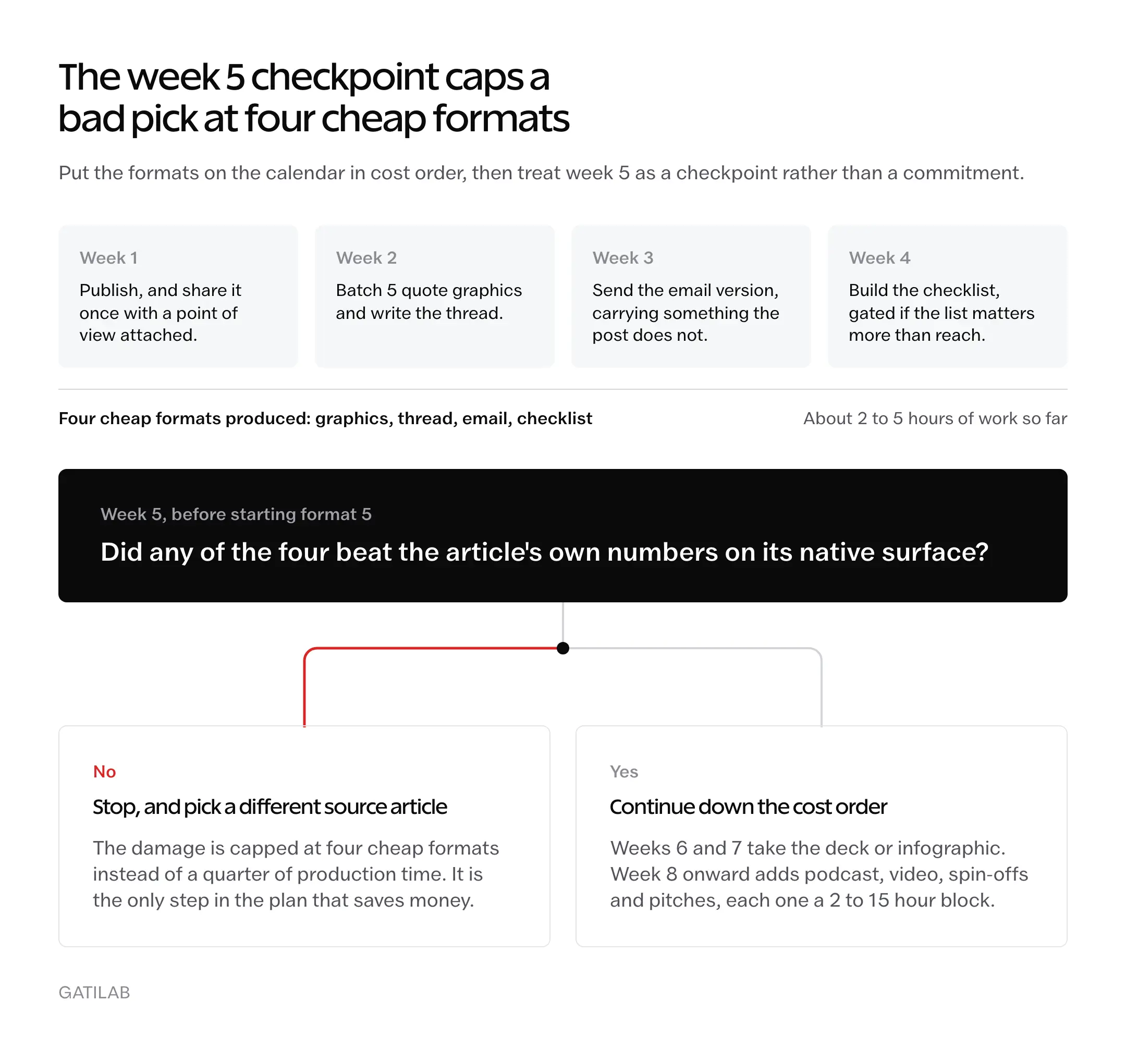
Put the formats on a calendar in cost order and treat each one as a checkpoint rather than a commitment. Spreading the work also keeps a single article generating something for 2 months instead of exhausting it in a week.
- Week 1. Publish. Share it once with an actual point of view attached, not a restated headline.
- Week 2. Batch 5 quote graphics and schedule them across the next 6 weeks. Write the thread.
- Week 3. Send the email version, with something in it the public post does not have.
- Week 4. Build the checklist. Gate it if growing the list matters more than reach this quarter.
- Week 5. Read the numbers and decide whether to continue.
- Weeks 6 and 7. Slide deck or infographic, whichever the material genuinely supports.
- Week 8 onward. Podcast, video, spin-offs, and outside pitches, in that order.
Week 5 is the step most content repurposing plans leave out, and it is the only one that saves money. Make it a written rule:
Before starting format 5, check what formats 1 through 4 returned. If none of them outperformed the article’s own numbers on their native surface, stop and choose a different source article.
That single rule caps the damage from a bad pick at 4 cheap formats instead of a quarter of production time. Cheapest first.
The scheduling itself belongs in whatever calendar already governs your posting, not in a separate repurposing tracker that nobody opens. If you do not have one, a one-page social media content plan is enough structure to hold this.
Google deduplicates rather than punishes
The duplicate content worry stops most people before they start, and for the majority of these formats it does not apply. A video, an audio file, a slide deck, and an article are different documents by every measure a search engine uses. The question only becomes real when the same words appear as indexable text on 2 or more URLs, which happens with syndication, guest reprints, and republishing to Medium or LinkedIn.
Even then, the documented mechanism is selection, not punishment. Google’s documentation on canonicalization describes the process as deduplication: when Google finds a set of pages it considers duplicates, it picks one representative URL and shows only that version in results.
So the exposure is not a penalty. It is that the version Google picks may be the copy on a bigger domain, and yours quietly stops appearing.
Three things reduce that risk when you republish text:
- Ask the host for a canonical tag pointing at your URL, or a noindex on their copy. Most publications will agree if you ask before signing.
- Publish on your own domain first and give it time to be crawled before the copy goes live.
- Change the angle enough that the two pieces are not the same document, which also makes the reprint worth reading.
AI handles the reformatting. You still pick what matters.
Text models turn an article into a thread, an outline, or a script draft in seconds, and clipping tools cut a long recording into vertical segments without anyone scrubbing a timeline. That work is mechanical and handing it over is a straightforward win, especially for the top half of the cost table where the whole job is reformatting.
Selection is the part that does not hand over. Which of the article’s 7 claims matters to a LinkedIn audience and which matters to a podcast audience, which caveat has to survive compression, which number is load-bearing and which was only scene-setting: that is editorial judgment, and a model guessing at it produces output that is fluent and wrong in ways only you will catch. Draft, then decide.
One caution on the numbers you will see quoted. Claims that AI cuts repurposing time by 70% or 90% circulate widely in marketing writing and trace back to vendor surveys and self-reported estimates rather than measured work. Time your own before and after if the figure is going to justify a budget.
What to measure, and what you cannot
Measure per format, against the hours in the table above, or the exercise tells you nothing about what to repeat. A podcast reaching 5,000 people for 5 hours of work and an infographic reaching 500 for 3 are not the same trade, and averaging them hides that.
- Reach per format, divided by production hours. This is the number that decides next quarter’s order.
- Assisted conversions rather than last click, since repurposed pieces mostly sit early in a path.
- Signups from gated formats, which is the only clean, unambiguous number in the set.
- Return traffic to the source article, tagged by format so threads and newsletters are distinguishable.
That last one requires discipline at link-creation time, not at reporting time. Deciding to tag every repurposed link with UTM parameters before the first graphic goes out is the difference between a readable report and 8 weeks of direct traffic you cannot explain.
Some of it stays unmeasurable. Nobody can tell you which of 30 quote graphics moved someone to hire you, and pretending otherwise produces confident dashboards built on guesses.
What repurposing will not fix
It cannot create demand that was never there. If the original article underperformed because almost nobody wants the topic, 10 formats produce 10 pieces almost nobody wants. Formats change the surface, not the interest behind it, and the cost of learning that lesson in video is much higher than learning it in a thread.
It cannot rescue a weak argument. Compression makes thin reasoning more visible, not less. A 60-second clip has room for exactly 1 claim, and if the claim does not hold, there is nothing else on screen to distract from it.
It cannot build an audience you do not have yet. Every format in the table assumes a distribution surface already exists, and a podcast with no listeners costs the same 5 hours as a podcast with 5,000. Building the surface is a separate project on a separate timeline, and repurposing into an empty room is the most common way this work turns into busywork.
It cannot keep itself current. When a price, a version, or a policy in the source article changes, every derivative is wrong too, and most of them live on platforms where editing is awkward or impossible. Someone has to own the list of what exists and where. That is a standing job, which is why this work belongs inside a content operations system rather than in a person’s head.
What quietly ruins a repurposing program
Publishing everything in the same week. It feels efficient and it looks like flooding to the handful of people who follow you on 3 platforms at once, who are also the people most likely to buy something.
Pasting the article into LinkedIn or Medium unchanged. Sentences that worked under a headline and a table of contents read as an unformatted wall inside a feed, and the lack of effort is the first thing anyone notices.
Repurposing on schedule instead of on merit. Once it becomes a fixed step in the publishing checklist, weak articles get 10 formats because the checklist said so, and the calendar fills with derivatives of things that never worked in the first place.
Skipping the source update. Turning a 2-year-old post into a video without rechecking its numbers puts a stale figure onto a surface you cannot quietly edit later, and corrections on video reach a fraction of the original audience.
Treating every derivative as an ad for the article. A thread whose only job is to send clicks gives the reader nothing on its own and gets distributed accordingly. Each piece has to be worth its 40 seconds whether or not anyone clicks through.
The archive is your inventory
Most teams behave as though the work ends at publish, so the archive fills with finished pieces treated as spent. They are not spent. They are the only material you own that has already been researched, argued, checked, and proven against a real audience, and putting them in front of new people costs production time alone.
The trade is honest and worth saying plainly: repurposing multiplies distribution and does nothing at all for quality. A strong article in 10 formats is 10 useful things. A mediocre one in 10 formats is 10 reminders that it was mediocre.
Pick the piece that already worked, and start with the format you can finish this week.
Tell Google you want more of this.
Add Gatilab as a preferred sourceOne tap, and this site shows up more often in your own Top Stories, AI Overviews and AI Mode. Remove it any time.