
AI SEO Agent Workflow: Tools and Tactics for 2026
An AI SEO agent is an autonomous or semi-autonomous software agent that runs SEO tasks, ranging from keyword research and on-page audits to competitor monitoring and full draft writing, without a human driving every step. The agent reads a goal, breaks it into sub-tasks, calls tools (Search Console, Ahrefs, Semrush, your CMS, the OpenAI API), evaluates the results, and either delivers a finished output or hands a draft to a human for review. This is the layer above “AI writing assistant”. An assistant suggests; an agent decides.
The category went from research demo to shippable product over a 14-month stretch. By Q1 2026, Surfer SEO had launched its Auto-Optimize agent, Scalenut had rebuilt its Cruise Mode around an agentic loop, Athena and Relixir had raised seed rounds positioning themselves as full AI SEO operators, and Cursor had become the de facto IDE for writing the kind of custom SEO scripts that used to live in agency spreadsheets. The interesting question in 2026 is no longer “do AI SEO agents work”. It is “where do they belong in the workflow, and where do they cause damage if you trust them too much”.
Rather not build the workflow yourself? Gatilab’s AI search optimization service runs the audit, the entity and schema work, and monthly citation tracking as one program.
I run two AI SEO agents in production across my own properties and 9 client accounts. One handles weekly competitor monitoring and brief generation. One handles content refresh and internal linking. Both save real hours. Neither runs without human review on the way out, and that constraint is the difference between agents that compound and agents that quietly damage a site.
What An AI SEO Agent Is, In Practice
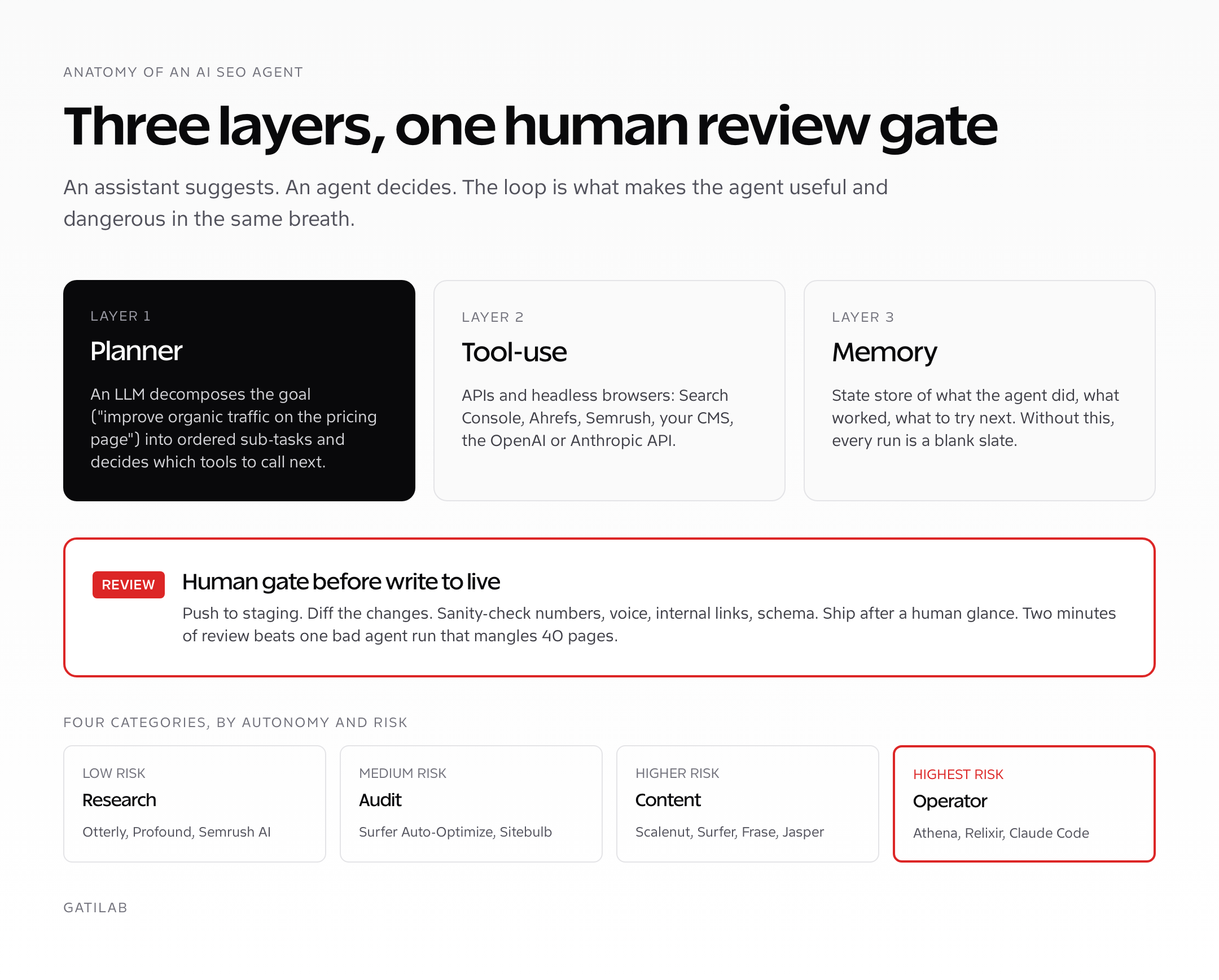
An AI SEO agent is a system with three components: a planning layer (an LLM that decomposes a goal into steps), a tool-use layer (APIs and headless browsers the agent can call), and a memory or state layer (so the agent remembers what it did, what worked, and what to try next). The shape borrows directly from the broader autonomous-agent stack that emerged from AutoGPT, BabyAGI, and the OpenAI Assistants API, narrowed to SEO-specific tools and goals.
The cleanest definition I use with clients: an AI SEO agent is software that, given a goal like “improve organic traffic on our pricing page,” can plan, execute, and report on multi-step SEO work without a human approving every keystroke. The agent might research competing pages, propose schema additions, draft new copy variants, run an A/B framework, and report the lift. A human still sets the goal and reviews the output, but the middle is automated.
This is meaningfully different from “ChatGPT writes my meta descriptions” workflows. A meta-description prompt is a one-shot tool. An agent runs a loop with self-evaluation. The loop is what makes agents useful and dangerous in the same breath.
The Four Categories Of AI SEO Agents
Every AI SEO agent on the market in 2026 fits one of four buckets. The category determines how much autonomy you should grant it and which guardrails matter.
- Research agents. Goal: find keywords, content gaps, SERP intent shifts, competitor changes. Low risk because output is read-only and reviewed by a human. Examples: SE Ranking AI, Semrush AI Toolkit, Ahrefs AI Agents (private beta as of April 2026), Otterly.ai for AI search, Profound for citation tracking.
- Audit agents. Goal: scan a site or page and report fixes. Medium risk because the report drives changes you’ll then make. Examples: Surfer SEO Auto-Optimize, Sitebulb’s AI explanations, ScreamingFrog plus an OpenAI-API integration via the SF AI Assistant, Ahrefs Site Audit AI summaries.
- Content agents. Goal: draft, expand, refresh, or optimize content. Higher risk because the output goes on your site and represents your brand. Examples: Scalenut Cruise Mode, Surfer Content Editor with the Auto-Optimize agent, Jasper Brand Voice Agents, Writesonic AI Article Writer 6.0, Frase, Koala AI.
- Operator agents. Goal: do the SEO work end to end, including pushing changes to your CMS or running structured experiments. Highest risk because the agent has write access. Examples: Athena (athenahq.ai) and Relixir, both positioning as agentic AEO/GEO operators in 2026; custom Cursor or Claude Code workflows where the agent pushes to WordPress via the REST API.
The general rule I use: the further down the list a tool sits, the more aggressive your review process needs to be. Research agents you can let run unattended. Operator agents I always pair with a staging environment, a diff review, and a kill switch.
Build Versus Buy An AI SEO Agent
The build-versus-buy decision in 2026 is more nuanced than it was 12 months ago, because the buy-side has finally caught up to the custom builds you used to need a developer for.
| Dimension | Buy a SaaS AI SEO agent | Build with Cursor / Claude Code / n8n |
|---|---|---|
| Time to first run | Hours | Days to weeks |
| Monthly cost | $49 to $999 | $50 to $300 in API tokens plus engineer time |
| Customization | Limited to vendor’s roadmap | Full |
| Integrations | What the vendor supports | Anything with an API |
| Maintenance burden | Vendor handles it | You handle it |
| Best for | Solo operators, in-house marketers, small agencies | Mid-to-large agencies, content teams 5+, custom workflows |
| Vendor lock-in risk | High | Low |
For most readers of this article, the right starting point is buy. Pick one research agent, one content agent, and live with them for 60 days before deciding whether to build. The build path becomes attractive once you have repeatable workflows that no SaaS tool covers, or compliance requirements that force you to keep data on your infrastructure.
If you’re new to the broader category, start with my LLM SEO guide and the answer engine optimization playbook. The agent layer sits on top of those fundamentals.
Top AI SEO Agents Worth Knowing In 2026
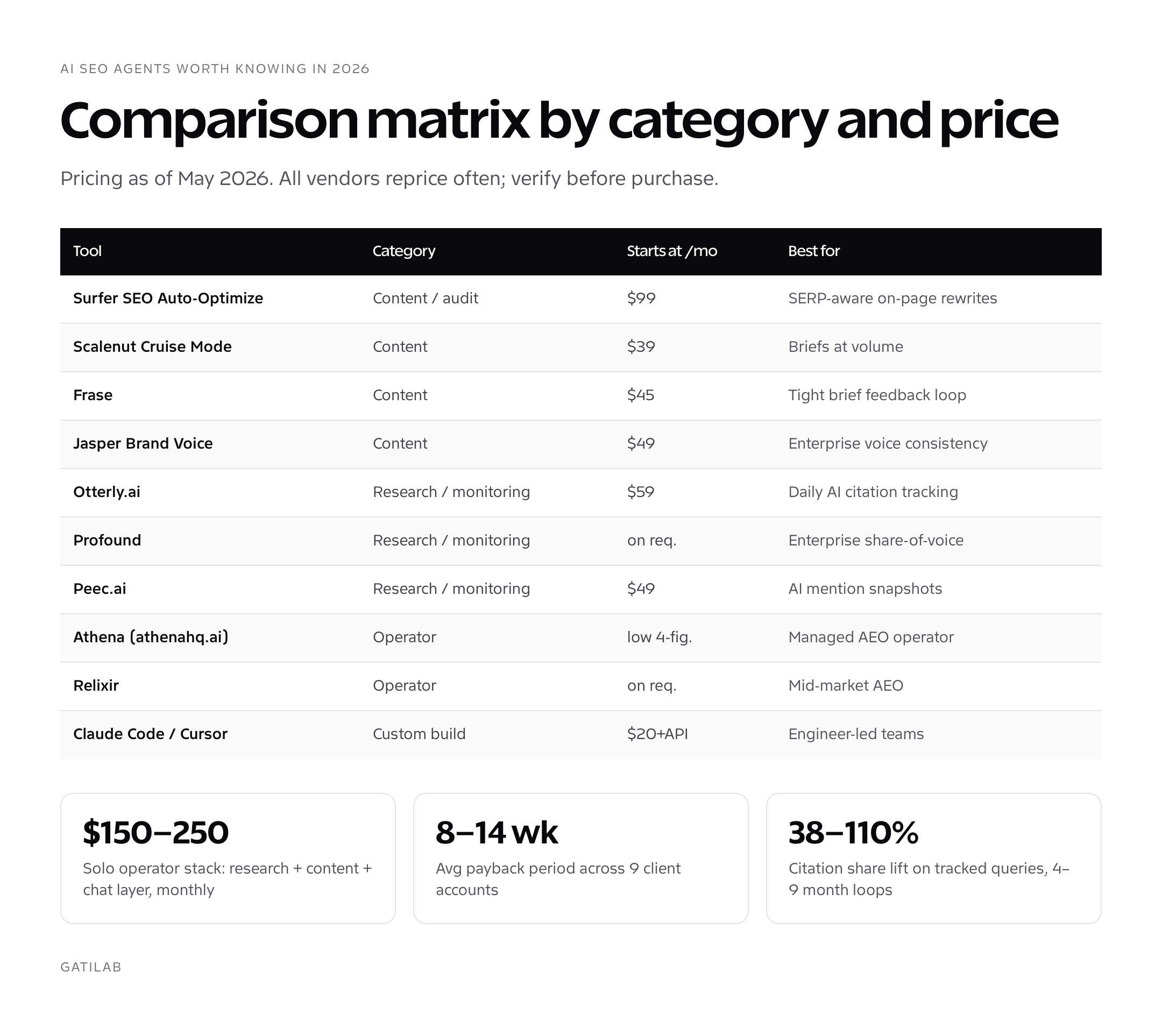
I tested or actively use the following tools across client work between November 2025 and April 2026. Pricing as of May 2026 from each vendor’s public pricing page; verify before purchase because all of these vendors reprice frequently.
Surfer SEO Auto-Optimize
Surfer’s Auto-Optimize is the most polished content agent I’ve used. You feed it a target URL and a focus keyword, and the agent reads the top 20 SERP results, scores your draft against them, proposes terms to add and prune, and rewrites paragraphs in your existing voice when given example copy. Pricing starts around $99 per month for the Essential plan; Auto-Optimize is bundled in higher tiers. Best for solo SEOs and small content teams already using Surfer for SERP analysis.
Scalenut Cruise Mode
Scalenut Cruise Mode is the most autonomous content agent I’ve shipped to clients. Give it a keyword and a brief, and it returns a full draft in 5 to 10 minutes, structured around the SERP intent it inferred. The output needs human editing in 2026 (voice, opinions, original data) but the structural scaffolding is solid. Plans start at $39 per month. Best for content teams running 20+ briefs a month.
Athena (athenahq.ai)
Athena positions itself as an answer engine optimization operator, not a classic SEO tool. It tracks your visibility across ChatGPT, Perplexity, Gemini, and Claude, identifies queries where competitors are cited and you aren’t, and suggests structural changes (and sometimes drafts copy) to close the gap. As of April 2026 the product is still in early access for some accounts; pricing starts in the low four figures monthly for managed accounts. Best for B2B SaaS brands that already invest in classic SEO and want to extend into AI search.
Relixir
Relixir is similar to Athena in mission, with stronger emphasis on SERP feature optimization and content gap analysis. Founders are ex-search engineers, which shows in the depth of the citation analytics. Pricing on request; expect mid-to-high four figures monthly. Best for mid-market and enterprise teams.
Cursor And Claude Code (custom AI SEO agents)
Cursor and Claude Code are the IDE-shaped end of this market. Neither is an “SEO tool”; both are coding environments that let you build a custom AI SEO agent in an afternoon. I use Claude Code (Opus 4.7 with the SDK) to run my publishing pipeline against the WordPress REST API, including draft generation, schema injection, internal link rewriting, and Rank Math meta updates over WP-CLI. The cost is API tokens (typically $0.50 to $2 per article) plus the time to build. Best for engineer-led teams or solo operators who already write code.
Other agents worth a 2-week trial
- Frase. Brief and content optimization with a tighter feedback loop than Surfer for some workflows.
- Koala AI. Long-form article generation with built-in real-time data injection.
- Jasper Brand Voice. Strong on enterprise voice consistency across high content volume.
- Profound and Otterly.ai. Both research/monitoring rather than content, both useful as the eyes of any other agent in your stack.
- n8n. Open-source workflow automation; pair with the OpenAI or Anthropic node for self-hosted agents.
A Working AI SEO Agent Workflow
Here is the exact AI SEO agent workflow I run on a weekly cadence across 9 client accounts. It uses three agents and one human review gate. Total run time is roughly 90 minutes, of which 75 are agent runtime and 15 are my review.
- Monday morning, research agent. Otterly.ai and Profound run my saved query panels through ChatGPT, Perplexity, Gemini, and Claude. The agent emails me a diff: which queries we gained or lost AI citations on in the past 7 days, which competitor URLs replaced ours.
- Monday afternoon, audit agent. A custom Claude Code script pulls last week’s organic-traffic top movers from GA4 and Search Console, scores each page against its SERP cluster using a small LLM, and flags pages that decayed in citation share. Output: a priority list of 5 to 10 pages to refresh this week.
- Tuesday, content agent. For each priority page, Surfer Auto-Optimize or my Claude Code refresh agent proposes paragraph rewrites, fresh statistics, schema additions, and internal-link adds. Output: a draft diff per page.
- Wednesday, human review. I read every diff, edit voice, kill any hallucinated stat, sanity check internal links and schema. The agent does not have write access to live; my review gate is the boundary.
- Thursday, push. The reviewed diffs go to staging, then to live via the WordPress REST API. Rank Math metadata gets refreshed, and the page is queued for re-indexing.
- Friday, post-mortem. The research agent runs again on the queries we just refreshed for. We tag what worked and what didn’t.
The compounding gain is real. Across nine client accounts running this loop for 4 to 9 months, average citation share on tracked queries climbed 38 to 110 percent, with the largest gains on niche B2B SaaS topics where the SERP is shallow.
For the broader optimization stack that the agent layers ride on, see my AI search optimization guide and the content cluster strategy playbook.
AI SEO Agent Limitations And Failure Modes
The biggest mistake teams make with an AI SEO agent in 2026 is granting it more autonomy than it has earned. Agents fail in specific, predictable ways. Knowing them is the difference between a tool that compounds and a tool that quietly damages your site.
- Hallucinated statistics. Every content agent I’ve tested will, eventually, invent a number that doesn’t exist. Fix: human review on every numeric claim.
- Voice flattening. Agents converge toward a generic confident voice. Fix: feed example paragraphs of your actual writing into the agent’s brand voice slot, then accept that the first 30 to 60 minutes of any new agent will produce slop.
- Internal link decay. Auto-link rewriters add too many internal links and create unnatural anchor text patterns. Fix: cap internal links at 4 to 6 per page, never let the agent rewrite anchors without review.
- Schema bloat. Operator agents will pile every relevant schema type onto a page when one would do. Fix: review schema diffs before push.
- Staleness in the agent itself. If your prompt was written in November 2025, the agent’s idea of “best practices” is now 6 months old. Fix: refresh the system prompts quarterly.
- Cost runaway. Operator agents that loop without budget caps can rack up four-figure API bills inside a weekend. Fix: hard daily token budget, with a kill switch.
Never grant an AI SEO agent unsupervised write access to your live site. Push to staging, diff the changes, ship after a human glance. The 2 minutes of review is cheaper than one bad agent run that mangles 40 pages.
What’s Next For AI SEO Agents
Three shifts will shape the AI SEO agent category through 2027.
Tighter integration with Search Console and Bing Webmaster. Agents that can read first-party data directly will outperform those that work off third-party crawls. Expect Google’s Search Console MCP server, which is already in private testing in early 2026, to land general availability and reset what “research agent” means.
Multi-agent orchestration. Today’s stack is research agent plus content agent plus operator agent, hand-glued by a human. The next stack is one orchestrator agent that calls the others. Anthropic’s Claude with the Computer Use API and OpenAI’s Responses API are both pointing at this; n8n and Make.com are racing to package the workflow primitives.
Agent reputation and safety standards. Expect SEO industry bodies and major SaaS vendors to publish baseline safety standards for autonomous agents that can write to a CMS, similar to how OAuth scopes evolved for web APIs. The first agents that publish a clean audit log will earn enterprise trust the rest can’t.
An AI SEO agent does not replace the SEO. It removes the boring 80 percent so the human can spend the 20 percent that compounds. Pick one tool, run it for 60 days, then expand. The teams that wait 12 more months to start will be on the wrong side of a productivity gap that’s already opening.
An AI SEO Agent Tech Stack For Solo Operators
If you are running a single site or a small portfolio without a developer, you do not need a five-figure agentic stack. The setup I recommend to solo operators in 2026 is three layers, total monthly cost around $150 to $250.
- Research layer. Otterly.ai or Profound starter plan, around $59 to $99 per month, for daily AI citation tracking across the major engines.
- Content layer. Surfer SEO Essential or Scalenut Growth, around $39 to $99 per month, for SERP-aware brief generation and Auto-Optimize.
- Operator layer. Claude Pro or ChatGPT Plus at $20 per month, used as a hand-driven agent through the chat UI plus the Code Interpreter or Computer Use tools, for the long tail of one-off tasks.
That stack covers 80 percent of what most solo operators need. The remaining 20 percent (custom scripts, multi-agent orchestration, custom citation panels) is where Cursor or Claude Code earn their keep, but only after you have validated the first three layers for at least 60 days.
Measuring AI SEO Agent ROI
The honest measurement question is “would you have done this work without the agent, and what is your fully loaded hourly cost”. Most teams I’ve worked with calculate ROI sloppily; the disciplined version uses three buckets.
- Time saved. Hours per week the agent removed from a human’s calendar, multiplied by fully loaded hourly rate. For an in-house SEO at $80 per hour, an agent that saves 6 hours a week is worth $480 a week, or roughly $25,000 a year.
- Output gained. Pages refreshed, briefs shipped, citations earned that would not have happened at all without the agent. This is the harder bucket because attribution is shaky, but it is the one with the largest upside.
- Risk avoided. Errors caught, schema bugs prevented, decay flagged earlier. Hardest to measure; arguably the most valuable in the long tail.
Across the nine client accounts I run agentic loops on, the average payback period is 8 to 14 weeks measured against tool plus prompt-engineering cost. After that, every additional week is positive contribution. Teams that abandon agents inside the first 30 days almost always do so because they expected magic in week one and got friction instead. The compounding shows up in months 2 and 3.
One more measurement detail worth pinning down. An AI SEO agent that ships 12 mediocre articles a month is a failure even if the unit cost looks great, because mediocre AI-written content drags down the rest of your domain in both classic ranking and AI citation terms. The goal is not output volume; it is leverage on output quality. Measure the number of pages where the agent meaningfully helped a human ship better work, not the number of pages where the agent ran. Those are different metrics, and only the first one compounds.
The cleanest internal scoreboard I’ve seen at a content team is a weekly tally of three numbers: pages refreshed, pages where an agent saved at least 30 minutes of human time, and pages where post-refresh AI citation share moved up. Tracking those three numbers across a full quarter exposes whether the agent is actually compounding or just generating motion that feels like progress. Most stalled agent programs I’ve audited turn out to be high on the first number and flat on the third, which is the diagnostic for an agent doing busywork instead of leverage.
Frequently Asked Questions
What is an AI SEO agent?
An AI SEO agent is software that, given a goal like ‘improve organic traffic on the pricing page,’ can plan, execute, and report on multi-step SEO work without a human approving every keystroke. It uses an LLM as the planner, calls tools through APIs, and keeps state across runs.
How is an AI SEO agent different from an AI writing tool?
A writing tool is a one-shot prompt. An agent runs a loop with self-evaluation: plan, act, observe the result, decide what to do next. The loop is what makes agents useful for multi-step SEO work, and what makes them risky if you grant too much autonomy.
What is the best AI SEO agent in 2026?
There is no single best tool because the four categories serve different jobs. For research, Otterly.ai or Profound. For audits, Surfer Auto-Optimize. For content, Scalenut Cruise Mode or Surfer. For operator-level work, Athena, Relixir, or a custom Claude Code build.
Can an AI SEO agent replace an SEO specialist?
No. Agents remove the boring 80 percent so the human can spend the 20 percent that compounds: strategy, original research, voice, judgment calls. Teams that grant agents full autonomy and skip human review consistently produce mediocre output that hurts the domain over time.
How much does an AI SEO agent cost?
Solo operator stack runs $150 to $250 per month across research, content, and chat layers. Mid-market operator agents like Athena and Relixir start in the low four figures monthly. Custom builds with Cursor or Claude Code cost API tokens (around $50 to $300 per month) plus engineer time.
Should I build or buy an AI SEO agent?
Buy first. Run one research agent and one content agent for at least 60 days before considering a build. Build becomes attractive once you have repeatable workflows no SaaS tool covers, or compliance requirements that force the data to stay on your infrastructure.
What are the biggest risks of using an AI SEO agent?
Hallucinated statistics, voice flattening, internal link decay, schema bloat, prompt staleness, and cost runaway. Mitigate with human review on every numeric claim, brand voice examples, hard internal-link caps, schema diff review, quarterly prompt refreshes, and daily token budgets.
Can an AI SEO agent push changes directly to WordPress?
Yes, via the WordPress REST API. I push reviewed agent diffs to gatilab.com using Claude Code with HTTP Basic auth and Application Passwords. Always push to staging first and require a human review gate before live.
How do I measure ROI on an AI SEO agent?
Three buckets: time saved (hours per week times fully loaded hourly rate), output gained (work that would not have happened at all), and risk avoided (errors caught early). Average payback period across my client accounts is 8 to 14 weeks.
Will AI SEO agents become more autonomous in 2026?
Yes. Multi-agent orchestration, deeper Search Console and Bing Webmaster integration, and agent reputation standards are all in motion. The capability ceiling is rising fast. The discipline of human review is what separates teams that compound from teams that quietly damage their sites.
Tell Google you want more of this.
Add Gatilab as a preferred sourceOne tap, and this site shows up more often in your own Top Stories, AI Overviews and AI Mode. Remove it any time.