
White Label SEO: How It Works and How to Choose a Provider
White label SEO lets an agency sell SEO under its own name while a specialist provider does the work behind the scenes, and it is a common way to add SEO to what you offer without hiring a team first. So if you run an agency and are weighing a white label partner, or you already use one and something feels off, this guide will help you set it up well.
At Gatilab we deliver white label WordPress development for other agencies, so the arrangement is familiar from the provider’s side.
Every agency has its own clients and margins, so one guide can’t hand you the right provider. But most white label problems start in two places, a provider whose methods you can’t see and a contract that doesn’t protect your client, and I will cover both properly here.
I have also put together a white label SEO partner scorecard, free in PDF and Word, with the questions to ask and a margin worksheet. If the WordPress side of client work is the gap, we can help with that directly. Here is how the arrangement works first.
How White Label SEO Works
White label SEO has three parties, and each one has a clear job:
- The client pays your agency, sees only your brand and keeps ownership of the website and the Google accounts.
- Your agency sells and prices the service, owns the relationship and checks the work before the client sees it.
- The provider does the SEO work, sends reports that carry your brand and never contacts the client.
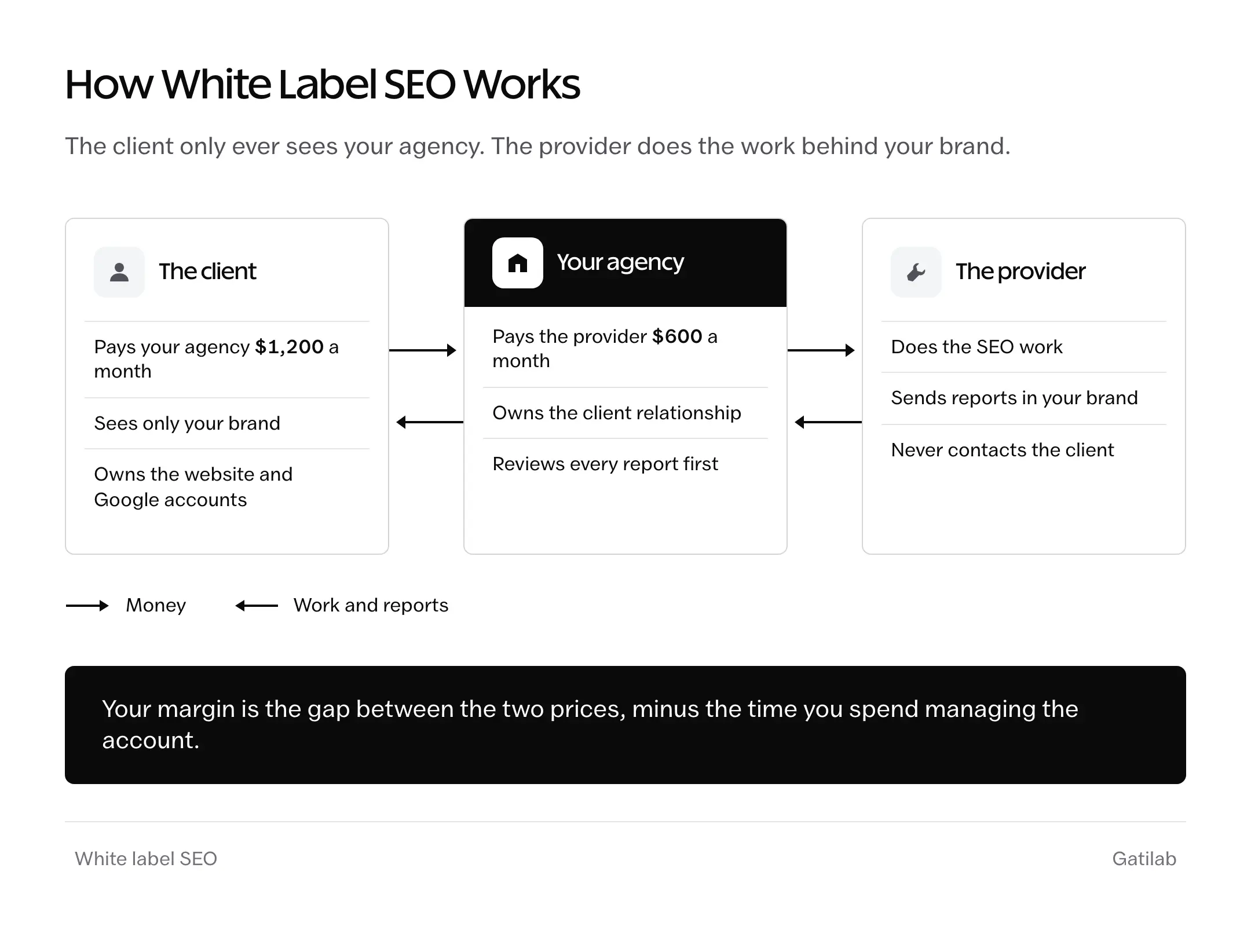
The money moves one way and the work moves the other. Your margin is the gap between the provider’s price and yours, less the time you spend managing the account.
You will also see it called an SEO reseller program or private label SEO, and in practice these describe the same arrangement.
What White Label SEO Services Include
Most providers build their packages from the same parts:
- technical audits and fixes
- keyword research and on-page optimization
- content writing
- link building
- local SEO, including Google Business Profile work and citations
- monthly reports in your agency’s brand
Quality varies a lot between providers, and link building and content are where it varies most, so those two deserve the closest look. Our guide to white label link building covers the link side in depth.
When White Label SEO Makes Sense
White label SEO makes sense when:
- clients keep asking for SEO and there isn’t enough of it yet to hire a specialist
- you want to test demand before building a team
- you need a skill your team doesn’t have, like link building or local SEO across many locations
It is a poor fit when SEO is your main product, since your reputation then rests on a team you don’t manage, or when your prices can’t carry both the provider’s fee and your own time.
It works well as a bridge. You start with a provider and learn what clients actually buy, then bring the core work in-house once there is enough of it to keep a specialist busy.
How to Choose a Provider
Google’s own advice on hiring an SEO applies here, with one difference: when something goes wrong, the client blames your agency, not the provider. These questions separate the providers worth trusting from the rest:
- Who actually does the work? Some providers resell another provider’s service, and every extra layer adds delay and hides quality.
- Can you show examples and explain the results? A provider who can walk you through what changed and why is worth more than one with a wall of logos.
- How do you earn links? The answer should describe outreach and content, not packages of links sold by volume.
- Will you share the full list of links every month? A provider who won’t is hiding where they come from.
- Who writes and edits the content? A named editor matters more than the word count.
- What do the reports include, and can they carry our brand?
- What happens to the work and the access if we stop?
The same questions should go to every shortlisted provider, in writing, so the answers can be compared side by side.
Red Flags in a Proposal
Google states plainly that “no one can guarantee a #1 ranking on Google”, and its spam policies treat buying or selling links for ranking purposes as link spam. A provider whose pitch leans on either is a risk your brand will carry:
- guaranteed rankings, or a guaranteed number one spot
- claims of a special relationship with Google
- link packages priced per link, especially from sites the provider controls
- content produced in bulk with nobody named as the editor
- a request to own the client’s Google accounts or domain
- no non-solicitation clause, or any direct contact with your clients
What a risky proposal says:
Guaranteed page one rankings in 90 days, with 50 high-authority backlinks a month.
What a sound proposal says:
A technical audit in month one, then on-page fixes, two edited articles and outreach for links each month, with every link listed in the report.
The first promises an outcome nobody controls and a link count that suggests the links are bought. The second promises work you can check.
The Contract Terms That Protect You
Most of the protection in a white label arrangement sits in a few contract clauses:
- Confidentiality: the provider never reveals itself to your clients.
- Non-solicitation: the provider can’t approach your clients, during the contract or for a set period after it.
- Ownership: content, links and reports belong to your agency or the client, not the provider.
- Scope: monthly deliverables listed as work, not as hours.
- Exit: a notice period and a handover of everything in progress.
A lawyer should look at the final version, especially the non-solicitation term. Our guide to white labeling WordPress development goes deeper into NDAs and ownership from the provider’s side.
Keep the Client’s Accounts in the Client’s Name
This is the rule that saves you when a relationship ends badly. Everything the site runs on stays in the client’s name, and the provider gets user access, never ownership:
- Google Business Profile: the provider is added as a manager
- Search Console: a full or restricted user
- Google Analytics: a viewer or analyst role
- the website: an editor account or a custom role, not the main admin login
Google makes a similar point in its advice on hiring an SEO, where it expects anyone with access to a site to explain every change they make. Removing a user takes a minute, while getting back ownership of a Business Profile can take weeks.
Pricing and Margins
Providers usually price the work in one of three ways:
- monthly packages per client
- a fixed price per task, like an audit or an article
- a price per link for link building
Whatever the model, the number to work out before you sell anything is your margin after your own time, because the calls and report reviews it takes are real hours.
Say the provider charges $600 a month and you bill the client $1,200. If you spend 4 hours a month on calls and reporting at $50 an hour, your margin after time is $400, or about a third of the price. At $900, the same client would leave you $100.
A package priced without your own hours in it looks profitable on paper and pays you very little in practice. Our breakdown of SEO agency pricing shows what clients typically pay, which sets the top of your range.
White Label SEO Reports and Tools
The reports are the one part of the work the client sees every month, so they need your brand and your judgment on them:
- Semrush produces branded reports and client portals through its agency add-on
- AgencyAnalytics builds white label dashboards and reports that can sit on your own domain
- BrightLocal produces white label local SEO reports for Business Profile and ranking work
- Looker Studio is free and can be branded, if you are happy to build the report yourself
Whichever tool you use, it is wise to add a short summary in your own words at the top of every report, since the provider’s numbers without your reading of them look like a data dump.
Check the Work Every Month
Your name is on the work, so a few minutes of checking every month is part of the price of the arrangement:
- open a handful of links from the list and check the sites are real and relevant
- read two pieces of content before they go to the client
- confirm the report arrived on time and matches what was agreed
- watch the client’s rankings and traffic for sudden drops
A trial on one client, or a single audit, shows you most of this before you commit to anything long.
White Label SEO Partner Scorecard (PDF and Word)
A process you can run for every provider you consider, from the first questions to the monthly quality check.
- Provider questions with a scoring column for up to three providers
- A red-flag checklist that rules a provider out
- A contract checklist covering confidentiality, non-solicitation and ownership
- A pricing and margin worksheet that counts your own time
- A client access table, a trial project plan and a monthly quality check
Free to use in your agency.
The Limits
White label SEO doesn’t remove the need to understand SEO. Someone at your agency has to be able to question a provider and explain the results to a client, or the arrangement runs on trust alone.
It doesn’t hide a weak provider for long either. Clients notice when rankings stall, and the conversation about why happens with you.
And no contract can stop a provider from making a mistake on a client’s site. Regular checks and quick removal of access limit the damage, but they don’t rule it out.
Mistakes Agencies Make With White Label SEO
Choosing the cheapest provider. The low price usually comes from cheap links or thin content, and the client pays for it later in rankings.
Handing over the client’s main logins. It is quicker on day one and a real problem on the day the relationship ends.
Forwarding reports without reading them. The first time a client asks about a number you haven’t seen, the white label shows.
Selling SEO before pricing your own time. The margin disappears into calls and report reviews that nobody counted.
Repeating what the provider promised you. If a provider guarantees rankings and you pass that on, the broken promise is yours.
Skipping the non-solicitation clause. A provider that can approach your clients directly can undercut you with them.
FAQs on White Label SEO
What is white label SEO?
It is an arrangement where an agency sells SEO under its own brand while a specialist provider does the work, and the provider’s name never appears to the client.
Is white labeling legal?
Yes. It is a common business arrangement, as long as you don’t mislead clients about what you deliver and the contract covers confidentiality and ownership. A lawyer should review the agreement before you sign it.
How much does white label SEO cost?
Providers charge by monthly package, by task or by link, and prices vary widely with the scope. The number that matters is your margin after your own account management time, which the scorecard’s worksheet helps you work out.
What is the difference between white label SEO and an SEO reseller program?
In practice they describe the same thing: you sell SEO under your brand and a provider does the work. Some reseller programs add sales material and client dashboards for the agency.
Should I tell clients I use a white label provider?
Most agencies don’t name the provider, and that is the point of white label. What matters is that you stand behind the work, answer for the results and never claim to do something you don’t.
Can I white label local SEO?
Yes. Many providers offer local packages covering Google Business Profile work, citations and local links, and tools like BrightLocal produce white label local reports. The client should still own the Business Profile.
Is SEO dead now with AI?
No. AI answers in Google and tools like ChatGPT still draw on pages that are well built and trusted, so the same fundamentals matter, with more weight on clear answers and on how often a brand is mentioned elsewhere.
Final Remarks
If you have worked through this, you know how the arrangement works and what to check before your brand goes on someone else’s work. The one idea to keep is that white label moves the work to a provider but keeps the responsibility with you.
The partner scorecard above turns this into a process you can run for every provider, and its margin worksheet is worth filling in before you quote a client. If the WordPress side of client projects is where you need a partner, our white label WordPress development team works behind agencies in exactly this way.
I hope the partner you choose makes your agency look as good as it deserves to.
Tell Google you want more of this.
Add Gatilab as a preferred sourceOne tap, and this site shows up more often in your own Top Stories, AI Overviews and AI Mode. Remove it any time.