
Dental SEO: How to Get More Patients From Google
Dental SEO is what decides whether your practice shows up when someone nearby searches for a dentist, and a new patient can stay with a practice for years, which makes each one worth a lot more than a single visit. So if you run a dental practice, or do its marketing, and want more new patients to find you on Google, this guide covers the work that brings them in.
We handle local SEO for service businesses at Gatilab, and healthcare practices bring a few rules of their own.
Every practice is different, and a solo family dentist has different goals than a group with five offices. But the work generally comes down to the Business Profile and the website, plus one thing that is easy to get wrong: replying to reviews without breaking patient privacy rules. I will cover each of these properly.
I have also put together a dental SEO checklist, free in PDF and Word, with review reply templates that don’t reveal anything about a patient. If you would rather have us take it on, we are happy to talk. The searches patients type are the right place to start.
How Patients Search for a Dentist
The searches patients type tell you which pages to build and what to put on the profile:
- “dentist near me” dwarfs every other dental search, which is why the Business Profile and the map results matter more than anything else for a general practice
- “pediatric dentist near me” is one of the largest specialty searches, so a practice that sees children should say so clearly on the profile and on its own page
- “dental implants near me” is large and among the hardest to rank for, which makes an implants page a long-term project rather than a quick win
- “dentist that accepts medicaid near me” is searched widely, so the insurance you take belongs on the website and the profile
- “dentist open on saturday” shows that hours are part of the search, and weekend or evening hours are worth making obvious
Most of these searches end in the map results or on a page that answers one practical question, so the profile and a handful of clear pages do most of the work.
Set Up the Practice and Dentist Profiles
A dental practice sees patients at its address, so the address stays visible on the profile. Google’s guidelines also have a section on individual practitioners, and it matters for any practice with more than one dentist:
- a dentist who sees patients and can be reached at the office during stated hours can have their own profile
- in a practice with several dentists, the practice gets its own profile, and each dentist’s profile carries only their name, without the practice name
- a solo dentist who practices under a brand shares one profile with the practice, named in the format [Practice]: [Dentist]
The rest of the setup follows the usual rules:
- the practice name exactly as it appears on the sign, with no added keywords
- the most specific primary category that fits, such as Dentist, Cosmetic dentist or Pediatric dentist
- hours that include early, late and weekend openings, since patients search for them
- an appointment link that goes straight to online booking
- photos of the office, the team and the entrance, so a nervous patient knows what to expect
Dentist profiles are worth setting up in a larger practice, because a patient who was recommended a dentist often searches for them by name, but each one needs the dentist’s own name and nothing else. Our Google Business Profile playbook covers the rest of the profile in detail.
Reviews and HIPAA-Safe Replies
Reviews are part of how Google ranks local results, and for a dental practice they do a second job, since people choosing a dentist are often nervous and read the reviews carefully.
Google’s review rules apply to practices like any other business:
- no discounts, gifts or prize draws in exchange for a review
- no asking only the patients you expect to be happy
- no pressuring anyone to write a review while they are in the office
The part that is specific to healthcare is the reply. It is natural to want to set the record straight when a review feels unfair, and for most businesses a factual reply is fine. For a dental practice, a reply that confirms the reviewer is a patient can count as a disclosure of protected health information, and so can one that mentions their visit or their treatment. HHS has fined dental practices for exactly that.
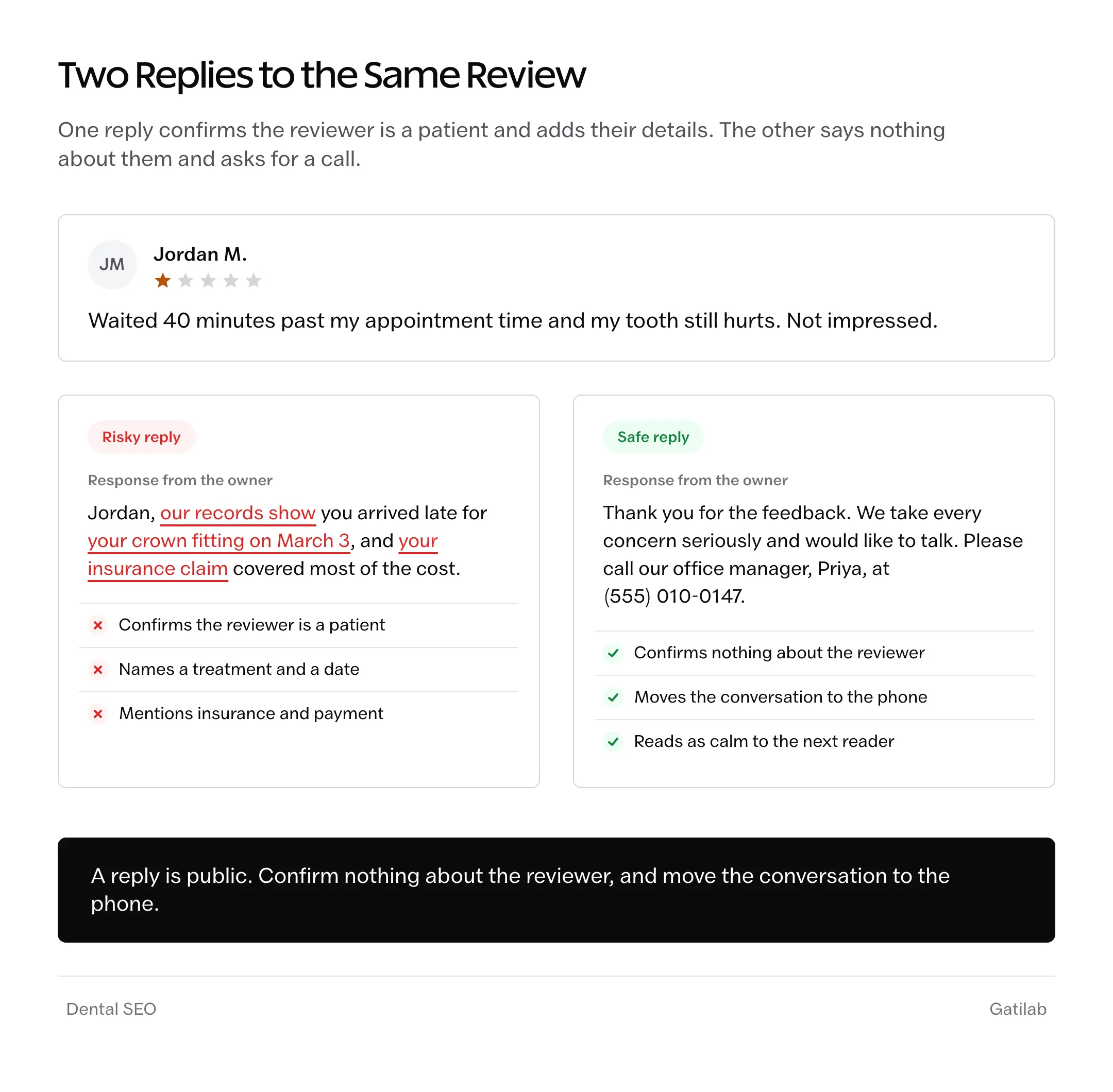
The safe version is short, confirms nothing and moves the conversation to the phone:
Thank you for the feedback. We take every concern seriously and would like to talk. Please call our office manager, Priya, at (555) 010-0147.
It never says the reviewer was in the chair, which is why it is safe, and to the next reader it looks calm and responsive.
The same care applies to positive reviews. A warm thank-you is fine, while a reply that mentions the reviewer’s implant or their child’s first visit is not. None of this is legal advice, and a practice with a compliance officer should run its reply templates past them.
Treatment Pages Patients Trust
Each treatment you want to be found for needs its own page, and the pages that do well answer the questions a patient has before booking:
- who the treatment suits and who it doesn’t
- what happens at each visit and how long it takes overall
- a cost range, what changes it and whether insurance or financing helps
- recovery and aftercare, in plain language
- the name of the dentist who wrote or reviewed the page
Health pages are held to a higher standard, by patients and by search engines, so each one should be checked by a dentist and carry their name. A page that reads like it came from someone who does the procedure every week is the one patients trust.
The website should also carry Dentist markup from schema.org, a type that sits under both MedicalBusiness and LocalBusiness:
{
  "@context": "https://schema.org",
  "@type": "Dentist",
  "name": "Brightside Family Dental",
  "url": "https://www.example.com/",
  "telephone": "+1-555-010-0147",
  "isAcceptingNewPatients": true,
  "address": {
    "@type": "PostalAddress",
    "streetAddress": "120 Main Street",
    "addressLocality": "Springfield",
    "addressRegion": "IL",
    "postalCode": "62701",
    "addressCountry": "US"
  },
  "openingHours": ["Mo-Fr 08:00-17:00", "Sa 09:00-13:00"]
}
The address, phone number and hours in it should match the Business Profile exactly. Our local business schema guide covers the other properties worth adding.
Pages Patients Check Before They Call
A lot of patients rule a practice in or out before they ever pick up the phone, based on a few practical details:
- the insurance plans you accept, on one page that stays current
- what a new patient visit involves, what to bring and whether forms can be filled in online
- payment and financing options
- parking, accessibility and how to find the entrance
- the languages the team speaks
These pages rarely rank for big searches on their own, but they turn a visit to the website into a booking, and the insurance page is exactly what someone looking for a dentist who takes their plan is hoping to find.
More Than One Location
Dental groups with several offices need one profile per office and one page per location, each with its own details and photos. Google’s doorway rules apply here like anywhere else, so a location page that only swaps the city name helps nobody. Our guide to SEO for multiple locations covers the structure in detail.
What Dental SEO Costs
Local SEO retainers for a single-location practice generally run between $500 and $3,000 a month, and dental practices in larger cities tend to sit toward the top of that range, because so many of them compete for the same searches. Our look at SEO services for local businesses breaks down what each level includes.
The profile, the review requests and the replies can stay in-house with a trained front desk. Treatment pages and links are where outside help usually pays for itself.
Dental SEO Checklist (PDF and Word)
Everything in this guide on a few pages, including review reply templates your front desk can use without revealing anything about a patient.
- Setup checklists for the practice profile and for each dentist’s profile
- A treatment page planner with the questions each page must answer
- Insurance and new patient page checklists
- Review request templates and HIPAA-safe reply templates
- A monthly tracking sheet for new patient calls, bookings and reviews
Free to use for your own practice or for clients.
The Limits
SEO can’t fix a profile with a two-star average. Reviews reflect how the practice treats people, and that fix starts at the front desk and in the chair.
It can’t promise a quick spot for the biggest treatment searches either. Terms like dental implants near me are competitive enough that a new implants page can take many months to rank, and some practices do better paying for those clicks while the page builds.
And none of this replaces advice on privacy rules. Testimonials and patient photos touch patient information just as review replies do, so they are worth confirming with whoever handles compliance for the practice.
Mistakes That Hold Dental Practices Back
Replying to a bad review with the patient’s chart in mind. Every detail that proves the practice right also confirms the reviewer was a patient.
Using stock photos of smiling models. Patients want to see the office and the team before they book, and a stock photo tells them nothing about either.
Leaving the insurance list out of date. A patient who books because a plan was listed and then finds out otherwise rarely comes back, and often leaves a review about it.
Adding the city and treatments to the practice name on the profile. It breaks Google’s guidelines and puts the profile at risk of suspension.
Publishing treatment pages no dentist has read. A wrong detail about recovery or pricing loses trust with patients and search engines alike.
Setting up a separate profile for the dentist in a solo practice. Google asks solo practitioners to share one profile with the practice, and a second one splits the reviews.
FAQs on Dental SEO
How much does dental SEO cost?
Local SEO retainers for a single-location practice generally cost between $500 and $3,000 a month, and practices in competitive cities usually sit toward the top of that range. Keeping the profile and review work in-house brings the cost down.
What is SEO in dentistry?
It is the work of making a dental practice show up when nearby patients search Google for a dentist or a treatment, mainly through the Google Business Profile, reviews and the practice website.
How long does dental SEO take to work?
Profile and review improvements can show in the map results within weeks, while treatment pages for competitive searches, such as dental implants, generally take several months.
Can dentists reply to negative reviews?
Yes, as long as the reply confirms nothing about the reviewer. A short thank-you with an invitation to call the office is safe, while any mention of a visit, a treatment or insurance can breach patient privacy rules.
Should each dentist have their own Google Business Profile?
In a practice with several dentists, each public-facing dentist can have one, named with their own name only. A solo dentist should share one profile with the practice, named in the format [Practice]: [Dentist].
Does a dental practice need a page for each treatment?
Yes, for every treatment you want patients to find you for. A single services page can’t rank for implants, whitening and emergency visits at the same time.
What does SEO mean in healthcare?
It stands for search engine optimization, the work of helping a practice appear in search results. In healthcare it comes with extra care around accuracy and patient privacy, since health pages are held to a higher standard and patient details are protected by law.
Final Remarks
If you have worked through this, your practice has a profile patients can trust and a safe way to reply to their reviews. The one idea to keep is that patients choose a dentist on trust, so every page and every reply should add to it.
The dental SEO checklist above includes the reply templates, so the front desk can start using them today. If you would like us to handle the SEO, our local SEO team works with local practices and service businesses, and Business Profile optimization is available on its own.
I hope your schedule fills up with the kind of patients who stay.
Tell Google you want more of this.
Add Gatilab as a preferred sourceOne tap, and this site shows up more often in your own Top Stories, AI Overviews and AI Mode. Remove it any time.