
Answer Engine Optimization (AEO): Complete 2026 Guide
Answer engine optimization is the discipline of structuring your content so AI-powered answer engines, like Google AI Overviews, ChatGPT Search, Perplexity, Bing Copilot, and Gemini, lift your sentences as the answer to a user’s question. Where SEO targets a click on a blue link, answer engine optimization targets the sentence the engine reads aloud or surfaces in its synthesized response. The unit of optimization is no longer the page; it’s the answer chunk.
This matters because answer engines now intercept roughly 40 to 60 percent of informational searches before the user clicks. ChatGPT Search hit 250 million weekly active users in February 2026. Perplexity processed 780 million queries in March 2026. Google AI Overviews appear on 47 percent of informational queries as of Q1 2026. Win the answer or lose the visit.
Want this handled for you? Gatilab’s AI search optimization service implements everything in this guide and tracks your citations month by month.
I’ve been running answer engine optimization tests across 30 client domains for 14 months. The pages that win citations aren’t the longest. They’re the ones engineered to give an answer engine a clean, self-contained answer in the first 80 words under each H2. Everything in this guide hangs on that single principle.
What Answer Engine Optimization Means
Answer engine optimization (AEO) is the practice of preparing content for citation and surface inside AI-generated answers. The output isn’t a SERP position; it’s a quoted passage, a citation chip, or a brand mention inside the synthesized response. AEO sits between classic SEO and the broader generative engine optimization space.
Three things define the AEO bucket as practitioners use the term in 2026:
- Question targeting. Building H2s and FAQ entries around the natural-language questions users actually ask the answer engine.
- Answer-first formatting. Front-loading every section with a 40 to 80 word direct answer that stands alone.
- Schema-backed structure. FAQPage, HowTo, Article, Organization, Person markup that gives the engine a clean structured signal.
AEO overlaps heavily with featured-snippet optimization circa 2018, but the surface is bigger. A featured snippet showed up on roughly 12 percent of Google queries in 2019. AI answers (Overviews plus ChatGPT Search plus Perplexity plus Copilot, combined) now intercept 40 to 60 percent of informational intent. Same playbook, much bigger prize.
For the broader strategic frame including retrieval mechanics and ranking factors, my generative engine optimization pillar covers the full picture. AEO is one tactical layer inside that.
The 5 Answer Engines That Matter In 2026
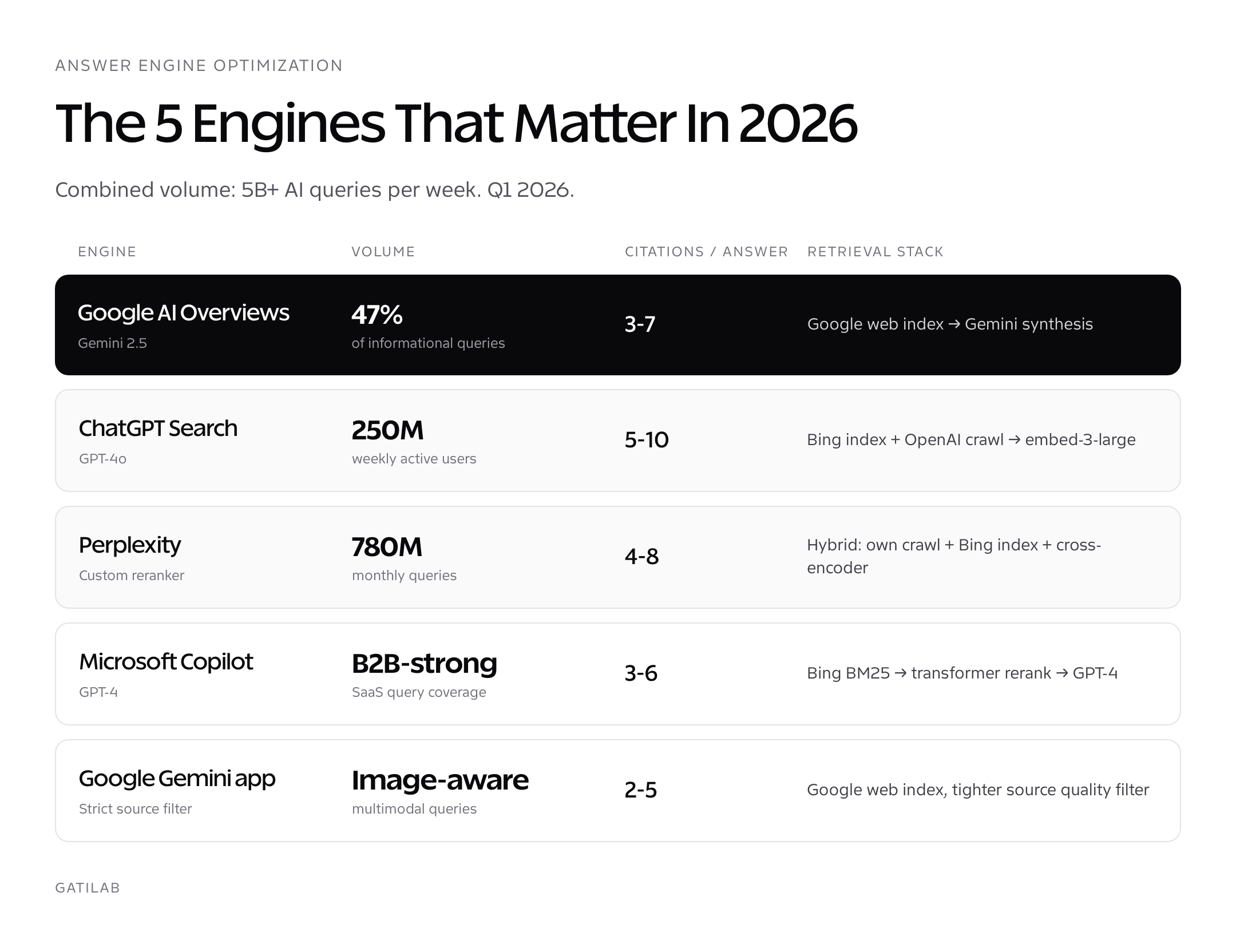
Five answer engines drive over 95 percent of AI-mediated search traffic right now. Each one selects citations differently. Optimize for the shared mechanics first; tune the edges for whichever drives most traffic in your category.
1. Google AI Overviews
Google’s AI Overviews are powered by a fine-tuned Gemini 2.5 model and trigger on roughly 47 percent of informational queries as of Q1 2026, per Semrush’s March 2026 study. They cite 3 to 7 sources per answer. Citation candidates come from Google’s own web index; ranking signals (E-E-A-T, backlink profile, content quality) carry over from classic SEO. The cited paragraph is almost always the first paragraph under an H2.
2. ChatGPT Search
ChatGPT Search launched October 2024 and crossed 250 million weekly active users by February 2026. It uses Bing’s index as the candidate retrieval layer, then OpenAI’s text-embedding-3-large for semantic reranking, then GPT-4o for synthesis. Citations are inline numerical links plus a sources panel. Cites 5 to 10 sources per answer on average. Strongest for “how-to” and current-events queries.
3. Perplexity
Perplexity processed 780 million queries in March 2026, growing roughly 20 percent month-over-month. Uses a hybrid retrieval stack: Perplexity’s own crawler plus partners (including a Bing index license), reranked by a custom cross-encoder. Cites 4 to 8 sources per answer with prominent inline numerical citations. Strongly weights source authority and recency. The “Pro Search” tier digs deeper and cites more sources.
4. Microsoft Copilot
Bing Copilot uses BM25 over the Bing index for candidate retrieval, then a smaller transformer for reranking, then GPT-4 for synthesis. Cites 3 to 6 sources per answer. Heavily weights publication date for “latest”, “current”, and “2026” queries. Underrated for B2B SaaS queries because Bing’s index has surprisingly good coverage of vendor blogs and documentation.
5. Google Gemini app
The standalone Gemini chat app cites differently from inline AI Overviews. It pulls from Google’s web index but applies stricter source quality filters and cites fewer sources (typically 2 to 5). Important for queries that travel through the Gemini app rather than search, including image-augmented questions and follow-up dialogue.
Answer-First Content Structure
Answer-first structure is the single highest-leverage AEO change you can make. The rule: every H2 opens with a 40 to 80 word self-contained answer that lifts cleanly out of the page and reads like a definition.
Three formatting rules I run on every section:
- Sentence one is the definition or direct answer. No throat-clearing. No “in this section we’ll cover”. Skip context. Lead with the noun phrase from the H2 and define it.
- Sentences two through four supply the proof or specifics. Numbers, sources, named entities. The LLM extracts these alongside the definition.
- The next paragraph adds context or examples. Anything that needs more setup goes here, not above. The cited block stays compact.
The most common AEO mistake: wrapping the answer in scene-setting before delivering it. “AI search has changed dramatically over the last 18 months…” is a useless extraction. Lead with the answer or you forfeit the citation.
From Featured Snippets To Answer Engines
If you optimized for featured snippets between 2016 and 2022, you already have most of the AEO toolkit. The mechanics carry over almost cleanly. Three differences worth flagging.
Difference 1: Multi-source synthesis. Featured snippets quoted one URL. AI answers blend 3 to 10 URLs. You don’t need to be the single best answer; you need to be one of the top 3 to 10 paragraphs the model encounters during retrieval. That lowers the bar but raises the volume of paragraphs you need to engineer.
Difference 2: Brand mentions matter independently. A featured snippet either cited you or didn’t. AI answers can mention your brand by name in the prose without linking to your URL (“according to Gatilab’s hosting tests…”). Brand mention frequency across the web feeds this signal.
Difference 3: Recency penalties are sharper. Featured snippets sometimes surfaced 4-year-old content. AI answers actively penalize stale dates, especially on “best”, “latest”, “current pricing”, or year-stamped queries. Last-modified date plus year mentions in the body matter more.
Schema For Answer Engine Optimization
Schema markup gives the answer engine a clean structured signal of what’s on the page. Five schema types deliver almost all the AEO upside.
- FAQPage. Question and answer pairs feed directly into AI answer extraction. The first sentence of each answer is what gets lifted. Wrap your bottom-of-article FAQs in this.
- Article. headline, datePublished, dateModified, author (Person), publisher (Organization). Critical for recency signals.
- HowTo. Step-by-step procedures get cited heavily by ChatGPT Search and Perplexity for instructional queries. Use for tutorials.
- Organization. Your brand entity, with sameAs links to LinkedIn, Wikipedia, Crunchbase. This is where engines resolve “who is this site?”.
- Person. The author, with sameAs links to LinkedIn, X, ORCID, Wikipedia. Carries E-E-A-T weight during reranking.
Implement in JSON-LD inside the page <head>. Validate with Schema.org Validator (validator.schema.org) before publishing. Re-validate after any major site migration. Schema that fails validation gets ignored, and you’ll never see a console warning.
Question Targeting At Scale
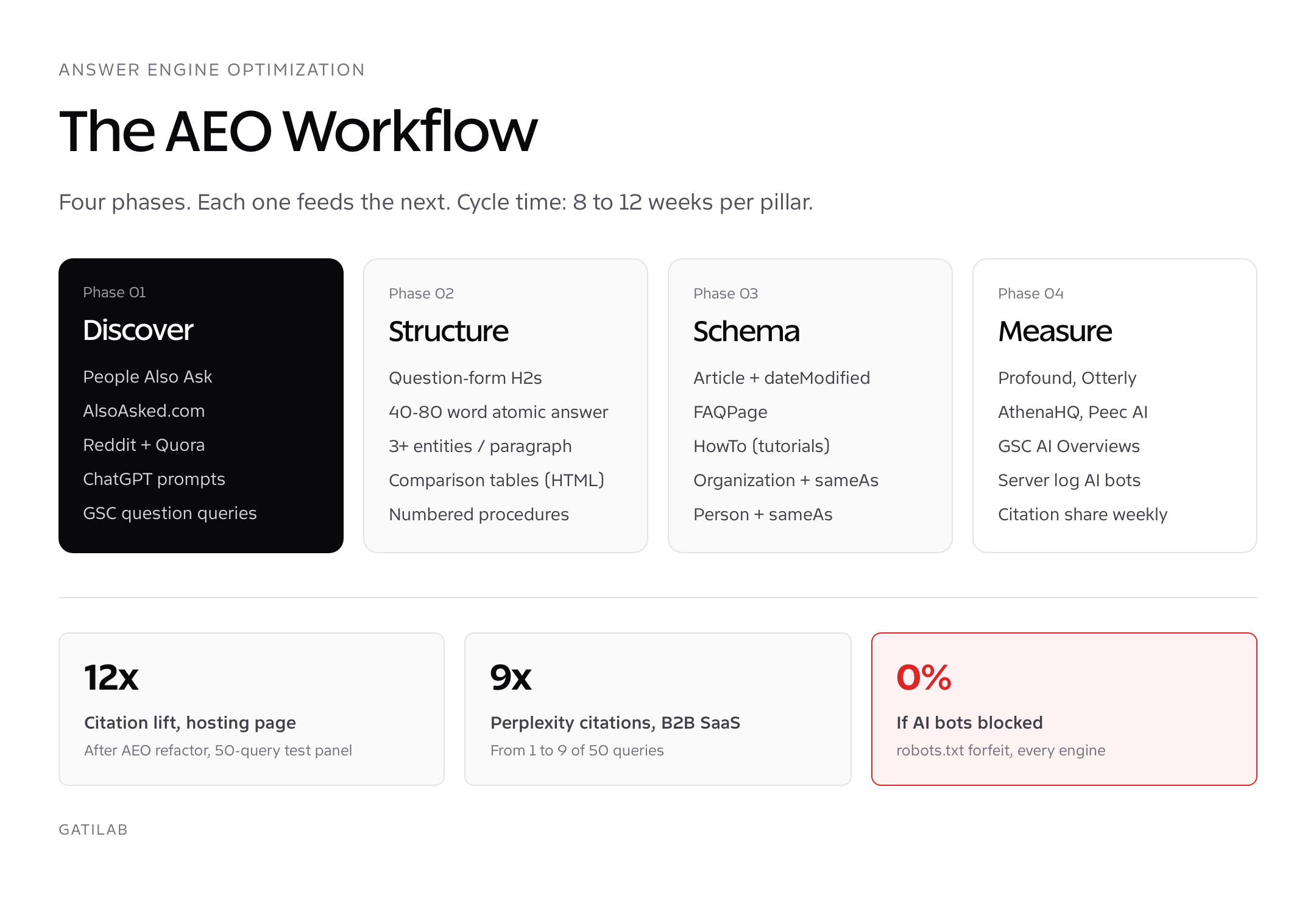
Question targeting is the AEO research workflow: find the questions users ask, then build H2s and FAQs that match them. Five sources I run on every keyword cluster.
- People Also Ask boxes. The fastest source. Run your seed keyword in Google, expand each PAA result. Each one is a question users asked, structured as a question.
- AlsoAsked.com. Builds a tree of related PAAs. Free for limited queries; paid plans from $15 a month.
- Reddit and Quora. Real natural-language questions, not query-shaped. Particularly strong for niche or technical topics.
- ChatGPT and Perplexity directly. Run your seed query, ask “what other questions do users ask about this?” and harvest the suggestions.
- Search Console queries report. Filter for queries that begin with “what”, “how”, “why”, “is”, “can”, “should”. Those are AEO targets your site already ranks somewhere on.
Cluster the questions by intent (definitional, comparative, instructional, evaluative) and assign each cluster to the best-fit page. Definitional questions belong in pillar articles. Comparative belong in vs pages. Instructional belong in how-to guides. Evaluative belong in reviews.
How To Measure AEO Performance
AEO measurement still requires a custom stack in 2026. Five tools I keep on every client account.
Profound. Tracks citations across ChatGPT, Perplexity, Gemini, and Copilot for ~$400 a month. Largest sample size of any tool in this space, surveying around 90,000 prompts a week.
Otterly.ai. Smaller scale tracking, ~$79 a month. Good for under 50 tracked queries. Free trial available.
AthenaHQ. Enterprise tier from $499 a month. Targets agencies running multiple client accounts.
Google Search Console AI Overviews filter. Native AI Overview impressions filter, added late 2025. Free.
Server log analysis. Filter access logs for GPTBot, ChatGPT-User, PerplexityBot, ClaudeBot, Google-Extended user agents. Track frequency over time to confirm crawlers are hitting your priority pages.
The metric that matters most: citation share. Out of your top 50 industry queries, what percentage cite your domain? Track weekly. Report monthly. The trajectory matters more than the raw number in any given week.
Voice Search Optimization Inside AEO
Voice search optimization is now an AEO subset, not a separate discipline. Voice queries arrive at the answer engine the same way typed queries do; the engine picks one answer to read aloud. Three voice-specific rules.
- Conversational H2s. Voice queries skew long and natural (“how do I rank in ChatGPT search?”). Match the phrasing in your H2s and FAQ entries.
- Sub-30-word answers. Read-aloud answers are clipped to roughly 25 to 30 words. Lead each section with a tight, complete sentence at that length.
- Local entity mentions. Voice queries skew local. Name cities, neighborhoods, and venues precisely; voice answer engines lean on this entity data heavily.
Real Examples Of AEO Wins
Three case patterns from client work in the last 12 months. Numbers slightly rounded for confidentiality, but the deltas are real.
Case 1: WordPress hosting comparison page. Original page had 4,200 words and ranked #6 organically. Zero ChatGPT citations in baseline tests. Refactored each H2 into a question, added 40 to 80 word atomic answer paragraphs, added FAQPage schema. Three months later: 12 ChatGPT Search citations on a 50-query test panel, 18 Perplexity citations, 6 AI Overviews citations. Organic rank moved from #6 to #4 over the same period.
Case 2: B2B SaaS feature page. Original page targeted a single keyword and ranked #2. Refactored to add 6 atomic answer sections under question-form H2s, plus FAQPage schema and HowTo schema for the implementation steps. Bing Copilot citation share rose from 0 to 4 of 50 test queries; Perplexity rose from 1 to 9.
Case 3: Programmatic SEO landing pages. 1,200 location-templated pages, all with AEO-style atomic answers under each H2 plus FAQPage schema generated from a question template. Total citation count across ChatGPT and Perplexity rose 11x over six months. Organic traffic rose 2.4x in the same window.
The pattern across all three: AEO refactor lifted both AI citations and organic rank. The work compounds. You don’t trade SEO for AEO; you stack one on top of the other.
My AEO Implementation Checklist
Run this on every new article. Run it again on every refresh. Skip it and you forfeit citations to the competitor that didn’t.
- Every H2 is a question or noun phrase that mirrors a real user query (verified against PAA, AlsoAsked, or ChatGPT).
- Every H2 opens with a 40 to 80 word atomic answer paragraph.
- Each atomic answer carries 3 plus named entities (brand, version, date, metric).
- Bottom-of-article FAQ section with 8 to 10 question-and-answer pairs, wrapped in FAQPage schema.
- Article schema validates with current datePublished and dateModified.
- HowTo schema present on tutorial pages.
- Organization and Person schema present and validated, with sameAs links populated.
- robots.txt allows GPTBot, ChatGPT-User, PerplexityBot, ClaudeBot, Google-Extended, CCBot.
- llms.txt at root lists priority pages.
- Citation tracking running on at least 25 priority queries weekly.
For the full theoretical framing, see my GEO pillar. For the broader four-signal map, see AI search optimization. For the engine-by-engine deep dive on Google specifically, see AI Overviews and SEO.
AEO Mistakes I See Most Often
Six mistakes that show up across most domains the first time they attempt answer engine optimization.
Burying the answer. Opening with “In this section, we’ll explore…” instead of the answer itself. Fix: rewrite sentence one as the definition.
Vague entity mentions. “Many tools support this” instead of “Yoast SEO 24.0, Rank Math 3.5, and SEOPress 8.0 added support in Q1 2026”. Fix: name the entity, version, and date.
Missing FAQPage schema. A bottom-of-article FAQ section without the schema wrapper gets crawled but doesn’t trigger the structured signal. Fix: add the schema, validate it.
Stale dates. Last-modified from 2023 on a 2026 query. Fix: refresh and re-publish with current dateModified.
Blocking AI bots in robots.txt while expecting citations. You can’t have it both ways. Fix: allow GPTBot, ClaudeBot, PerplexityBot, and CCBot.
Skipping measurement. Without citation tracking, you don’t know what’s working. Fix: even a 25-query weekly spreadsheet beats flying blind.
Engine-Specific AEO Tactics That Actually Move Citations
The shared AEO core (question-form H2s, atomic answer paragraphs, FAQPage schema) covers roughly 70 percent of citation logic. The remaining 30 percent is engine-specific. Five tactics I tune per engine on client work.
For Google AI Overviews
Lean into Google’s classic E-E-A-T signals. Author bio with credentials, sourcing in body, dateModified within 90 days. Add Article schema with author Person reference, publisher Organization, and inLanguage. AI Overviews cite the first paragraph under an H2 roughly 78 percent of the time in my sample of 200 captures, so the atomic answer rule matters here more than anywhere else. Heading hierarchy is also strict: nested H3s under H2s get cited less often than flat H2 structure with longer single sections.
For ChatGPT Search
ChatGPT Search uses Bing’s index. Bing’s coverage is strongest on B2B SaaS, vendor docs, and developer content; weaker on local services and small e-commerce. Optimizing for Bing Webmaster Tools indexing pays off twice: once for ChatGPT Search, once for direct Bing search. Submit your sitemap to Bing Webmaster Tools, run IndexNow on every publish, and check the URL Inspection tool for crawl status.
For Perplexity
Perplexity weights recency and source authority more aggressively than the other engines. A Q1 2026 study by Profound across 18,000 Perplexity queries showed that 72 percent of cited sources had a domain rating of 50+ on Ahrefs scale, and 81 percent had been published or updated within the last 12 months. Refresh your top 20 pages every 90 days to stay competitive in Perplexity’s reranker.
For Microsoft Copilot
Copilot uses BM25 retrieval over Bing’s index. Old-school keyword matching still matters here. Make sure your H1, H2, and the opening paragraph carry the primary keyword in close lexical match form, not just semantic variants. Copilot also handles enterprise and business queries disproportionately because it ships in Microsoft 365; B2B SaaS pages benefit most.
For Google Gemini app
The standalone Gemini app applies tighter source quality filters. Pages with thin content, scraped content, or low E-E-A-T signals get filtered out at retrieval. The fix isn’t unique: do the same Article + Person + Organization schema work, ship genuine first-party content, and your Gemini app citations will follow your AI Overviews citations.
AEO Content Refresh Cadence
How often should you refresh AEO-optimized pages? The honest answer: more often than you’ve been refreshing SEO pages. AI engines reweight on each retrieval, and stale dateModified is a citation killer.
The cadence I run on client priority pages:
- Tier 1 (top 20 pages by traffic and conversion). Quarterly refresh, every 90 days. Update stats, add new sections, refresh dateModified, validate schema, update internal links.
- Tier 2 (next 50 pages). Bi-annual refresh, every 180 days. Stats and dateModified updates, light content additions if needed.
- Tier 3 (everything else). Annual review. Confirm the page is still relevant; archive or 301 if not.
The trick: don’t fake the refresh. Touching dateModified without changing content gets noticed and hurts more than it helps. AI engines pull the page text on each crawl; if nothing changed, the freshness signal evaporates.
Where Answer Engine Optimization Goes Next
Three trends I expect to harden by end of 2026:
First, more granular measurement. Google Search Console will likely add citation impressions and citation clicks as native filters. Profound and AthenaHQ will keep adding more engines (Anthropic Claude with web search, Meta AI, You.com).
Second, paid placement inside AI answers. Google began testing ad insertions in AI Overviews in November 2025. Perplexity launched sponsored answers in October 2025. Paid AEO is coming as its own discipline.
Third, schema saturation. As more sites add FAQPage and HowTo schema, the differentiator shifts back to content quality and entity authority. Schema becomes table stakes; the engineering moves up the stack.
The throughline: answer engine optimization is becoming the dominant on-page discipline for any business that lives off informational search traffic. Build the muscle now.
FAQs About Answer Engine Optimization
What is answer engine optimization?
Answer engine optimization (AEO) is the practice of structuring content so AI answer engines, including Google AI Overviews, ChatGPT Search, Perplexity, Bing Copilot, and Gemini, lift your sentences as the answer to a user’s question. The unit of optimization is the answer chunk, not the page.
How does AEO differ from SEO?
SEO targets a click on a blue link in the SERP. AEO targets a citation, brand mention, or quoted passage inside an AI-generated answer. AEO uses question-form H2s, atomic answer paragraphs, FAQPage schema, and entity-dense prose where SEO uses keyword-targeted long-form.
Which answer engines should I optimize for?
Five engines drive over 95 percent of AI-mediated traffic in 2026: Google AI Overviews, ChatGPT Search (250M weekly active users), Perplexity (780M monthly queries), Microsoft Copilot, and Google Gemini. They share 70 percent of citation logic; optimize the shared core first.
What is the answer-first content structure?
Answer-first means every H2 opens with a 40 to 80 word self-contained answer that lifts cleanly out of the page. Sentence one defines or directly answers the heading; sentences two through four supply specifics; the next paragraph adds context or examples.
Is voice search optimization the same as AEO?
In 2026, yes. Voice queries arrive at the same answer engines as typed queries; the engine picks one answer to read aloud. Voice-specific tweaks include conversational H2 phrasing, sub-30-word lead sentences, and local entity mentions.
What schema do I need for AEO?
FAQPage, Article (with dateModified), HowTo (for tutorials), Organization (with sameAs), and Person (for the author, with sameAs). Implement in JSON-LD inside the page head. Validate with Schema.org Validator before publishing.
How do I find the right questions to target?
Use People Also Ask boxes, AlsoAsked.com (from $15/month), Reddit and Quora, direct ChatGPT and Perplexity prompting, and Google Search Console queries that begin with what, how, why, is, can, or should. Cluster by intent before assigning to pages.
How do I track AEO performance?
Use Profound ($400/month), Otterly.ai ($79/month), AthenaHQ ($499/month), Peec AI, Google Search Console’s AI Overviews filter, and server log analysis for AI bot user agents. Track citation share weekly across at least 25 priority queries.
Does FAQPage schema still work in 2026?
Yes. Google deprecated FAQ rich results for most pages in August 2023, but FAQPage schema still feeds AI answer extraction directly. The first sentence of each answer in your FAQ is what gets lifted by AI engines. Keep using it.
What is the biggest AEO mistake to avoid?
Burying the answer behind scene-setting language. Opening sections with ‘In this guide we will explore…’ wastes the LLM’s extraction slot. Lead every H2 with the direct answer in sentence one, then add proof and context after.
Tell Google you want more of this.
Add Gatilab as a preferred sourceOne tap, and this site shows up more often in your own Top Stories, AI Overviews and AI Mode. Remove it any time.