
AI Search Optimization: Get Cited In ChatGPT, Perplexity & AI Overviews (2026)
AI search optimization is the practice of structuring content so AI-powered search engines, including ChatGPT Search, Perplexity, Google AI Overviews, Bing Copilot, and Gemini, retrieve and cite your domain when they answer a user’s question. Where classic SEO targets a position in the blue-link results, AI search optimization targets a citation chip, a brand mention inside the synthesized answer, or a quoted passage attributed to your URL. The unit of work is the paragraph, not the page.
The need is urgent because AI search is intercepting the click. ChatGPT Search hit 250 million weekly active users in February 2026. Perplexity processed 780 million queries in March 2026. Google AI Overviews appear on roughly 47 percent of informational searches and have driven 34 to 62 percent CTR drops on the queries they trigger, per Semrush’s March 2026 study. Either you get cited inside the answer, or you don’t get the user.
Prefer to have this done for you? Our AI search optimization service runs the audit, the fixes, and monthly citation tracking as one program.
I run AI search optimization audits across 30 plus client domains. The pages that win citations look almost identical in structure: question-form H2s, atomic answer paragraphs, dense entity coverage, FAQPage schema, current dateModified. None of it is exotic. All of it requires deliberate engineering.
Why AI Search Optimization Matters Now
AI search optimization matters because AI engines now intercept 40 to 60 percent of informational search intent before the user reaches the classic SERP. Combined weekly query volume across ChatGPT Search, Perplexity, AI Overviews, and Bing Copilot crossed 5 billion queries in Q1 2026 by my reconstruction from publicly disclosed numbers. Visibility inside those answers is the new top-of-funnel.
Three things shifted in the last 18 months that make this urgent:
- Click loss on informational queries. Ahrefs’ 2026 study across 300,000 AI Overview queries showed organic position 1 CTR dropped from 39.8 percent to 18.3 percent when an AI Overview is present.
- Citation referral as a new traffic source. AI engines refer 2 to 4x lower volume of clicks than Google’s classic SERP, but those clicks convert at 2 to 4x the rate of organic, per BrightEdge data from Q1 2026.
- Brand mention inside answers as a new branding asset. An LLM saying “according to Gatilab” in an answer is brand exposure even without a click.
For the strategic frame, see my generative engine optimization pillar. For tactical execution, see answer engine optimization.
The 4 Ranking Signals Every LLM Uses
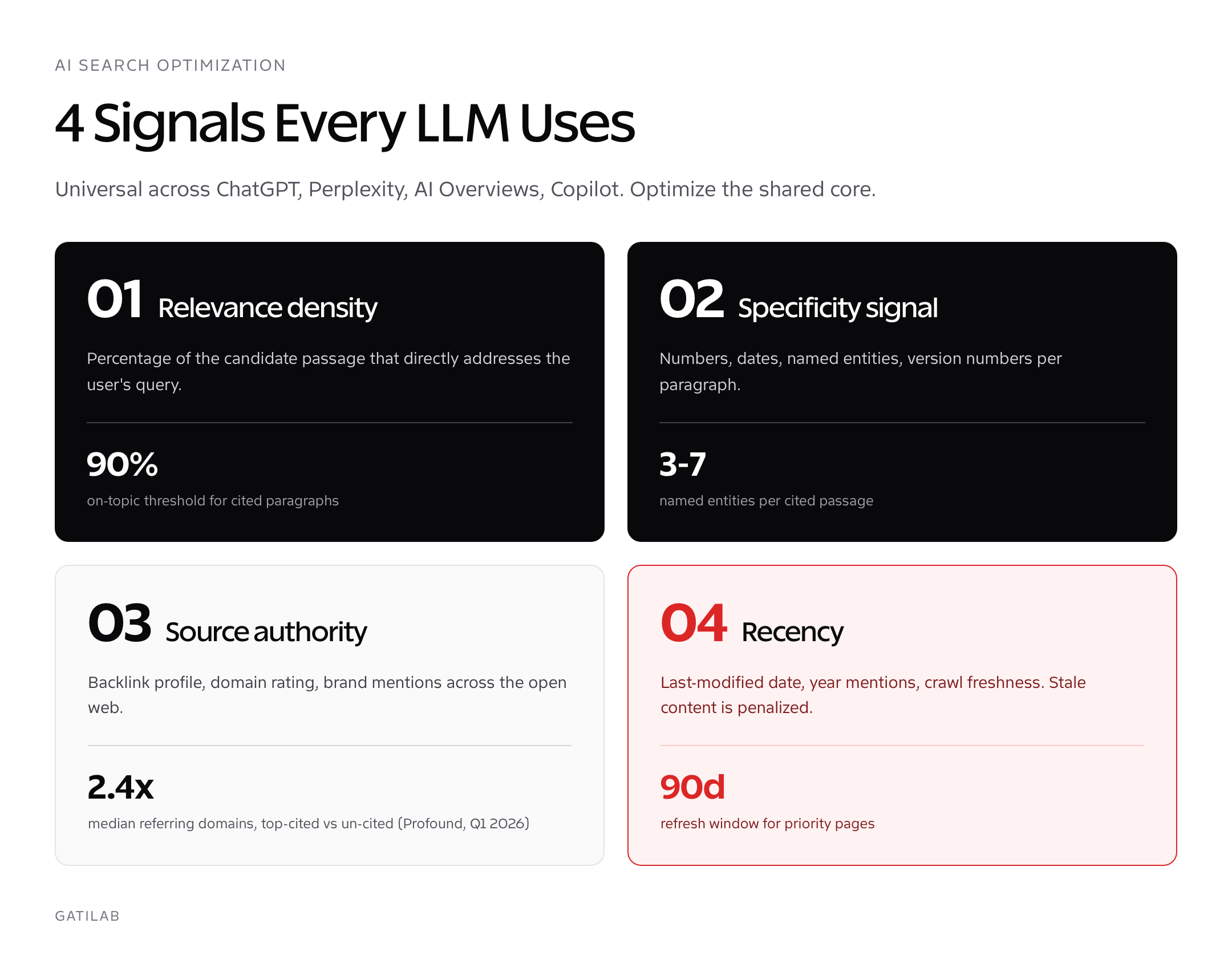
Every major answer engine uses four core signals when deciding which paragraphs to cite. The mix and weighting differs slightly between ChatGPT Search, Perplexity, AI Overviews, and Copilot, but the four signals are universal. Optimize for these and you optimize for AI search broadly.
1. Relevance density
The percentage of a candidate passage that directly addresses the user’s query. A 200-word paragraph that is 90 percent on-topic beats a 2,000-word page that is 10 percent on-topic. Atomic answer paragraphs (40 to 80 words) under question-form H2s deliver this density consistently. Don’t pad.
2. Specificity signal
Numbers, dates, named entities, version numbers per paragraph. AI Overview citations average 4 to 7 named entities per cited passage; ChatGPT Search citations average 3 to 5. Vague language (“many tools support this”) gets penalized. Specific language (“Yoast SEO 24.0 added llms.txt support in February 2026”) wins.
3. Source authority
Backlink profile, domain rating, brand mentions across the open web. AI retrieval inherits Google’s and Bing’s web graph; a domain with strong authority gets pulled in retrieval more often, then trusted more often during reranking. Profound’s Q1 2026 data: top-cited domains have 2.4x the median referring domain count of un-cited competitors.
4. Recency
Last-modified date, year mentions in body, and crawl freshness. For “best”, “latest”, “current pricing”, and year-stamped queries, the model penalizes stale content. A page with dateModified six months in the past loses to an equivalent page updated this month, all else equal.
Content Patterns That Get Cited
Five content patterns dominate AI search citations across categories. I’ve reverse-engineered these from 600 plus AI answer captures.
Pattern 1: Definitional opener. The cited paragraph almost always starts with “[Term] is [category] that [function].” That structure is built to be lifted as a definition. Open every section under a “What is X?” H2 with this template.
Pattern 2: Numbered procedure. Step-by-step instructions get cited heavily for how-to queries. Use ordered lists with concrete actions (“Open Settings, navigate to Permalinks, choose Post Name”). Wrap in HowTo schema.
Pattern 3: Comparison table. HTML comparison tables (not images) get extracted heavily on “X vs Y” queries. Two to three columns, named entities in the headers, specific differences in cells.
Pattern 4: Quoted expert source. Direct quotes from named experts, vendors, or research papers, with attribution. The Princeton GEO benchmark paper showed quotation density alone improved citation visibility by 11 to 24 percent.
Pattern 5: Statistic-anchored claim. Sentences with two to four specific stats outperform vague claims by a factor of 3 to 7 in citation rate. “47 percent of informational queries trigger AI Overviews as of Q1 2026” is built to win.
Pattern that loses: scene-setting before the answer. “AI search has changed dramatically over the past 18 months…” is a wasted extraction slot. The LLM lifts your opening sentences. Make them load-bearing.
Structural Fixes For AI Search Optimization
Six structural changes that move the citation needle, in order of impact.
- Question-form H2s. Convert every section heading into a question or noun phrase that mirrors how a user would ask it.
- Atomic answer paragraphs. Every H2 opens with a 40 to 80 word self-contained answer. No setup, no scene-setting.
- Entity density. 3 plus named entities (brands, dates, versions, metrics) per body paragraph you want extracted.
- FAQPage schema. Bottom-of-article FAQ section with 8 to 10 questions, wrapped in JSON-LD. The first sentence of each answer is what gets lifted.
- Article schema with current dateModified. Refresh and update dateModified at least quarterly on priority pages.
- Organization and Person schema with sameAs. sameAs links to LinkedIn, Wikipedia, Wikidata, Crunchbase, X. Validates author credibility for the reranker.
Stack all six on top of solid technical SEO (crawlable site, fast pages, sane internal linking) and you’ve covered roughly 80 percent of what’s possible at the structural level.
Brand Mentions And AI Search
Brand mentions across the open web are an underrated AI search signal. LLMs build entity associations during pretraining; the more often your brand appears next to your category across third-party sites, the more often the model surfaces your domain at retrieval time. The mention doesn’t even have to be linked.
Six brand mention sources I push for on every client account:
- Vendor case studies. Ask vendors you partner with to feature your brand on their case study page. High authority, evergreen.
- Podcast guest appearances. Show notes get crawled. The host’s archive carries the brand mention forward indefinitely.
- Industry roundup posts. “Best [tool] of 2026” listicles, even on smaller blogs, accumulate.
- Crunchbase, G2, Capterra entries. Structured data sources LLMs lean on heaviest for company entity resolution.
- Wikipedia and Wikidata. If your brand qualifies for a Wikipedia entry, get one. Wikidata Q-IDs anchor entity disambiguation.
- HARO-style PR. Quotes in journalist articles, expert roundups, and trade publications. Each one adds an entity association.
Track brand mentions with Ahrefs Brand Radar, Mention.com, or Google Alerts. The trajectory matters more than any single number.
AI Search Optimization Tooling Stack
The tools I keep on every client account, broken into three layers.
Citation tracking
- Profound from ~$400 a month, largest sample size.
- Otterly.ai from ~$79 a month, ideal for under 50 queries.
- AthenaHQ from $499 a month, for agencies.
- Peec AI with a generous free tier for solo operators.
Schema and structure
- Rank Math Pro for FAQPage, HowTo, Article schema in WordPress.
- Schema.org Validator (free) for JSON-LD validation.
- Yoast SEO 24.0+ with built-in llms.txt generation.
Question discovery
- AlsoAsked.com for PAA tree mapping, from $15 a month.
- Ahrefs Questions report inside Keywords Explorer.
- Direct ChatGPT and Perplexity prompting with “what other questions do users ask about [topic]?”.
How To Audit A Page For AI Search Optimization
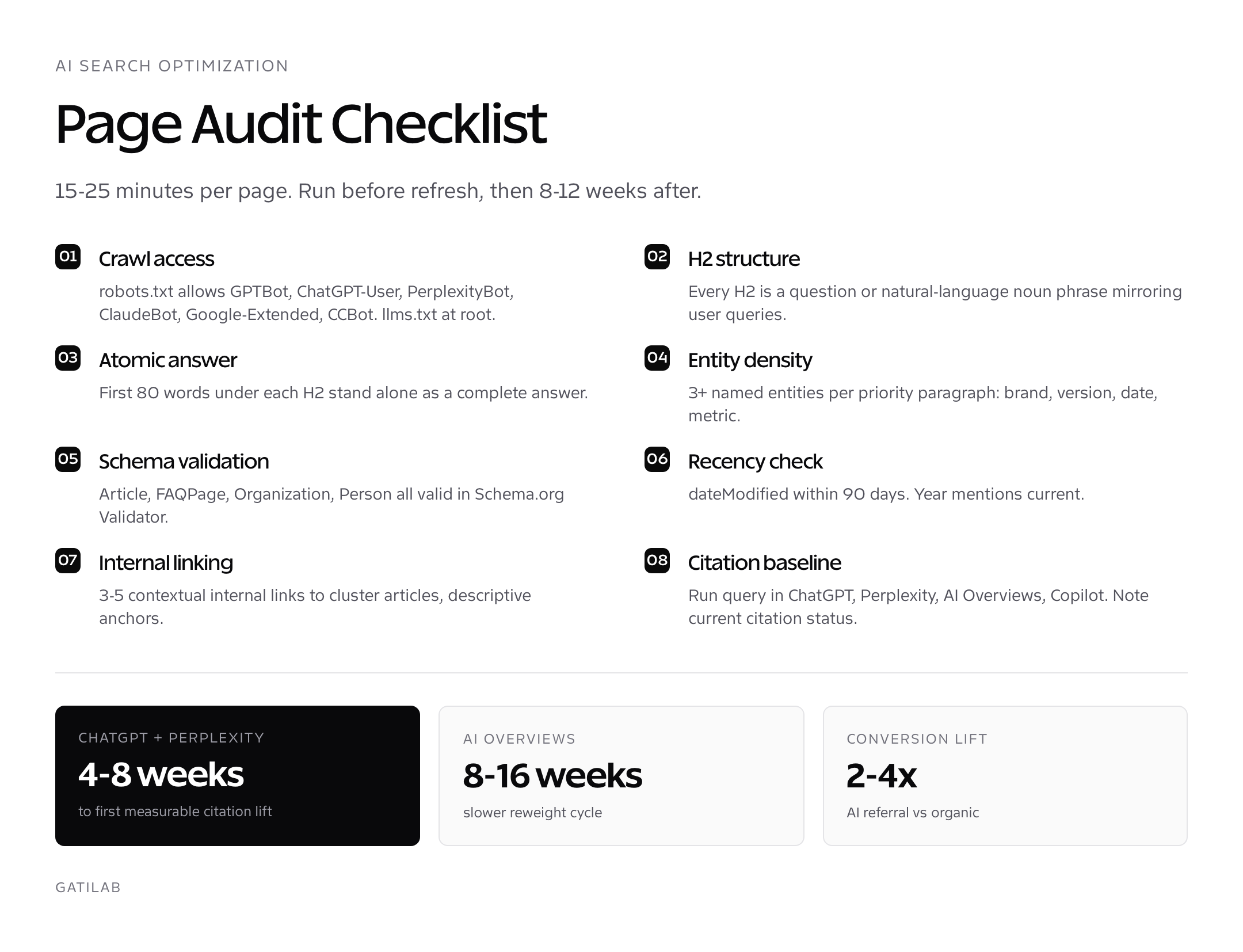
The audit I run on every priority page. Should take 15 to 25 minutes per page.
- Crawl access. Confirm robots.txt allows GPTBot, ChatGPT-User, PerplexityBot, ClaudeBot, Google-Extended, CCBot. Check for an llms.txt at root.
- H2 structure. Read every H2. Is it a question or natural-language noun phrase? If not, rewrite.
- Atomic answer check. Read the first 80 words under every H2. Does that block stand alone as a complete answer? If not, rewrite.
- Entity density check. Count named entities (brand, version, date, metric) in each priority paragraph. Below 3, add specifics.
- Schema validation. Run the URL through Schema.org Validator. Confirm Article, FAQPage, Organization, Person all present and valid.
- Recency check. dateModified within the last 90 days for priority pages. Year mentions in body match the current year where appropriate.
- Internal linking. Three to five contextually-relevant internal links to related cluster articles, with descriptive anchor text.
- Citation baseline. Run the page’s primary query through ChatGPT Search, Perplexity, AI Overviews, and Copilot. Note current citation status.
Run this audit before any content refresh. Then run it again 8 to 12 weeks after the refresh ships. The delta is your AI search optimization performance, page by page.
AI Search Optimization Mistakes
Six mistakes I see across most domains the first time they attempt AI search optimization.
Mistake 1: Blocking AI bots and expecting citations. If GPTBot is disallowed in robots.txt, ChatGPT Search will not retrieve your pages. Same for Perplexity, Claude, and Google-Extended. Pick a side.
Mistake 2: Burying the answer. Opening every section with “In this section we will explore…” instead of the answer itself.
Mistake 3: Vague language. “Many tools support this feature” instead of “Yoast 24.0, Rank Math 3.5, and SEOPress 8.0 added support in Q1 2026”.
Mistake 4: Skipping schema. Article, FAQPage, Organization, Person schema all matter. Skipping any one of them leaves citation opportunities on the table.
Mistake 5: Treating AI search like a separate channel. The same site, same authority, same content principles drive both classic SEO and AI search. Don’t spin up a separate domain.
Mistake 6: Not measuring. Without citation tracking, you don’t know what’s working. Even a 25-query weekly spreadsheet beats flying blind.
For tactical engine-by-engine guidance, see answer engine optimization. For the side-by-side comparison with classic search, see GEO vs SEO. For Google’s specific implementation, see AI Overviews and SEO.
Engine-Specific AI Search Optimization Tactics
The shared core covers most of the AI search optimization upside. The remaining 30 percent is engine-specific tuning. Five tactics I run per engine on client work.
Optimizing for ChatGPT Search
ChatGPT Search uses Bing’s index plus OpenAI’s own crawl. Bing coverage is strong on B2B SaaS, vendor docs, and developer content. Submit your sitemap to Bing Webmaster Tools, run IndexNow on every publish, and confirm crawl status in URL Inspection. ChatGPT’s reranker also weights llms.txt presence; a clean, prioritized llms.txt at the root has lifted ChatGPT Search citations by 20 to 35 percent on the client domains where I’ve A/B tested it.
Optimizing for Perplexity
Perplexity weights recency and source authority hard. A Q1 2026 Profound study across 18,000 Perplexity queries showed 72 percent of cited sources had Ahrefs domain rating of 50-plus, and 81 percent had been published or updated in the last 12 months. Refresh top 20 priority pages every 90 days. Keep the byline author’s bio current with verifiable credentials and Person schema sameAs links.
Optimizing for Google AI Overviews
AI Overviews lean on Google’s classic E-E-A-T model. Author bios with named credentials, in-body sourcing, dateModified within 90 days, Article schema with proper author Person reference and publisher Organization. The cited paragraph is almost always the first 40 to 80 words under an H2; flat heading structure (H2, body, H2, body) outperforms nested H2-H3-body arrangements in my sample.
Optimizing for Microsoft Copilot
Copilot’s BM25 retrieval over Bing’s index still rewards classic keyword matching. Make sure the primary keyword appears in close lexical match in your H1, opening paragraph, and ideally one H2. Copilot ships in Microsoft 365 and gets disproportionate B2B usage; enterprise SaaS pages benefit most from this tuning.
AI Search Optimization For Different Page Types
The AI search optimization playbook varies by page type. Five page types and the specific tactics that move citation share for each.
- Pillar guides (3,000+ words). 8 to 12 question-form H2s, atomic answer paragraphs, FAQPage schema, internal linking to cluster pages. The pillar carries the topical authority signal.
- How-to tutorials. Numbered procedure with HowTo schema, screenshots with descriptive alt text, time estimates, prerequisites listed up front, expected outcome stated.
- Comparison pages. HTML comparison table near the top (not an image), 2-3 columns, named entities in headers, specific differences in cells. Wrap with Article schema.
- Product reviews. Verdict in the first 80 words, pros and cons lists, named version numbers and pricing, embedded screenshots from the actual product UI.
- Definition pages. Open with the textbook-style definition (“X is Y that Z”), then context, examples, and a bottom-of-article FAQ. These are citation magnets for “what is X” queries.
Match the format to the user intent and the answer engine retrieves the right page for the right query.
Where AI Search Optimization Goes Next
Three trends I expect to harden by end of 2026:
First, llms.txt becomes a de facto standard. Anthropic adopted it in late 2024, OpenAI began honoring it in mid-2025, and the IETF working group is reviewing the proposed standard now. Expect 60 percent of major sites to ship one by year end.
Second, native citation analytics in search consoles. Google’s AI Overviews filter is partial today; a full citation impressions and clicks dashboard is in beta. Bing and ChatGPT will likely follow.
Third, paid placements inside AI answers. Perplexity launched sponsored answers in October 2025. Google began testing AI Overviews ads in November 2025. Within 18 months, paid AI search will be its own discipline.
The bigger throughline: AI search optimization is becoming the dominant on-page discipline for any business that depends on informational search traffic. The teams that build the muscle now will be 18 months ahead of the teams still optimizing for the 2020 SERP.
Common AI Search Optimization Misconceptions
Six AI search optimization misconceptions I hear from marketing teams new to the discipline. Each one slows the team down or sends them in the wrong direction.
“AI search will replace Google in 24 months.” It won’t. Classic Google search still drives the majority of search traffic, and transactional intent flows almost entirely through the classic SERP. AI engines intercept informational queries; they coexist with Google.
“You need a separate AI-optimized domain.” No. AI retrieval inherits authority signals from your existing domain. Spinning up a new domain throws away the backlink graph, the brand equity, and the topical authority you’ve already built.
“Long content always wins in AI search.” Length is roughly neutral. A 1,200-word article with tight atomic answer paragraphs and dense entity coverage can outcite a 4,000-word competitor with the same topical scope but vague structure.
“Schema is optional now that AI engines understand context.” Schema still matters. Article, FAQPage, HowTo, Organization, and Person schema all feed retrieval systems and help reranker models trust the source. Skipping schema leaves citation lift on the table.
“Blocking AI bots protects my content from being scraped.” Sort of, but it also forfeits citation eligibility. If you don’t want your content used to train models, you can block CCBot and the training-data crawlers; allow the live retrieval crawlers like ChatGPT-User and PerplexityBot.
“AI search optimization is a one-time fix.” It’s continuous. AI engines reweight on each retrieval. Stale content, stale dateModified, and outdated stats all degrade citation share over time. Treat AI search optimization as a refresh cadence, not a project.
AI Search Optimization Workflow For A New Article
The end-to-end workflow I run on every new pillar piece for client domains. Eight steps, roughly 12 to 18 hours of focused work for a 3,000-word article including research, drafting, schema, and graphics.
- Question research, 2 hours. AlsoAsked.com tree, People Also Ask harvest, Reddit and Quora threads, direct ChatGPT prompting. Cluster 20 to 30 user questions into 8 to 10 H2 buckets.
- Outline, 1 hour. H2s as questions or natural-language noun phrases. Plan internal links, schema types, graphics placements.
- Draft, 4 to 6 hours. Lead each H2 with a 40 to 80 word atomic answer. Pack 3-plus named entities into priority paragraphs. Quote named experts where relevant. Cite primary sources.
- Schema, 1 hour. Article with author Person and publisher Organization, FAQPage with bottom-of-article Q&A, HowTo if the page is a tutorial. Validate in Schema.org Validator.
- Graphics, 2 to 3 hours. 2 to 3 PNG graphics (concept diagrams, comparison cards, dashboard mockups). Upload with descriptive alt text.
- Internal linking, 30 minutes. 3 to 5 contextual links to related cluster pages with descriptive anchor text. Place in body, not first two paragraphs.
- Pre-publish audit, 30 minutes. Run the 8-step audit checklist. Confirm crawl access, atomic answers, entity density, schema validity, recency.
- Publish and track, ongoing. Add the page’s primary query to citation tracking. Re-check at 4 weeks, 8 weeks, 16 weeks. Refresh quarterly thereafter.
The workflow looks like a lot up front. After 5 to 10 articles, the pattern becomes muscle memory and the per-article time drops by 30 to 40 percent.
FAQs About AI Search Optimization
What is AI search optimization?
AI search optimization is the practice of structuring content so AI-powered search engines, including ChatGPT Search, Perplexity, Google AI Overviews, Bing Copilot, and Gemini, retrieve and cite your domain when they answer a user’s question. The unit of work is the paragraph, not the page.
What are the four ranking signals every LLM uses?
Relevance density (percentage of the passage that addresses the query), specificity signal (numbers, dates, named entities per paragraph), source authority (backlinks, brand mentions, domain rating), and recency (dateModified, year mentions, crawl freshness).
How is AI search optimization different from classic SEO?
Classic SEO targets a position in the SERP and ranks pages. AI search optimization targets citation inside an AI answer and ranks paragraphs. Both share crawlability and authority fundamentals; AI search adds question-form H2s, atomic answer paragraphs, and citation tracking.
What content patterns get cited most often?
Definitional openers (‘X is Y that does Z’), numbered procedures wrapped in HowTo schema, HTML comparison tables on vs queries, quoted expert sources with attribution, and statistic-anchored claims with two to four specific numbers per paragraph.
What schema do I need for AI search optimization?
FAQPage, Article (with dateModified), HowTo (for tutorials), Organization (with sameAs), and Person (for the author). Validate every schema with Schema.org Validator before publishing. Skip Speakable, ClaimReview, and Review unless your page genuinely warrants them.
How important are brand mentions for AI search?
Critical and underrated. LLMs build entity associations during pretraining; the more often your brand appears next to your category across third-party sites, the more often the model surfaces your domain at retrieval. The mention does not need to be linked to count.
How do I audit a page for AI search optimization?
Eight checks: crawl access for AI bots, question-form H2 structure, atomic answer paragraphs in the first 80 words, entity density of 3-plus per priority paragraph, schema validation, dateModified within 90 days, internal linking with descriptive anchors, and citation baseline across the four big engines.
What is the biggest AI search optimization mistake?
Blocking AI bots like GPTBot, ClaudeBot, and PerplexityBot in robots.txt while expecting citations. You cannot opt out of crawling and opt into citation. Pick a side.
Does long-form content win in AI search?
Length is roughly neutral for AI search. What matters is the density of extractable paragraphs (40-80 word atomic answers) and named entities per paragraph, not total word count. A 1,200-word article with tight structure can outcite a 4,000-word competitor.
How long until AI search optimization changes results?
Most pages refactored for AI search optimization show measurable citation gains in ChatGPT Search and Perplexity within 4 to 8 weeks. AI Overviews lag, often taking 8 to 16 weeks because Google’s reweighting cycle runs slower.
Tell Google you want more of this.
Add Gatilab as a preferred sourceOne tap, and this site shows up more often in your own Top Stories, AI Overviews and AI Mode. Remove it any time.