
Content Marketing vs Inbound Marketing: The Difference and Which to Fund First
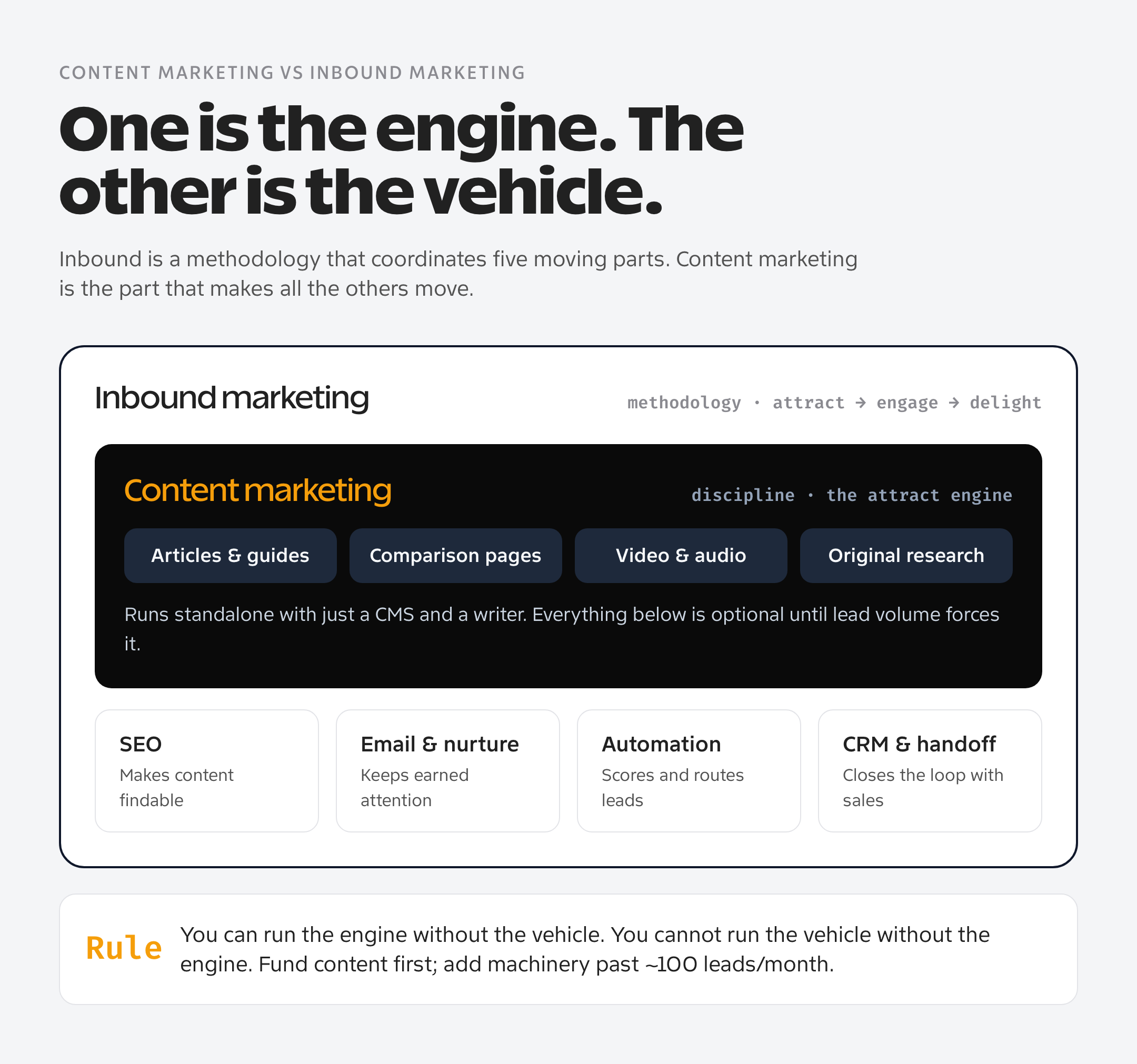
Content marketing vs inbound marketing is mostly a fake fight. Content marketing is a discipline: creating and distributing valuable content to attract and convert an audience. Inbound marketing is a broader methodology (coined by HubSpot’s founders in 2005 to describe, and frankly to sell, a software-shaped way of doing marketing) that uses content marketing as its engine, alongside SEO, email, social, and lifecycle automation. One is the motor. The other is the whole vehicle plus the driving philosophy.
The distinction sounds academic until budget season, when someone asks whether to ‘do inbound’ or ‘do content,’ and the answer determines what gets hired, bought, and measured. I’ve run both flavors for clients, and this guide covers what each term actually means, where they overlap, where they genuinely differ, and the order I’d invest in 2026 if the budget only covers one starting point.
What Is Content Marketing?
Content marketing is the practice of publishing useful or entertaining content (articles, guides, videos, tools, newsletters) to earn an audience’s attention and turn some of it into revenue. The term predates inbound by years: Joe Pulizzi was evangelizing it in the early 2000s and founded the Content Marketing Institute around it in 2011. It’s channel-agnostic. A blog post is content marketing, but so is a YouTube series, a comparison page, or an original research report.
What content marketing is not: a synonym for blogging, and not automatically tied to any funnel software. The discipline’s core bet is simple and measurable, which is why 83% of marketers rate content as their most effective demand-generation method. The economics behind that number, including the 9-to-12-month breakeven, are in my content marketing ROI breakdown.
What Is Inbound Marketing?
Inbound marketing is a methodology that says: earn attention by being findable and helpful, then convert it through progressively deeper engagement, instead of buying interruptions. Brian Halligan and Dharmesh Shah coined the term alongside founding HubSpot in 2005-2006, and the framework matured into the attract-engage-delight flywheel that replaced their original funnel diagram in 2018.
Inbound’s toolkit is wider than content: SEO, marketing automation, lead scoring, email nurture, chatbots, CRM-driven personalization, and yes, all of content marketing, which does the ‘attract’ work. That width is also the honest criticism: inbound as a package tends to assume you’re running a platform like HubSpot (from $890/month for Marketing Hub Professional) and staffing lifecycle operations, which is a real commitment for a small team.
Content Marketing vs Inbound Marketing: The Actual Differences
The practical differences come down to scope, tooling, and what you measure. Content marketing is a production discipline you can run with a writer and a CMS; inbound is an operating system that coordinates content with automation and sales handoff:
| Content marketing | Inbound marketing | |
|---|---|---|
| What it is | A discipline: make content that earns attention | A methodology: attract, engage, delight |
| Coined by | Popularized by Joe Pulizzi, early 2000s | HubSpot’s founders, 2005-2006 |
| Scope | Content creation + distribution | Content + SEO + email + automation + CRM |
| Minimum stack | CMS and a writer | CMS + automation platform + CRM |
| Typical entry cost | $2,500-$10,000/mo for a real program | Same content cost + $890+/mo platform + ops time |
| Measured by | Traffic, leads, pipeline from content | Full lifecycle: MQL → SQL → customer → expansion |
| Fails when | No distribution or no conversion path | Ops complexity outruns the team running it |
The overlap is deliberately huge: you cannot run inbound without content marketing, because content is what search engines index, what emails deliver, and what social feeds share. The reverse isn’t true. Plenty of effective content programs run without lead scoring or automation, converting through a simple contact form and a fast sales reply.
Where Each One Wins
Content marketing wins when the buying journey is short or search-driven; inbound wins when the journey is long, multi-touch, and sales-assisted. Concretely:
- Content marketing alone is enough for local services, e-commerce, productized services, and any business where a reader can become a buyer in one or two visits.
- Inbound’s machinery earns its cost in B2B with 3-to-18-month sales cycles, multiple stakeholders, and deal sizes over roughly $10K, where nurture and lead scoring change close rates.
- Content-first, inbound-later is the right sequence for almost everyone else: build the content asset base, then add automation once leads exist to automate.
- Inbound-first is almost always wrong: automation with no content is a sprinkler system with no water. I’ve audited more than one $890/month HubSpot instance nurturing forty contacts.
If you’re building the content base first, the sequencing in my SEO content strategy framework covers which pages come first, and my guide to creating a content marketing strategy handles the planning layer.
Has Inbound Marketing Aged Well? A 2026 Reality Check
Inbound’s core premise (be findable when buyers search) held up; its 2010s mechanics didn’t all survive. Three shifts matter in 2026:
- AI answers eat top-of-funnel clicks. AI Overviews and assistants resolve many informational queries with no visit, so ‘attract’ now includes being cited by AI engines, not just ranking. Informational CTR drops of 30-60% on AI-Overview queries are widely documented.
- Gated-content nurture weakened. Buyers expect ungated depth; the ebook-behind-a-form play converts a fraction of what it did when inbound was codified. The modern trade: give the asset away, retarget the readers.
- Email and community got stronger. Owned audiences are the hedge against both algorithm and AI-answer volatility, which quietly makes inbound’s ‘engage’ layer more valuable even as its ‘attract’ layer gets taxed.
Net: the methodology survives, renamed in practice. Most teams now just call it ‘marketing’ and argue about the budget lines, which brings us to the only question that matters.
Which Should You Invest In First?
Invest in content marketing first, and graduate into inbound machinery when three conditions are true: you generate 100+ leads a month, sales can’t follow up manually anymore, and deals involve multiple touches. That’s the whole decision rule. Before those thresholds, every automation dollar does less than the same dollar spent on another money page or a better comparison article.
The one exception worth naming: if you already have traffic (say, 30K+ organic visits a month) and no conversion architecture, skip straight to inbound’s middle layer, because your bottleneck is capture and nurture, not attention. That’s rarer than founders think… traffic problems outnumber conversion problems about ten to one in the audits I run. If you’d rather buy the whole engine assembled, that’s the subscription model I priced out in my guide to content marketing as a service.
A Short History, Because It Explains the Confusion
The two terms feel interchangeable because they were born from the same rebellion against interruption advertising, a few years apart, by people selling different things. The timeline that untangles it:
- 1999: Seth Godin publishes Permission Marketing, the intellectual ancestor of both terms: attention should be earned, not seized.
- 2001: Joe Pulizzi starts using ‘content marketing’ at Penton Custom Media; custom publishing had existed for decades (John Deere’s The Furrow since 1895), but now it had a name.
- 2005-2006: Halligan and Shah found HubSpot and coin ‘inbound marketing’ as both a philosophy and, functionally, a product category for their software.
- 2011: Pulizzi founds the Content Marketing Institute; the discipline gets a research body and an annual B2B benchmark study that still runs.
- 2018: HubSpot retires the funnel for the flywheel, folding customer experience into inbound.
- 2024-2026: HubSpot pivots hard into AI (the Breeze suite), and ‘inbound’ quietly recedes as a brand while its ideas get absorbed into default marketing practice.
Notice the pattern: content marketing was named by publishers, inbound by software founders. Each term optimizes for what its namers sold. That’s not cynicism, it’s just useful context when a vendor tells you one ‘replaced’ the other.
The Minimal Stack for Doing Both (Without Enterprise Pricing)
You can run a genuine content-plus-inbound motion for under $150 a month in tools, and I’ve set this exact stack up for clients who assumed they needed a five-figure platform commitment:
- CMS: WordPress, self-hosted, ~$30/month on solid managed hosting. The content asset base lives here, on a domain you own.
- Email + automation: FluentCRM (from ~$129/year) or Kit (from $29/month) covers capture, tagging, and the three nurture sequences that matter: welcome, post-download, and pre-sales.
- CRM: a free HubSpot CRM seat or a spreadsheet until 100 leads/month. Genuinely. The discipline of fast follow-up beats the sophistication of scoring at this size.
- Analytics: GA4 plus Google Search Console, both free, wired the way I described in the ROI guide: conversions defined, content grouped, source captured.
- Scheduling/social: one scheduler (~$20/month) to redistribute every article three ways. Distribution is the half of content marketing most programs skip.
Total: roughly $90-$150 a month, against HubSpot Marketing Hub Professional at $890 plus onboarding. The platform earns its premium at scale (revenue attribution, lead scoring across thousands of contacts, sales-marketing handoff SLAs). Below that scale, the money belongs in content production, where it compounds instead of administrating.
Content Marketing vs Inbound Marketing: FAQ
The versions of this question I get asked most, answered straight:
Is content marketing the same as inbound marketing?
No. Content marketing is a discipline (creating valuable content to attract and convert an audience). Inbound marketing is a broader methodology that uses content marketing as its attract engine, plus SEO, email nurture, automation, and CRM-driven lifecycle marketing.
Is content marketing part of inbound marketing?
Yes. Content is the fuel of every inbound program: it’s what ranks in search, fills email sequences, and feeds social. You can run content marketing without inbound’s automation layer, but you can’t run inbound without content.
What’s an example of the difference?
Publishing a comparison guide that ranks on Google is content marketing. Inbound is the full chain: the guide attracts a visitor, a related checklist captures the email, a nurture sequence scores their engagement, and a rep gets alerted when they hit the pricing page.
Which is better for small businesses?
Content marketing first. It needs only a CMS and consistent production, and it builds the asset base everything else depends on. Add inbound machinery (automation, scoring, nurture) when manual follow-up breaks, typically past 100 leads a month.
Do I need HubSpot to do inbound marketing?
No, though HubSpot coined the term and the methodology fits their software deliberately. You can assemble inbound with a CMS, an email tool, and a CRM. HubSpot’s Marketing Hub Professional starts around $890/month; a small-team stack can replicate the core for under $150.
Is inbound marketing still relevant in 2026?
The philosophy (earn attention, don’t rent it) is more relevant than ever. The 2010s tactics aged unevenly: gated ebooks and drip-heavy nurture weakened, while being citable by AI engines, owned email audiences, and helpful ungated depth got more valuable.
What about outbound: is it the opposite of both?
Outbound (cold email, ads, calls) interrupts strangers; inbound earns volunteers. Mature programs run both: content compounds while outbound fills the near-term pipeline. It’s a mix ratio, not a religion.
My Verdict
Stop choosing between the terms. Fund content marketing as the base layer, because nothing else in the inbound stack works without it, and hold the automation spend until lead volume forces the issue. When someone pitches you ‘an inbound program,’ ask what percentage of the retainer goes to producing content people actually search for. If it’s under half, you’re buying software administration with a philosophy attached.
The magnet doesn’t work without the metal.
Tell Google you want more of this.
Add Gatilab as a preferred sourceOne tap, and this site shows up more often in your own Top Stories, AI Overviews and AI Mode. Remove it any time.