
Marketing Budget Template for Small Businesses
Marketing spend is easy to underestimate when the budget only lists invoices. The hours your team spends writing a campaign or answering inquiries quietly drop out of the math, and a channel ends up looking cheaper than it really is.
A marketing budget template should separate cash spending from internal time and compare the plan with what actually happened. I would start with one monthly view your team can keep up to date, then connect spending to qualified inquiries using a definition everyone agrees on. The free workbook below has a blank plan and a fully worked example.
How the Marketing Budget Template Works
The workbook has 2 sheets with identical columns. Budget is your working sheet, and Example shows fictional values so you can see the calculations before entering your own.
You fill in these columns:
- Channel or activity.
- Planned cash spend.
- Actual cash spend.
- Internal hours.
- Internal hourly cost.
- Qualified inquiries.
- Notes on allocation or attribution.
The workbook calculates these:
- Internal labor cost: hours multiplied by hourly cost.
- Total actual cost: actual cash spend plus internal labor.
- Cash variance: actual cash spend minus planned cash spend.
- Cost per qualified inquiry: total actual cost divided by qualified inquiries, shown only when the inputs exist and the count is above zero.
A positive cash variance means the activity went over its planned budget, and a negative one means it spent less. Lower spending isn’t automatically good news, because a campaign that never launched also comes in under budget.
Decide What Belongs in the Budget
A useful marketing budget covers the work needed to create and convert demand. The exact categories depend on how your business reaches customers.
A small service business might include:
- Paid advertising.
- Content creation and distribution.
- Email software and campaign work.
- Design or landing-page work.
- Measurement and reporting.
- Contractor fees tied to marketing.
The workbook doesn’t prescribe a percentage for each category. Spending should follow the business’s actual constraint. A company that handles inquiries poorly should usually fix the follow-up before buying more visitors.
Kevin Indig, who writes the Growth Memo newsletter, splits a plan by how well each activity can be measured:
Proven work like technical SEO, content refreshes and digital PR that earns citations gets full funding. Unmeasurable bets and experiments get their own line, based on judgment.
Kevin Indig on X, October 7, 2026
The workbook holds that split easily. Give each experiment its own row, so its cost stays visible without blurring the inquiry cost of the channels you already understand.
For the bigger financial picture, the small-business budgeting guide covers the budget beyond marketing. Your marketing sheet should reconcile with that business budget, so nobody ends up explaining 2 different sets of numbers.
Separate Cash and Internal Labor
Cash spending is what you pay for the activity during the period. Internal labor estimates the cost of the work your own team does.
Chase Dimond, a partner at an ecommerce email agency, sees exactly this gap when founders try to work out what their email program returns:
the revenue side of email lives in one dashboard, and the cost side lives in five.
ESP invoice, SMS bill, agency retainer, design hours nobody’s tracking.
Chase Dimond on X, July 15, 2026
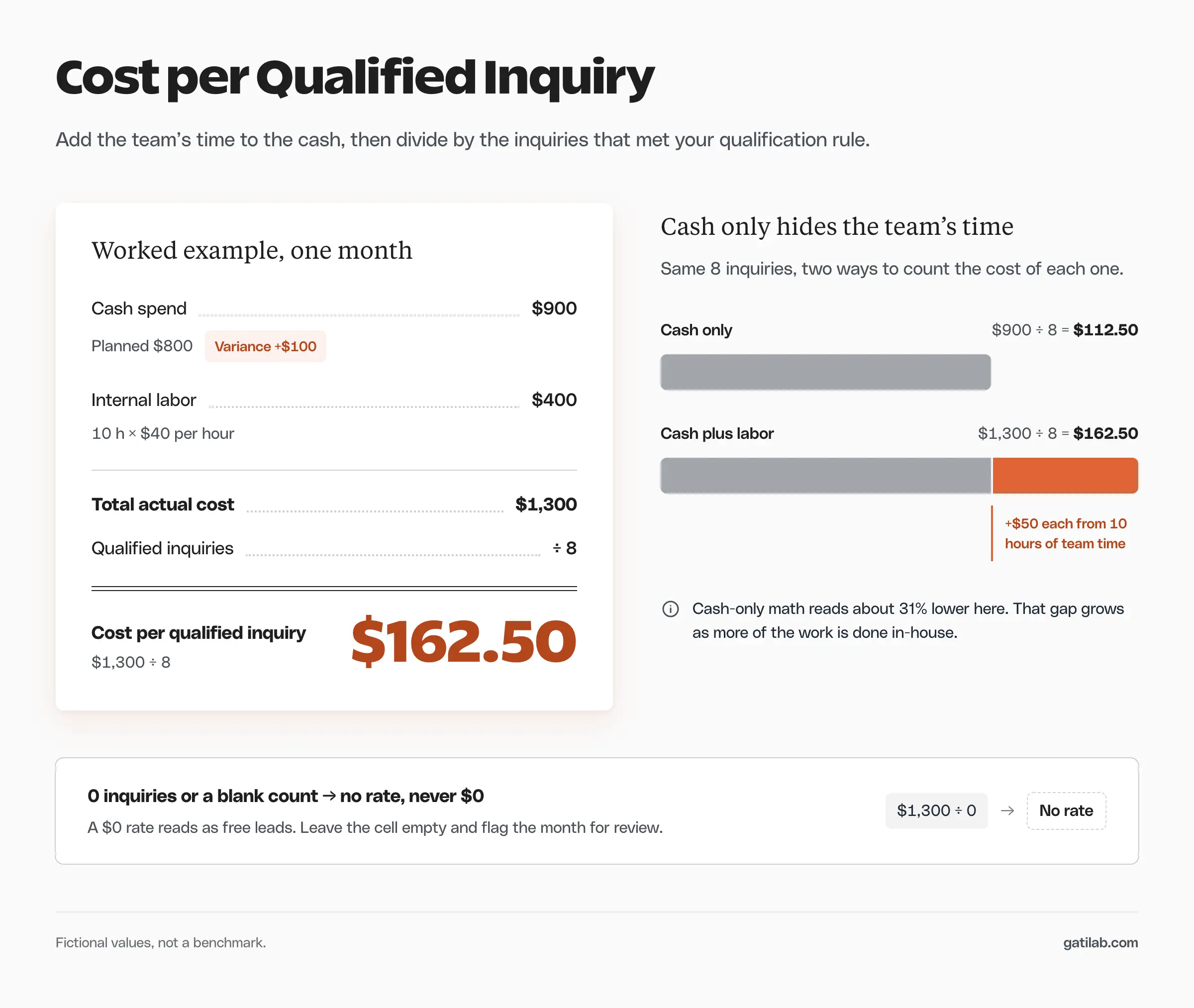
Here is the fictional campaign from the Example sheet:
- Planned cash spend: $800.
- Actual cash spend: $900.
- Internal work: 10 hours.
- Internal hourly cost: $40.
- Qualified inquiries: 8.
The workbook turns that into:
- Internal labor cost: 10 × $40 = $400.
- Total actual cost: $900 + $400 = $1,300.
- Cash variance: $900 – $800 = $100 over plan.
- Cost per qualified inquiry: $1,300 ÷ 8 = $162.50.
These are illustrative numbers, not a benchmark. Counting cash alone, the same campaign would cost $112.50 per inquiry, which looks about 31% cheaper only because the team’s time disappeared. Both numbers can be useful as long as you say what each includes. The workbook’s inquiry-cost column uses total actual cost.
An owner’s time belongs in the sheet even when it never shows up as an invoice. Use a documented estimate of what that time costs the business.
Use Consistent Periods and Definitions
Choose the reporting period before comparing channels. A monthly ad invoice and a quarterly contractor payment won’t compare fairly until you decide how to spread the quarterly one.
Use the notes column to explain exceptions such as:
- An annual software charge spread across months.
- A one-time landing-page build.
- A refund or credit.
- Work shared by several campaigns.
- An inquiry whose source is uncertain.
The template is a planning and management tool, not an accounting system. Your finance records decide how cash and expenses are recognized. Keep the budget’s convention consistent and write it down wherever a reader might misread a result.
Define a Qualified Inquiry
A qualified inquiry should meet the conditions your business actually needs for a useful sales conversation. A website-services business might require a relevant project and a contact who can discuss its scope.
Agree on that definition before anyone enters counts. Otherwise one person counts every form submission while another counts only calls sales accepted, and the cost per inquiry means nothing.
A blank inquiry count means the number hasn’t been entered yet. A confirmed 0 means the activity produced no qualified inquiries. In both cases the workbook shows n.a. for cost per inquiry instead of $0, so nothing looks like free acquisition.
Handle Attribution Carefully
A prospect might read an article, come back through an email and later contact sales directly. Crediting that inquiry to one channel is a reporting convention, and the other touches may still have done real work.
Jason Cohen, the founder of WP Engine, is blunt about multi-touch models:
Multi-touch marketing attribution nearly impossible.
Even Shopify’s 600-person killer growth team can’t do it. They look at incremental channel lift only.
Jason Cohen on X, May 29, 2026
A small business has far less data than that team, so a simple, stable convention with its uncertainty written down is the practical choice. Pick a rule your team can explain and keep it fixed while you compare months. If you can’t attribute an inquiry reliably, record that in the notes rather than inventing an allocation to make every row look complete.
The content marketing ROI guide explains why acquisition cost and attributed revenue need careful comparison. Cost per qualified inquiry measures one stage of the funnel; it doesn’t tell you profit.
How to Use the Workbook
A first monthly review takes no dashboard at all:
- Choose the reporting month and the currency.
- List the marketing activities you’ll actually run.
- Enter planned cash spend.
- Add actual spend and internal hours as the work happens.
- Enter qualified inquiries using the agreed definition.
- Review the calculated costs alongside the notes.
- Decide which activity needs a closer look or a different allocation next month.
Keep the Example sheet out of your totals. The Budget sheet starts blank, and its formula columns should stay intact when you enter data. If you need more rows, copy a complete formula row and check the references in the new one.
Use one currency per review. Convert under a documented rate before combining values, because dollars and rupees typed into the same column produce a total that means nothing.
The formulas are plain IF, COUNT and arithmetic, with no macros or external connections, so the file opens in Excel and imports cleanly into Google Sheets. Check the formatting after an import before you make it your working copy.
Review Spending Before Changing the Plan
An expensive inquiry can still be worth it if it leads to profitable work. A cheap one wastes time if it keeps asking for services you don’t offer. Look at quality alongside cost before moving money.
These situations deserve a closer look:
- Spending rose but the campaign’s scope didn’t change.
- Costs are low because planned work wasn’t done.
- This month’s inquiry count uses a different definition from last month’s.
- A channel looks efficient because shared labor was left out.
- A small sample is being treated as a stable trend.
A marketing audit helps when the problem goes beyond one row. The sheet should make the next question clearer. One red number on its own is no reason to cut or grow a budget.
FAQs on Marketing Budgets
There is no universal percentage, because margins, growth stage and sales capacity differ. Start with the work needed to fix the current business problem and check whether the business can fund it. A percentage can serve as a planning reference once you know what it has to cover.
Include the part you choose to treat as marketing cost under your convention. A redesign often serves operations or support too, so record the split in the notes so the full cost isn’t charged to several activities at once.
Yes. The workbook uses ordinary formulas with no macros, so it imports into Google Sheets or another spreadsheet app. Check the formatting and a few calculated cells after importing.
Cash variance compares actual cash spend with the plan for the same activity. Cost per qualified inquiry divides the total actual cost, including labor, by the inquiries it produced. The first tells you about budget discipline, the second about efficiency.
Monthly works for most small teams, because it’s frequent enough to catch overspending and slow enough to collect meaningful inquiry counts. Compare quarters before making big reallocation decisions on a small sample.
Final Remarks
Enter one month of real numbers, including your team’s hours, and look hardest at the row you understand least. In my view that row usually tells you more about the plan than the biggest line item does.
Daniel Priestley, founder of Dent Global and ScoreApp, argues for a different way to set the budget once you have that data:
Stop setting your marketing budget as a fixed annual number. Start setting it as an allowable cost per lead or per sale.
Daniel Priestley on X, May 21, 2026
That approach needs a reliable cost per qualified inquiry and a sense of how many inquiries become profitable work. The workbook gives you the first of those numbers.
Tell Google you want more of this.
Add Gatilab as a preferred sourceOne tap, and this site shows up more often in your own Top Stories, AI Overviews and AI Mode. Remove it any time.