
Content Marketing Best Practices: 12 That Matter, Ranked by Leverage (2026)
Most content marketing best practices lists are twenty items of equal-weight advice, which is another way of saying no advice at all. So here’s the same genre with the honesty turned on: twelve practices, ranked by leverage, with the reason each one sits where it does. The top three do more than the bottom nine combined. If you only fix what’s above the fold here, you’ll beat most of your competitors, because most of them are polishing item twelve while item one sits broken.
Quick calibration before the list: plenty of programs still publish on instinct rather than a documented strategy that specifies numbers. The gap between average and good in this field isn’t talent. It’s sequencing, measurement, and the discipline to stop doing popular things that don’t pay.
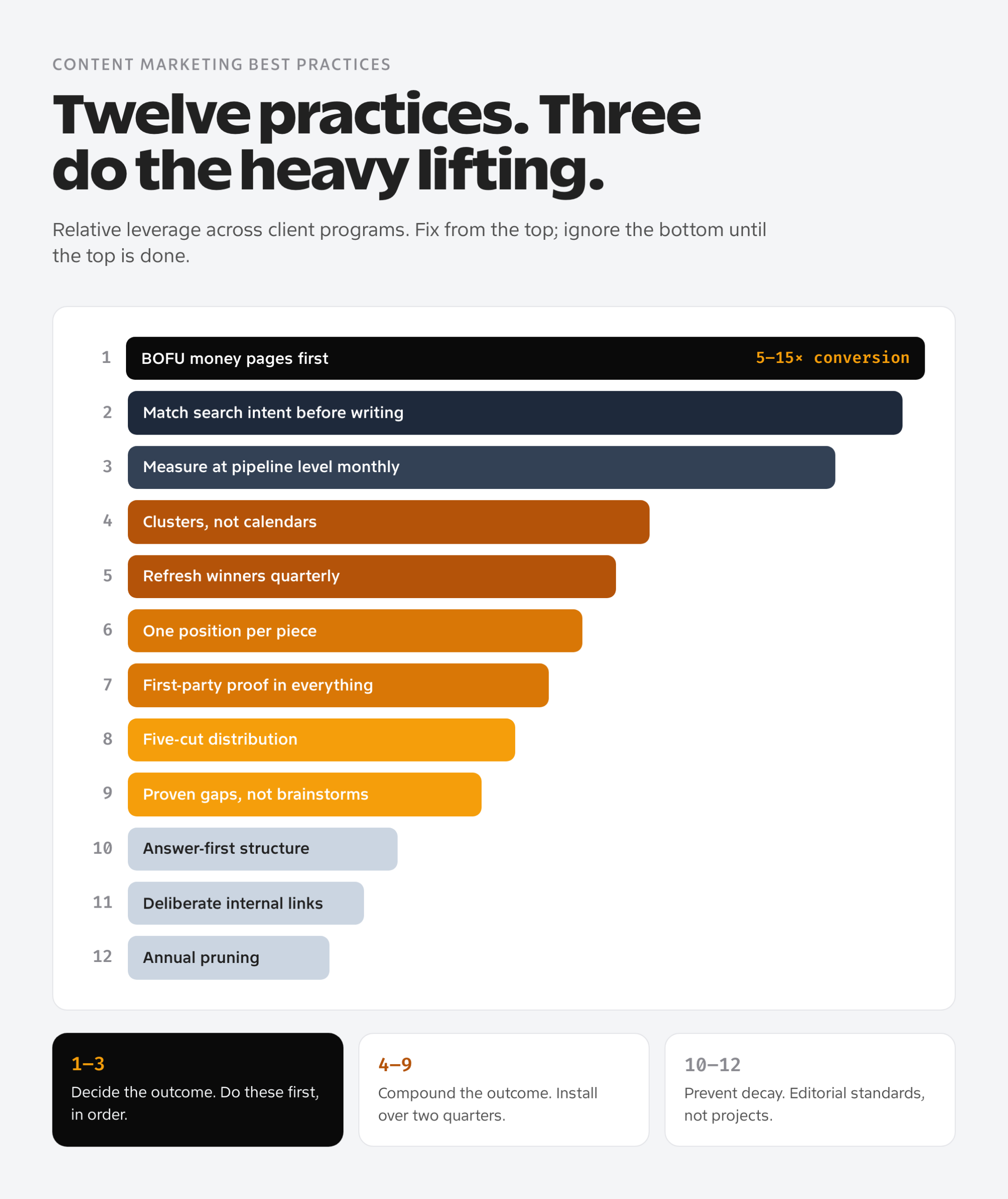
The Top Three: Where the Leverage Lives
These three practices decide most of a program’s outcome, and all three happen before or after writing, not during it:
- 1. Build bottom-of-funnel pages before anything else. Comparison, alternatives, pricing-explainer, and use-case pages convert far better than informational posts because the reader is already comparing options. The usual pattern behind a program that ‘isn’t working’ is the inverse: forty blog posts, zero comparison pages. Sequence: money pages first, then the informational content that feeds them internal links.
- 2. Match search intent before optimizing anything. The page type has to match what Google already rewards for the query: if the SERP shows listicles, a beautiful essay will not rank. Check the top five results’ format before briefing a single word. Intent mismatch is the most common fatal, invisible error in content marketing.
- 3. Measure at the pipeline level, monthly. Conversions, pipeline value, cost per SQL, not traffic. The full setup takes an afternoon (I walked through it in my content marketing ROI guide) and changes every decision downstream, because you finally see which content pays.
The Middle Six: Compounding Habits
These six practices separate programs that grow from programs that plateau. None is urgent; all compound:
- 4. Organize content in clusters, not calendars. A pillar page plus supporting articles interlinked around one topic builds ranking authority that isolated posts never accumulate. The mechanics are in my content cluster strategy guide.
- 5. Refresh winners before writing new posts. A post at position 6 refreshed to position 3 doubles its clicks with zero new URLs. Quarterly, update the ten pages closest to page-one breakthroughs. Highest ROI-per-hour activity in the discipline.
- 6. Put a specific point of view in everything. Recommend one thing, not five. ‘It depends’ content gets read and forgotten; positions get cited, argued with, and remembered. AI engines quote sources that say something definite, too.
- 7. Show first-party evidence. Screenshots, test results, client numbers, your own data. It’s the only content moat left: a competitor can paraphrase your structure in an afternoon, but not your receipts.
- 8. Distribute every piece at least five ways. The repurposing pipeline from my social media content plan: claim post, framework graphic, short video, proof cut, question post. Production without distribution is journaling.
- 9. Fill proven gaps, not brainstormed ones. Run a content gap analysis against competitors who already rank; write what has demonstrated demand and a beatable incumbent. Ideation meetings are where budgets go to feel productive.
The Last Three: Hygiene That Prevents Decay
Lower leverage, still load-bearing. Skip these long enough and they quietly tax everything above:
- 10. Keep titles and intros answer-first. Verdict in the first 150 words, direct answers at the top of every section. Readers, featured snippets, and AI citation all reward extractable structure.
- 11. Maintain internal links deliberately. Every informational post links to a money page with descriptive anchors; every new post gets three links from older posts within a week of publishing. Orphan pages rank like orphans.
- 12. Prune what’s dead. Annually, consolidate or delete pages with no traffic, links, or purpose. Thin, decaying content drags sitewide quality signals, and ‘we might need it’ is not a purpose.
Best Practices That Aren’t (Skip These)
Some standard advice costs more than it returns, and dropping it is itself a best practice. Three I’d cut from most programs today:
- Publishing frequency as a goal. ‘Two posts a week’ with no intent-matched targets produces volume, not pipeline. Ten right pages beat a hundred adequate ones. Cadence is an input; treating it as a KPI is how teams celebrate 48 posts and zero revenue.
- Gating your best asset. The ebook-behind-a-form play converts a fraction of what it did in 2015, and it hides your best work from search and AI engines. Ungate the depth, retarget the readers, capture emails with something ongoing (a newsletter) instead.
- Chasing every format. Podcast, YouTube, newsletter, LinkedIn, TikTok, webinars… simultaneously. Every format added before the previous one is systematized halves the quality of both. Master one channel plus one repurposing pipeline first.
How AI Changed the List (and What It Didn’t Touch)
AI moved two items and left the fundamentals alone. What changed: answer-first structure got promoted (AI Overviews and assistants quote extractable, definite statements, and Ahrefs found that an AI Overview cuts the click-through rate of the top-ranking page by 58% on December 2025 data), and first-party evidence became the moat, because generated content commoditized everything that isn’t a receipt. What didn’t change: intent matching, BOFU-first sequencing, clusters, and pipeline measurement work exactly as they did before ChatGPT existed.
The practical AI rule for 2026: use it for research compression, outlines, and variant testing; keep judgment, positions, and proof human. Google doesn’t penalize AI-assisted text, but audiences and AI engines both discount content that could have been written by anyone, which is precisely what unedited model output is. The deeper strategic layer (which topics, which order, which channel) still lives in my SEO content strategy framework.
The 90-Day Implementation Order
Content marketing best practices fail in adoption, not in theory, usually because teams try all twelve at once. Here’s the order I’d install them in, one quarter, no heroics:
- Weeks 1-2: measurement first (practice 3). GA4 conversions, content groups, CRM source capture. You can’t sequence what you can’t see.
- Weeks 3-6: money pages (practice 1). Ship the comparison, alternatives, and use-case pages for your two most valuable offers, each intent-checked against the live SERP (practice 2).
- Weeks 7-10: the first cluster (practice 4) around your single most valuable topic, plus internal links wired from every existing relevant post (practice 11).
- Weeks 11-12: refresh the five posts closest to page one (practice 5), stand up the five-cut distribution pipeline (practice 8), and prune the obvious dead weight (practice 12).
- Ongoing from week 4: every piece ships with a position (practice 6), proof (practice 7), and answer-first structure (practice 10). These are editorial standards, not projects.
Ninety days later you have a measured, sequenced, distributed program, and you’ve spent nothing on new tooling. Most ‘our content isn’t working’ complaints would be solved by this quarter alone.
The 10-Minute Self-Audit
Want to know if your program actually follows content marketing best practices, as opposed to agreeing with them? Ten yes/no questions, one point each. Under 6, run the 90-day order above:
- Can you name your three highest-converting pages from memory?
- Does a comparison or alternatives page exist for your main offer?
- Did anyone check the live SERP before your last article was briefed?
- Is there a monthly report tying content to leads or pipeline?
- Are your posts organized into linked clusters around pillar topics?
- Did you refresh at least one existing post last quarter?
- Does your latest article recommend one thing (not five options)?
- Does it contain a number or screenshot a competitor couldn’t copy?
- Did it get repurposed into at least three social assets?
- Have you deleted or consolidated anything in the past year?
Most programs score lower than their owners expect on the first pass. Getting to 8 is usually the point where founders stop asking ‘why isn’t content working’ and start asking ‘how much more should we invest’… which is the whole difference between content as a cost center and content as an asset.
Content Marketing Best Practices: FAQ
Straight answers to the questions this topic always drags in:
What are the most important content marketing best practices?
Ranked by leverage: build bottom-of-funnel pages first (visitors there are already choosing), match search intent before writing, and measure at the pipeline level monthly. Those three outweigh everything else on any best-practices list, including this one’s remaining nine items.
Why is content marketing important?
It’s the only marketing channel where the asset compounds: a ranking page keeps producing leads for years after the production cost is sunk, while ads stop the moment spend stops.
How often should I publish content?
As often as you can publish intent-matched, evidenced pages, and no more. Two excellent pages a month beats eight adequate ones. Treat cadence as capacity planning, not as a KPI, and spend at least a quarter of production time refreshing existing winners.
What are common content marketing mistakes to avoid?
Inverted sequencing (informational posts before money pages), intent mismatch, publishing without distribution, gating your best asset, measuring traffic instead of pipeline, and adding channels before the first one is systematized. Each is the shadow side of a real best practice.
Do content marketing best practices change with AI search?
Two got heavier: answer-first extractable structure (AI engines quote definite statements) and first-party evidence (the only moat generated content can’t copy). The rest, intent matching, clusters, BOFU-first, pipeline measurement, are unchanged.
What are examples of great content marketing?
The pattern behind famous wins is consistent: a definite position plus original evidence plus years of consistency. HubSpot’s early blog built a category; Ahrefs’ product-led tutorials turned documentation into demand; smaller wins look like a services firm owning every comparison query in its niche.
How long until content marketing shows results?
First rankings in 3-6 months, breakeven around months 9-12, compounding after month 12. Any practice list that promises faster is describing ads with extra steps.
The One-Line Version
Build the pages that convert, match what search rewards, measure in pipeline, and let everything else compound behind those three. Print the top three, ignore the bottom nine until Q3, and skip the fake practices entirely.
Best practices don’t fail because they’re wrong. They fail because they’re all given equal weight, and equal weight is a decision not to decide.
Tell Google you want more of this.
Add Gatilab as a preferred sourceOne tap, and this site shows up more often in your own Top Stories, AI Overviews and AI Mode. Remove it any time.