
Content Marketing as a Service: What CaaS Costs and Who It Fits in 2026
Content marketing as a service (CaaS) is a subscription model where an outside team runs your entire content operation, strategy, writing, editing, SEO, publishing, and reporting, for a flat monthly fee. You buy an outcome (published, ranking content) instead of hiring people or approving hourly invoices. WebFX’s 2026 pricing survey puts agency content retainers at $1,000 to $20,000 a month, and the model sits between hiring freelancers directly and signing a traditional agency retainer.
Content services are sold two ways: hourly agency work and flat productized subscriptions. The subscription version is the better fit for most businesses under $5M in revenue, and a poor one in a few specific situations that sales pages rarely mention. The difference comes down to unit economics, which this guide breaks down line by line.
Verdict: content marketing as a service fits companies that need 4 to 12 pieces of ranking content per month, have a customer lifetime value above $1,000, and don’t want to manage writers. If you need deep subject-matter expertise (legal, medical, hard engineering) or your budget only covers a couple of articles a month, hire a specialist freelancer instead. A cheap subscription produces cheap content, just on a schedule.
What Is Content Marketing as a Service?
Content marketing as a service is productized content marketing: a fixed monthly subscription that covers the full content lifecycle instead of billing by the hour or by the project. The provider owns the process (keyword research, briefs, drafting, editing, on-page SEO, publishing, performance reporting) and you own the results and the content itself.
The model copied its shape from SaaS. Predictable fee, defined deliverables, cancel monthly or quarterly. Platforms like Verblio, Compose.ly, and ClearVoice run it as a marketplace with software on top. Boutique shops run it as a productized service: same subscription mechanics, but a named team instead of a rotating writer pool.
The important distinction isn’t the label. It’s what happens when you ask for something outside the package. An hourly agency says yes and bills you. A CaaS provider says no, or upgrades your tier. That constraint is exactly why the model stays affordable… and exactly why it frustrates companies with messy, changing needs.
CaaS vs Agency Retainer vs In-House vs Freelancers
A CaaS subscription buys process without headcount, and that’s the honest one-line comparison. Most growing companies get outside help with content at some point. The question isn’t whether to get help. It’s which shape of help matches your stage. The cost ranges below come from WebFX’s 2026 content marketing pricing survey of 350 digital marketers.
| Model | Monthly cost (WebFX, 2026) | You manage | Best for |
|---|---|---|---|
| Freelancers, direct | $1,000-$10,000, or $60-$200+ per hour | Everything: briefs, edits, publishing | Under ~4 posts/month, tight budgets |
| Content marketing as a service | WebFX’s own plans: $1,800-$6,000+ | Approvals only | 4-12 posts/month, no content manager on staff |
| Traditional agency retainer | $1,000-$20,000 retainers | The relationship | Custom strategy, multi-channel campaigns |
| In-house team | $5,000-$25,000+ | People | 12+ posts/month, content as a core function |
I’ve broken down what agencies actually charge and deliver in my guide to content marketing SEO services pricing, so I won’t repeat the tier math here. The short version: at the bottom of every range, every model degrades into the same thing, cheap articles from whoever’s available (the invoice just hides it differently).
The in-house number surprises people. A full-time content marketer costs a salary plus tools, benefits and management time, and a new hire still has to build the process from scratch. That’s why the subscription model exists at all: a mid-tier fee buys a share of a content team’s output plus a process that’s already running.
What Should a Content Marketing Subscription Include?
A legitimate CaaS subscription includes strategy, production, optimization, and reporting, all four layers, every month. If any layer is missing, you’re buying articles, not content marketing. Here’s the full checklist I’d hold any provider to:
- Strategy: keyword and topic research, a documented content roadmap, quarterly reviews against traffic and pipeline
- Briefs: per-article outlines with target keyword, search intent, entities to cover, and internal link targets
- Production: writing, editing, and revisions by named writers (ask for names; pools rotate quality)
- On-page SEO: titles, meta descriptions, schema, image optimization, internal linking
- Publishing: formatted uploads into your CMS, not Google Docs handoffs
- Reporting: rankings, organic traffic, and conversions, not a PDF of vanity metrics
Higher tiers add SME interviews, content refreshes, digital PR, and conversion copy. These bundles are what separate a subscription from a one-off article order.
How Much Does Content Marketing as a Service Cost in 2026?
For the wider market, WebFX asked 350 digital marketers what their companies spend and puts content marketing at $1,000 to $20,000+ per month in 2026, with blog posts at $150 to $600 each. WebFX’s own published plans show how one agency tiers a subscription: $1,800 a month for 3 content assets, $3,600 for 6 and $6,000 for 10. The tiers below describe what each level should include, so check every quote against its deliverables.
| Tier | What you actually get |
|---|---|
| Starter | 4-6 SEO articles, basic briefs, monthly report |
| Growth | 6-10 articles, strategy, refreshes, internal linking, named writers |
| Full-funnel | 10+ assets incl. landing pages, SME interviews, digital PR, CRO input |
One number to sanity-check any quote: the provider’s blended hourly rate. Ask for it, divide the monthly fee by it, and ask whether the deliverables plausibly take that many senior hours. At $90 an hour, a $6,000 subscription should represent 65+ hours of work. If the deliverable list reads like 25 hours, the margin is going somewhere else (usually a writer paid well below the $150 to $600 per blog post WebFX reports).
The Inside Math: Where Your Subscription Fee Actually Goes
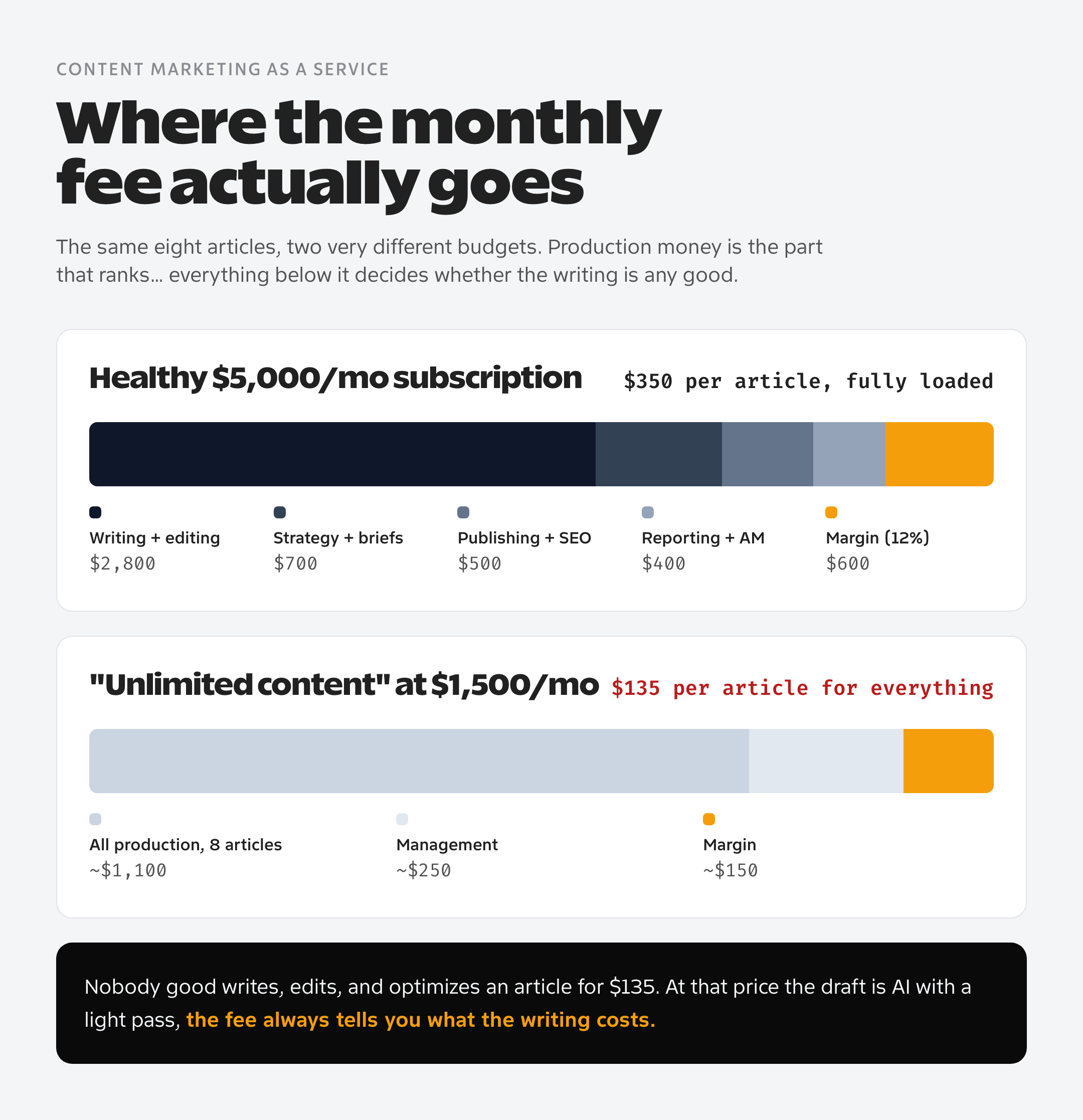
On a healthy $5,000 subscription, roughly 55 to 65 percent of the fee pays for production, and the rest is strategy, management, and margin. Here is an illustrative month, built from typical writer, editor, and management costs rather than one provider’s books:
- $2,800: writing and editing (8 articles at ~$350 fully loaded: researcher-grade writer plus a real editor pass)
- $700: strategy and briefs (keyword research, outlines, internal-link mapping)
- $500: publishing, formatting, images, schema
- $400: reporting and account management
- $600: margin (12%, and yes, that’s thinner than clients assume)
Now run the same math on a $1,500 ‘unlimited content’ subscription. After even 10% margin and minimal management, production gets about $1,100 a month. If they ship eight articles, that’s $135 per article for writing AND editing AND SEO. Nobody good works at that rate. The output is AI drafts with a light human pass, exactly what Google targeted with its March 2024 core update, which it says left 45% less low-quality, unoriginal content in search results. Cheap subscriptions didn’t get cheaper. They got riskier.
That’s also why competing on price is a losing game for providers. The clients who churn over price tend to be the same ones who churn over results six months later, at any provider.
When Does Content Marketing as a Service Make Sense?
CaaS pays for itself when your buyer researches before buying and your customer value clears the content cost with room to spare. Three conditions, all required:
- Your average customer LTV is above $1,000 (below that, the payback math rarely closes)
- You need consistent output, 4 to 12 pieces monthly, and nobody on staff owns content
- You can commit 9 to 12 months; organic compounding is slow before it’s fast
Skip the subscription model entirely if any of these describe you:
- You need deep regulated-industry expertise (legal, medical, finance); buy specialist freelancers instead
- You’re pre-product-market-fit; you’ll change positioning before the content ranks
- Your budget only covers a couple of articles a month; one great article beats four mediocre ones, every time
- You want brand campaigns, PR stunts, or virality; that’s agency work, not subscription work
The pattern behind both lists: subscriptions reward predictable, repeatable content needs. The moment your needs become bespoke, the retainer models I covered in my breakdown of retainer models clients keep paying for fit better, because scope flexibility is what you’re actually buying.
How to Evaluate a CaaS Provider Before You Sign
Ask every provider the same five questions and compare answers side by side. The tells are consistent across the industry:
- Who writes my content, by name? ‘Our writer network’ means a rotating pool. Named writers mean accountability.
- Show me three pieces that rank today, with the client named. Anonymized samples hide expired results.
- What happens in month one? A separately billed ‘content audit’ before any article ships is margin padding. Strategy should be baked into the fee.
- How do you use AI? The right answer names a workflow (research, outlines, first drafts with human rewrite). ‘We never use AI’ in 2026 is either false or inefficient.
- What’s your churn rate? Providers with 12-month average retention will tell you. Providers with 4-month retention will change the subject.
And check their own site. A content provider whose blog hasn’t shipped anything in 90 days, or whose own pages don’t rank for their service keywords, is selling a treadmill they don’t run on. This is the same diligence I recommend for picking any partner in my marketing agency guide, but with content the evidence is public and searchable. Use that.
How AI Changed CaaS Pricing (and What That Means for Buyers)
AI collapsed the price of drafting and left the price of judgment untouched, and that split rewrote every subscription tier between 2023 and 2026. A first draft that used to take a writer hours now takes a fraction of that time in an AI-assisted workflow. Some providers passed the savings on. Most didn’t. They kept prices flat and moved the spend up the stack, into SME interviews, original data, and editors who know the niche.
As a buyer, this gives you a clean test. Ask what the provider does with the hours AI freed up. The good answer sounds like: more interviews with your team, more content refreshes, more internal-link and conversion work. The bad answer sounds like: more articles. Volume was never the constraint… ranking was, and Google’s spam updates made volume a liability. In CMI’s 2026 B2B research, 87% of marketers using AI for content creation say productivity improved, yet the teams that call their content effective credit content relevance and quality (65%) ahead of everything else.
There’s a second-order effect nobody prices in: AI search. ChatGPT, Perplexity, and Google’s AI Overviews now sit between your content and your buyer. Subscriptions worth signing in 2026 include entity optimization, extractable answer formatting, and citation tracking in the base tier, the on-page work that gets content quoted by AI engines, not just ranked. If a provider’s sample brief doesn’t mention AI Overviews or answer-first structure, their playbook is from 2022.
How to Run a CaaS Engagement So It Actually Works
The engagements that fail usually fail in the first 45 days, and it’s the buyer’s process, not the provider’s writing, that decides it. The same subscription can produce a strong year for one client and nothing for another, and the difference is usually operational:
- Give them one decision-maker. Content approved by committee ships late and reads like a committee wrote it. One owner, 48-hour approval SLA.
- Do the SME interviews. The single highest-leverage hour of your month is a founder or engineer talking into a recorder. Providers can’t fake your expertise; they can only package it.
- Front-load access: CMS logins, analytics, brand docs, customer-call recordings, past content inventory. Every week of delayed access is a week of generic output.
- Agree on kill criteria upfront. A reasonable one: if zero target keywords crack the top 20 by month five, the strategy is wrong, and you change it or part ways. Write yours into the contract.
- Review quarterly against pipeline, not pageviews. Traffic that doesn’t touch revenue for three straight quarters is a vanity subscription.
One more thing buyers underweight: refreshes. Around month six, updating and expanding your 10 best-performing pieces beats publishing 10 new ones, and a provider who proposes that (billing you the same fee for ‘less’ new content) is optimizing for your results over their optics. That’s a keeper signal.
Content Ownership, Contracts, and How to Leave Cleanly
You should own every deliverable outright the moment you pay for it, drafts, briefs, keyword research, and the content calendar included. Most subscription contracts get this right for published articles and quietly wrong for everything else. The strategy artifacts are where switching costs hide.
- Demand work-for-hire language covering all deliverables, not just ‘final content’
- Publish into your CMS from day one. Content living in the provider’s Google Drive is leverage against you
- Monthly or quarterly terms, never annual lock-ins. A provider confident in results doesn’t need a 12-month cage
- Offboarding clause: full handover of research, briefs, calendars, and access within 14 days of cancellation
When you do switch providers, and most businesses eventually do, the handover quality tells you everything about who you hired. A provider that hands over one zip file of Word docs, with no keyword map, no brief archive and no explanation of what was targeting what, leaves the next team to rebuild that context from scratch. Ask about offboarding before you sign, precisely because you won’t care until it’s expensive.
Content Marketing as a Service: FAQ
The questions buyers ask most often, answered with no deal on the table:
What does content marketing as a service mean?
It’s a subscription model where a provider runs your full content operation (strategy, writing, SEO, publishing, reporting) for a flat monthly fee. WebFX’s 2026 survey puts agency content retainers at $1,000 to $20,000 a month. You approve content; they handle everything else.
How is CaaS different from a content marketing agency?
Scope and billing. An agency retainer is custom-scoped and often hourly underneath; CaaS is a fixed package with defined monthly deliverables. Subscriptions are cheaper and more predictable, retainers are more flexible.
How much does content marketing as a service cost?
WebFX’s survey of 350 digital marketers puts content marketing at $1,000 to $20,000+ per month in 2026 and blog posts at $150 to $600 each. WebFX’s own plans run from $1,800 a month for 3 content assets to $6,000 for 10. Budgets at the bottom of the range force cheap writing that rarely ranks.
Is content marketing as a service worth it for small businesses?
Only if customer lifetime value is above roughly $1,000 and you can wait 9 to 12 months for organic traffic to compound. Below that, hire one good freelancer for fewer, better articles.
What should be included in a content marketing subscription?
Strategy and keyword research, per-article briefs, writing and editing by named writers, on-page SEO, publishing into your CMS, and reporting tied to traffic and conversions, not just output counts.
How long does content marketing take to show ROI?
Expect first rankings in 3 to 6 months and payback in 9 to 18 months depending on keyword difficulty and domain strength. Anyone promising page one in 90 days is selling either low-competition keywords or fiction.
Can AI replace a content marketing service?
AI replaces the typing, not the judgment. Google says its March 2024 core update left 45% less low-quality, unoriginal content in search results, so the working model is AI-assisted research and drafting with human strategy, expertise and editing on top. That’s what competent providers already do.
What I’d Buy at Each Budget Level
One recommendation per budget, no hedging:
- Budget for one or two articles a month: one specialist freelancer, two exceptional articles a month, and you write the briefs yourself. Skip subscriptions entirely at this level.
- Budget for a steady 4 to 6 articles a month: a boutique CaaS subscription with named writers. This is the sweet spot where the model beats both freelancers (process) and agencies (price).
- Budget for 6 to 10+ assets plus strategy and refreshes: a Growth or full-funnel subscription, but only after the provider passes the five evaluation questions above. At this spend, a bad quarter costs more than the diligence ever will.
- Budget at the level of a full-time salary: hire an in-house content lead and keep a subscription for production overflow. Judgment in-house, throughput outsourced.
Whichever level you’re at, connect the content plan to a documented strategy first. The framework in my step-by-step content marketing strategy guide takes an afternoon to work through, and it’s the difference between buying content and buying compounding search equity. Buyers without a documented strategy are exactly who cheap providers feed on.
The Bottom Line on CaaS
Content marketing as a service is the right default for businesses between freelancer chaos and in-house scale, roughly $500K to $5M in revenue, with real LTV behind each customer. Buy the Growth tier from a provider with named writers and public results, hold them to the four layers (strategy, production, optimization, reporting), and give it three quarters before judging.
And if a subscription costs less than a decent freelancer… believe the math, not the sales page. The fee always tells you what the writing costs. It never lies about that.
Tell Google you want more of this.
Add Gatilab as a preferred sourceOne tap, and this site shows up more often in your own Top Stories, AI Overviews and AI Mode. Remove it any time.