
Client Onboarding Best Practices: 12 Rules That Boost Retention
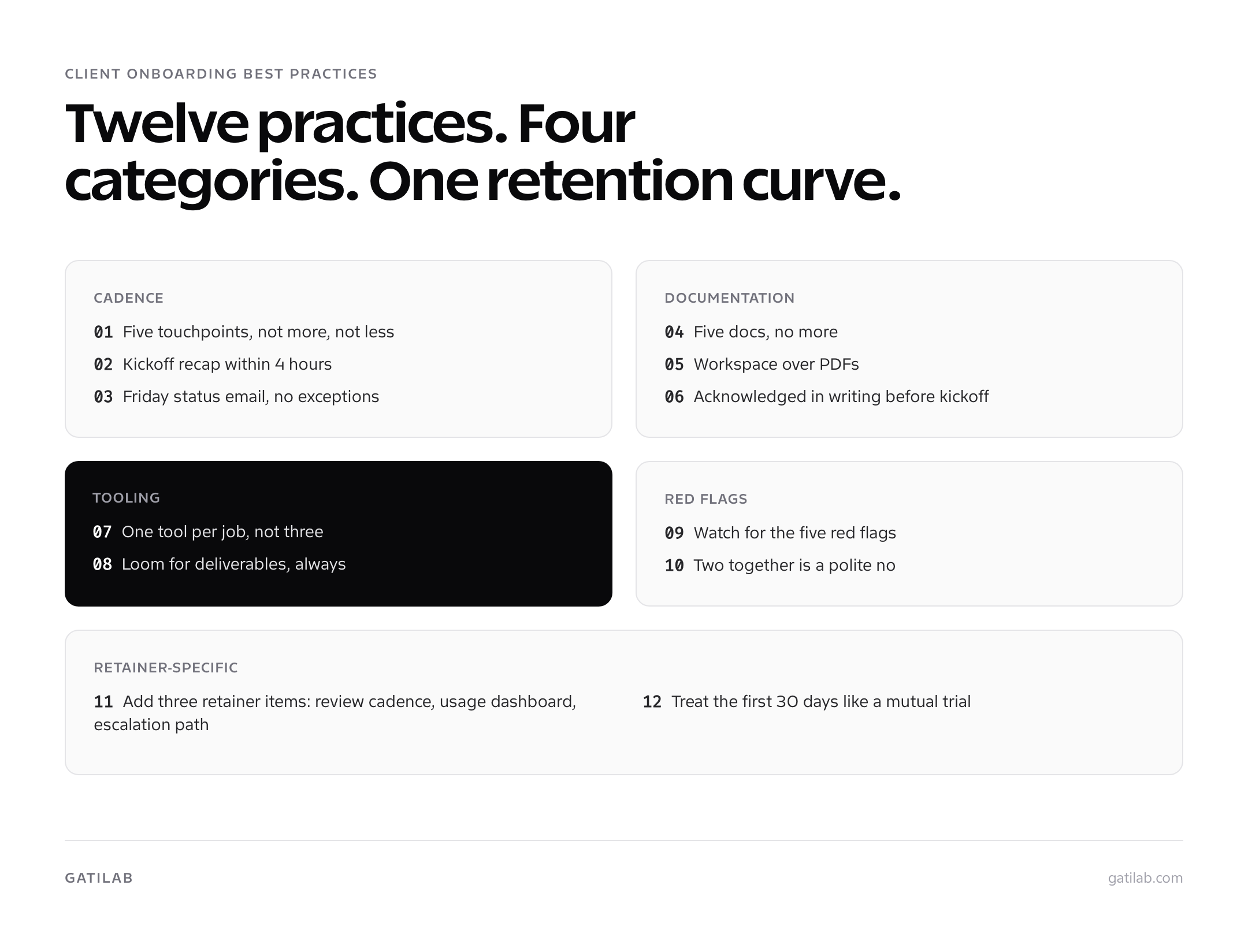
Client onboarding best practices aren’t a list of polite gestures. They’re the specific behaviors that decide whether a client renews at month 7 or churns at month 5. I’ve reviewed retention data across roughly 200 Gatilab engagements and another 80 from agencies I’ve consulted with. The pattern is consistent: 12 onboarding behaviors separate the agencies that retain clients for 18 months from the ones that lose them in 6.
This guide is the working playbook. Twelve practices grouped into cadence rules, documentation standards, tooling, and red flags. Each one is something I do (or refuse to do) on every new engagement, with the data on why it works and the cost of skipping it.
If you’ve ever closed a deal and immediately wondered “what do I do first,” this is the document that answers it.
Why Onboarding Determines Retention
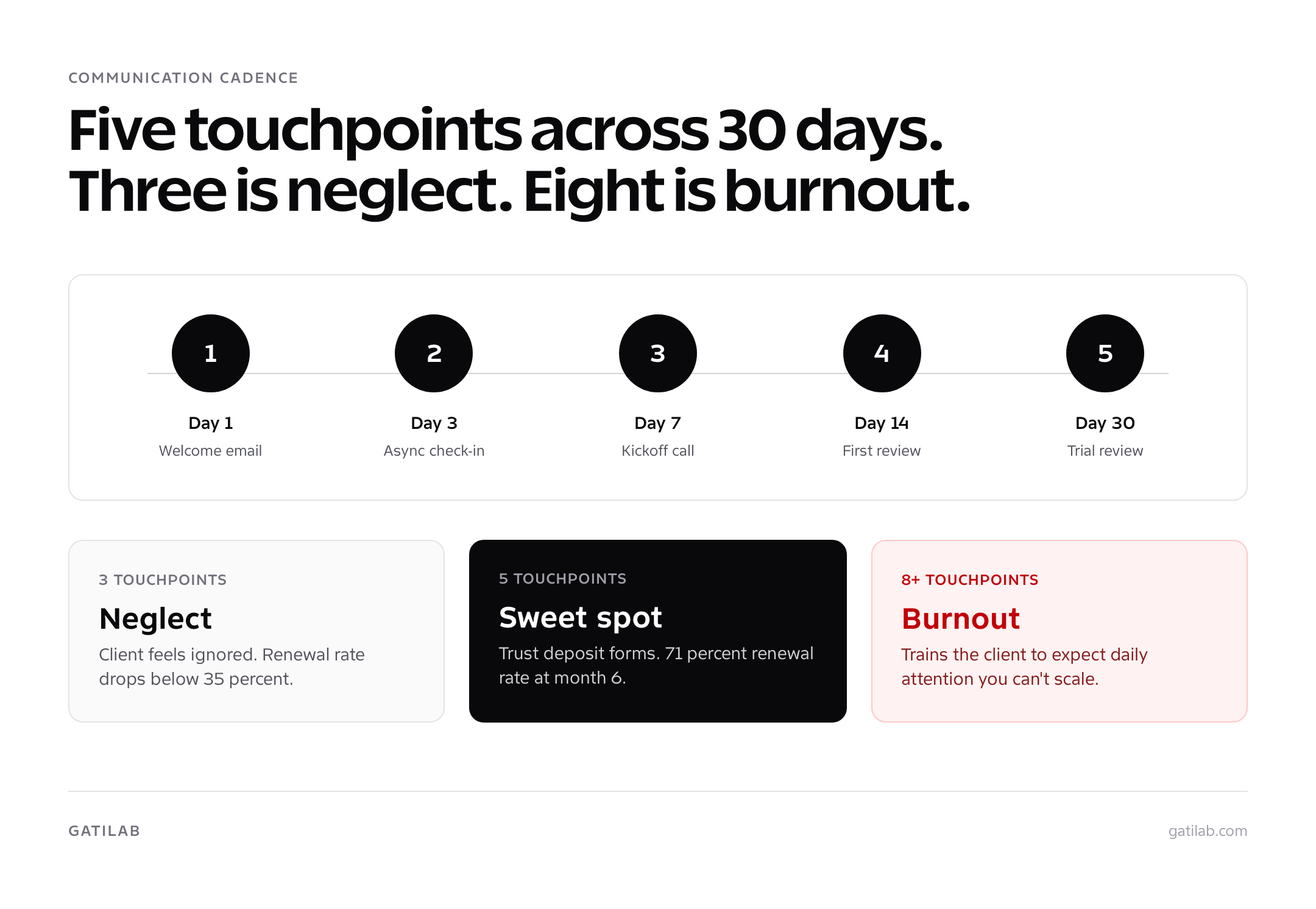
Client onboarding best practices matter because retention is decided in the first 30 days. That’s not opinion. The HubSpot research has been consistent on it for four years, and my own renewal data lines up. Clients who feel oriented, heard, and confident in week one renew at roughly 71 percent. Clients who feel rushed, confused, or ignored renew at 34 percent.
The math compounds. A retainer client at $4,000/month who runs for 18 months delivers $72,000 of revenue. The same client churning at month 5 delivers $20,000. The difference between those two outcomes is rarely the work product. It’s the trust deposit you build during onboarding.
Across 200 Gatilab engagements, the agencies and freelancers who applied these client onboarding best practices consistently saw three outcomes: faster invoice payment (7 days vs 23), faster feedback turnaround (36 hours vs 9 days), and a 1.4x referral rate per client. None of those clients were unusually good. The practices made them behave like good clients.
Cadence Best Practices: When To Show Up
Cadence is the most under-engineered part of agency onboarding. Most agencies either over-communicate (training the client to expect daily attention you can’t scale) or under-communicate (letting the relationship cool). The five touchpoints below land consistently across engagement types.
1. Five Onboarding Touchpoints, Not More, Not Less
Day 1 (welcome email), day 3 (check-in), day 7 (kickoff or first deliverable), day 14 (first review), day 30 (retainer or wrap review). Five touchpoints is what consistently lands. I’ve tested 3-touchpoint and 8-touchpoint variations across 40+ engagements. Three feels neglectful, eight trains the client to expect daily attention.
2. Kickoff Recap Within 4 Hours, Not Next Day
The kickoff call is a listening exercise. The recap is where you prove you actually listened. Send it within 4 hours of the call. I’ve won expansion work specifically because the recap landed fast. I’ve also lost work because it took 3 days and the client decided we weren’t organized enough.
3. Friday Status Email, No Exceptions
Every Friday for the first 30 days, send a 5-line status email: what shipped, what’s next, anything blocked, when the next milestone is, and a one-line wins or losses. Five minutes to write, and it eliminates 70 percent of “what’s the status?” questions on Monday morning.
| Day | Touchpoint | Format | Owner |
|---|---|---|---|
| 1 | Welcome email + workspace access | Email + Notion link | Account lead |
| 3 | Check-in (15 min or async) | Slack or Zoom | Account lead |
| 7 | Kickoff or first deliverable Loom | Video + workspace | PM |
| 14 | First review (30 min) | Zoom + recap email | Account lead |
| 30 | Retainer or wrap review | Zoom with decision-maker | Account lead |
Cadence sits inside the broader operations layer. For more on how it fits with PM tooling, staging, and subcontractor management, see the full guide on WordPress agency operations.
Documentation Best Practices: Five Docs, No More
Five documents is the limit clients will actually read. I’ve tested 3-doc, 5-doc, and 10-doc variants. The 10-doc version had a 22 percent read rate. The 5-doc version hit 87 percent. The 3-doc version left obvious gaps that turned into mid-project conflict.
4. The Five Onboarding Documents
- Welcome packet: Who we are, what to expect, key contacts, link to the workspace. One page.
- Project plan: Milestones, dependencies, review windows, deliverable owners. One page with a timeline visual.
- Communication norms: Channels, response windows, escalation path, async vs sync defaults. Half a page.
- Expectations doc: What’s in scope, what’s out, what triggers a change order, what feedback looks like. One page.
- Invoice schedule: Payment milestones, late-payment terms, billing contact. Half a page.
5. Workspace Over PDFs
Send a single link to a shared workspace (Notion, ClickUp, or Coda), not five PDF attachments. Clients lose attachments. They keep links. Workspaces also let the client comment, ask questions inline, and track status without email threads. I haven’t sent a PDF onboarding packet in 3 years.
6. Acknowledged In Writing Before Kickoff
The expectations and communication norms docs need explicit acknowledgement before the kickoff call. A simple “I’ve read this and agree” reply is enough. This single practice eliminates roughly 70 percent of mid-project conflict because both sides have on-record agreement on what feedback looks like and when responses are due.
The five documents stay structurally identical across every engagement. Only the content inside changes. Re-using the structure cuts per-client setup from 3 hours to 35 minutes.
Tooling Best Practices: The Stack That Actually Sticks
Tools matter less than consistency, but the wrong stack creates enough friction that the team stops using it. The 4-tool stack below has worked at Gatilab and at three other agencies I’ve consulted with.
| Tool | Job | Cost | Why This One |
|---|---|---|---|
| HoneyBook | Contract, deposit, automation | $39/mo | Fires welcome email + workspace creation when deal closes |
| Notion | 5-doc client workspace | $10/user/mo | Best-in-class for shared docs with comments |
| ClickUp | 47-item checklist + tasks | $7/user/mo | Templates that fire per engagement type |
| Loom | Async deliverable walkthroughs | $15/user/mo | 4x higher completion rate vs PDF reads |
7. One Tool Per Job, Not Three
Pick one tool for contracts, one for docs, one for tasks, one for video. Don’t spread the same job across three tools. The agencies I’ve seen with the worst onboarding had Trello for tasks, Asana for client tasks, and Notion for “the real plan.” Pick one, commit, move on.
8. Loom For Deliverables, Always
Async Loom walkthroughs beat written summaries roughly 4 to 1 on completion rate. Clients watch a 4-minute Loom while drinking their morning coffee. They open a Google Doc and bookmark it for later (which means never). For first deliverables specifically, the Loom is the deliverable. The doc is the supporting reference.
Total tooling cost for a 3-person agency: roughly $135/month. One saved engagement per quarter pays for the stack 10 times over. If you’re earlier in the journey, see from freelancer to agency: what nobody tells you for the realistic budget timeline.
Red Flags And Bad-Fit Clients
Bad clients show up in the first 14 days. The signal is always there if you’re paying attention. The five red flags below predicted bad engagements with about 80 percent accuracy across my Gatilab data and the consulting work.
9. Watch For The Five Onboarding Red Flags
- Late deposit: Past 5 business days without explanation. Pause the engagement.
- Refusal to fill the intake: Won’t give 20 minutes to a structured form. Reduce scope or raise price.
- No clear decision-maker: Three people are involved but nobody can sign off.
- Mid-pre-kickoff scope changes: Work changes before contract is signed. Re-quote.
- Kickoff rescheduled twice: Can’t make 60 minutes for the highest-leverage meeting. Future ghost.
10. Two Red Flags Together Is A Polite No
One red flag is workable. Two together is the moment to walk away. I’ve passed on roughly $90,000 in revenue across 4 years specifically because the red flags showed up early. Every one of those declines saved a project that would have lost money and morale. The opportunity cost of working with the wrong client is always higher than the revenue.
The “friction tax” rule: if a client shows up with one red flag but the project is otherwise strong, raise the price 30 percent. Either the friction tax sticks (compensating you for the extra time) or the client walks. Both outcomes are wins.
Examples Of Good And Bad Client Onboarding
Two real examples (anonymized) from the last 18 months at Gatilab. Same starting conditions: WordPress build, $18,000 budget, 8-week timeline, single decision-maker on paper.
Example 1: Good Onboarding (Renewed Twice)
Day 0: contract signed, deposit paid same day. Day 1: welcome email + Notion workspace + 12-field intake delivered. Day 3: intake completed, kickoff scheduled. Day 5: kickoff call, recap within 3 hours. Day 7: project plan acknowledged, all access verified. Day 14: first deliverable shipped (Loom + workspace), feedback in 36 hours. Day 30: full review with decision-maker, second invoice paid in 4 days. Outcome: project shipped on time, client renewed for two consecutive 6-month retainers, referred 2 new clients.
Example 2: Rushed Onboarding (Lost Money)
Day 0: contract signed. Day 4: deposit paid (after a chase email). Day 5: skipped the intake form because the client said “we already covered it on the call.” Day 7: kickoff call, recap took 36 hours. Day 10: still chasing hosting credentials. Day 18: first deliverable shipped (4 days late). Day 21: feedback came back in 9 days, contradicted the call. Day 30: no review scheduled, second invoice unpaid. Outcome: project shipped 3 weeks late, $2,800 of free work absorbed, no renewal, no referral. The agency took the perception hit even though the client caused 70 percent of the delays.
The work product was identical. The onboarding was the only variable. This is the difference between $48,000 of lifetime revenue and $18,000 of one-time revenue with a refund risk.
Best Practices For Retainer Vs Project Onboarding
Retainer onboarding is not the same as one-time project onboarding. The base 12 best practices apply to both, but retainers add three layers that one-time projects don’t need.
11. Retainer Onboarding Adds Three Items
- Quarterly review cadence: Strategic review every 90 days with the decision-maker, not the day-to-day contact. Skipping this is the #1 cause of retainer churn at month 7.
- Usage tracking dashboard: Where retainer hours go, broken down by project type. Without it, the client assumes you’re under-delivering even if you’re not.
- Escalation path for urgent work: A documented process for “I need this in 24 hours.” Without it, every urgent request becomes a relationship test.
12. Treat The First 30 Days Like A Trial
Both sides are evaluating the retainer for the first 30 days. The agency is checking whether the client’s expectations match the retainer scope. The client is checking whether the agency delivers what was promised. Acknowledge this explicitly in the welcome packet: “Month 1 is mutual. We’ll do a formal go/no-go review at day 30.” Clients respect the honesty. It’s also the cleanest way to end a retainer that isn’t working.
For the broader question of how to structure retainers as productized offers, see how to productize agency services. A productized retainer makes onboarding easier because the deliverables, hours, and reporting are pre-defined.
How To Implement These Onboarding Best Practices In 30 Days
Don’t try to implement all 12 client onboarding best practices at once. Pick three this week, three next week, and so on. The team needs time to build the muscle. The order below has worked at every agency I’ve consulted with.
- Week 1: Set up the 5-doc workspace template. Pick the tool stack. Document the 5 touchpoints.
- Week 2: Implement the kickoff recap discipline (within 4 hours). Set up the Friday status email template.
- Week 3: Build the 12-field intake form. Document the red flags. Train the team on the friction tax rule.
- Week 4: Add the retainer-specific items (quarterly review, usage dashboard, escalation path). Run a retro on the first new engagement.
The full implementation takes 30 days of part-time work. The payoff shows up on the very next engagement and compounds across the year. If you’re juggling multiple clients while implementing this, see managing multiple clients without burning out for the capacity management side of the same problem.
Putting The Best Practices Together
The 12 client onboarding best practices stack into a single coherent system. Cadence sets the rhythm. Documentation sets the expectations. Tooling makes both repeatable. Red flags filter out the engagements that won’t return the investment. The combination is what produces the 71 percent retainer renewal rate, not any single practice on its own.
Three companion guides cover the rest of the onboarding system: the 47-item client onboarding checklist for the operational layer, the 8-step client onboarding process for the workflow, and the client onboarding template pack for the documents themselves.
Common Mistakes When Adopting These Practices
Three mistakes show up consistently when agencies first roll out client onboarding best practices. The first is treating the checklist as a script. The five touchpoints are a minimum, not a ceiling. If a client needs an unscheduled call in week one, take it. The cadence is there to prevent neglect, not to ration attention.
The second mistake is skipping the kickoff recap because “we just covered everything on the call.” The recap isn’t a transcript. It’s the artifact that proves listening happened and locks in the decisions before memory drifts. I’ve seen agencies argue with clients three weeks later about what was decided in the kickoff. The recap eliminates that argument.
The third mistake is building beautiful documentation that nobody reads. The five-doc set works because each document is short and structurally identical across engagements. A 14-page welcome packet with a custom illustration on every section gets opened once and never referenced again. The point isn’t to impress the client. The point is to give the team something to point at when the client asks “wait, what’s the response window for Slack?”
Metrics That Tell You The Onboarding Is Actually Working
The 12 client onboarding best practices need feedback loops or they rot. These six metrics, tracked across the last 5 engagements, will tell you within a quarter whether the system is working.
| Metric | Target | What It Tells You |
|---|---|---|
| Days to deposit paid | Under 5 | Friction in contract or trust signal |
| Days from kickoff to first deliverable | 7 to 10 | Team capacity and access readiness |
| Feedback turnaround time | Under 48 hours | Client engagement and clarity of asks |
| Day-30 review completion rate | Above 95 percent | Account lead discipline |
| Retainer renewal rate at month 6 | Above 70 percent | Onboarding quality, ultimately |
| Referral rate per client | Above 1.0 | Trust deposit you built early |
Track these in a single sheet, not a complex dashboard. Quarterly review of the last 5 engagements is enough cadence. The agencies that hit all six targets ran tight onboardings. The agencies that missed three or more had specific, fixable practices to revisit.
Onboarding Best Practices By Engagement Size
The 12 client onboarding best practices apply to every engagement, but the depth scales with the deal size. A $4,000 one-time project doesn’t need the same paperwork tail as a $40,000 retainer. Cutting items at the wrong tier is one of the fastest ways to lose money on small projects or trust on big ones.
| Engagement Size | Touchpoints | Documents | Kickoff Format | Review Cadence |
|---|---|---|---|---|
| Under $5,000 | 3 (welcome, kickoff, wrap) | 3 (welcome, plan, invoice) | 30-min async kickoff | Day 14, day 30 |
| $5K to $25K | 5 (full cadence) | 5 (full pack) | 60-min video kickoff | Days 7, 14, 30 |
| $25K and above | 5 plus weekly | 5 plus stakeholder map | 90-min kickoff with team | Weekly + monthly + quarterly |
The under-$5,000 tier is where agencies lose the most margin on onboarding. Skipping the structured intake to “save time” feels efficient and ends up costing 4 hours of clarification later. Even on a $3,000 engagement, the 5-doc workspace and 3 touchpoints pay for themselves on the first scope question.
For enterprise engagements, the security and legal layers add 7 to 14 business days to the timeline. Stakeholder mapping (named decision-maker, budget owner, technical sponsor) becomes its own pre-kickoff exercise. Most agencies under-quote the time on the enterprise tier specifically because they don’t add the paperwork tail to the proposal.
Client onboarding best practices aren’t the work. They’re the conditions that make the work win. Pick the three practices in cadence, the two in documentation, and the one on red flags. Run them on your next 5 engagements. Review on day 30. The retention curve will tell you the rest.
How These Best Practices Evolved At Gatilab
The 12 client onboarding best practices in this guide didn’t arrive fully formed. The first version, around 2021, was 4 practices and a Google Doc. It worked for the first 8 clients and broke on the 9th, when two engagements landed in the same week and I tried to onboard both with the same founder bandwidth. That week is when I started writing down what was actually happening on each engagement and looking for patterns.
By 2022 the list was 8 practices. The cadence rules existed but the documentation rules were vague. Two clients in that year went sideways specifically because expectations weren’t acknowledged in writing. One led to a partial refund. The other led to a 6-week support tail after the project formally ended. Both showed up in the post-mortem with the same root cause: I had assumed alignment that wasn’t on record.
The current 12-practice version came together in late 2024 after I consolidated the playbooks from three other agencies I’d consulted with. The four red flags became five. The communication norms doc joined the document set. The retainer-specific layer was carved out as its own category because retainer onboarding kept failing in different ways than project onboarding. Every practice on this list earned its place by failing visibly when it was missing.
What To Do When The Best Practices Aren’t Working
Sometimes the full template, the right cadence, and the documented expectations still don’t produce a healthy engagement. When that happens, the diagnosis is usually one of three things, and each has a specific fix.
First, the practices are being followed in form but not in spirit. The team is sending the welcome email, but it’s a 30-line policy document instead of an 8-line orientation. The kickoff agenda exists but the call still ends without three concrete decisions. The fix here isn’t more checklist; it’s a 30-minute internal review of what each practice is actually for.
Second, the client is genuinely not a fit. Two red flags surfaced in week one and got ignored because the revenue was needed. No best practice can rescue an engagement that should have been declined at the proposal stage. The fix is harder: better qualification at the sales stage, and a willingness to walk away from deals that show two red flags before signing.
Third, the team is overloaded and onboarding is being rushed. Five touchpoints become three. The kickoff recap takes 18 hours instead of 4. The day-30 review slips to day 36. This is a capacity problem masquerading as an onboarding problem. The fix is on the staffing side, not the template side.
Frequently asked questions
Why do client onboarding best practices matter for retention?
Retention is decided in the first 30 days. Clients who feel oriented, heard, and confident in the process renew at roughly 2x the rate of clients who experience confusion early. The HubSpot retention research is clear on this, and my Gatilab data matches it. Onboarding is not paperwork. It is the trust deposit you draw from for the rest of the engagement.
What is the most important client onboarding best practice?
Set communication norms before kicking off the work. Slack vs email, response windows, who decides what, when feedback is due. I write these into a one-page document and have the client acknowledge it before the kickoff call. This single practice eliminates roughly 70 percent of mid-project conflict.
How often should I check in with clients during onboarding?
Day 1 (welcome), day 3 (check-in), day 7 (kickoff or first deliverable), day 14 (first review), day 30 (retainer or wrap review). Five touchpoints is what consistently lands without overwhelming the client. Sliding to 8 or 10 touchpoints during onboarding trains clients to expect attention you cannot maintain at scale.
Should I onboard clients on a video call or async?
Video for the kickoff. Async for everything else. The kickoff call is where the relationship gets built. After that, async via Loom videos, Notion docs, and structured email beats more meetings every time. Agencies that try to onboard fully async lose the trust deposit. Agencies that try to onboard fully on video burn out their team.
What’s the right communication cadence for an agency client?
Weekly status email on Friday, monthly retainer review, quarterly strategic review. Slack for ad-hoc questions with a 4-hour response window during business hours. This cadence covers 90 percent of what clients ask for without setting up a daily-check-in expectation. Document it in the onboarding packet so it’s clear from day one.
What documentation should I share during onboarding?
Five documents: welcome packet, project plan, communication norms, escalation path, and invoice schedule. Anything more and clients don’t read it. Anything less and you’ll repeat yourself. I store these in a Notion workspace shared with each client, with the same five sections every time so my team can find anything in 10 seconds.
What are red flags during client onboarding?
Late deposit payments, refusal to fill out the intake form, no clear decision-maker, requests for scope changes before the contract is signed, and disputes over the kickoff call schedule. Any one of these is workable. Two together usually means the engagement will fail. Three is a polite no.
Should I charge for client onboarding?
For one-time projects, build onboarding cost into the project price (it’s roughly 8 to 12 percent of total). For retainers, I bill the first 30 days at the full retainer rate even if the deliverables are setup-heavy. Free onboarding signals that your time is free, which makes scope creep worse.
What tools do you use for client onboarding?
HoneyBook handles the contract and deposit flow. Notion stores the project workspace and welcome packet. Loom records walkthroughs. ClickUp tracks the checklist and tasks. That’s the full stack at Gatilab. Before HoneyBook I used Dubsado, which works equally well. The tool matters less than the consistency.
How do I improve onboarding for repeat clients?
Keep a running file per client with their preferences (Slack, email, screenshots vs Loom), past wins, past friction, and decision-maker turnover. Re-onboarding a returning client takes 30 minutes with that file and 3 hours without it. The agencies that retain clients for 4 years run on memory; the ones that lose them at year 2 keep restarting from scratch.
Tell Google you want more of this.
Add Gatilab as a preferred sourceOne tap, and this site shows up more often in your own Top Stories, AI Overviews and AI Mode. Remove it any time.