
Client Onboarding Process: 8-Step Agency Workflow
The client onboarding process isn’t a feeling. It’s an 8-step workflow with named owners, clear inputs, clear outputs, and a 14-day timeline from contract-signed to first-deliverable-shipped. The version below is built to produce on-time projects, paid invoices, and renewed retainers.
The full process has 8 steps: welcome, discovery, access, kickoff, setup, first deliverable, first review, handoff. Each step has its trigger, its owner, its SLA, and the template you can copy. There’s also a one-page workflow diagram, the metrics I track per step, and the failure modes that cost me real money before I tightened the process.
If you’re operating without a documented onboarding workflow today, every engagement is reinventing the wheel. The 8 steps below are the wheel.
The 8-Step Client Onboarding Process At A Glance
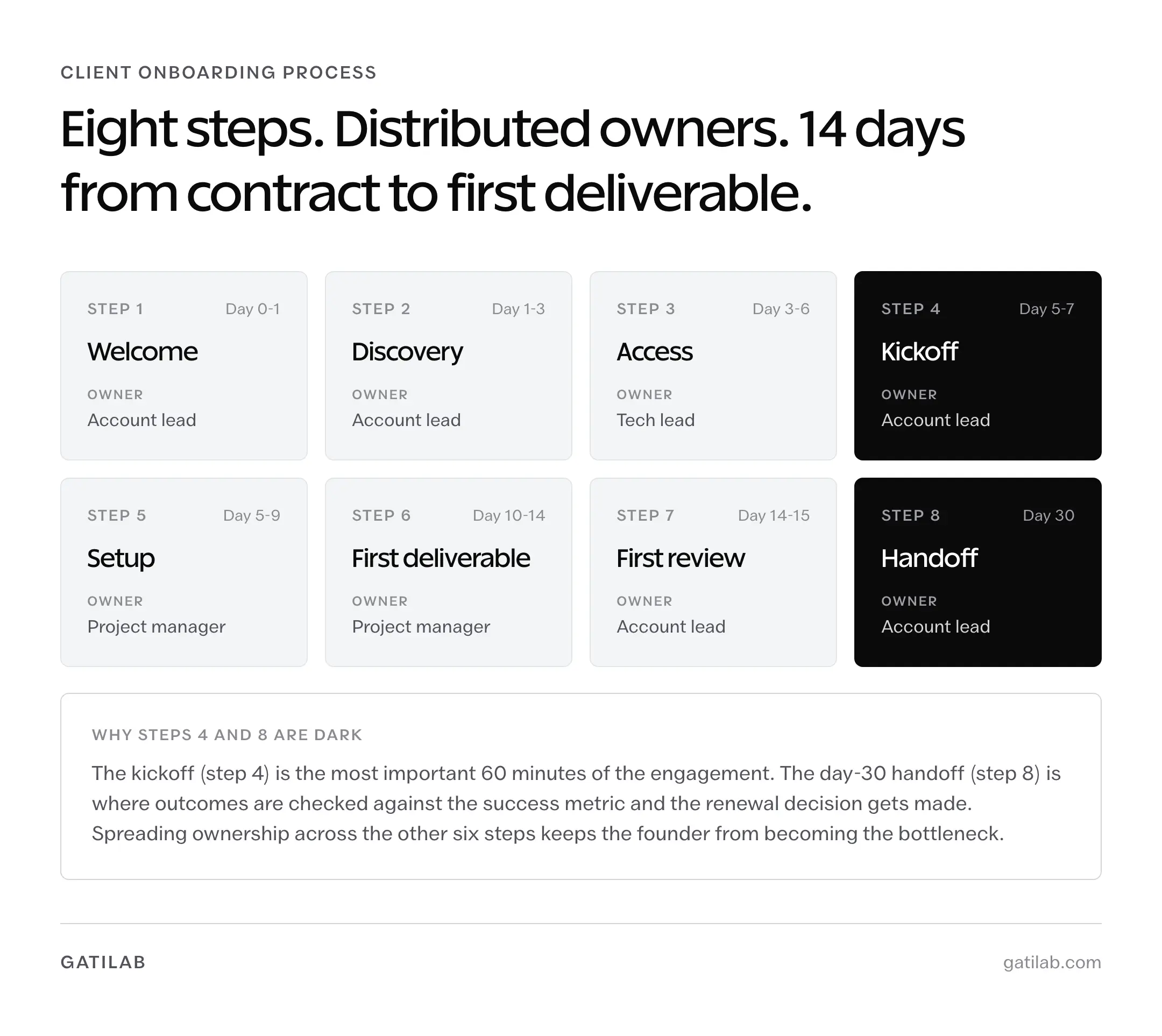
The full client onboarding process runs 10 to 14 business days from signed contract to first deliverable shipped. Each step has a single owner, a clear input, a clear output, and an SLA. Skipping any step works for a few engagements, then fails predictably on the rest.
| Step | Name | Owner | Day | Output |
|---|---|---|---|---|
| 1 | Welcome | Account lead | Day 0-1 | Welcome email + workspace access |
| 2 | Discovery | Account lead | Day 1-3 | Completed 12-field intake form |
| 3 | Access | Tech lead | Day 3-6 | Verified credentials + access audit |
| 4 | Kickoff | Account lead | Day 5-7 | 60-min call + 4-hour recap |
| 5 | Setup | Project manager | Day 5-9 | Project plan + tooling configured |
| 6 | First deliverable | Project manager | Day 10-14 | Loom walkthrough + workspace artifact |
| 7 | First review | Account lead | Day 14-15 | Feedback captured + plan updated |
| 8 | Handoff | Account lead | Day 30 | Day-30 review + report |
The single biggest mistake agencies make with this client onboarding process is treating the 8 steps as a checklist for the founder. Each step needs a different owner. Without distributed ownership, the founder becomes the bottleneck at exactly the moment the agency is trying to scale past 5 active projects.
Step 1: Welcome (Day 0-1)
Trigger: signed contract and deposit invoice sent. Owner: account lead. SLA: welcome email out within 1 business day of deposit clearing.
The welcome step has one job: tell the client what happens next. Most agencies overload the welcome email with policies, FAQs, and team bios. Cut all of it. The client cares about three things on day one: when the kickoff is, who their main contact is, and where to find the workspace.
Welcome Email Template
- One-paragraph “we’re glad you’re here, here’s what happens next”
- Link to the shared Notion workspace
- Calendar link to schedule the 60-min kickoff (Calendly or Cal.com)
- Link to the 12-field intake form (Tally, Typeform, or Notion form)
- Primary point-of-contact name + email + Slack handle
- One-line on response windows (“we reply within 4 business hours”)
Total length: 8 to 10 lines. The 30-line welcome email gets skimmed and bookmarked. The 8-line welcome email gets read fully and acted on. Judge yours by one metric: did the client schedule the kickoff within 48 hours.
Step 2: Discovery (Day 1-3)
Trigger: welcome email sent. Owner: account lead. SLA: completed intake form by day 3.
Discovery is where you collect the structured data the kickoff call will operate on. The 12-field intake form below is what consistently captures enough to run a strong kickoff without overwhelming the client into abandonment. More than 15 fields and clients quit. Fewer than 10 and you’ll chase information later.
The 12-Field Discovery Intake
- Company name + URL
- Primary contact (name, email, role)
- Secondary contact
- Decision-maker (must be one person, not “the team”)
- Billing contact
- Project goal in one sentence
- Success metric (the one number that defines a win)
- Timeline constraints (events, launches, fiscal year)
- Brand assets location (Figma, Drive, Dropbox)
- Existing tools we’ll touch (CMS, hosting, analytics, CRM)
- Access list (what credentials we’ll need)
- Known risks or concerns
Field 7 (success metric) is the most important and the most often skipped. Without a single agreed-upon success metric, the day-30 review becomes a debate about whether the project worked. With it, the conversation is data-first.
If a client refuses to fill the discovery intake, that’s a red flag. Clients who won’t spend 20 minutes on a form will not give you 2 hours of focused feedback in week 2. Pause and re-quote, or pass.
Build a WordPress Client Intake Form
The intake form should collect what the next person needs to begin the engagement. You can keep the answers in WordPress and route them into the rest of the onboarding process instead of repeatedly asking the client for details already supplied during sales.
Core Forms is our WordPress form plugin for structured intake and submission actions. It is useful when the website already handles the inquiry and you want the accepted client’s information to follow a defined path.
For a website project, start with fields that change the next action:
- The business and primary contact.
- The site URL and the problem to solve.
- The agreed scope or order reference.
- The person who approves decisions.
- Any fixed deadline and the reason for it.
- The material the client can provide now.
Keep credentials out of ordinary intake fields. Account invitations or an appropriate private access-sharing method should handle passwords and other secrets. File uploads also need access and retention rules; a form accepting a file doesn’t automatically make its public storage location suitable for private material.
Conditional questions can keep the form focused. An existing-site project needs its current URL, while a new-site project may need domain status instead. The client should not have to invent answers to irrelevant required questions.
Before connecting the form to a CRM or project tool, decide which system owns the engagement. Match submissions to the order or project reference and check for duplicates before creating another client record.
Test the intake with harmless details and follow the result into the actual work queue. Confirm the saved submission and the assigned owner independently of the email notification. If notifications fail, the responsible person still needs a way to see waiting work.
A completed form is ready for onboarding when its answers let someone take the next step without another general discovery email. Review Core Forms if that is the gap in your current WordPress setup.
Step 3: Access (Day 3-6)
Trigger: intake completed. Owner: tech lead. SLA: full credential list verified by day 6.
Access is the step that quietly destroys timelines. The team can’t start until they can log in. Hosting credentials are usually fine. The ones that take 5 days are Google Search Console, Google Tag Manager, third-party email tools, and code repositories.
Standard Access Audit For WordPress Engagements
| Access | Format | Common Delay |
|---|---|---|
| WordPress admin | Editor or admin role | Same day |
| Hosting (cPanel, Cloudways, Kinsta) | Sub-account or shared login | 1-2 days |
| DNS (Cloudflare, registrar) | Reader or admin invite | 3-5 days |
| Google Analytics 4 | Editor invite | 2-4 days |
| Google Search Console | Owner invite | 3-7 days |
| Google Tag Manager | Editor invite | 2-4 days |
| Code repo (GitHub, Bitbucket) | Outside collaborator | 1-3 days |
| Design tools (Figma) | Editor invite | Same day |
| Email (Mailchimp, Klaviyo) | Limited admin | 2-5 days |
Verify every credential on day one. Don’t trust the password; log in. The number of times “the credentials don’t work” surfaces 4 days into a project is enough to make verification non-negotiable. For WordPress engagements specifically, the access step intersects with the broader operational layer covered in WordPress agency operations.
Step 4: Kickoff Call (Day 5-7)
Trigger: intake completed and access requested. Owner: account lead. SLA: kickoff scheduled within 7 business days of contract; recap email within 4 hours of the call.
For a kickoff booked through your WordPress site, Core Bookings lets you define availability, preparation buffers, and customer rescheduling rules. Keep the intake and access review as prerequisites so a calendar slot does not get mistaken for a project that is ready to start.
The kickoff call is the most important 60 minutes in the entire client onboarding process. Every other step is recoverable if it goes wrong. A weak kickoff sets a tone that’s hard to fix later.
60-Minute Kickoff Agenda
- Minutes 0-5: Introductions and context. Light, not robotic.
- Minutes 5-15: Walk through the intake responses. Confirm the success metric.
- Minutes 15-30: Project plan and milestones. Show the timeline visual.
- Minutes 30-40: Communication norms and decision-making. Who decides what.
- Minutes 40-50: Open questions from the client. Don’t rush this.
- Minutes 50-60: Three concrete decisions made. Next steps named with dates.
The 4-Hour Recap Rule
Send the kickoff recap within 4 hours of the call ending. Not next day. Not “by end of week.” Four hours. The recap captures the three concrete decisions, the next steps, the owners, and the dates. Sending it fast proves you actually heard the client and tells them “these people are organized.” A recap that takes 36 hours lets momentum cool.
Step 5: Setup (Day 5-9)
Trigger: kickoff complete. Owner: project manager. SLA: project plan, tooling, and shared workspace finalized by day 9.
Setup is the operational layer that supports everything that comes after. The project plan goes into ClickUp or Asana. The shared workspace goes into Notion. The communication channels (Slack Connect or shared email) go live with the documented response windows. The Friday status email template goes into the recurring task list.
- Project plan in PM tool with milestones, owners, dependencies
- 5-doc workspace finalized (welcome, plan, expectations, communication, invoices)
- Slack Connect channel or shared email thread documented
- Recurring Friday status email scheduled
- Day-3 check-in scheduled
- Week-2 first review scheduled
- Day-30 retainer or wrap review scheduled
The non-obvious item here is “schedule the day-30 review on day 5.” Calendars are full 30 days out. Booking late is how the day-30 review actually happens on day 38, which destroys the renewal timing. Always schedule forward.
Step 6: First Deliverable (Day 10-14)
Trigger: setup complete. Owner: project manager (with the technical lead executing). SLA: first deliverable shipped by day 14.
The first deliverable is the trust-building artifact. It does not need to be the biggest piece of the project. It needs to ship on time and ship cleanly. A focused first deliverable that lands on day 14 builds more confidence than a comprehensive deliverable that lands on day 21.
First Deliverable Format
- The artifact itself (design mock, audit report, working prototype)
- A 4 to 6 minute Loom walkthrough explaining the artifact
- A workspace page summarizing the artifact (one-page max)
- An explicit ask: “Please leave feedback by October 22, 2026 on these specific items”
The Loom walkthrough is the single biggest lever. Clients watch a 4-minute Loom while drinking their morning coffee. They open a doc and bookmark it. Bookmarked docs don’t get read.
Step 7: First Review (Day 14-15)
Trigger: first deliverable shipped. Owner: account lead. SLA: 30-minute review call on day 14 or 15; written recap within 4 hours.
The first review is where you find out whether the relationship is working. Three things must happen: the feedback is captured in writing, the project plan is updated to reflect it, and the next deliverable is named with an owner and date. If the client wants to skip the call (“looks great, just keep going”), insist on it anyway. The 30-minute review on day 14 is what makes the day-30 review feel routine instead of risky.
If feedback contradicts what was decided in the kickoff recap, surface the contradiction explicitly. Don’t quietly absorb it. “In the kickoff we agreed X. The new direction is Y. That changes the timeline by Z.” This is the moment scope creep is caught or absorbed silently.
Step 8: Handoff Or Renewal (Day 30)
Trigger: 30 days since contract signed. Owner: account lead. SLA: review meeting with the decision-maker on day 30 (not day 32, not day 36).
For one-time projects, day 30 is the handoff conversation: final invoice timing, deliverable archive, support window, and referral ask. For retainers, day 30 is the renewal trial review: hours used, outcomes versus the success metric, friction surfaced, and decision on month 2.
The Day-30 Review Agenda
- Outcomes versus the success metric named in discovery
- Deliverables shipped versus deliverables planned
- Hours or budget used versus quoted
- What’s working in the engagement
- What’s friction
- Decision on month 2 (or formal handoff)
- Testimonial or referral ask if the engagement is going well
Hold the day-30 review on day 30. It is where the renewal decision gets made, and a review that drifts to day 36 loses the momentum the first month built.
Metrics Per Step Of The Onboarding Process
Every step in the client onboarding process has a metric that tells you whether it’s working. Track these across your last 5 engagements. If you miss 3 or more, each miss points to a specific, fixable step to revisit.
| Step | Metric | Target |
|---|---|---|
| 1. Welcome | Hours from deposit to welcome email | Under 24 |
| 2. Discovery | Days to intake completion | Under 3 |
| 3. Access | Days to verified credentials | Under 6 |
| 4. Kickoff | Hours from call end to recap sent | Under 4 |
| 5. Setup | Days to project plan signed | Under 9 |
| 6. First deliverable | Days to ship | Under 14 |
| 7. First review | Days to written feedback | Under 18 |
| 8. Handoff | Day-30 review completion rate | Above 95 percent |
Failure Modes Of The Onboarding Process
Even with the 8 steps documented, the process fails in predictable ways. Here are the four failure modes that show up most often, with the fix for each.
- Founder is the only owner of all 8 steps: The process collapses past 5 active projects. Fix: distributed ownership in the table at the top of this article.
- Day-30 review drifts to day 36+: Renewal momentum dies. Fix: schedule the day-30 review on day 5, not day 28.
- Access step quietly takes 9 days: First deliverable slips to week 3. Fix: trigger the access audit on day 3, not after kickoff.
- Kickoff recap takes 36 hours: Trust deposit doesn’t form. Fix: block the 4 hours after every kickoff call as recap-writing time.
The pattern is the same across all four failures: a step’s owner wasn’t named clearly, or a deadline wasn’t real. The 8-step client onboarding process only works when both of those are explicit.
How To Roll Out This Onboarding Process In 30 Days
Don’t try to implement all 8 steps at once. Start with the 3 highest-impact steps and add the rest over a quarter.
- Week 1: Build the welcome email template, the 12-field intake, and the 60-minute kickoff agenda. These three artifacts cover steps 1, 2, and 4.
- Week 2: Add the access audit checklist (step 3) and the 5-doc workspace (step 5).
- Week 3: Build the first-deliverable Loom format (step 6) and the first-review agenda (step 7).
- Week 4: Add the day-30 review agenda (step 8) and the metrics tracker. Run the first new engagement on the full process.
For the broader question of how to build the systems that the onboarding process plugs into, see how to create systems that scale your agency. The onboarding process is one of the systems. Pricing, capacity, and subcontractor management are the others.
Three companion guides cover the rest of the onboarding stack: the 47-item client onboarding checklist for the operational layer, 12 client onboarding best practices for the principles, and the client onboarding template pack for the documents themselves. If you’re solo and adding clients faster than your time allows, also see managing multiple clients without burning out.
The 8-step client onboarding process replaces judgment with workflow. Distribute the owners, hit the SLAs, ship the first deliverable on day 14, and run the day-30 review on day 30. The retention math takes care of itself.
How The Process Changes By Engagement Type
The 8-step client onboarding process is the base. Different engagement types modify how heavy each step gets, but the structure stays. The four most common variants are below.
One-Time WordPress Build
All 8 steps. Day 30 is the handoff conversation, not a renewal conversation. The first deliverable on day 14 is usually wireframes or a content audit, not the finished site. The day-30 review covers final invoice timing, support window, and the referral ask. Total onboarding effort: roughly 14 to 18 person-hours across the agency team.
Monthly SEO Or Maintenance Retainer
All 8 steps plus three retainer-specific items: quarterly review cadence, usage tracking dashboard, and an escalation path for urgent work. The first deliverable on day 14 is usually a baseline audit or the first month’s keyword report. Day 30 is the trial review with explicit go/no-go on month 2. Total onboarding effort: roughly 18 to 22 person-hours.
Sprint Or Audit Engagement
Compressed timeline. Steps 1 through 4 happen in 3 business days, not 7. The first deliverable on day 7 is the audit report itself. The day-30 review collapses into a final handoff at day 14 or day 21 depending on sprint length. Total onboarding effort: roughly 8 person-hours, but heavily concentrated in the first 72 hours.
Enterprise Engagement
All 8 steps plus a legal layer (NDA, MSA, SOW), a security layer (data handling, SOC 2 if applicable, access policies), and a stakeholder mapping layer (named decision-maker, budget owner, technical sponsor). Add 7 to 14 business days to the pre-kickoff timeline. The base 8-step process still applies, but each step has a heavier paperwork tail and more named owners.
Onboarding Process Troubleshooting
Three issues show up most often when teams try to run the 8-step client onboarding process at scale, with the fix for each.
The first issue is process fatigue from the team. After the third or fourth engagement run on the full process, someone (usually the founder) suggests “skipping the formal kickoff for this one” because the client seems easy. Do not skip it. The skipped kickoff is the engagement that bites you in week 4. Run the full process even when it feels excessive. The point is consistency, not intensity.
The second issue is client resistance to the structure. Some clients want to “just get started” and view the intake form, kickoff agenda, and expectations doc as bureaucratic. The response is to acknowledge the friction, explain that the structure is what protects both sides from scope confusion later, and stay the course. Some clients will resist, and they are often the engagements where the structure pays off most visibly.
The third issue is owner drift. The 8-step client onboarding process names a different owner per step on purpose. As soon as one person owns more than 4 steps, the process collapses on the next busy week. Re-distribute ownership at the first sign of drift. Past 10 active engagements, plan for at least 3 distinct owners across the 8 steps.
Frequently asked questions
What are the steps in a client onboarding process?
Eight steps: welcome email, discovery questionnaire, access and credentials, kickoff call, project setup, first deliverable, first review, and handoff. Each step has a clear owner, a clear input, and a clear output. Skipping any step works for a few clients then fails predictably on the rest.
How long does the client onboarding process take?
10 to 14 business days from signed contract to first deliverable. Days 1 to 3 are welcome and discovery. Days 4 to 7 are access and kickoff. Days 8 to 14 are setup and first deliverable. Going faster than 10 days means cutting corners that show up later. Going past 14 days means the client starts wondering if they hired the wrong agency.
Who owns each step of the onboarding process?
The account lead owns welcome, discovery, kickoff, and review. The project manager owns access, setup, and the first deliverable timeline. The technical lead owns the access audit and environment setup. Naming owners on day one prevents the most common failure: assuming someone else is doing the step.
What’s the difference between client onboarding and customer onboarding?
Client onboarding is for service businesses (agencies, consultants, freelancers) where you produce work for a client. Customer onboarding is for product businesses (SaaS, ecommerce) where the user logs in and uses your product. Different goals, different success metrics, different cadences. This article is about client onboarding for agencies.
How do I document the client onboarding process?
One master document per process step: trigger (what kicks it off), owner (who runs it), input (what’s needed), output (what’s produced), and SLA (how long it takes). Five fields, one document per step. I keep these in a Notion workspace and review them quarterly. Anything more elaborate doesn’t survive contact with a real engagement.
What’s the most important step in the onboarding process?
The kickoff call. Every other step is recoverable if it goes wrong. A weak kickoff sets a tone that’s hard to fix later. I prep for kickoffs more than for the discovery questionnaire because the questionnaire gives me data and the kickoff gives me trust. Trust compounds. Data does not.
How do I handle delays during the onboarding process?
Communicate the delay before the client notices it. Name the cause (often access or content from the client side), the new timeline, and the recovery plan. Most onboarding delays come from the client side, but the agency takes the perception hit unless you flag it early. A 24-hour delay flagged at hour 4 reads as professional. The same delay discovered by the client at hour 26 reads as incompetent.
Can I automate the client onboarding process?
Automate the trigger and the templates. Don’t automate the relationship. HoneyBook can fire a welcome email, create a workspace, and assign a kickoff task the moment a contract is signed. The kickoff call itself, the first feedback round, and the day-3 check-in stay manual. The agencies that automate too much win on cost and lose on retention.
How do I scale the onboarding process across a team?
Document every step as a checklist with named owners. Run a weekly onboarding huddle where the team reviews active onboardings together. Promote your best account lead to onboarding lead once the team has 4 or more active engagements. The process scales when the steps are visible to everyone, not just the founder.
How does the onboarding process change for enterprise clients?
Enterprise onboarding adds three layers: legal review (NDA, MSA, SOW), security review (data handling, SOC 2, access policies), and stakeholder mapping (named decision-maker, budget owner, technical sponsor). Add 7 to 14 business days to the timeline. The base 8-step process still applies, but each step has a heavier paperwork tail.
Tell Google you want more of this.
Add Gatilab as a preferred sourceOne tap, and this site shows up more often in your own Top Stories, AI Overviews and AI Mode. Remove it any time.