
SEO Proposal Template
An SEO proposal template is only useful if it defines the business problem, current baseline, proposed work, owners, timeline, price and reporting rules clearly enough to become the first project plan after approval.
Most proposals fail that test. They sell a bag of activities, promise “more traffic” and leave implementation, data access and acceptance rules for later. The document closes the sale and opens an argument.
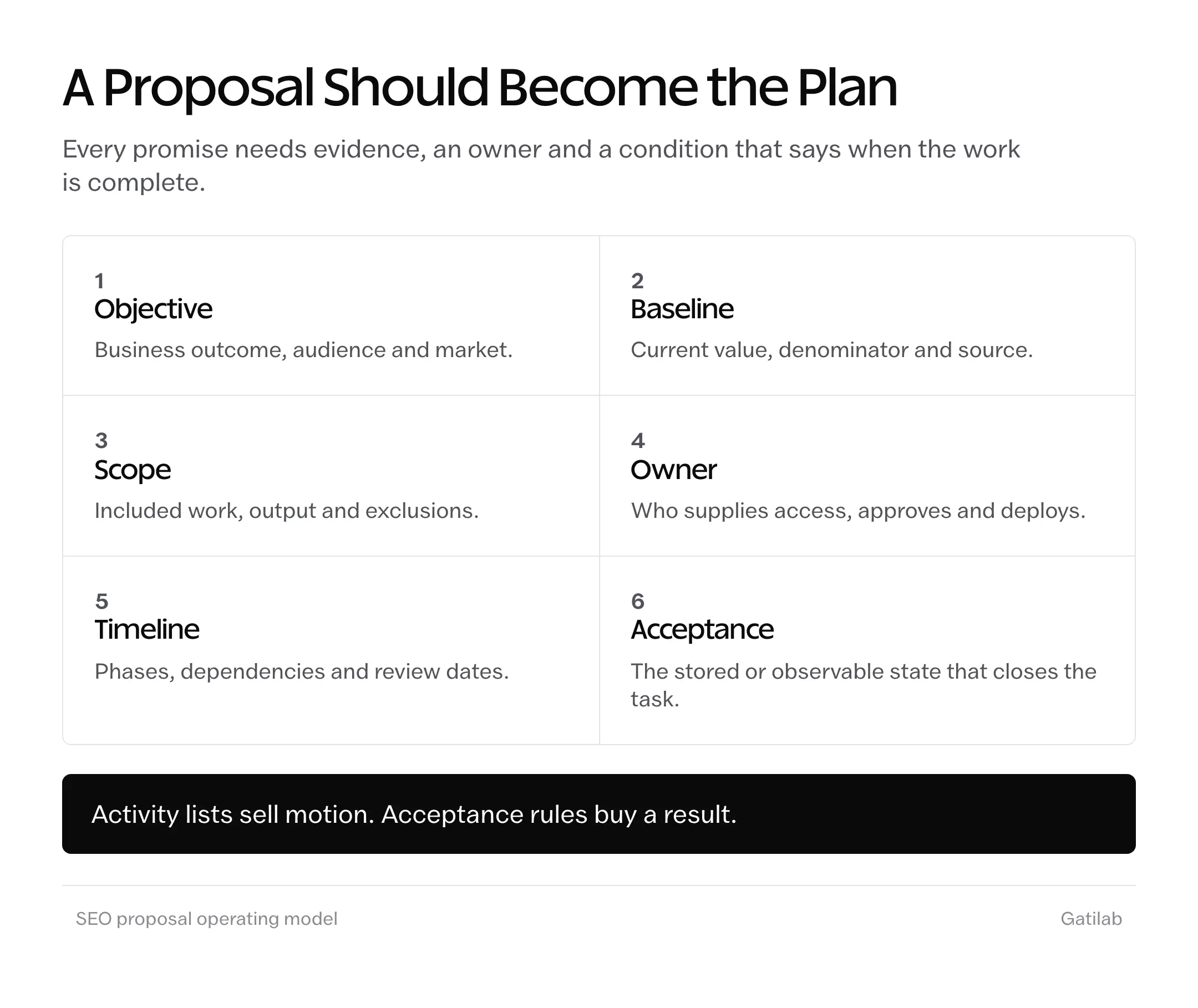
The template below takes the opposite approach. Every recommendation is tied to evidence, an owner and a condition that tells both sides when the work is done.
Proposal Structure
A useful SEO proposal needs 9 parts:
- Decision summary
- Business objective
- Current baseline
- Findings and priorities
- Scope of work
- Ownership and dependencies
- Timeline and acceptance rules
- Measurement and reporting
- Pricing, terms and exclusions
The order matters. Price comes after the buyer can see what the engagement contains.
Decision Summary
The first page should state the problem and recommendation without making the client decode an audit.
SEO Proposal For [Company]
Primary objective: [Business outcome]
Current constraint: [The clearest verified problem]
Recommended engagement: [Audit, project or monthly program]
Initial term: [Duration]
Investment: [Price and billing schedule]
Decision required by: [Date]
The summary is useful because it allows a decision-maker to reject the wrong scope early. Hiding the price until slide 42 does not make it more persuasive. It makes the meeting longer.
Business Objective
“Improve SEO” is not a business objective. The objective should name the audience, action and economic reason behind the work.
Weak objective:
Increase rankings and organic traffic.
Useful objective:
Increase qualified enquiries from non-brand searches for commercial accounting services in Delhi and Gurgaon, while reducing dependence on paid search for those same services.
The second version narrows the program:
- Audience: buyers of commercial accounting services;
- market: Delhi and Gurgaon;
- conversion: qualified enquiry;
- comparison: non-brand organic search versus paid acquisition;
- boundary: the proposal does not promise traffic from every informational query.
This is what keeps the keyword plan from drifting toward easy traffic that never becomes business.
Current Baseline
The baseline should use the smallest set of metrics needed to explain the problem. A proposal is not the place for every chart an SEO tool can export.
Use a table like this:
| Metric | Current Period | Comparison Period | Change | Source | Interpretation |
|---|---|---|---|---|---|
| Non-brand organic clicks | 1,240 | 1,080 | +14.8% | Search Console | Discovery traffic is growing. |
| Commercial-page clicks | 180 | 220 | -18.2% | Search Console | Growth is concentrated away from buying pages. |
| Organic enquiries | 14 | 18 | -22.2% | Analytics / CRM | More clicks are producing fewer leads. |
| Indexed service pages | 8 of 12 | 10 of 12 | -2 pages | Search Console | Important destinations are missing from search. |
| Local top-3 grid coverage | 31% | 37% | -6 points | Local rank tracker | Visibility weakened around the edge of the service area. |
These figures are illustrative. Replace them with the client’s verified data and keep the denominator visible.
The formulas should be written down:
Conversion rate = qualified enquiries / organic landing-page sessions
Click-through rate = clicks / impressions
Indexed coverage = valid indexed target pages / all target pages
Local top-3 coverage = grid points ranking 1 to 3 / enabled grid points
Google defines Search Console click-through rate as clicks divided by impressions. It also defines average position as the average topmost position across impressions, not the exact neutral rank someone will see during one manual search. That distinction belongs in the proposal when rankings are part of the baseline.
Findings And Priorities
Findings should connect observation, cause and consequence. A tool warning by itself is not a recommendation.
Use this pattern:
| Finding | Evidence | Business Consequence | Priority |
|---|---|---|---|
| 4 service pages are not indexed | URL Inspection and sitemap comparison | Those services cannot receive organic enquiries | 1 |
| 2 city templates share the same canonical | Canonical inspection across 18 URLs | Google consolidates pages the business intended to keep separate | 1 |
| Commercial pages receive 14.5% of organic clicks | Search Console page grouping | Traffic growth is not reaching the lead-generating part of the site | 2 |
| GBP category differs across locations | Profile audit | Location comparisons are not operating under matched conditions | 2 |
| 38 old posts have no internal links | Crawl and link graph | Useful pages receive no authority or reader path from the rest of the site | 3 |
Priority should follow impact, dependency and reversibility:
- Impact: what changes if the issue is fixed?
- Dependency: what later work is blocked by it?
- Confidence: how strong is the diagnosis?
- Effort: what does implementation consume?
- Reversibility: how safely can the change be rolled back?
A proposal that puts new articles ahead of a broken canonical system is selling visible output before foundation work. The content calendar looks busy while search engines consolidate the pages underneath it.
Scope Of Work
Every scope item needs an output and acceptance rule. “Technical SEO” is a category. It is not a deliverable.
| Workstream | Included Work | Output | Acceptance Rule |
|---|---|---|---|
| Technical SEO | Crawl, indexation, canonical, redirect and sitemap review | Prioritized issue register and implemented critical fixes | Critical URLs return the intended status, canonical and indexability state |
| Content architecture | Query-to-page map and ownership review | Approved content map | Every priority query has one named page owner |
| On-page work | Rewrite or improve agreed commercial pages | Updated pages | Title, H1, copy, internal links and structured data match the approved brief |
| Local SEO | GBP audit, category review, citation and grid baseline | Location action plan | Location data is matched and baseline grid is stored |
| Reporting | Search Console, analytics and conversion dashboard | Monthly report | Every KPI retains its source, denominator and comparison period |
The acceptance rule prevents “done” from meaning “the document was sent.” It should describe the stored or observable state the client is buying.
Ownership And Dependencies
SEO stalls when recommendations have no owner. The proposal should name who supplies access, who approves changes and who deploys them.
| Responsibility | Agency | Client | Third Party |
|---|---|---|---|
| SEO diagnosis and prioritization | ✓ | ||
| CMS and server access | ✓ | Hosting provider if needed | |
| Copy approval | ✓ | Legal or compliance team if needed | |
| Code implementation | ✓ / defined separately | ✓ / internal developer | Development vendor |
| Analytics access | ✓ | Analytics provider | |
| Final deployment approval | ✓ | ||
| Rollback execution | Defined owner | Defined approver | Hosting provider if required |
Do not leave split responsibilities as “shared.” Name the action on each side. “Agency prepares redirect map; client developer deploys; agency verifies stored rules before launch” is clearer than a shared checkbox.
Timeline
The timeline should show dependencies rather than pretending every workstream starts on day 1.
| Phase | Timing | Work | Dependency |
|---|---|---|---|
| Baseline | Week 1 | Access, crawl and measurement definitions | Credentials and target-market approval |
| Critical fixes | Weeks 2-3 | Indexation, canonical, redirect and tracking repairs | Technical approval |
| Commercial pages | Weeks 3-6 | Briefs, content and implementation | Page ownership and subject approval |
| Authority work | Weeks 5-10 | Digital PR, citations or partnership work | Approved assets and outreach identity |
| Review | Monthly | KPI comparison and next priority queue | Complete source data |
SEO results do not follow this calendar mechanically. The calendar controls the work. Search engines control discovery, crawling, indexing and ranking.
That boundary belongs in the proposal.
Measurement And Reporting
The reporting section should define each KPI before the first monthly report.
Use a compact measurement table:
| KPI | Definition | Source | Cadence | Owner |
|---|---|---|---|---|
| Qualified organic enquiries | Enquiries meeting the agreed qualification rule from organic landing sessions | CRM and analytics | Monthly | Client + agency |
| Non-brand clicks | Search Console clicks excluding agreed brand variants | Search Console | Monthly | Agency |
| Commercial-page click share | Commercial-page clicks / all organic clicks | Search Console | Monthly | Agency |
| Indexed priority-page coverage | Indexed priority pages / all priority pages | Search Console | Monthly | Agency |
| Local top-3 coverage | Grid points ranking 1-3 / enabled points | Local rank tracker | Monthly | Agency |
| AI commercial citation rate | Commercial AI answers citing the domain / eligible commercial answers | AI visibility source | Monthly | Agency |
One KPI may need 2 sources. That is normal. Search Console can report clicks. It cannot decide whether an enquiry was qualified. The CRM or sales team owns that judgment.
Forecast Boundary
Forecasts should be scenarios, not promises.
Expected clicks = search demand × expected click-through rate
Expected leads = expected clicks × landing-page conversion rate
Expected gross value = expected leads × lead-to-sale rate × average gross profit
Suppose the approved query set represents 20,000 monthly searches. A 5% click-through scenario produces 1,000 clicks. At a 3% landing-page conversion rate, that becomes 30 enquiries. If 20% become customers, the scenario produces 6 sales.
Every input can be wrong:
- search demand is an estimate;
- ranking and AI features change click-through rate;
- conversion rate changes by page and device;
- lead quality changes the close rate;
- seasonality changes the month.
The proposal should show low, base and high cases, then state which input has the greatest sensitivity. A single precise forecast hides more than it explains.
Pricing
Pricing should connect to the defined scope and responsibility.
| Option | Scope | Monthly Price | Choose When |
|---|---|---|---|
| Advisory | Strategy, review and prioritized recommendations | $[amount] | The client has writers and developers who can implement |
| Collaborative | Strategy plus agreed content and technical implementation | $[amount] | Responsibility is split between the agency and client team |
| Managed | Agency owns the operating queue and implementation | $[amount] | The client needs one accountable owner |
The options should differ by responsibility, not by withholding basic competence from the cheaper tier.
The proposal must also name:
- billing schedule;
- taxes;
- minimum term;
- notice period;
- included capacity;
- approval delays;
- third-party costs;
- work outside scope;
- change-request pricing;
- pause and termination rules.
The guide to pricing professional services helps anchor the commercial model. The proposal still needs its own workload and scope arithmetic.
Exclusions
Exclusions protect both sides when they are written plainly.
Common exclusions include:
- paid advertising spend;
- website redesign;
- custom development beyond named fixes;
- legal review;
- translation;
- photography or video;
- third-party software fees;
- guaranteed rankings, traffic or revenue;
- work on properties not listed in the scope;
- emergency work outside the agreed response time.
Google’s SEO hiring guidance says no one can guarantee a number-1 ranking. A proposal making that guarantee is not ambitious. It is promising control the provider does not have.
Copy-Ready SEO Proposal Template
SEO Proposal For [Client]
Decision Summary
Objective: [Business outcome]
Current constraint: [Verified problem]
Recommended engagement: [Project or retainer]
Term: [Duration]
Investment: [Price]
Business Context
[Audience, market, commercial model and the decision SEO needs to support.]
Baseline
[Table containing current metric, comparison, source and interpretation.]
Findings
[Prioritized findings with evidence and business consequence.]
Scope
[Workstream, included work, output and acceptance rule.]
Ownership
[Agency, client and third-party responsibilities.]
Timeline
[Phases, timing and dependencies.]
Measurement
[KPI, formula, source, cadence and owner.]
Pricing
[Fee, schedule, capacity and change rules.]
Exclusions
[Explicit exclusions and third-party costs.]
Approval
Name: [Name]
Role: [Role]
Date: [Date]
Signature or written approval: [Method]
The template is deliberately plain. The evidence and scope should win the work. Decorative slides cannot repair a proposal that avoids responsibility.
Proposal Red Flags
The proposal contains a fixed article count before keyword ownership and existing-page performance are reviewed. Production volume has been sold before the content problem is known.
The timeline promises ranking dates. The provider can schedule deployment, not Google’s response.
The report measures average position without defining location, device, query set or impression weighting. The number will become an argument on the first call.
Implementation is marked “as needed.” Nobody owns it, which means recommendations can sit untouched for months.
The proposal contains a long deliverables list with no exclusions. Either the price will change later or the work will shrink quietly.
The case study shows traffic growth but no baseline, time window or contribution from brand queries. The result cannot be interpreted.
The Limits
A template cannot replace discovery. It does not know the client’s approval structure, technical debt, sales cycle or risk tolerance.
The proposal also cannot serve as the final contract in every jurisdiction. Payment, liability, intellectual property, confidentiality and termination terms may need legal review.
And a precise scope cannot make SEO certain. It makes responsibilities certain. Search outcomes remain conditional on competition, implementation quality, search-engine behavior and time.
What A Proposal Should Settle
The proposal should settle what problem is being addressed, what work will happen, who owns each dependency, how the result will be measured and what the client pays.
If those answers remain fuzzy after approval, the proposal did not close the project. It only postponed the negotiation.
Make it usable on day 1.
Tell Google you want more of this.
Add Gatilab as a preferred sourceOne tap, and this site shows up more often in your own Top Stories, AI Overviews and AI Mode. Remove it any time.