
How to Fire a Client Without Burning the Bridge
You dread opening their emails. Every call runs 20 minutes past the end. Scope has moved three times and the fee has not moved once. Somewhere in the last month you decided this relationship is finished, and the only thing still missing is how to fire a client without losing the referral, the review, and the money they still owe you.
Service providers stall in one of two ditches. The first keeps waiting for a difficult client to self-correct, and pays for that patience with slower replies to everyone else on the roster. The second waits until the resentment boils over, then sends 600 words of grievance and calls it honesty.
Both lose.
Ending a client relationship is a sequencing problem before it is an emotional one.
Run as a dated sequence, a termination takes about a week, ends with the final invoice paid, and leaves the client with nothing to say publicly that a record would contradict. Run as a feeling, it takes a month and ends in an argument about work you already delivered.
Most difficult clients don’t need firing
Friction is normal in service work. A client who pushes on deadlines, asks uncomfortable questions, or hates the first draft is not a termination candidate. They are a conversation you have been putting off, and there is a whole playbook for handling difficult clients without losing the revenue attached to them.
Communication is usually where these relationships break. The Project Management Institute’s 2013 Pulse of the Profession report on communications found that ineffective communication was the primary contributor to project failure about a third of the time. That makes it the leading single factor, not the only one, and it says nothing about quality being blameless. Before you end anything, check whether the problem is the person or an expectation nobody ever wrote down.
A few patterns are different, because the incentive sits on the client’s side and stays there. Three of them you can check against your own records rather than your mood:
- Payment history: 3 or more invoices past terms, or repeated attempts to renegotiate a fee after signature
- Change requests arriving faster than change orders, with resistance every time you price one, which is what unmanaged scope creep looks like in an inbox
- Contract terms you have had to enforce in writing more than once
The rest are judgment calls, and each one costs you something specific.
They speak to you as staff rather than as a supplier. That reframing does not stay in the tone of the emails, it shows up in the assumptions about your evenings and your weekends.
They want outcomes the budget or the calendar cannot produce, and you have explained the constraint more than twice. Every delivery after that gets graded against a target you never agreed to.
Their business asks for work you would rather not attach your name to. Misleading claims, a review scheme, content aimed at people who will be hurt by it. You can decline the individual task, but the request tells you what the next one will be.
You procrastinate their work while staying productive for everyone else. That gap between your general output and your output for one account is the cleanest signal in the list, because it is behavioral rather than emotional and you can see it in your own timesheet.
Settle the money and the files before you say a word
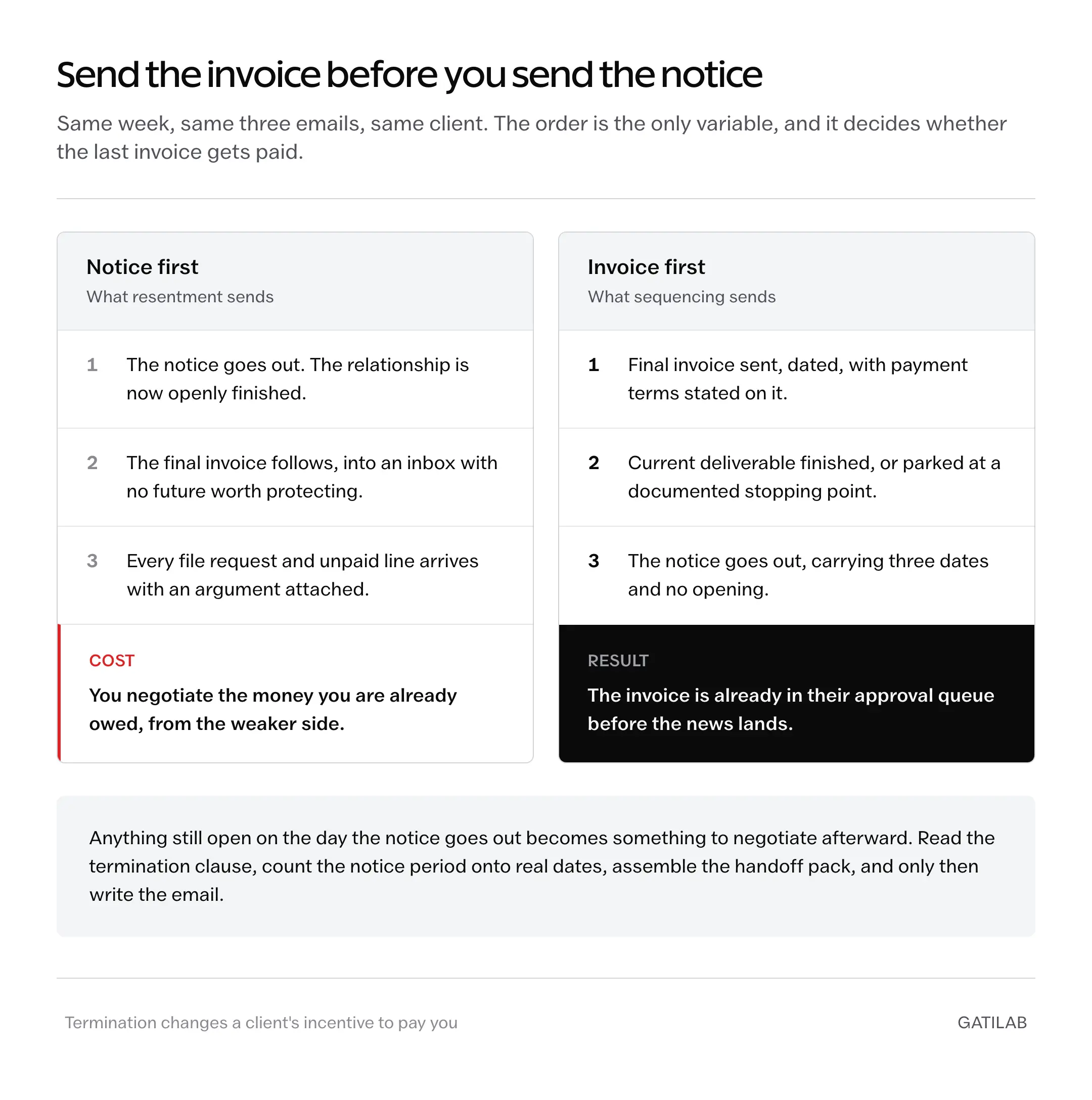
A termination announced before the paperwork is ready hands the client an advantage they never earned. Once the end is public between you, unpaid invoices slow down and every file request arrives with an argument attached.
Read the contract first, and pull out 4 things:
- The termination clause, and whose notice period applies to whom
- Deliverables you are still obligated to finish after notice is given
- Refund or pro-rata language covering prepaid work you will not deliver
- Who owns the files, licenses, and account access on the last day
Then assemble the record: emails carrying the demands, change requests with your written responses pricing them, and a payment history with dates. None of that is ammunition for a fight. It is what keeps a fight from starting, because a client who can see a dated record rarely bothers to test it. If your agreement does not cover any of the 4 points above, a proposal and contract structure with termination terms on both sides is the fix for the next client, not this one.
Work down this list before you draft the email:
Final invoice sent, dated, and with payment terms stated.
Current deliverable finished, or parked at a documented stopping point.
Notice period read from the contract and counted onto a calendar with real dates.
Handoff pack assembled: files, credentials, current status, open items.
Replacement revenue identified, even if it is not signed yet.
Anything still open on the day you send the notice becomes something to negotiate afterward, from a weaker position.
Notice is the variable clients judge you on for years afterward. Match it to the commitment you made, not to how you feel about them.
| Situation | Notice that reads as professional | What goes with it |
|---|---|---|
| One-off project, work delivered | None beyond the final invoice | Files, invoice, short handoff note |
| Project in progress | Finish the current deliverable, then 2 weeks | Completed deliverable, status document, invoice |
| Monthly retainer | 30 days, or the contract period if it is longer | Handoff pack, transition call, final invoice |
| Harassment, fraud, or an illegal request | Immediate | Files as they stand, invoice for work completed |
Where the contract number is longer than the row, the contract wins. Giving more notice than you owe is a gift you can afford once; giving less is the one thing in this whole process that creates a real claim against you.
The exit conversation is shorter than you think
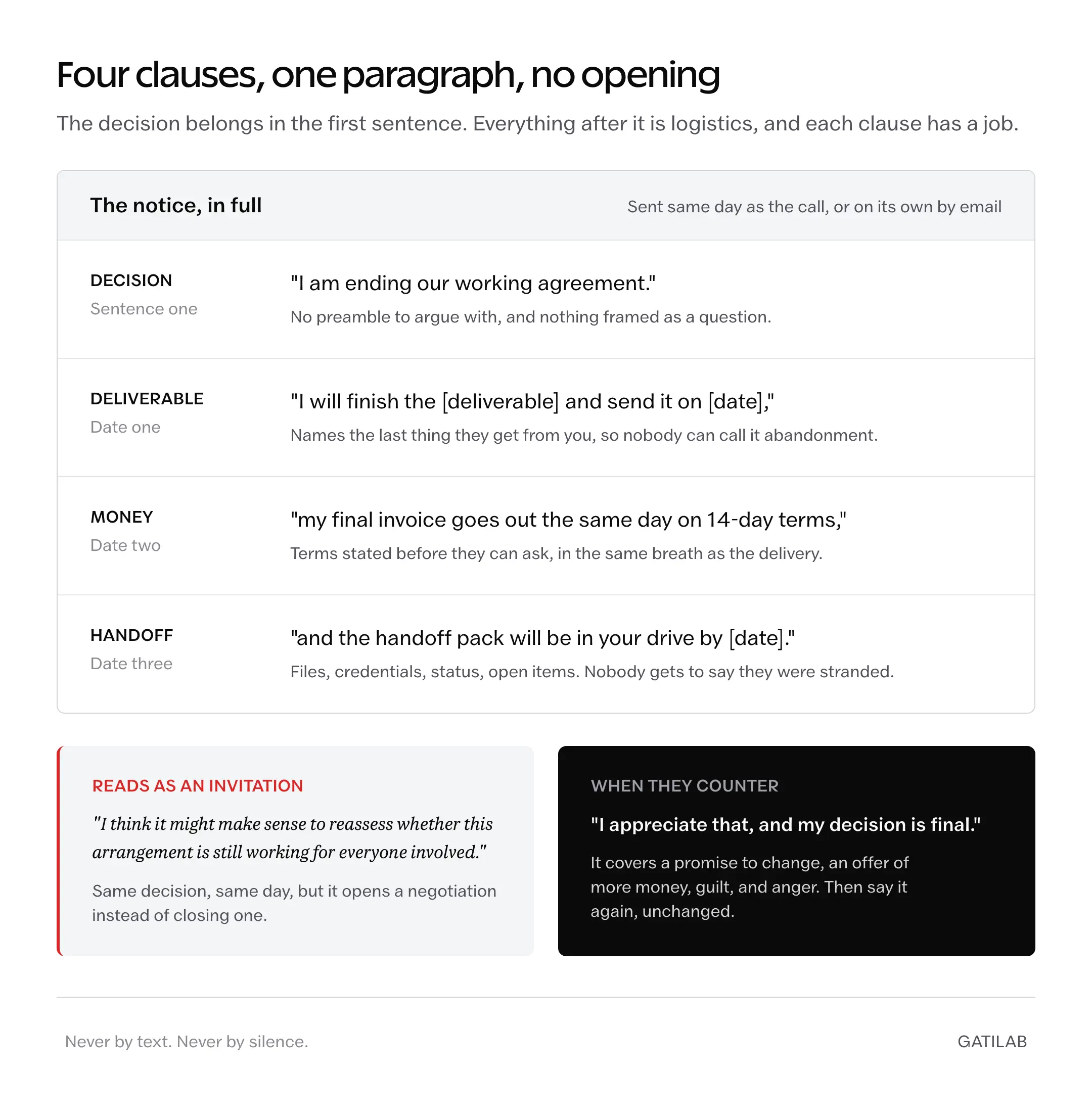
The decision belongs in the first sentence. Everything after it is logistics.
For a retainer or any relationship with a call history, say it on a call and confirm in writing the same day. For project work, or a client you have only ever emailed, email is enough and creates the record for you.
Never by text. Never by silence.
What most people send:
I wanted to reach out because I have been thinking a lot about our work together and where things are heading. It has been a challenging few months for both of us, and I think it might make sense to reassess whether this arrangement is still working for everyone involved.
What works:
I am ending our working agreement. I will finish the [deliverable] and send it on October 22, 2026, my final invoice goes out the same day on 14-day terms, and the handoff pack will be in your drive by October 22, 2026.
Same decision, same day. The second version gives the client 3 dates and no opening, which is why it usually earns a one-line reply instead of a phone call. The first version reads as an invitation to renegotiate, because that is what it is.
You owe a reason, not a case file. Keep it about fit and about your side of the arrangement:
- “I am not the right fit for what you need”
- “Our working styles are not lining up”
- “I am reducing my client load to focus on fewer projects”
- “My business is moving in a different direction”
Then state the terms so precisely that nobody can claim they were left stranded:
- The last day you will work on their projects
- Which deliverables land before that date
- When the final invoice is due, and on what terms
- What happens to files, credentials, and third-party accounts
- What transition support you will and will not provide
Some clients counter. Promises to change, an offer of more money, guilt about the timing, or anger designed to make you flinch. One sentence covers all 4: “I appreciate that, and my decision is final.” Then say it again, unchanged, as many times as the conversation requires.
Repetition wins.
Exit scripts you can adapt
Three situations cover almost every ending. Change the names and the dates, keep the order: decision, dates, money, handoff. If you want the versions for the ordinary weeks instead, the client communication templates cover kickoffs, delays, and change orders.
The clean exit
For a client who did nothing wrong and simply is not the work you want anymore.
Hi [Name],
I am wrapping up our working relationship over the next few weeks as my business shifts focus.
I will complete [current project] by October 22, 2026. After that I will not be taking on further work. My final invoice goes out on October 22, 2026 with [terms].
I will send handoff documentation with everything a new provider needs, and I am happy to suggest 2 people who would fit what you are building.
Thanks for the work we did together. Good luck with [their business].
It never names a fault, which is what makes it safe for the client to forward internally. People who feel respected on the way out keep sending referrals for years.
The bad-fit exit
For chronic scope pressure, late payment, or a working style that keeps costing you unpaid hours.
Hi [Name],
After reviewing how our work together has gone, I have concluded I am not the right fit for what you need. Our working styles are not aligning in a way that serves either of us.
I will complete work through October 22, 2026, per the notice period in our agreement. Attached is the current project status and the files you will need to hand this to someone else.
The final invoice for completed work is also attached, due October 22, 2026.
I hope you find a provider who matches how your team likes to work.
“Not the right fit” is true and unarguable. A full list of their failures would be equally true and would cost you the final invoice.
The immediate exit
For harassment, fraud, a request to do something illegal, or a threat. Nothing milder qualifies, because walking away without notice is the one move that can put you in the wrong.
Hi [Name],
I am ending our working relationship effective immediately.
All project files and documentation are attached in their current state, along with the final invoice for work completed through today.
I will not be available for further discussion on this.
Short by design. Anything longer invites a reply, and there is nothing here you want to discuss.
When the final invoice goes unpaid
Termination changes a client’s incentive to pay you, so plan the collection path before you need it.
- Send the final invoice before the termination notice, with a stated due date and whatever late-fee term your contract allows
- Escalate in writing on a schedule: a reminder on the due date, a formal demand 14 days later, both citing the contract clause
- Small claims court is the route for small invoices, not large ones, because it is defined by a statutory ceiling. Cornell’s Legal Information Institute puts that limit generally between $2,500 and $25,000 depending on the state
- The ceilings are lower than most people assume. California caps individual claims below $12,500 and business claims below $6,250
- Above the ceiling, the realistic options are regular civil court or a collections agency, and both cost real money against the amount you are chasing
- Below a few hundred dollars, the arithmetic usually favors writing it off and tightening the deposit terms for the next client
Check your own state or country’s limit before you plan around a number. The threshold is set by statute where you file, and it moves.
Whether a client can sue you for ending the agreement depends on your contract and your jurisdiction, not on a general rule. A termination that honors the notice period, finishes what you owed, and refunds prepaid work you will not deliver leaves very little to argue about. Abandoning paid work mid-project, or withholding files the client has already paid for, is the version that ends up in front of somebody. For a contract worth defending, ask a lawyer where you operate rather than a checklist on the internet.
The cheapest firing is the one you screen out
Every question about how to fire a client eventually collapses into an earlier one: why did you sign this project? Most terminations trace back to a sales call where somebody ignored a signal that was already visible.
Prospects who negotiate a proposal line by line negotiate invoices the same way, because the behavior is a habit rather than a reaction to your pricing. Prospects who arrive 10 minutes late to a call they requested are showing you what your delivery deadlines will be worth. And a prospect who cannot name who signs off on the work is describing a revision cycle that has no end, since approval will keep moving to whoever is unhappiest that week.
Decline it.
Turning down the wrong project is a 5-minute conversation, and there is a straightforward method for saying no to client projects without damaging the relationship. Firing the same client 8 months later costs a week and a chunk of your reputation.
For the ones you do take, the structure carries the load. Payment terms with a consequence attached, scope defined tightly enough that a change order has something to compare against, termination language that works in both directions, and an explicit statement of what happens to the work if the relationship ends. Set the expectations during client onboarding, while everyone is still pleased with each other, because the same conversation in month 5 sounds like an accusation.
Then raise problems in month 1, when they are small enough to sound like a process note. A direct conversation sometimes fixes the behavior outright. When it does not, you learn that early and exit with 11 months of your year still available.
What a clean exit will not fix
The process above is a risk-reduction tool, not a magic wand. Four things stay stubbornly outside it.
It will not make the last invoice arrive faster. Payment speed is governed by the client’s accounts process and your contract terms, not by how gracious your email was, which is exactly why the invoice goes out before the notice rather than after.
It will not stop them talking about you. You control your account of the ending, not theirs. What a dated record buys you is narrower and more useful: nothing they say can survive being checked.
It will not replace the revenue. The slot empties the day you send the email and pipeline moves slower than that, so if your runway is under 8 weeks you line up the replacement first and fire second. That is a real constraint, not weakness, and it is the reason cash flow planning quietly determines how much say you have over your own client list.
It will not produce agreement. Most fired clients never accept the diagnosis, and a few will be genuinely surprised. Exiting cleanly and being understood are separate outcomes, and only one of them is available to you.
What quietly turns a clean exit into a mess
Ghosting instead of sending 3 sentences. It feels like avoiding a fight, and it leaves the work in limbo. It is also the only version of this story a former client can tell publicly without sounding petty.
Reopening the decision when they offer more money. The rate was never the problem, so a raise buys you the same relationship at a higher price and a second termination a few months later, this time with less credibility.
Attaching the full list of grievances. It feels like closure. What it actually does is convert an administrative email into a dispute, and every line you wrote becomes something they answer instead of paying.
Telling the story to peers who share clients with you. Nobody hears “that client was impossible” and thinks only about the client. They also file away how you talk about people who are not in the room.
Sending the notice before the invoice. It is a sequencing mistake with a price attached, because you have just told the person who owes you money that the relationship has no future worth protecting.
Waiting until you are furious. By then you cannot write 3 neutral sentences, the notice period feels like a punishment rather than an obligation, and the version of you that shows up to the call is not the one your reputation was built on.
The slot matters more than the client
The useful question is not whether this client deserves to be fired. It is what else could occupy the hours, the calendar space, and the attention they currently hold. A client whose fee is average and whose demands are not is an occupancy problem wearing a revenue costume.
The trade is honest. You give up known revenue for unknown revenue, and for a few weeks the arithmetic looks worse than it did before. Most of that gap is timing rather than loss, and the size of it depends almost entirely on whether you sent the invoice before the notice.
Go read your termination clause today, while nothing is on fire.
Tell Google you want more of this.
Add Gatilab as a preferred sourceOne tap, and this site shows up more often in your own Top Stories, AI Overviews and AI Mode. Remove it any time.