
B2B vs B2C Lead Generation: What Actually Changes
You have one lead form, one follow-up sequence, and two very different people filling it in. One wants a demo they can show a committee next quarter. The other wants a price and a callback before lunch.
Most teams weighing B2B vs B2C lead generation land in one of two camps. The first treats it as a channel argument, as though the difference lives somewhere between LinkedIn and Instagram. The second treats it as a budget argument, moves money toward whichever cost per lead looks cheaper, and cannot work out why sales quietly stopped calling half the queue.
Both arguments skip the thing that actually sets the funnel, which is how the purchase gets approved.
Start with the purchase, not the platform
Every channel on the usual list works in both models. Search, content, email, referrals, paid ads, events, and direct outreach all show up in B2B and B2C programs that hit their numbers. What changes is the buying unit, the evidence that lowers risk, the qualification rule, the handoff, the timing, and how much gross profit is available to win one customer.
If several people have to approve a high-value contract, build for accounts, proof, and sales follow-up. If one person can decide in minutes, strip the friction and make the next step immediate.
High-consideration consumer purchases sit between those two, and that gap is where most funnels get built wrong.
What actually changes between the two models
Seven decisions separate the two motions. Everything else on a typical comparison chart is downstream of these.
| Decision | B2B lead generation | B2C lead generation |
|---|---|---|
| Buying unit | An account plus several stakeholders | An individual, a household, or a small influencer group |
| Typical next step | Demo, assessment, discovery call, trial, or proposal | Quote, booking, consultation, sample, trial, or checkout |
| Evidence that lowers risk | Payback, integration, security, process fit, and stakeholder proof | Outcome, convenience, reviews, price, availability, and personal fit |
| Qualification | Account fit, role, need, timing, authority, commercial value | Need, readiness, location, eligibility, budget, purchase intent |
| Handoff | Marketing to sales or a named account owner | Marketing to checkout, booking, counselor, adviser, or local team |
| Volume and value | Lower volume, higher potential contract value | Higher volume, lower value per transaction |
| Main metric | Qualified pipeline and won revenue by account | Revenue, bookings, or enrolled customers by lead cohort |
The dividing line is not company versus consumer. B2B lead generation prepares a group decision inside an account, and B2C lead generation prepares an individual decision, even when a spouse, an adviser, or a lender influences it. The same split runs downstream into the copy, which is why B2B and B2C sales change what your content has to prove.
B2B starts with the account, B2C starts with the situation
A B2B ideal customer profile describes the company before it names a contact. Industry, size, region, current stack, compliance requirements, the trigger that opened the project, expected contract value, and implementation constraints all decide whether the account is worth a salesperson’s week.
Then map the roles, because one form submission is not one person’s demand. A marketing manager may find the tool, an operations lead may own the pain, IT may check the integration, finance may test the payback, and somebody else signs the contract.
One inbox, five opinions.
Consumer segments work the other way around. A useful B2C segment describes a live situation rather than a demographic bracket, because someone comparing universities, replacing a roof, planning a wedding, or choosing health cover carries a different deadline, a different risk, and a different kind of proof that settles it.
Age and location still matter for targeting. Behavior and circumstance explain more. A parent often fills in the education form while the student uses the service, and one partner often researches the renovation while the other approves the spend, so the follow-up has to serve the decision rather than the person who typed the email address.
The offer follows the intent, not the audience
Both models move a buyer through the same four jobs. What sits behind the button changes.
| Buyer’s job | B2B offer | B2C offer |
|---|---|---|
| Diagnose | Maturity assessment, audit, benchmark, cost model | Quiz, checklist, eligibility check, cost estimator |
| Compare | Payback calculator, architecture guide, vendor checklist, workshop | Buying guide, comparison, sample, itinerary, price range |
| Evaluate | Demo, proof of concept, trial, security review | Consultation, free class, test drive, trial, appointment |
| Commit | Discovery call, proposal, commercial terms, implementation plan | Quote, booking, application, checkout, financing step |
Discounts appear nowhere on the consumer side of that table, and the omission is deliberate. A discount pulls in price-sensitive demand and teaches everybody else to wait for the next one, so the offer that looked like a conversion win becomes a margin problem two quarters later. A planner, an availability check, a personalized estimate, or a consultation moves the buyer forward instead of moving the price down.
Skip the discount.
Channels are shared, the job you assign them is not
Search captures intent that already exists. Social builds familiarity and carries proof. Email does the follow-up. Referrals transfer trust you have not earned yet. Outbound opens a conversation you chose rather than one that arrived.
The same channel does different work in each model.
- Organic search. B2B answers category, integration, and vendor-evaluation questions. B2C answers local intent, cost, availability, symptoms, and product comparison.
- Paid search. B2B buys demo, category, and competitor terms. B2C buys quote, booking, local service, and urgent-need terms.
- LinkedIn. B2B uses it for account research, expert content, events, and selected outreach. B2C only earns a place there when the purchase is tied to career, education, or finance.
- Video and short-form. B2B uses it to demonstrate the product and show the people behind it. B2C uses it for discovery, proof, and desire.
- Email. B2B carries the business case to people who never filled in the form. B2C carries reminders, availability, and the next appointment.
- Outbound. B2B works when the account and the trigger are defined first. B2C is usually limited to consented follow-up, local service, and existing relationships.
- Partners and referrals. B2B runs through agencies, consultants, technology partners, and associations. B2C runs through creators, local businesses, professionals, and past customers.
The budget question underneath all of it is identical in both models. Whether to buy traffic or earn it is decided by how many months you can survive without the channel paying for itself, not by whether your buyer has a job title.
B2B forms need routing context, B2C forms need speed
A B2B demo form reasonably asks for work email, company, role, team size, use case, timeline, and current system. A B2C form usually needs a name, a contact method, a location, the service or product of interest, and a date. Both need honest expectations, source capture, a consent record where the law requires one, and a handoff somebody has actually tested end to end.
One rule settles most field arguments before they start.
Every field must change the qualification or the routing. If the answer does not send the lead to a different owner, a different sequence, or a different priority, it does not belong on first contact.
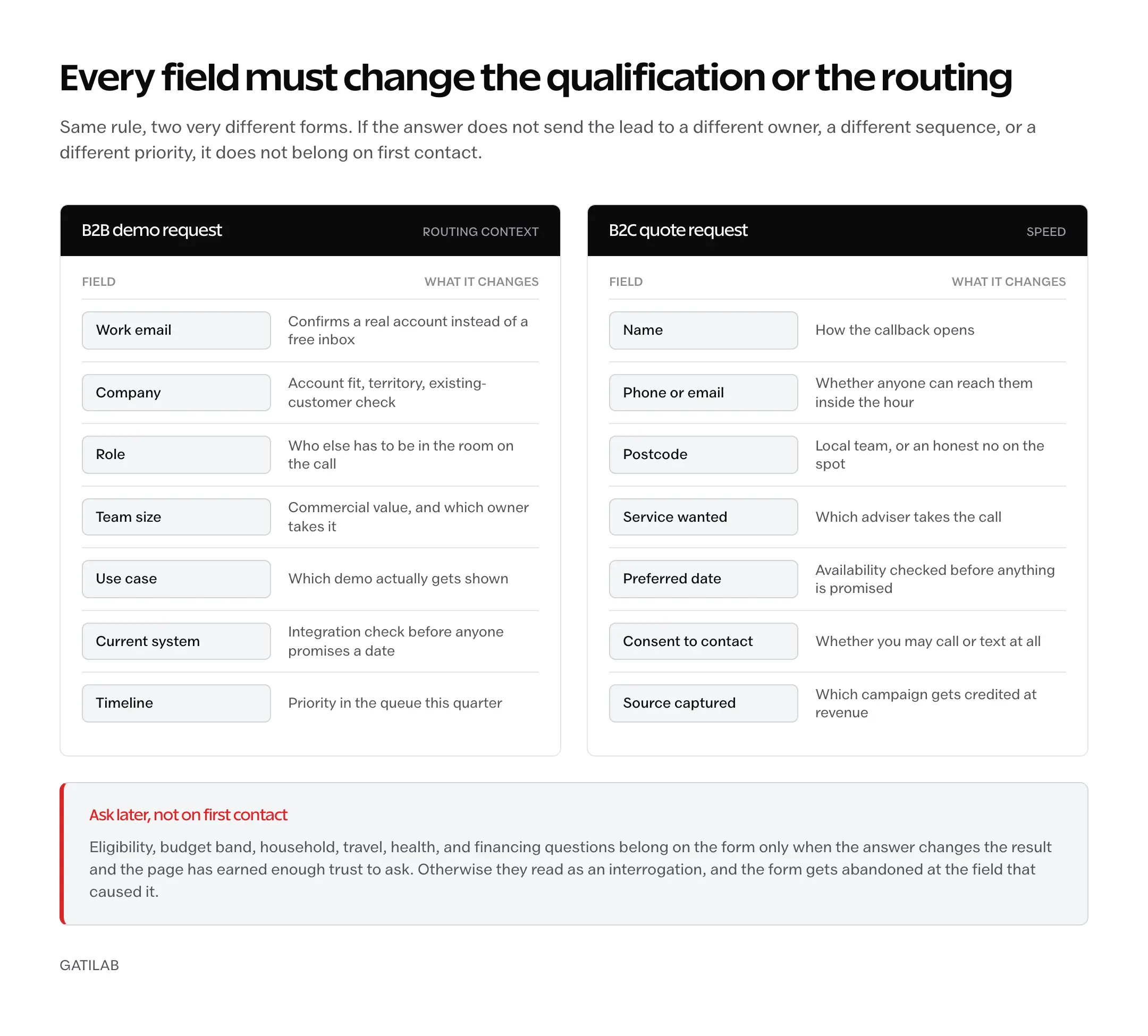
That rule removes more fields than any redesign, and it removes the right ones, because it deletes questions you were asking out of habit rather than questions the reader found intrusive. The rest of the work, from field order to error handling to the mobile keyboard that appears, sits inside a 14 day form optimization sprint.
Eligibility, budget, household, travel, health, and financing questions are the exception worth naming. Ask them only when the answer changes the result and the page has earned enough trust to ask. Otherwise they read as an interrogation and the form gets abandoned at the field that caused it.
Consent, calling, texting, and retention rules vary by jurisdiction and by contact type, and B2B contacts are not always covered by the same basis as consumer contacts. The FTC’s CAN-SPAM compliance guide covers commercial email in the United States, and the UK ICO’s business-to-business marketing guidance covers the corporate-subscriber distinction that trips up teams running one sequence across both motions. Document your lawful basis, and take legal advice where the stakes justify it.
Qualification asks different questions in each model
Five signals decide whether a lead deserves human attention. The signal names are shared, and the evidence behind each one is not.
| Signal | B2B evidence | B2C evidence |
|---|---|---|
| Fit | Industry, company size, region, stack, use case | Location, need, eligibility, product or service match |
| Intent | Demo request, repeat pricing visit, trial usage, second stakeholder engaging | Quote request, appointment, cart, availability check, repeat visit |
| Timing | Project funded this quarter, contract renewal, active migration | Immediate need, event date, intake deadline, planned purchase window |
| Value | Contract value, seats, expansion path, gross margin | Order value, repeat rate, margin, add-ons, referral potential |
| Disqualifier | Unsupported integration, wrong market, no commercial need | Outside service area, ineligible, date unavailable, wrong budget band |
The disqualifier row is the one most teams leave empty, and it is the row that protects the sales calendar. A lead outside your service area is not a slow lead that needs more nurture. It is a no, and pretending otherwise costs a real follow-up slot that a real buyer was waiting in.
Nurture either prepares a group or prepares a moment
B2B nurture should send material that can travel inside the account without you in the room. Payback assumptions, security notes, an implementation outline, comparison criteria, stakeholder questions and answers, and a recorded demonstration. Your champion is not persuading themselves anymore. They are explaining the decision to finance, IT, legal, the people who will use it, and whoever signs.
Arm the champion.
B2C nurture works on timing instead. Confirmations, reminders, availability, proof, comparisons, financing context, and the next appointment. High-intent consumer leads usually need a human inside the hour, and lower-intent ones need useful education without daily pressure, which means the same sequence cannot serve both without a branch.
Both models depend on the sequence arriving at all, which is a separate problem from writing it. A consumer reminder that lands in Promotions on the morning of the appointment has failed even though the report will count it as sent, and delivered does not mean received.
The two scoreboards do not translate
Judging one motion with the other’s numbers is the fastest way to defund the healthier program. The measures separate cleanly.
- B2B. Qualified accounts, opportunities created, pipeline value, win rate, sales cycle length, customer acquisition cost, payback period, and won revenue by source.
- B2C. Qualified inquiries, purchase or booking rate, revenue per lead, customer acquisition cost, repeat value, refund rate, and time from inquiry to purchase.
A cost per lead of $400 is alarming in one column and cheap in the other, and averaging the two produces a number that describes no part of the business. Report each motion to revenue before combining anything, and pick an attribution model that survives a long B2B cycle rather than one built for a same-week consumer purchase.
Never blend them.
Where the B2B and B2C labels break down
Purchase complexity predicts the funnel better than the label does. A business tool at $29 a month gets bought by one person with a company card in five minutes, and no sales handoff improves it. A university course, a mortgage, a medical procedure, or a home renovation can run for months and involve several influencers, a financing decision, and a professional adviser, and every one of those is technically B2C.
When a business purchase behaves like self-serve, put the weight on product pages, transparent pricing, trials, onboarding, and in-product signals, then offer human help rather than requiring it. When a consumer purchase behaves like a consultative sale, map the decision-makers, the documentation, and the follow-up cadence, and check that the margin supports the human attention you are about to promise.
Hybrid businesses run into this hardest, because the temptation is to save effort by merging.
What most hybrid teams do:
One contact form, one lifecycle stage called Qualified, one shared inbox, one blended cost per lead in the monthly report, and a note in the CRM saying whether the lead looked like a business.
What works better:
A visible choice on the way in, separate landing pages and forms, separate definitions of qualified, separate owners or queues, and separate reports that only get combined after revenue is attached. One contact record per person when someone appears in both motions, with purpose and consent history kept apart.
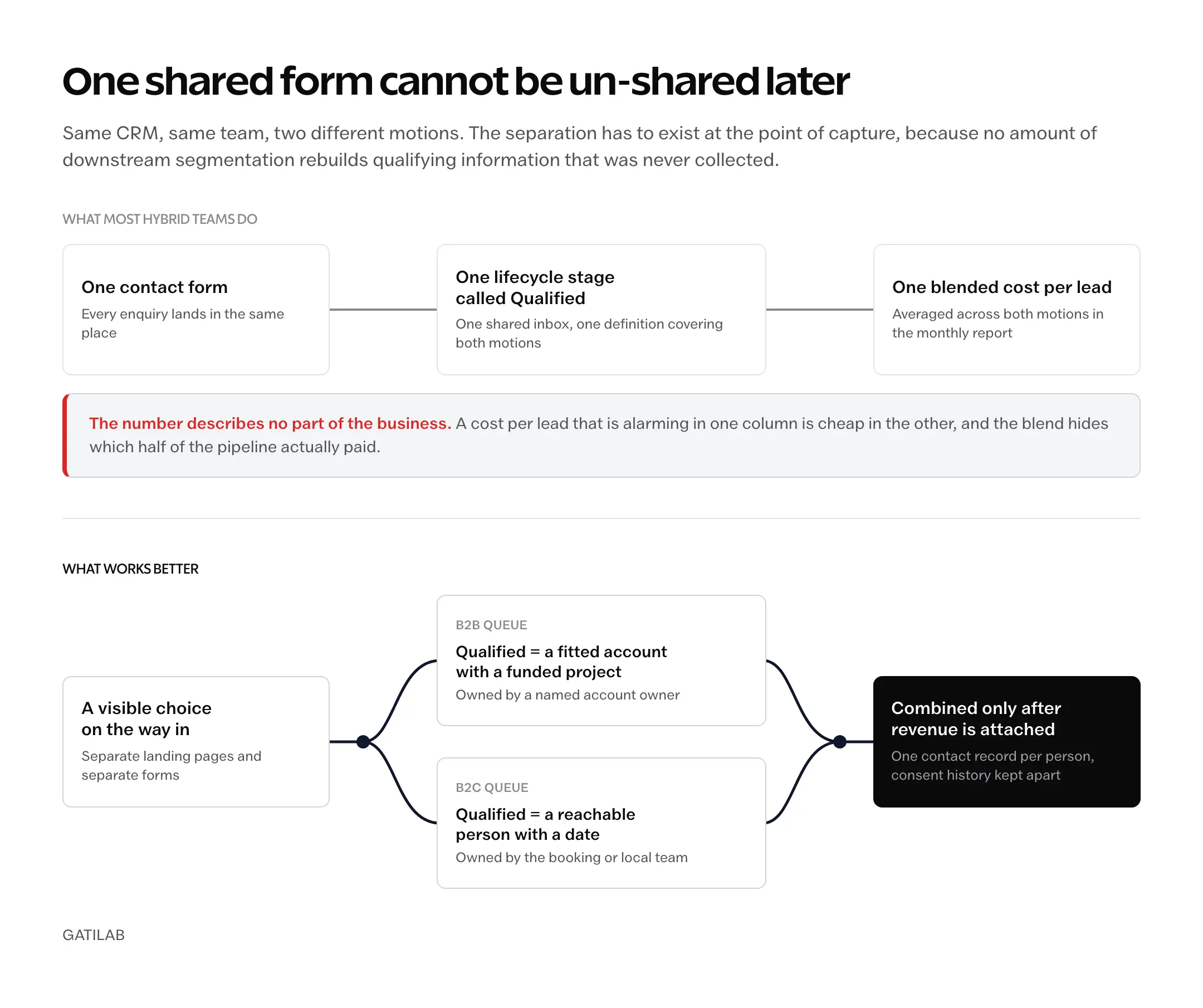
Same CRM, same team, and the second version stops the two motions from contaminating each other’s numbers. The merged version always looks cheaper to run until the first quarter where nobody can explain which half of the pipeline actually paid.
Two queues.
What this framework will not fix
It cannot tell you what you are allowed to spend to win a customer. That ceiling comes from gross profit per customer and expected retention, both of which live in your own books, and no comparison of the two models substitutes for that arithmetic.
It cannot compress a B2B sales cycle either. The cycle belongs to the buyer’s budget calendar, procurement queue, and security review, so a better funnel changes how many accounts enter that process rather than how long the process takes once they are in it.
It says nothing about whether the offer is wanted. Both models will faithfully generate leads for a product nobody buys, and the only difference is that B2C tells you inside a month and B2B takes three quarters to admit it.
And it will not survive a shared form. If B2B and B2C leads land in one queue against one definition of qualified, no amount of downstream segmentation rebuilds the distinction, because the qualifying information was never captured in the first place. That separation has to exist at the point of capture or it does not exist at all.
Capture it upfront.
What quietly ruins both funnels
Copying a competitor’s form length. It looks like a shortcut past a design argument, and it imports their routing logic and their sales capacity along with the field count, neither of which you have.
Judging B2B lead generation on cost per lead. The metric is easy to pull and easy to defend in a meeting, and it rewards the campaign that fills the queue with people who cannot sign, which is the exact outcome the sales team then has to absorb.
Treating a consumer inquiry as a nurture opportunity when it was a purchase attempt. A quote request answered on day 3 with an educational email is not nurture, it is a lost sale being logged as engagement.
Running one lifecycle stage set across both motions. Qualified means a fitted account with a funded project in one column and a reachable person with a date in the other, and one shared definition guarantees at least one of the two teams is reporting fiction.
Scoring leads with a model nobody in sales can explain. Reps work the queue they trust, so an unexplained score gets quietly ignored and the routing you paid to build stops running the day someone decides to check for themselves.
The decision underneath the labels
This was never a question about who your customer is. It is a question about how many people have to agree before money moves, and how much gross profit is left over to fund the agreeing.
The trade is plain enough. Account work costs more per lead and earns it back in contract value, consumer work costs less per lead and earns it back in speed and volume, and both fail in the same way when the follow-up was designed for the wrong number of decision-makers.
Count the people who have to say yes. That number picks your funnel.
Tell Google you want more of this.
Add Gatilab as a preferred sourceOne tap, and this site shows up more often in your own Top Stories, AI Overviews and AI Mode. Remove it any time.