
SEO vs Paid Ads: When to Use Each (And Together)
You are paying for clicks every month and quietly wondering whether organic search would be cheaper. Or you have been publishing for 8 months, the rankings are creeping up, and the phone still is not ringing.
Most teams stuck on this land in one of two camps. The first pours everything into paid ads because they produce numbers by Friday, then discovers the numbers stop the day the card declines. The second commits entirely to SEO, reads month 4 as a verdict, and gives up in the exact quarter compounding was about to start.
The two channels answer different questions, which is why choosing one is usually the wrong move.
The short version
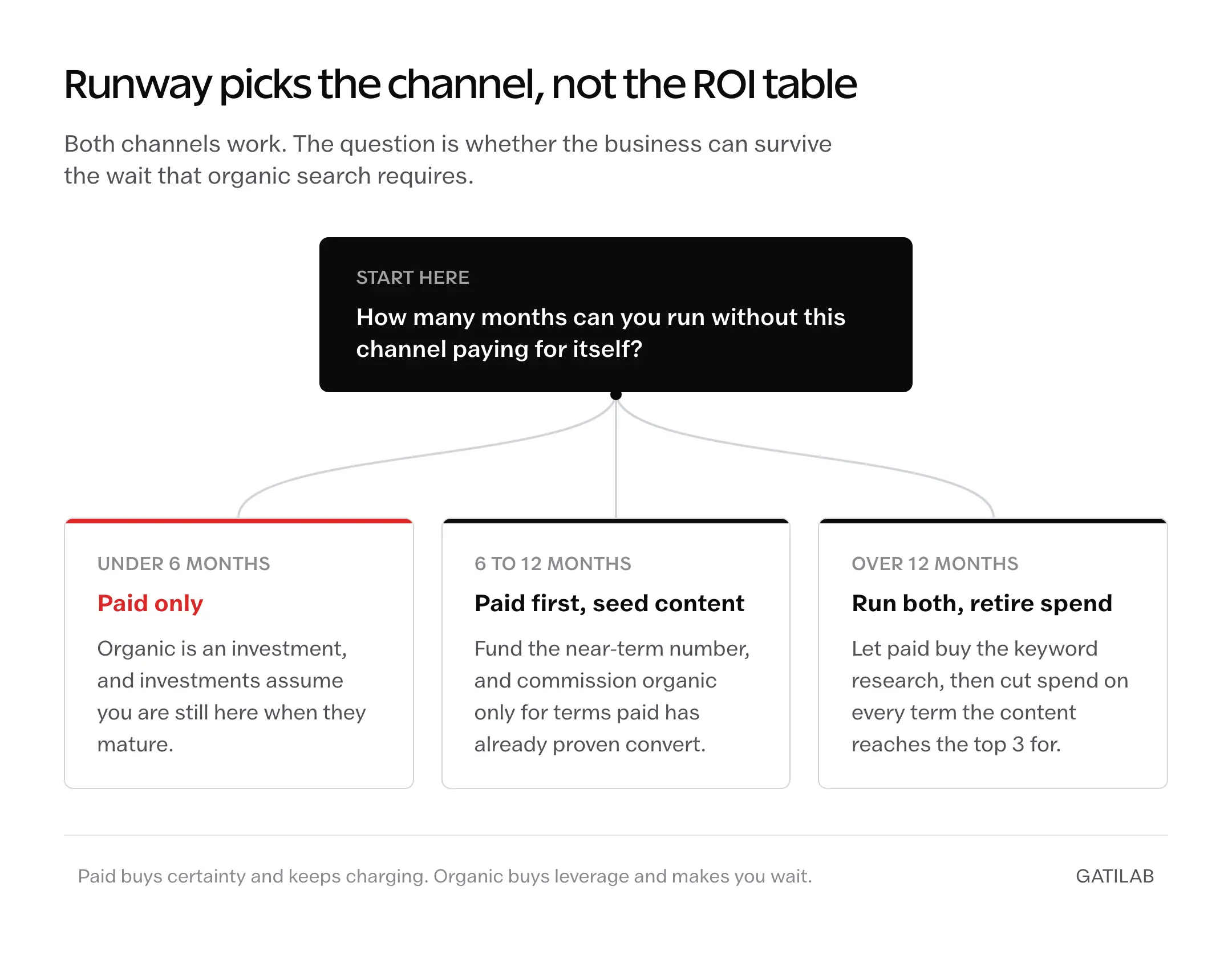
Buy traffic when you need pipeline this quarter. Earn it when you need cost per acquisition to fall over years. A business with 12 months of runway should usually run both, with paid carrying the near-term number while organic builds the asset that eventually lowers it.
The exception is sharp enough to name. If your runway is under 6 months, organic search is not a marketing channel, it is a bet you cannot afford to settle.
One channel rents attention, the other buys the building
SEO earns traffic. Paid ads buy it. Every other difference on the comparison table is downstream of that one fact, which is why feature-by-feature checklists tend to miss the actual decision.
Rank first for a term drawing 10,000 monthly searches, capture 30% of the clicks, and those 3,000 visits carry no per-click cost. Buy the same 3,000 visits at $2 a click and the month costs $6,000.
Same traffic, two different balance sheets. The paid line is an expense that resets every month, and the organic line is an asset that only depreciates when the rankings slip or the query dies.
That asymmetry cuts the other way too. A ranking takes months to build and can be erased by a competitor with better content or a core update, while a paid campaign turns on this afternoon and turns off just as fast. A ranking is not automatically a payday either, as what happens to click-through rate below position 3 shows. One is slow and durable, the other is instant and rented.
The ROI numbers, and what they leave out
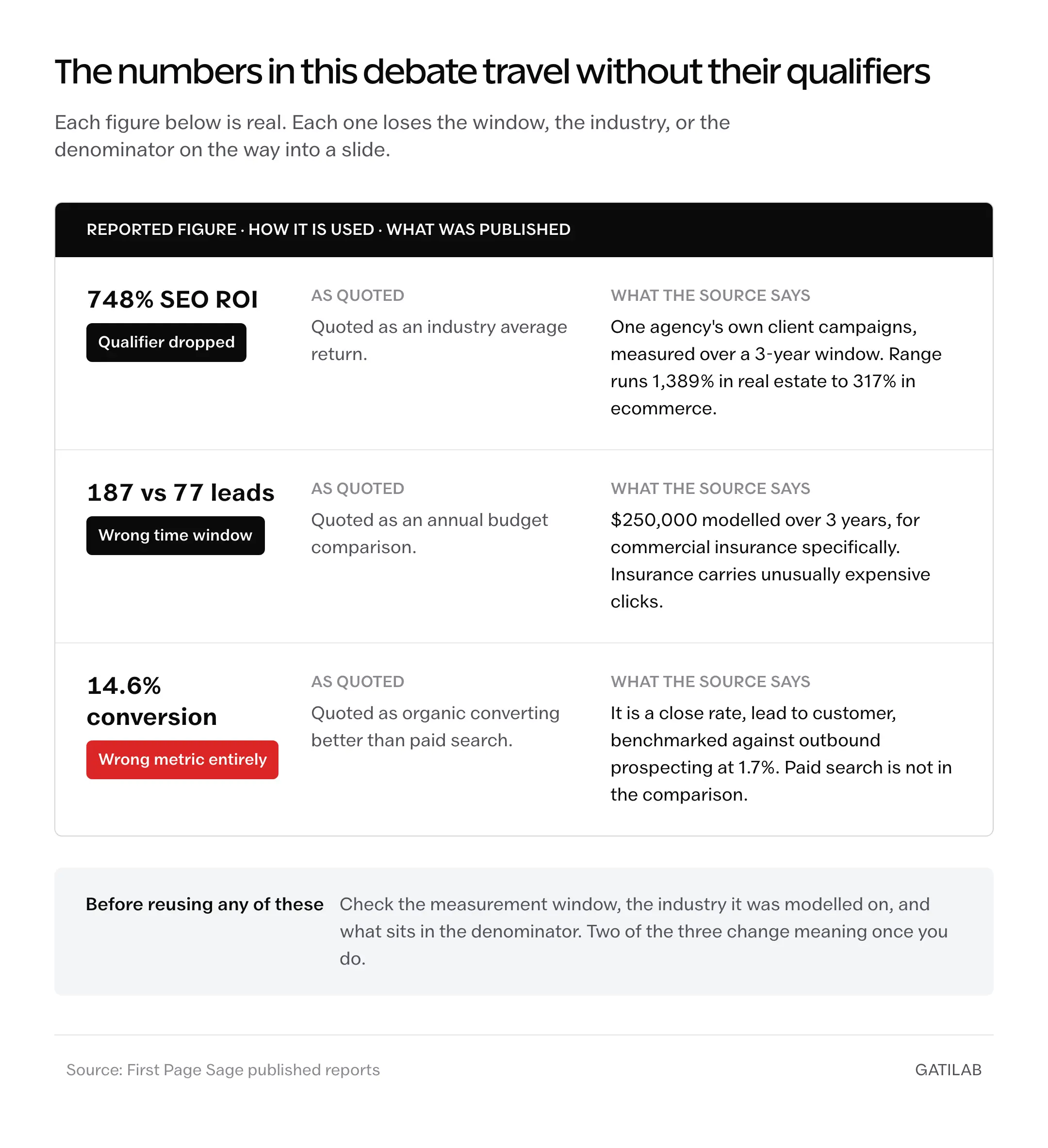
The most repeated figure in this argument is a 748% return on SEO. It is a real number with a specific owner: it comes from First Page Sage, an agency reporting on its own client campaigns, measured across a 3 year window. Read it as one firm’s book of business rather than an industry benchmark.
The spread inside that average matters more than the average. The same analysis puts real estate near 1,389% and ecommerce near 317%. A number that moves by a factor of 4 depending on your industry is a starting point for your own model, not a forecast you can take to a board meeting.
The same firm models a commercial insurance business with $250,000 to spend over 3 years. Put it all into organic and the model returns 187 marketing qualified leads. Put it into paid and the model returns 77.
That gap is worth understanding before you borrow it. Commercial insurance carries unusually expensive clicks, so paid starts the race with a weight in its pocket. Run the same model in a category with $1 clicks and the lines move much closer together.
One statistic in this debate gets quoted wrong so consistently that it deserves correcting. You will see it written that organic traffic converts at 14.6% against roughly 10% for paid search. The underlying figure is a close rate, meaning lead to customer, and the comparison is against outbound prospecting at 1.7%. Not against paid search at all.
Anyone citing it as proof that organic outconverts paid is quoting a different measurement entirely. Check the denominator before you put a number in a budget deck, the same way you would with third-party traffic estimates.
When organic is the cheaper answer
Organic search wins where clicks are expensive, intent arrives early, and the calendar is generous. The conditions are specific enough to check against your own situation.
- Clicks above roughly $20. Legal, insurance, and B2B software routinely clear that. Every month of ranking is a month of not paying it.
- Informational intent dominates the topic. Someone searching how to do the thing is expensive to convert on paid and cheap to reach with a page that answers them.
- The domain already has history. New content on an established site ranks faster, which shortens the payback period that makes organic hard to justify.
- Time is available and cash is not. Writing costs hours instead of budget, which is the one arbitrage a bootstrapped business genuinely has.
- The topic rewards depth. Where the useful answer runs 2,000 words, an ad has nowhere to put it.
Notice what is missing from that list: brand awareness, thought leadership, and every other outcome nobody can price. Those are real, but they will not settle a channel decision, because you cannot compare them against a cost per lead.
When paid is the only answer that fits
Paid search wins on speed, control, and the ability to be wrong cheaply. That last one is underrated.
- You are launching and do not know the market yet. A small campaign tells you within 2 weeks whether anyone wants the thing, which is a question organic answers 8 months late.
- The offer is time bound. A seasonal promotion cannot wait for a page to age into position 3.
- You need the query data. Paid search terms show you the exact language buyers use, and that data is worth the spend even when the campaign itself breaks even.
- The page cannot rank. Some commercial terms are locked up by directories and marketplaces, and buying the click is the only way onto the results page.
- Runway is short. Organic is an investment, and investments assume you will still be there when they mature.
Validation is the strongest case on that list. Spending $2,000 to learn that the market does not want your product is not a failed campaign, it is the cheapest research you will ever buy.
Running both is not the same as splitting the budget
Most teams that claim to run both are really running two disconnected programs and reporting them in separate decks. The combination only pays when one channel feeds the other.
What most teams do:
Allocate 50% to paid and 50% to content. Review each channel’s cost per lead at the end of the quarter. Move budget toward whichever number looks better.
What works better:
Run paid across the full keyword set for 1 quarter. Pull the search terms report, keep the terms that produced qualified leads rather than clicks, and commission organic content only for those. Then cut paid spend on any term where the page has reached the top 3.
Same budget, different sequence. The second version buys keyword research with money you were spending anyway, then retires the spend on every term the content wins, so paid slowly funds its own replacement.
What this will not fix
Neither channel repairs an offer people do not want. Paid finds that out in 2 weeks and organic takes a year, but the finding is identical, and no amount of budget reallocation changes it. Volume does not rescue it either: 748 published pages returning 13 clicks is what that failure looks like at scale.
Neither one fixes a site that cannot convert. Sending 3,000 visitors to a page with no clear next step produces 3,000 exits, and the channel report will blame the traffic rather than the page.
Organic cannot be scheduled. You can control publishing cadence and technical quality, and you cannot control when a page starts ranking, which means organic is a poor fit for any number a board expects on a fixed date.
And the published ROI models cannot be transplanted. Every figure quoted above belongs to one agency’s client set in a handful of industries, so the honest use of them is as a template for your own math, with your click costs and your close rate substituted in.
What quietly ruins the math
Judging organic on a 90 day window. It feels like due diligence, and it measures the investment before any of it has matured, which is how businesses kill programs 1 quarter before the payback.
Counting content as free because nobody invoiced for it. The hours are real, the opportunity cost is real, and an organic program costed at zero will always look like it beat paid.
Comparing cost per lead across channels without checking lead quality. Paid frequently produces more leads and worse ones, and a blended number hides that until the sales team starts ignoring the queue.
Pausing paid the moment organic starts working. The rankings you just bought your way into are the ones most exposed to a competitor, and turning the ads off is how a good quarter becomes a flat one.
Borrowing an industry ROI figure instead of building your own. Your click costs, close rate, and deal size decide this, and none of them appear in someone else’s case study.
The decision underneath the decision
This was never a contest between 2 channels. It is a question about time: whether the business needs revenue before it needs a lower cost of revenue, and only one person can answer that.
The trade is plain enough. Paid buys certainty and keeps charging for it, organic buys leverage and makes you wait, and the businesses that compound are usually the ones that could afford to wait because paid was covering the interim.
Work out how many months you can survive without the channel paying for itself. That number picks your answer.
Tell Google you want more of this.
Add Gatilab as a preferred sourceOne tap, and this site shows up more often in your own Top Stories, AI Overviews and AI Mode. Remove it any time.