
Parasite SEO: What It Is and Why It Stopped Paying
Someone has offered you a slot on a domain you could never outrank. Forbes, a news site’s coupons directory, a Medium publication, a university blog. The pitch never changes: skip the years of building authority and rent someone else’s by the month. That trade has a name, parasite SEO, and Google has spent since 2024 taking it apart.
That pitch produces opposite mistakes. Some people sign, stand up a permanent section of commercial pages under a masthead they don’t own, and read the early rankings as proof the model works. Others refuse every third-party placement on principle, including the ones that were always fine, and spend a year rebuilding reach they could have borrowed honestly.
The line between them isn’t the domain. It’s what the content is doing there.
Parasite SEO rents a ranking signal you don’t own
The mechanic is narrow, and stating it precisely matters more than the metaphor. A publisher spends decades earning ranking signals with its own reporting. A third party pays for space inside that domain, publishes commercial content it controls, and those pages start out ranking as though the newsroom wrote them.
The host gets a check. The third party gets rankings it couldn’t have earned on its own domain in under three years. The reader gets a credit card roundup wearing a newspaper’s byline.
Google’s spam policies for Google Web Search call it site reputation abuse, and the live definition reads:
“Site reputation abuse is a tactic where third-party content is published on a host site mainly because of that host’s already-established ranking signals, which it has earned primarily from its first-party content.”
Read the word “mainly.” The policy turns on why the content is sitting on that domain, not on who signed off on it. That distinction is the whole argument, and it’s the part Google rewrote in late 2024.
The November 2024 rewrite is the version that binds you
Google announced the site reputation abuse policy on March 5, 2024, effective May 5. That first version defined the violation as third-party pages published “with little or no first-party oversight or involvement.” Publishers read the oversight clause as an escape hatch. Add an editor, add a review step, document the involvement, keep the arrangement running.
Google deleted the clause on November 19, 2024.
“no amount of first-party involvement alters the fundamental third-party nature of the content or the unfair, exploitative nature of attempting to take advantage of the host’s sites ranking signals”
The same update named partial ownership agreements and white-label services specifically, which closed both structures publishers had built to stay inside the older wording. If your compliance argument was “we supervise it” or “we own part of it,” the update removed the argument rather than tightening it.
The three versions of the definition are worth reading side by side, because the change in wording is the change in risk.
| Policy version | Defining clause | What it meant for hosts |
|---|---|---|
| March 5, 2024, effective May 5 | Third-party pages published “with little or no first-party oversight or involvement” | Oversight looked like a defense, so publishers built one |
| November 19, 2024 | “publishing third-party pages on a site in an attempt to abuse search rankings by taking advantage of the host site’s ranking signals” | Oversight clause gone; partial ownership and white-label named directly |
| Live spam policies page | Third-party content published “mainly because of that host’s already-established ranking signals” | The test is why the content is there, judged on the section itself |
Each rewrite moved the test further from paperwork and closer to purpose. Paperwork is what a rented section can produce on demand; purpose is not.
The November update also stated the mechanism the whole policy rests on: sub-sections of sites don’t get a ranking boost just because of the reputation of the main site. That sentence decides whether any of this pays. If the section is measured on its own, the domain you rented was never the asset you were buying.
Rented, not owned.
Enforcement hit sections, not mastheads
Enforcement started on May 6, 2024, and it ran on human review. Google Search Liaison Danny Sullivan described the mode that day: “we’re only doing manual actions right now. The algorithmic component will indeed come, as we’ve said, but that’s not live yet.” The first casualties were coupon directories at CNN, USA Today, the Los Angeles Times, and Fortune.
The affiliate sections went down over the following months, not in a single event.
- Time Stamped: July 18, 2024, after an earlier hit during the March 2024 core update
- Forbes Advisor: September 25, 2024
- WSJ Buy Side: September 27, 2024
- CNN Underscored: September 27, 2024
Every one of those dates comes from third-party visibility tracking, mostly Glenn Gabe’s analysis and Sistrix data, not from Google. Google has never publicly named a penalized site, and the actions landed on affiliate sub-sections rather than the parent newsrooms.
Sections, not mastheads.
The URL structure was never the tell either, though plenty of write-ups still frame it that way. Forbes Advisor sat in a subfolder at forbes.com/advisor, WSJ Buy Side in a subfolder too, while CNN’s coupon directory lived on a subdomain at coupons.cnn.com. Google’s November wording treats an independent sub-section as standalone regardless of which structure it uses.
Moving a commercial section from a subdomain to a subfolder changes the address, not the classification.
What Forbes Advisor lost, and what it clawed back
Sistrix reported Forbes Advisor removed from the index after the September action, with the /health directory that housed its supplement content wiped completely. Forbes stopped ranking even for the query “Forbes Advisor.”
Ahrefs data, reported by BuzzStream, puts the peak near 24 million monthly visits and the loss at roughly 20 million. Traffic bottomed near zero in February 2025, started climbing in March, and reached about 4 million monthly visits by May 2025.
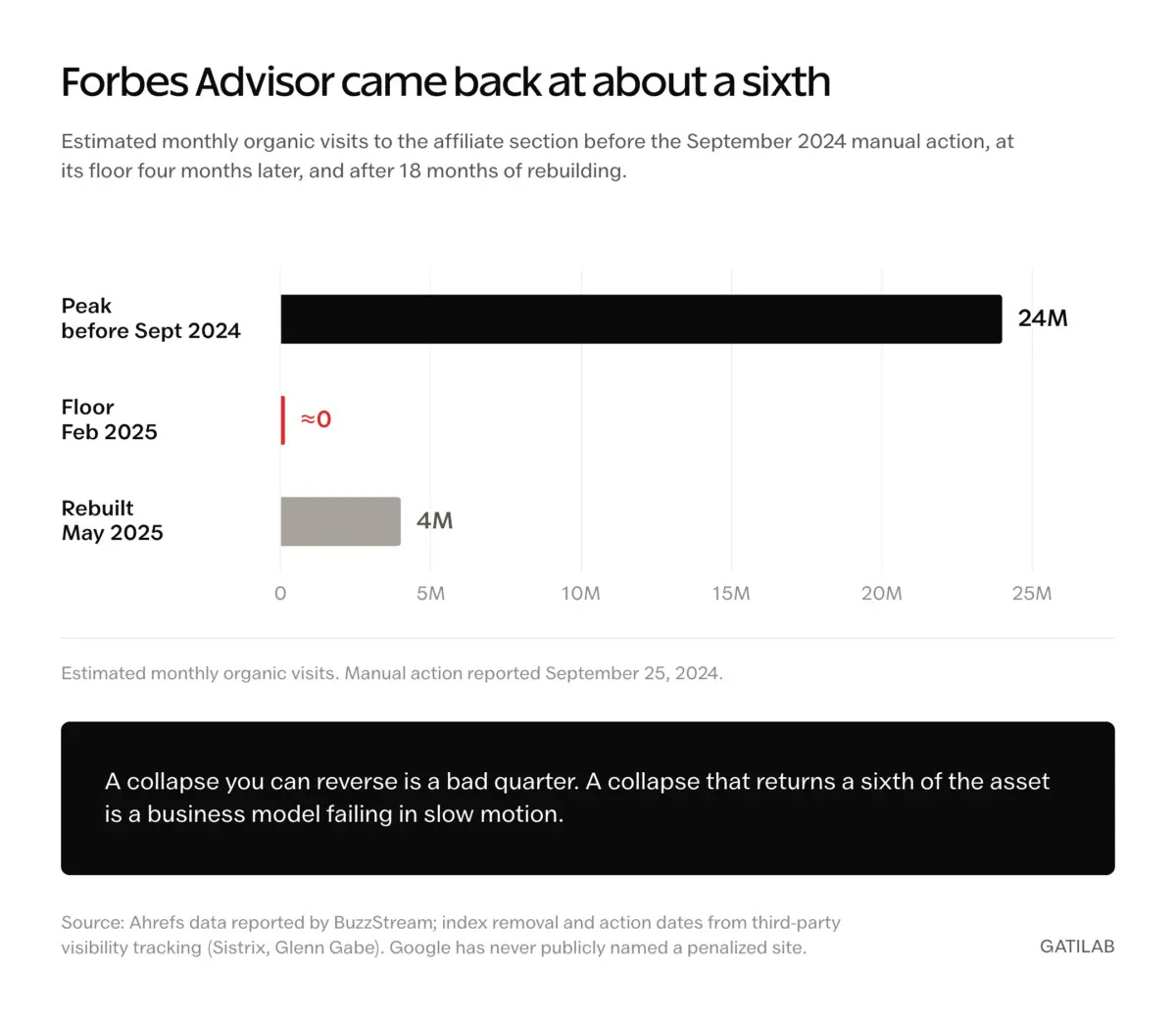
About a sixth.
The recovery number argues harder than “the traffic evaporated” ever did. Roughly 18 months on, with a global publisher’s resources behind the rebuild, the section held about a sixth of what it had. A collapse you can reverse is a bad quarter. A collapse that returns a sixth of the asset is a business model failing in slow motion.
The structure behind that section is contested, and the distinction matters when you repeat the story. Lars Lofgren’s September 2024 investigation reported that Forbes Marketplace operated as a separate company running the affiliate business inside the Forbes domain. Neither Forbes nor Forbes Marketplace has publicly confirmed that description, and it has been disputed since.
Treat the ownership claim as reporting, not record. The traffic movement was measured by tools anyone can check; the corporate structure is an allegation from one investigation.
The subfolder workaround has the same evidentiary problem. In November 2024, SEO practitioner Charles Floate posted on X that swapping /advisor/ for /portfolio/ produced “almost instant traffic worth millions of dollars per month.” Forbes SEO representative Jonathan Jones publicly countered that the swap was a test falling outside the timing of the manual actions and the new policy guidance.
Neither account is Google’s, and Google doesn’t comment on individual sites. What’s actually on the record is the policy language, which measures the sub-section independently whichever path it sits on.
Reddit is why the tactic still looks like it works
The strongest counterargument to all of this is that content on borrowed domains still ranks, and the numbers back it up. Sistrix measured a 1,328% increase in reddit.com’s Google visibility between July 2023 and April 2024. Reddit moved from 68th to 5th in US organic visibility by July 2024, then to 2nd by 2025, behind only Wikipedia.
That’s real, and it’s a different mechanism. Reddit rose because Google decided forum answers satisfy a class of query, not because a third party bought a walled section inside reddit.com and filled it with product roundups. Answering in a subreddit where you have standing is community participation. Leasing a permanent commercial wing under someone’s masthead is the arrangement the policy names.
Different trades.
Guest posting and parasite SEO split on one testable question
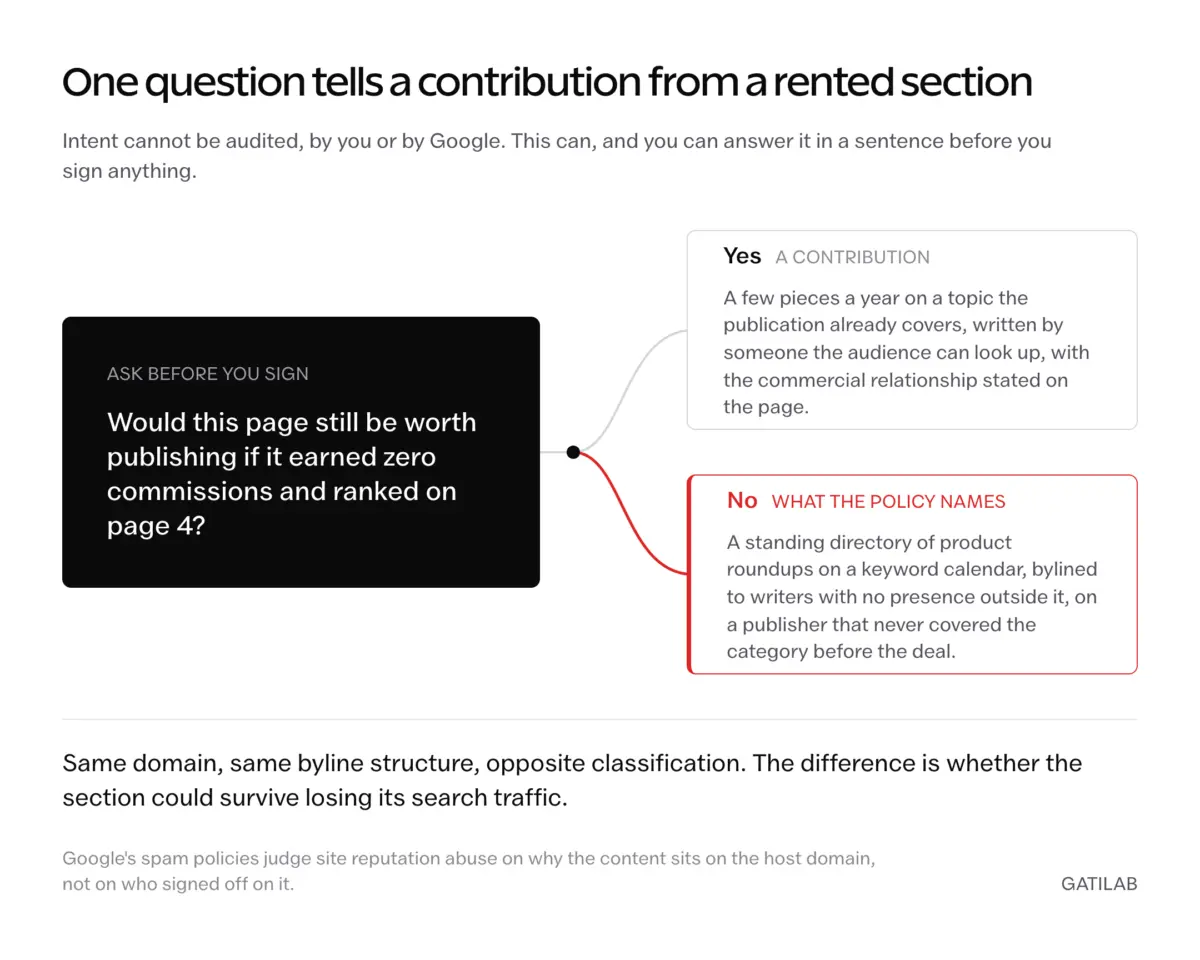
The two look identical from outside. A byline that isn’t the publisher’s, on a domain that isn’t yours. The distinction people usually reach for is intent, which nobody can audit, including Google. One question does better, and you can answer it in a sentence.
Would this page still be worth publishing if it earned zero commissions and ranked on page 4?
A guest post survives that question because the audience was the point. A rented commercial section doesn’t, because ranking was the entire deliverable, and everyone in the deal knew it at signing.
What the arrangement looks like when it fails:
A standing directory of product roundups, refreshed against a keyword calendar, bylined to writers with no presence outside that directory, on a publisher that never covered the category before the contract.
What it looks like when it holds:
A few pieces a year on a topic the publication already covers, written by someone the audience can look up, with the commercial relationship stated on the page.
Same domain, same byline structure, opposite classification. The difference is whether the section could survive losing its search traffic, which is also the test a manual reviewer is effectively applying.
How to check whether your arrangement is the problem
Most people asking whether they’re doing parasite SEO already have a placement running and want to know whether to unwind it. Four checks, in the order that produces an answer fastest.
- Did the host cover this category before the deal? If not, the rankings are coming from the masthead, which is the exact thing the policy measures separately now.
- Would the same content rank on your own domain? Publish a close equivalent there and compare. This is the only test that separates a good page from a good domain.
- Is the host’s editorial team accountable for it, or nominally attached? Oversight stopped being a defense in November 2024, but a section the newsroom won’t defend is a section the newsroom will eventually drop.
- Are you watching the manual actions report? A site reputation abuse action appears there and names the affected URLs, which is the only authoritative signal you get.
Manual actions land in Search Console well before they land in a revenue report, so that last check belongs in a monthly Google Search Console SEO audit rather than a panic session after traffic falls off a cliff.
Check first.
What replaces a rented section
None of the replacements are fast, and pretending otherwise is how people end up back in the pitch meeting six months later. Each one has the property the rented section lacks: you still hold it after a policy update.
- Earned links from publications that already cover your category. Slower per placement, but the signal points at your domain instead of someone else’s. The link building strategies that still work are mostly the unglamorous ones.
- A small number of genuine contributions a year, with the commercial relationship stated on the page. That’s branded content, it has its own disclosure rules, and it isn’t the thing the spam policy describes.
- Depth on a category you can actually defend, on your own domain. Fewer pages, each one answering something a buyer asked.
- Community participation where you have standing, which is what the Reddit visibility data actually rewards.
Volume by itself substitutes for none of that. A programmatic run that shipped 748 pages and returned 13 clicks in 90 days is what publishing at scale looks like when there’s no demand underneath it, and it costs real money to find that out.
The rule isn’t settled everywhere
Google’s policy isn’t the last word in every market. The European Commission opened proceedings against Google on November 13, 2025, assessing whether the site reputation abuse policy breaches the Digital Markets Act obligation to give business users fair, reasonable and non-discriminatory access to search. The specific concern is publishers being demoted for carrying commercial-partner content.
Google answered the same day, under a headline that used the practitioner’s own term for the tactic rather than the policy name. Pandu Nayak, its Chief Scientist for Search, wrote that “the investigation announced today into our anti-spam efforts is misguided and risks harming millions of European users.” The post is titled “Defending Search users from ‘Parasite SEO’ spam.”
Nothing in that proceeding changes what ranks this week. It does mean the policy’s shape in the EU is genuinely open, and it’s worth knowing that a regulator is looking at it before someone quotes the investigation at you as though it were a ruling. A strategy that only pays if the Commission forces a change is a bet on a regulator, not a plan.
What this can’t settle for you
Three things stay outside what any analysis of the public record can answer.
Whether your existing placement is already flagged. Google doesn’t publish the list and has never named a penalized site. Every attribution in this article traces back to third-party visibility tracking rather than a Google statement, which means outside observers can see a traffic collapse but can’t confirm its cause. Your own manual actions report is the only authoritative signal, and it’s specific to your property.
What recovery costs. Forbes Advisor got back to roughly a sixth of its peak in about 18 months with a global publisher funding the rebuild. There’s no published figure for what that rebuild cost, and no reason to assume a smaller operator recovers on the same curve or at all.
Where the borderline sits. A long-running section the host’s own newsroom staffs, that predates any search motive, isn’t obviously the thing the policy describes. Those get decided case by case through manual review, by a person applying judgment you can’t see. The four checks above give you the questions. They don’t give you the verdict.
What quietly ruins a legitimate placement
The arrangements that get caught rarely start out as violations. They drift.
Scaling a good placement into a section. One useful piece a quarter on a publication that covers your category is a relationship. The same relationship stretched into a standing keyword-mapped library is the thing the policy names, and the change happens without anyone deciding to cross a line.
Treating oversight as the compliance test. Adding an editor felt like the fix because the March 2024 wording said it was. That clause is gone, and a workflow built to satisfy it is a workflow built against a rule that no longer exists.
Moving the URL instead of the content. A subdomain-to-subfolder swap reads as a remedy because the address changed and something happened. Google measures the sub-section independently either way, so the only thing the move buys is the time it takes a reviewer to notice.
Judging the placement by its ranking. A page that ranks on a borrowed domain proves the domain works, not that the page does. Publishing the same content on your own domain is the test that separates them, and almost nobody runs it before signing because the answer might kill the deal.
Skipping disclosure because the host didn’t ask. Undisclosed commercial relationships carry regulatory exposure that has nothing to do with Google, and a publisher’s silence isn’t a legal opinion.
You were renting a signal, not buying an asset
The pitch was never really about content quality, which is why arguing about content quality goes nowhere. It was about whether ranking signals transfer down into a section. Google answered that in November 2024, and the answer was no. If a sub-section is measured on its own merits, the domain you were paying for was never the thing you were buying.
The honest trade is that building your own authority is slower and the first year looks worse on every dashboard. It also can’t be revoked by a policy update, doesn’t depend on a manual reviewer’s read of your contract, and doesn’t disappear when a publisher decides the partnership costs more reputation than it earns.
Before you sign anything that rents you a masthead, publish the page on your own domain first and find out what it’s actually worth.
Tell Google you want more of this.
Add Gatilab as a preferred sourceOne tap, and this site shows up more often in your own Top Stories, AI Overviews and AI Mode. Remove it any time.