
Google Analytics Alternatives: Count Decisions, Not Reports
Open your analytics. Look at what’s on the screen, then ask which of it changed a decision you made in the last 6 months. For most small sites the honest answer is 2 numbers, maybe 3, and everything else on that dashboard has never once altered a course of action.
That is the actual test for Google Analytics alternatives, and almost nobody applies it. The comparison posts line up feature checklists instead, which reliably concludes that the free tool with 400 reports beats the paid one with 12.
Wrong question. The right one is which decisions you make, then whether a tool supports those.
The 2 ways people get this wrong
The first group stays on Google Analytics out of inertia, opens it about twice a year, understands roughly none of it, and still pays for it with a consent banner, a slower page, and an obligation to explain to visitors what happens to their data.
The second group leaves in a hurry, picks whatever tool a newsletter recommended, and discovers 3 months later that the one report they genuinely relied on is gone and the historical data went with it.
Both skipped the same 20 minutes of thinking.
Write down the decisions before you shop. Not the metrics, the decisions: what would you actually do differently depending on the answer?
The decisions a small site actually makes
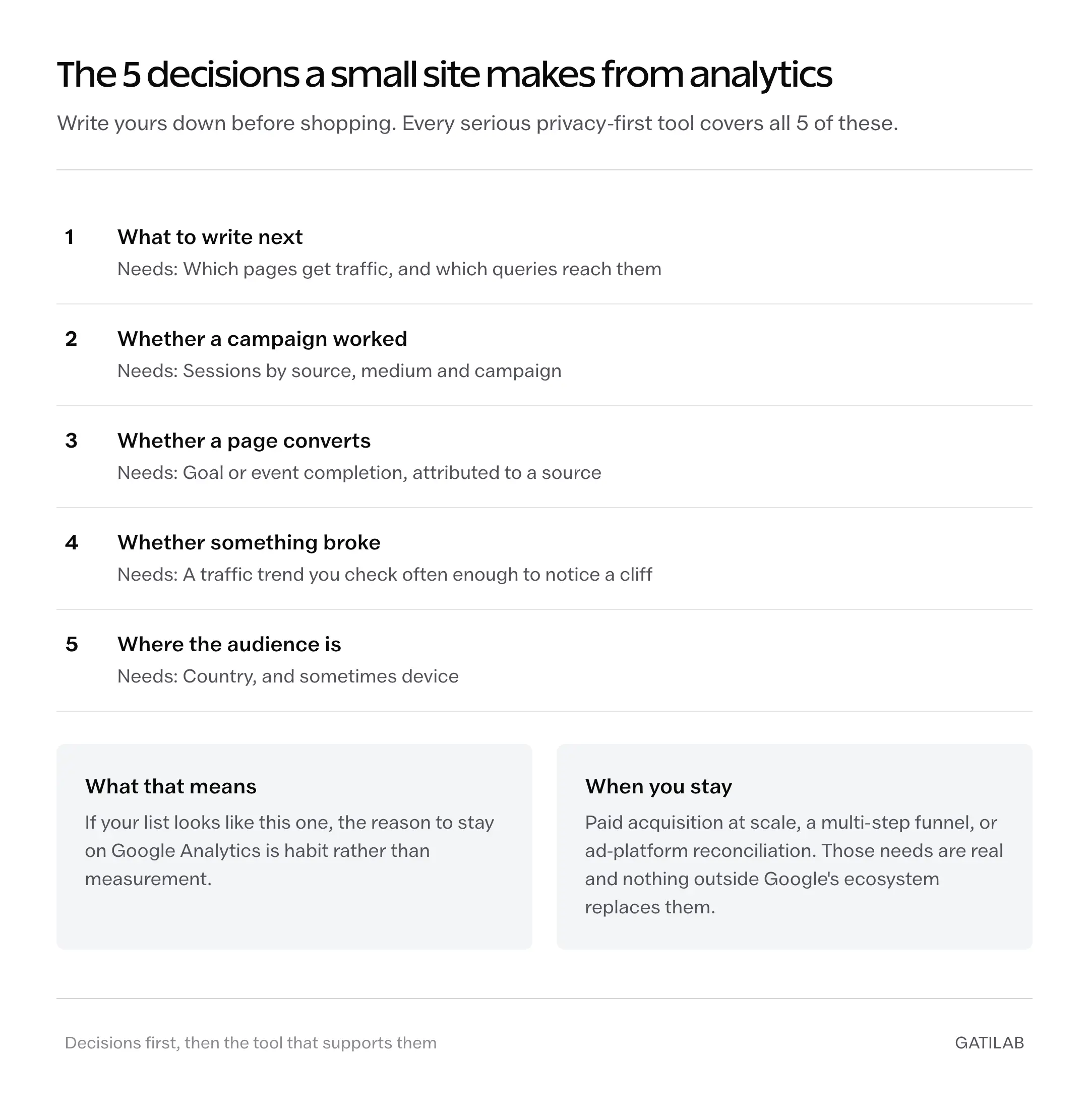
Across most blogs, service sites, and small stores, the list of analytics-driven decisions is short and remarkably consistent.
- What to write next. Needs: which pages get traffic, and which search queries reach them.
- Whether a campaign or post worked. Needs: sessions by source, medium and campaign.
- Whether a page converts. Needs: goal or event completion, attributed to a source.
- Whether something broke. Needs: a traffic trend you look at often enough to notice a cliff.
- Where the audience is. Needs: country, and sometimes device.
That is the entire list for most sites, and every serious privacy-first tool covers all 5. Which is the uncomfortable finding buried in this category: the reason to stay on Google Analytics is usually not measurement, it’s habit.
The decisions that genuinely need Google Analytics exist, and they belong to a specific kind of site. If yours runs paid acquisition at scale, sells across a multi-step funnel, or has to reconcile with ad-platform attribution, keep reading but expect the answer to be that you stay.
The Google Analytics alternatives worth considering
Prices are current list prices and all 4 tools are cookieless by default, which is what removes the consent banner in most jurisdictions. The meaningful differences are ownership and volume, not features.
| Tool | Entry price | Self-hosting | Best fit |
|---|---|---|---|
| Umami | Free cloud tier at 1M events per month | Yes, MIT licensed and free | Self-hosters and anyone with volume but no budget |
| Plausible | From $9 per month at 10K pageviews | Yes, AGPL Community Edition | The general default: clean dashboard, goals and funnels |
| Fathom | From $14 per month at 100K pageviews | No | People who want it handled and never touched again |
| Matomo | Cloud from about EUR 29 per month | Yes | Sites that need GA-style depth without giving up ownership |
The gap between Umami’s free tier and Fathom’s $14 is not a quality gap. It’s a question of whether you would rather run a database or pay someone else to.
For most people reading this, Plausible is the default and Umami is the answer if self-hosting sounds like a Saturday rather than a burden. Matomo earns its price only when someone genuinely needs the deeper reporting, and Fathom is worth its premium when the goal is to stop thinking about analytics entirely.
What you genuinely lose
The honest part, and the part the switching guides skip because it complicates the recommendation.
Cross-device identity goes. Google Analytics stitches a phone visit and a laptop visit into one user when it can. Cookieless tools cannot, by construction. If your buying cycle spans devices, your visitor counts will read higher and your conversion rates lower, and neither number is wrong, they are just measuring something different.
Deep funnel analysis mostly goes. Multi-step paths with branching, cohort retention curves, and detailed user-journey exploration are either absent or much simpler. Matomo is the exception if you need this and want to leave anyway.
Ad-platform attribution goes. Google Analytics and Google Ads share an identity graph, so conversions reconcile between them. Nothing outside Google’s ecosystem gets that, and if you are spending meaningfully on Google Ads that alone usually settles the decision.
Your history stays behind. Nothing imports your Google Analytics history. Run both in parallel for a few months if the past matters, and export whatever you will want to cite later.
Everything on that list is real. None of it appears in the 5 decisions above, which is the whole argument.
The mistakes that make the switch worse
The switch itself is 20 minutes. The surrounding decisions are where it goes wrong.
Deleting the Google Analytics property immediately. It costs nothing to leave it collecting alongside the new tool, and 3 months of overlap turns any future disagreement between the numbers into something you can actually check.
Expecting the numbers to match. They will not, and the new tool usually reports fewer sessions because it is not counting things Google Analytics counted. A 10% to 30% gap on the same site is ordinary. Compare each tool against itself over time, never against the other one.
Dropping the consent banner without checking. Cookieless removes the usual legal basis for one in many jurisdictions, but your other scripts may still require it, and the analytics tool is rarely the only thing on the page.
Forgetting Search Console. It is free, it is unaffected by any of this, and it answers the single most valuable question on the list, which is what people searched to reach you. No analytics tool of any kind can tell you that.
Treating self-hosting as free. The licence is free. The database, the backups, and the evening it goes down are not, and that trade is only worth it when you already run infrastructure.
Where this reasoning stops
This argument is built for small and mid-sized sites making the 5 decisions above. It gets weaker as the site gets more commercial.
If you run paid acquisition where attribution decides budget, the reconciliation problem is real and expensive, and no privacy-first tool solves it. If your product has a genuine multi-session funnel, the simplified reporting will hurt. And if a client or employer requires Google Analytics specifically, the technical merits are not the deciding factor.
Pricing in this category also moves. Every figure here is a list price at the time of writing, and volume tiers in particular get revised, so confirm at checkout before committing to an annual plan.
The recommendation is conditional on your list being short. Write it out first, and if it turns out to be long and cross-device, the honest answer is that you stay where you are.
Questions people ask next
Plausible for most people, at $9 a month with a clean dashboard and goal tracking. Umami if you are happy self-hosting, since it is free and MIT licensed. Both cover the decisions a small site actually makes.
Usually not, because they are cookieless by default and that removes the common legal basis for one. Other scripts on your page may still require consent, so check the whole page rather than the analytics tool alone.
Cross-device identity, deep multi-step funnel analysis and ad-platform attribution. If you spend meaningfully on Google Ads, that last one usually settles the decision on its own, because nothing outside Google’s ecosystem reconciles with it.
No. Nothing imports it, so the record stays behind. Run both tools in parallel for a few months if history matters, and export anything you expect to cite later.
Because the tools count differently, and the new one is usually not counting things the old one did. A 10% to 30% gap on the same site is ordinary. Compare each tool against its own trend rather than against the other.
Count the decisions, not the reports
A dashboard with 400 reports and 3 useful ones is not more measurement than a dashboard with 12. It’s the same measurement, with more places to get lost, and a consent banner attached.
Most Google Analytics alternatives are not competing on measurement quality, and the reason to leave was never that Google Analytics measures badly. It measures far more than most sites need, at a cost in page weight, comprehension, and the conversation you have to have with visitors about their data. When the thing you actually use is 5 numbers, paying that toll is a poor trade. Tagging your links properly with UTM parameters matters considerably more than which of these tools receives them.
Write down your decisions. Then pick the smallest tool that answers them.
Tell Google you want more of this.
Add Gatilab as a preferred sourceOne tap, and this site shows up more often in your own Top Stories, AI Overviews and AI Mode. Remove it any time.