
Stackless for WooCommerce Review: Pros, Cons, Pricing
Stackless for WooCommerce is a single plugin that adds subscriptions, Stripe, PayPal and Polar payments, software licensing, multi-currency pricing, invoices, quotes and about 20 smaller store tools to a plain WooCommerce install. It replaces a stack that most stores assemble from 6 to 12 separate extensions, and it costs $39 a year or $99 once. The catch is age: the first public release shipped on 13 October 2026, and some of the harder problems, such as importing from WooCommerce Subscriptions, aren’t solved yet.
One thing to say before anything else. Stackless is built by Gaurav Tiwari, who also runs Gatilab. This is a first-party walkthrough written from the product’s public demo store and its source, not an outside review, and the limits section is as long as the praise for that reason.
Choose Stackless if you run WooCommerce and currently pay for 3 or more extensions in this list: subscriptions, a Stripe or PayPal gateway with saved cards, software licensing, multi-currency, invoices, order bumps, a checkout customizer, wishlists, add-ons or delivery slots. One $39 license covers all of them on unlimited sites, and modules you leave off load nothing.
Skip it if you already have a WooCommerce Subscriptions install with live subscribers (there’s no importer yet), if your renewals depend on a gateway other than Stripe, PayPal or Polar, or if you need a product with years of public history behind it before you trust it with billing.
The evidence that decides it: on the demo store, switching the Optimizer module on took WooCommerce’s cart and checkout prefetch hints from 52 per page to 0, and the subscriptions module runs a full lifecycle (signup, trial, renewal, failed-payment retry, cancel) on core WooCommerce with no other plugin installed.
Pros
- 30 modules on one license: $39 a year or $99 lifetime, both for unlimited sites
- Subscriptions with automatic Stripe, PayPal and Polar renewals, trials, signup fees, plan switching and dunning
- Software licensing with an update server, so you can sell your own plugins and themes from WooCommerce
- Price books per currency with a currency selector and currency-aware gateways
- Modules that are off load no code, and the Optimizer removes WooCommerce’s own checkout prefetching
- Works with HPOS and the Cart and Checkout blocks, and pauses itself when a conflicting plugin is active
Cons
- Released 13 October 2026; nine releases in the first two days is fast, but it’s also a short track record
- No importer from WooCommerce Subscriptions, YITH or SUMO yet
- Gateways other than Stripe, PayPal and Polar renew through emailed pay links, not automatically yet
- Polar accepts one subscription per checkout and nothing else in the cart
- Documentation lives in a 39-lesson course; there are no searchable reference docs yet
- Add-on fields and the Buy now button need the classic add-to-cart form, not the block version yet
Quick Comparisons
These are the three products a WooCommerce store owner is most likely to be weighing against Stackless. Each gets a fuller treatment later in the piece.
- vs WooCommerce Subscriptions: the official extension costs $279 a year and does one job. Stackless does that job plus licensing, currency and checkout tools for $39, but WooCommerce Subscriptions has 10 years of edge cases behind it and a migration path from nearly everything. If you’re already on it with paying subscribers, stay.
- vs SureCart: SureCart is its own cart, not a WooCommerce extension, so it swaps your whole store. Stackless keeps WooCommerce, your theme, your orders and your shipping. SureCart wins if you want a hosted checkout with zero plugin maintenance; Stackless wins if you have anything WooCommerce-specific to keep.
- vs CartFlows: CartFlows is a funnel builder with order bumps and upsells. Stackless has order bumps and checkout layouts but not multi-step funnels or post-purchase upsells yet. Buy CartFlows for funnels; buy Stackless when bumps are enough and you also need billing features.
What Stackless for WooCommerce Is
Stackless is a modular plugin. Install it and only its License & Updates screen is on. Everything else is a switch in a dashboard under WooCommerce, grouped the way the admin groups it: Subscriptions, Payments, Checkout, Sales & invoices, Currency, Access & licensing, Catalog and Store tools. A module that’s off registers nothing, so a store that only wants the wishlist and the order bumps carries exactly those 2 modules’ worth of code.
It runs on core WooCommerce alone. The hard requirement list is WordPress 6.6, WooCommerce 9.9 and PHP 7.4, and it declares compatibility with HPOS (the order storage that keeps orders in their own tables) and with the Cart and Checkout blocks. The classic shortcode checkout works too. That combination matters because many older extensions still break on one of the two.
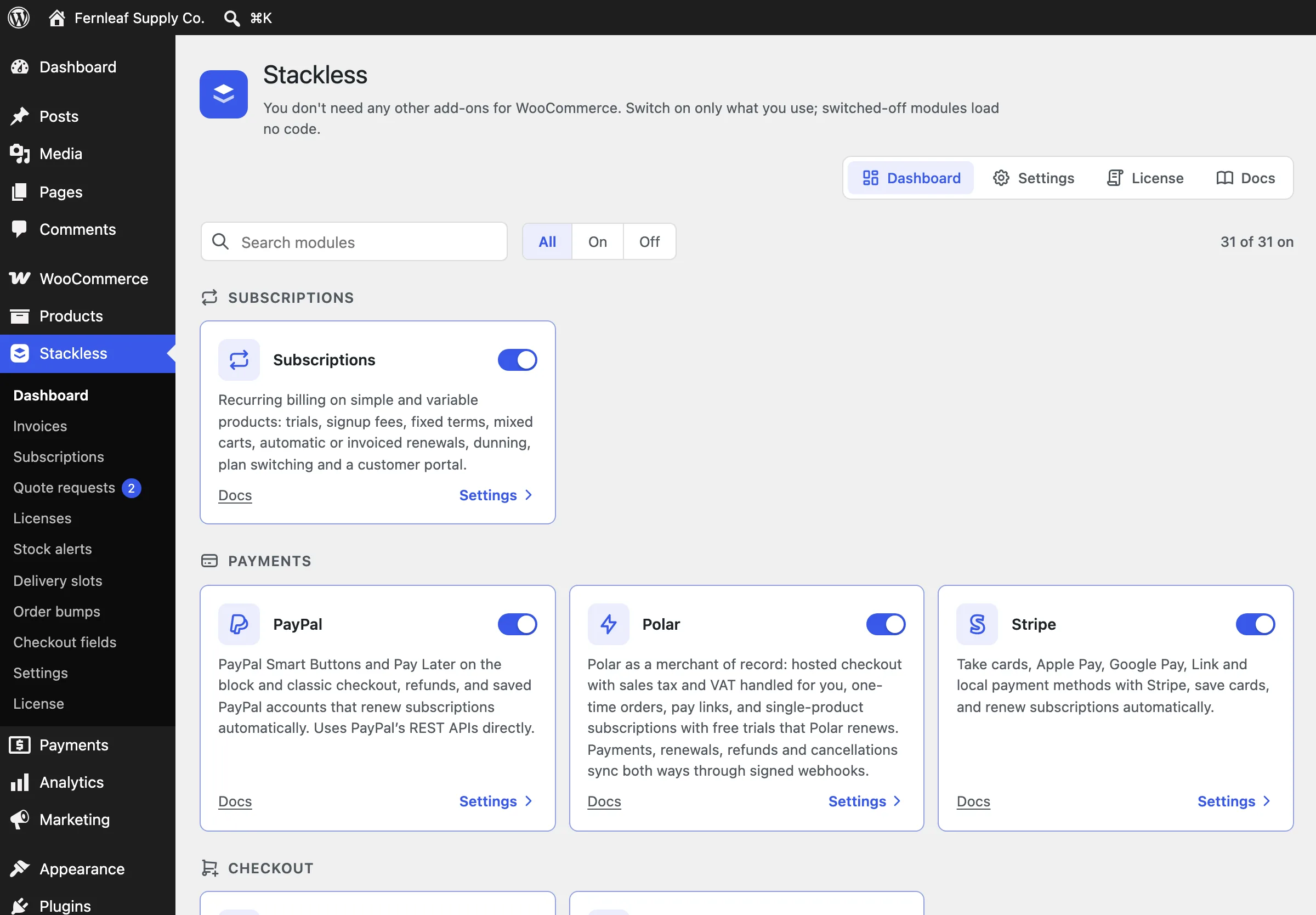
The groups, and what each one replaces:
- Subscriptions: recurring billing on simple and variable products, which otherwise means WooCommerce Subscriptions, YITH or SUMO.
- Payments: Stripe, PayPal and Polar gateways, in place of the separate Stripe and PayPal plugins or WooPayments.
- Checkout: consent checkboxes, a shorter checkout for virtual carts, 5 checkout layouts, order bumps and signed buy links, in place of a checkout field editor, a layout plugin and a funnel tool.
- Sales & invoices: numbered invoices, recurring invoices, deposits and quote requests, in place of an invoicing plugin and a quote plugin.
- Currency: price books, exchange rates and a storefront selector, in place of a multi-currency plugin.
- Access & licensing: license keys, an activation API and an update server, plus page access for buyers, in place of a licensing plugin and a membership plugin.
- Catalog and Store tools: 14 small modules such as sold counts, stock labels, min/max quantities, hide-price-until-login, wishlist, back-in-stock alerts, add-ons, delivery slots, saved carts and service products.
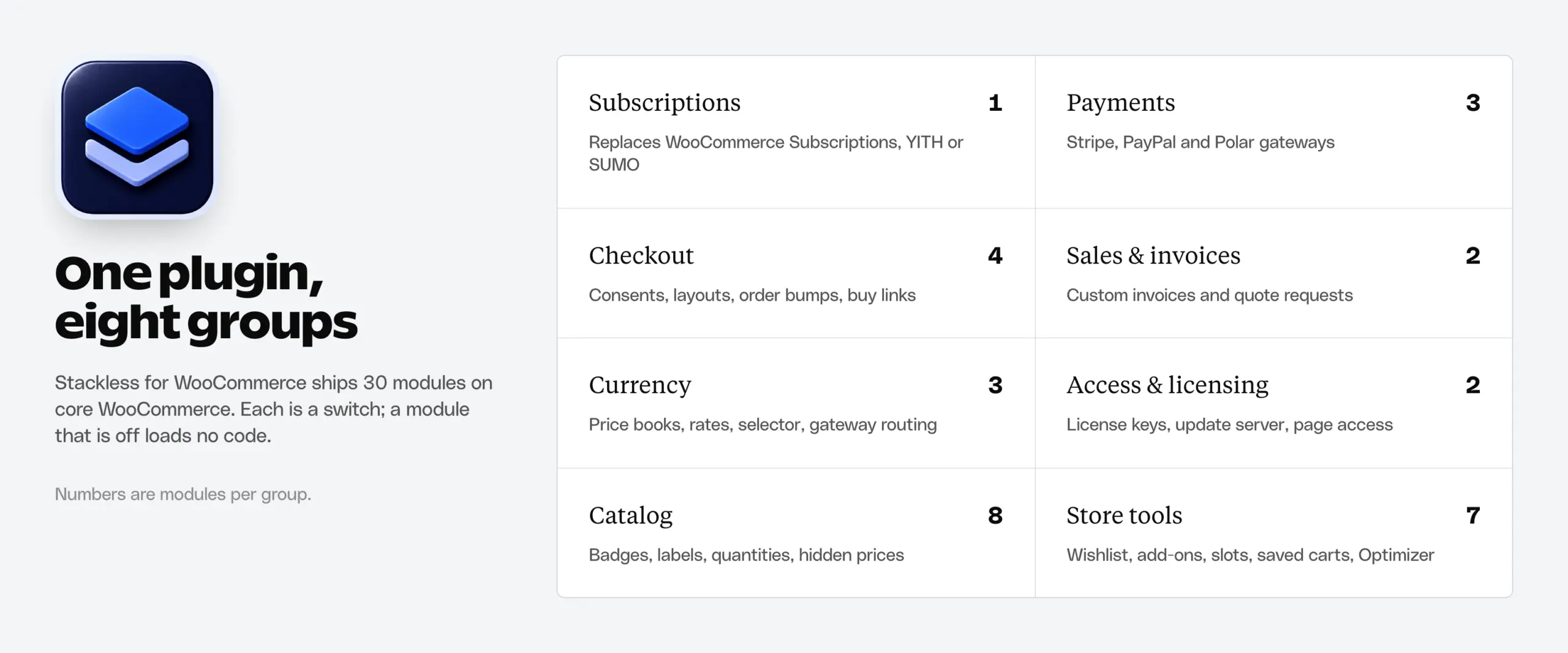
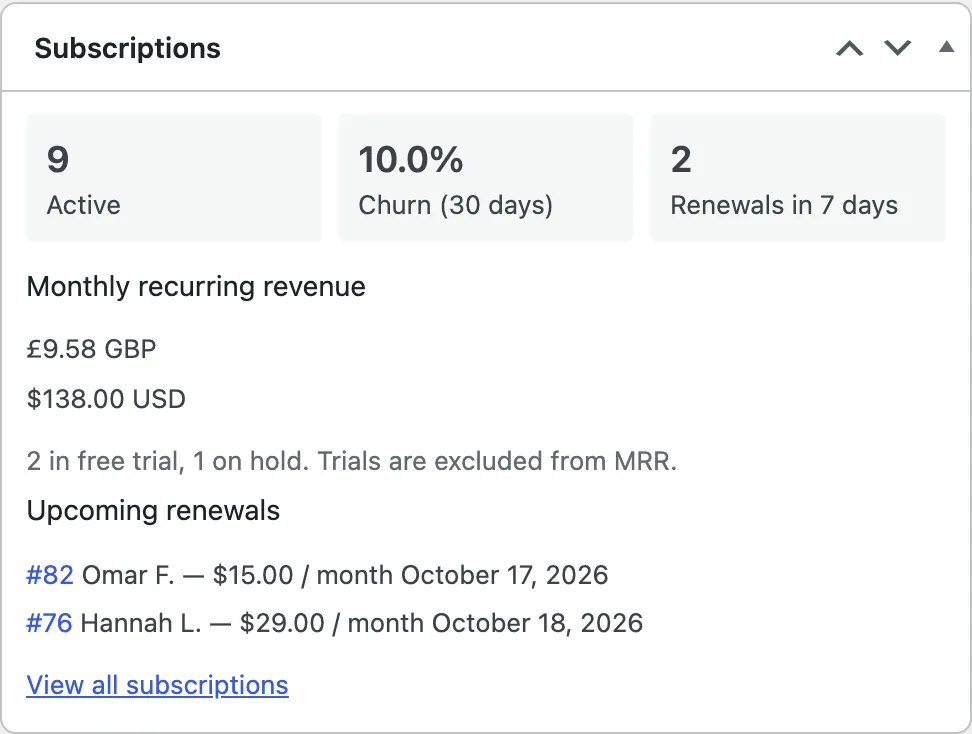
There’s a public demo store at demo.gatilab.com/stackless with every module on, test customers logged in and real subscriptions in every state. The screenshots in this piece come from it. The Stackless theme on that store is a separate free download; the plugin works with any theme.
Who Should Not Use Stackless
This section comes early because the disqualifiers are concrete.
- Stores with live subscriptions on WooCommerce Subscriptions, YITH or SUMO. Stackless has no importer yet. Its subscriptions module also pauses itself while one of those plugins is active, so there’s no way to run both and migrate gradually. Wait for an importer or stay where you are.
- Stores whose renewals must run through another gateway. Razorpay, Mollie, Square, Authorize.net and every other gateway can still sell subscriptions through Stackless, but renewals arrive as an emailed pay link the customer clicks. If automatic charging on those gateways is a requirement, this isn’t the product yet.
- Anyone who needs multi-step funnels or post-purchase upsells. Order bumps are there; one-click upsells after payment are not, yet. CartFlows or FunnelKit cover that.
- Teams that want a vendor with a support desk. Support is one-to-one email from the developer. That’s fast in practice, but it isn’t a 24-hour SLA.
- Buyers who won’t run software this young. Version 1.0.0 shipped on 13 October 2026. The changelog is public on GitHub and the pace is high, but a two-day-old billing plugin is a reasonable thing to be cautious about.
Subscriptions Without WooCommerce Subscriptions
The subscriptions module is the reason most people will look at Stackless, so it’s the right place to start. The design choice that shapes everything else is that a subscription is a pricing toggle on an existing product, not a new product type. A simple or variable product gets a billing interval (day, week, month or year, times a count), an optional free trial, an optional signup fee and an optional fixed number of cycles. That’s how FluentCart does it, and it means variations can mix one-time and recurring prices on the same product.
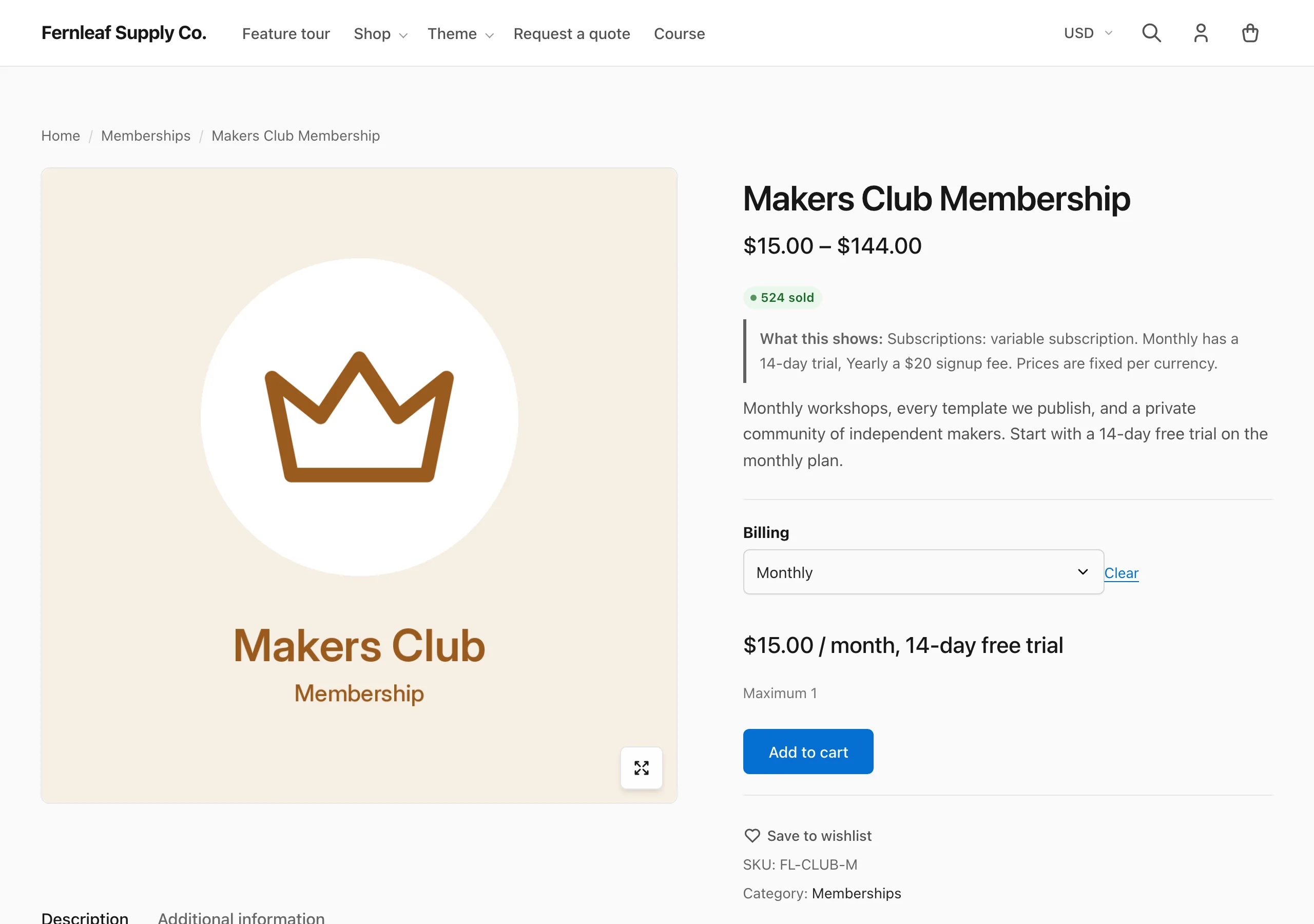
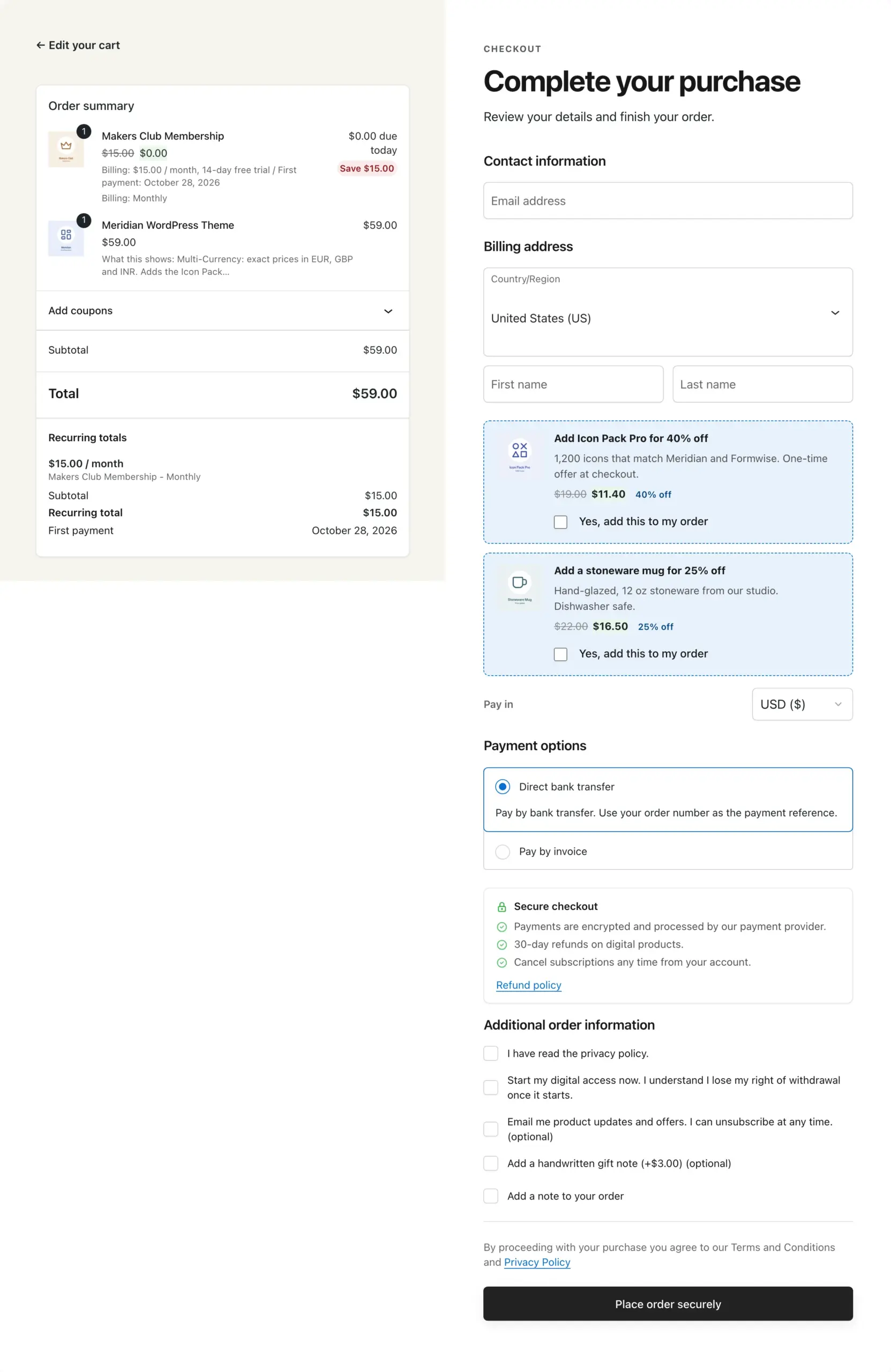
Carts can mix. Two subscriptions on different schedules plus a one-time item check out together: one parent order for today’s payment, and one subscription record per distinct billing schedule. The checkout shows a recurring totals group for each schedule, so the customer sees “$15.00 / month, first payment 28 October” under the order summary rather than finding out in an email.
Renewals work in 2 modes, and the difference decides whether Stackless fits your gateway:
- Automatic renewal with the built-in Stripe, PayPal or Polar gateways. The card or PayPal account is saved at checkout and charged off-session on the due date.
- Pay-link renewal with every other gateway. On the due date a pending renewal order is created and the customer gets an email with a link to pay it. This is how bank transfer and invoice customers renew, and it’s the fallback for any third-party gateway.
Failed payments go into a retry schedule you set, with a grace period before the subscription goes on hold, and emails for failed payment, card expiring, upcoming renewal, trial ending, cancelled and expired. There are 10 emails in all, each a normal WooCommerce email class, so your existing email template and any customizer plugin apply to them.
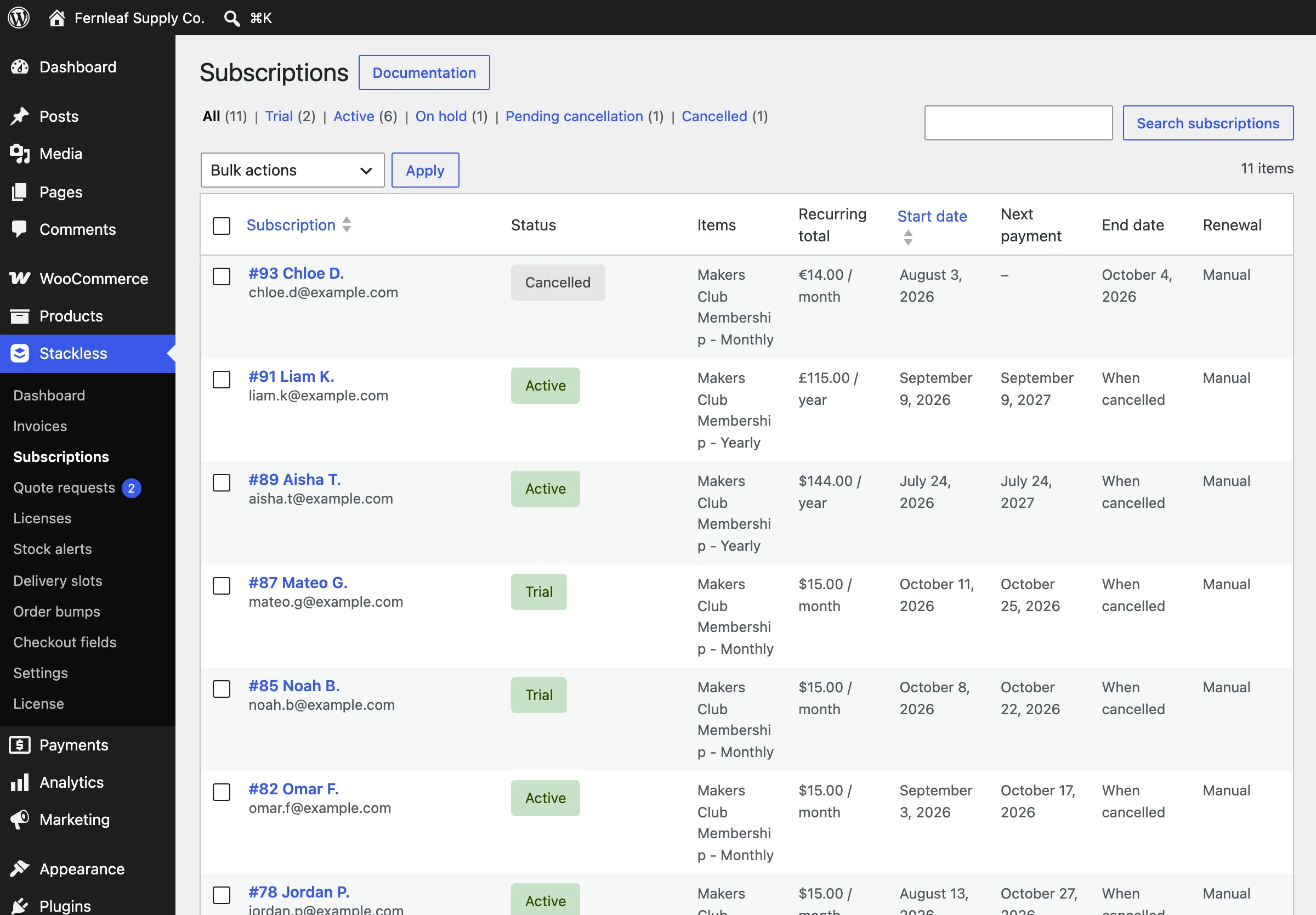
Plan switching is in, with proration: a customer moving from monthly to yearly gets credit for unused time, and the admin can set a switch fee. Recurring coupons can apply to every cycle, to the first payment only or to a fixed number of cycles. Customers manage all of this from a Subscriptions tab in My Account: renew now, cancel at period end, switch plan, update the card, see related orders.
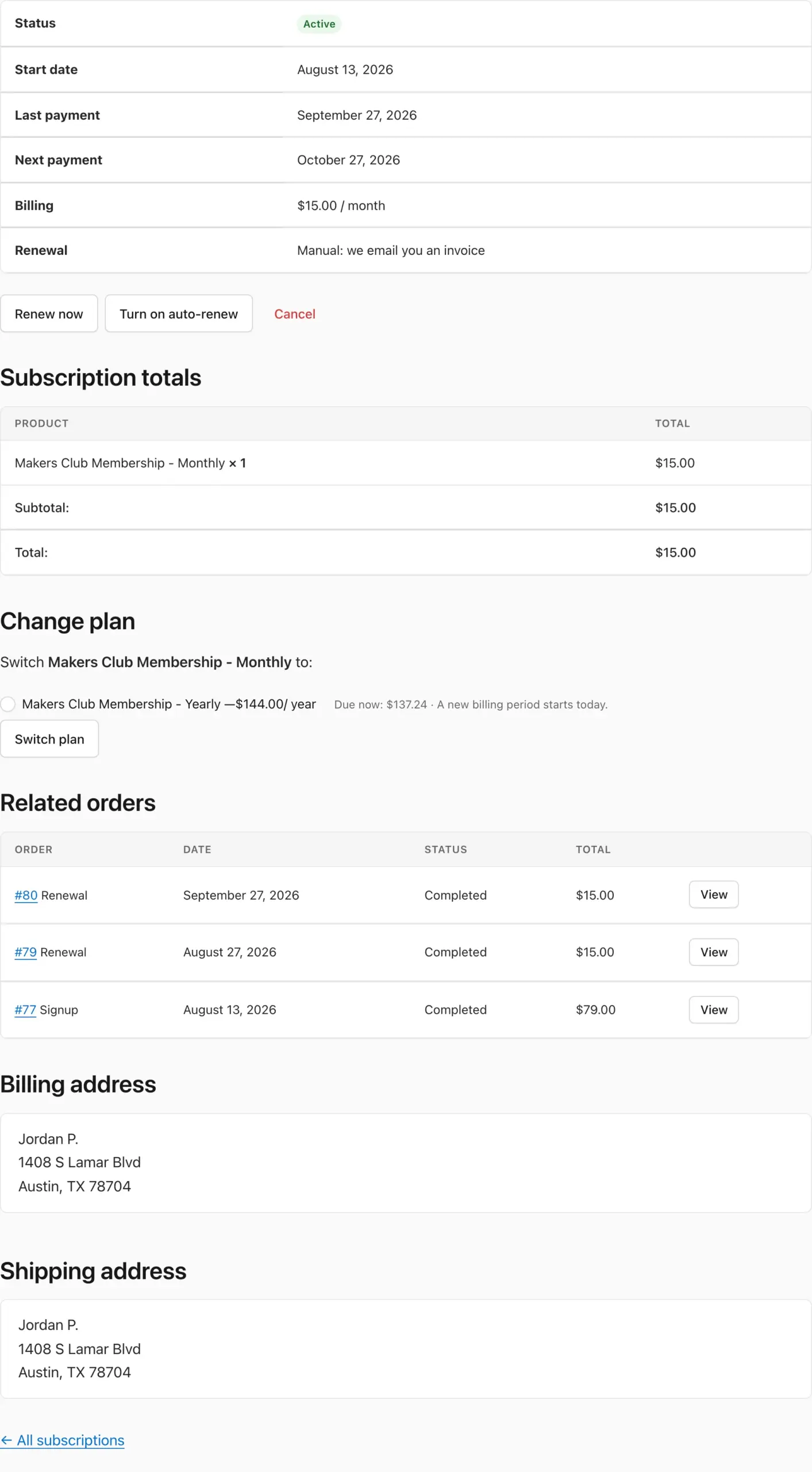
A dashboard widget shows active count, 30-day churn, monthly recurring revenue per currency and the next renewals. It’s a summary, not a reports module; there’s no WooCommerce Analytics integration yet.
Payments: Stripe, PayPal and Polar
Core WooCommerce ships only bank transfer, cheque and cash on delivery. None of those can charge a saved card, which is why “subscriptions with no other plugin” was never possible before. Stackless ships its own gateways to close that gap:
- Stripe: the Payment Element, so cards, Apple Pay, Google Pay, Link and local methods appear in one form. 3D Secure, saved cards and off-session renewals through SetupIntents and PaymentIntents. Card data never touches your server, which keeps you at the simplest PCI level.
- PayPal: Smart Buttons and Pay Later on both checkouts, refunds from the order screen, and vaulted PayPal accounts that renew subscriptions automatically.
- Polar: a merchant of record. Polar collects sales tax and VAT for you and runs the recurring billing, syncing state back by signed webhook. The limit is structural: Polar’s hosted checkout takes one product per session, so it’s offered only for carts with a single subscription and nothing else.
You still need your own Stripe, PayPal or Polar account. Stackless isn’t a payment processor and takes no cut of sales. Each gateway has one signed webhook endpoint with replay protection and an event log, which you can read in the admin when something goes wrong.
Software Licensing and Updates
This is the module that most clearly isn’t a port of something else. If you sell WordPress plugins or themes, the usual routes are Freemius, Easy Digital Downloads or a licensing add-on. Stackless does it inside WooCommerce: each order item or subscription issues a license key, keys have activation limits per site, and a REST API validates, activates and deactivates them. Development and staging domains don’t count against the limit. We covered the business side of this in our guide to selling WordPress plugins as a revenue stream; Stackless is one way to run the store end of it.
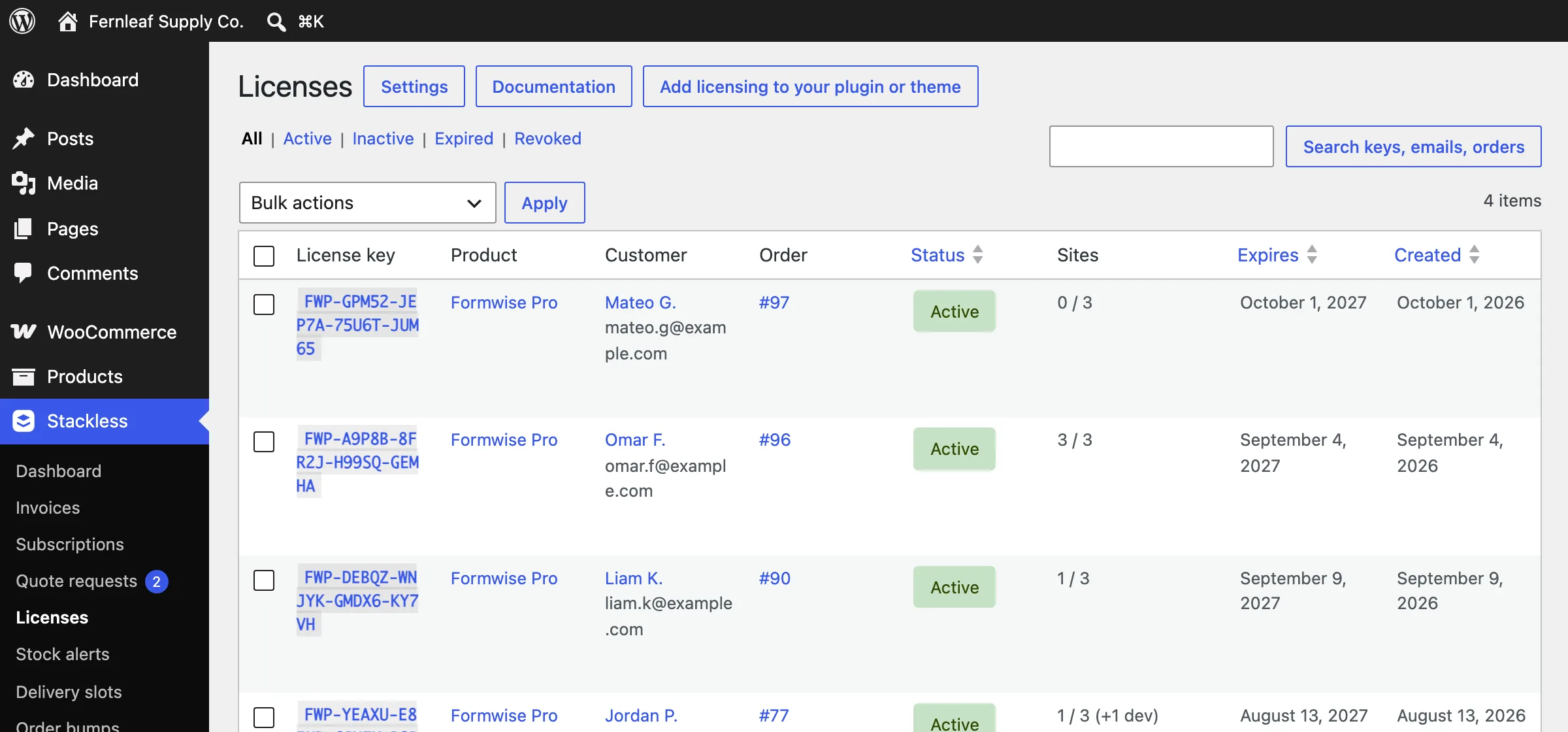
The part that saves real work is the update server. Stackless serves the update_plugins JSON that WordPress expects, with signed download links, and ships a small license client you drop into your own plugin or theme. Your customers then see updates in their WordPress admin like any other product. Themes are supported as well as plugins.
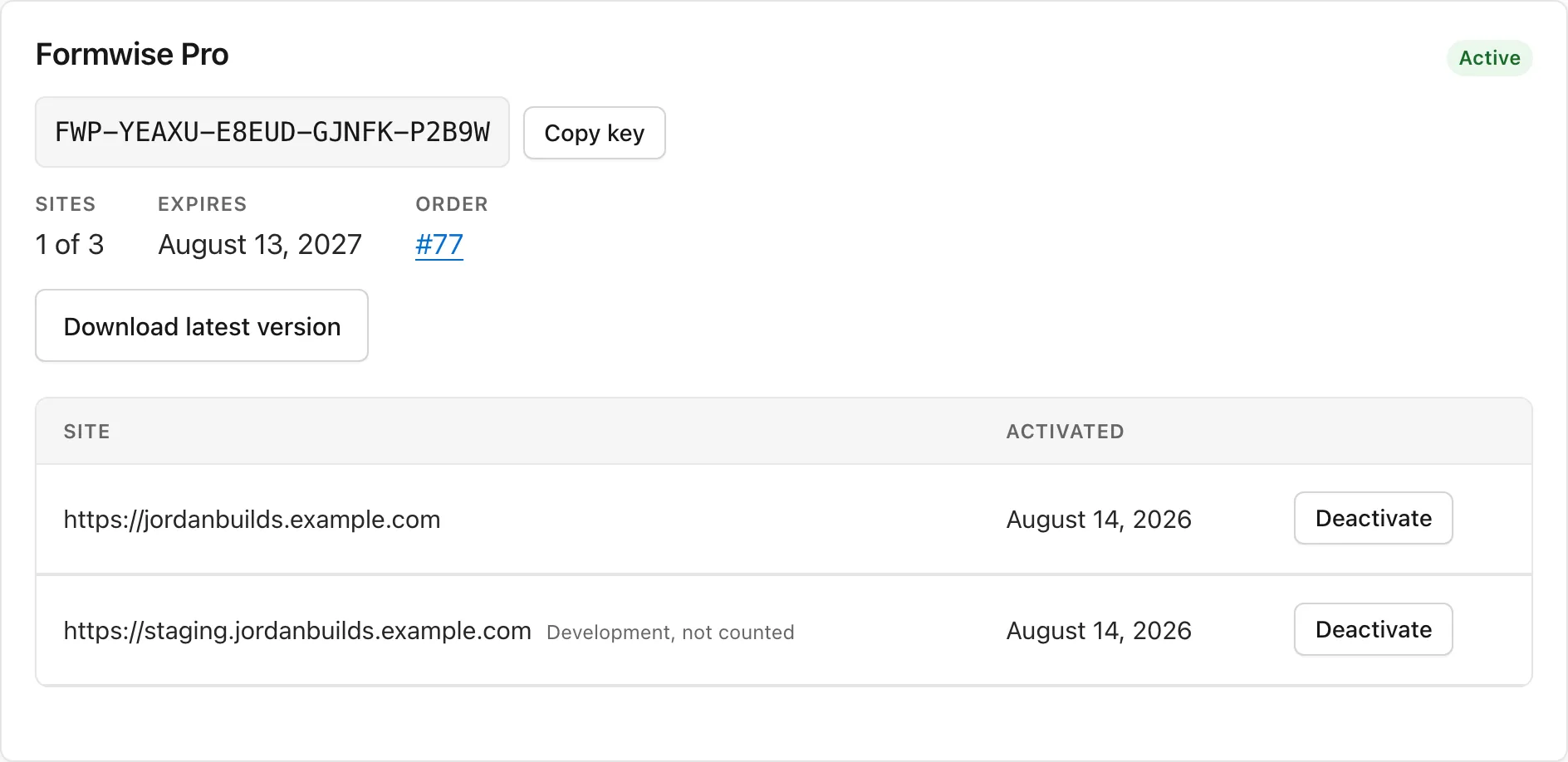
Page Access sits in the same group. It unlocks chosen pages for customers who bought a product, keeps them unlocked while a subscription is active, and shows a notice on published pages while hiding private ones. It’s a light membership feature, enough for a course page or a downloads area, not a replacement for MemberPress-style content rules yet.
Multi-Currency Checkout
Most WooCommerce currency plugins convert prices on the fly and let the customer pay in whatever the switcher shows. Stackless uses price books: an exact price per product and per variation in each currency, with manual or Frankfurter exchange rates, markup and rounding rules as the fallback for products that have no fixed price. A cart settles in one currency, the order records it, and a subscription keeps its signup currency for every renewal.
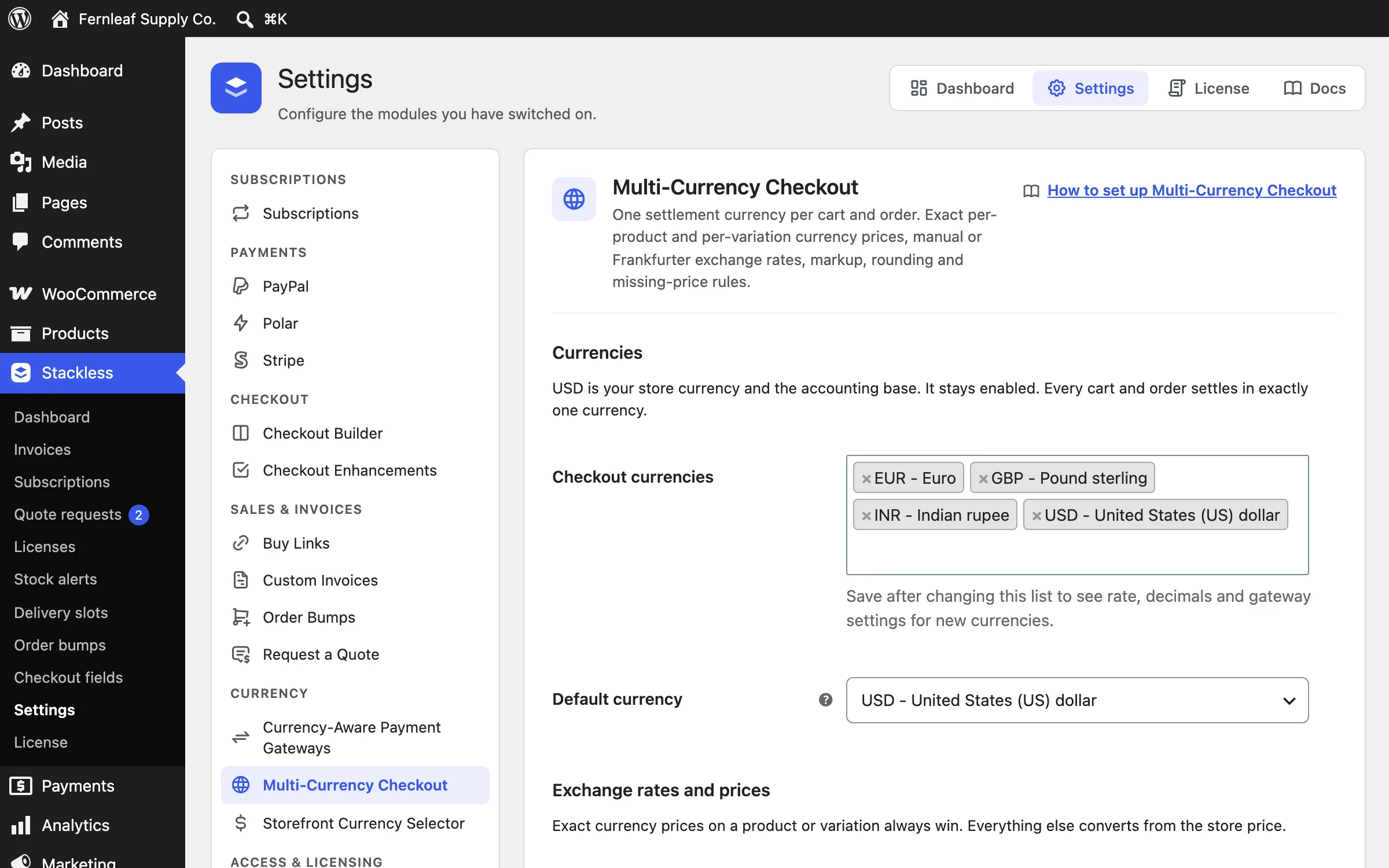
Two companion modules make it usable. Currency-Aware Payment Gateways lets you say which gateways may handle each currency and which is shown first; a gateway that can’t take INR is removed from the checkout and rejected on the server if someone forces it. The Storefront Currency Selector is a shortcode, a block or a selector above the payment methods, and switching reprices the cart on the server rather than in the browser. The regional pricing guide goes into why fixed per-currency prices beat live conversion for digital products; Stackless is the WooCommerce implementation of that argument.
Invoices and Quote Requests
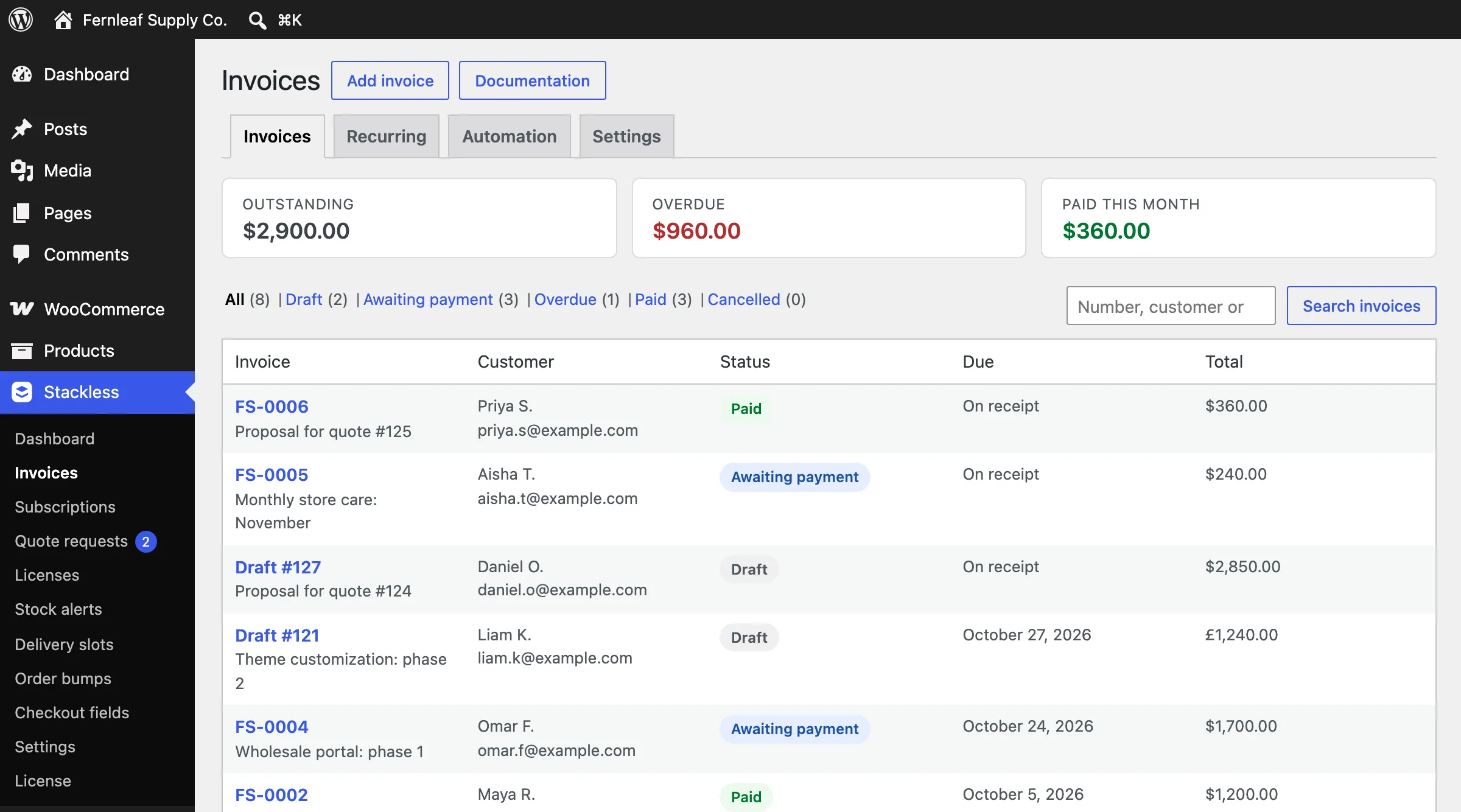
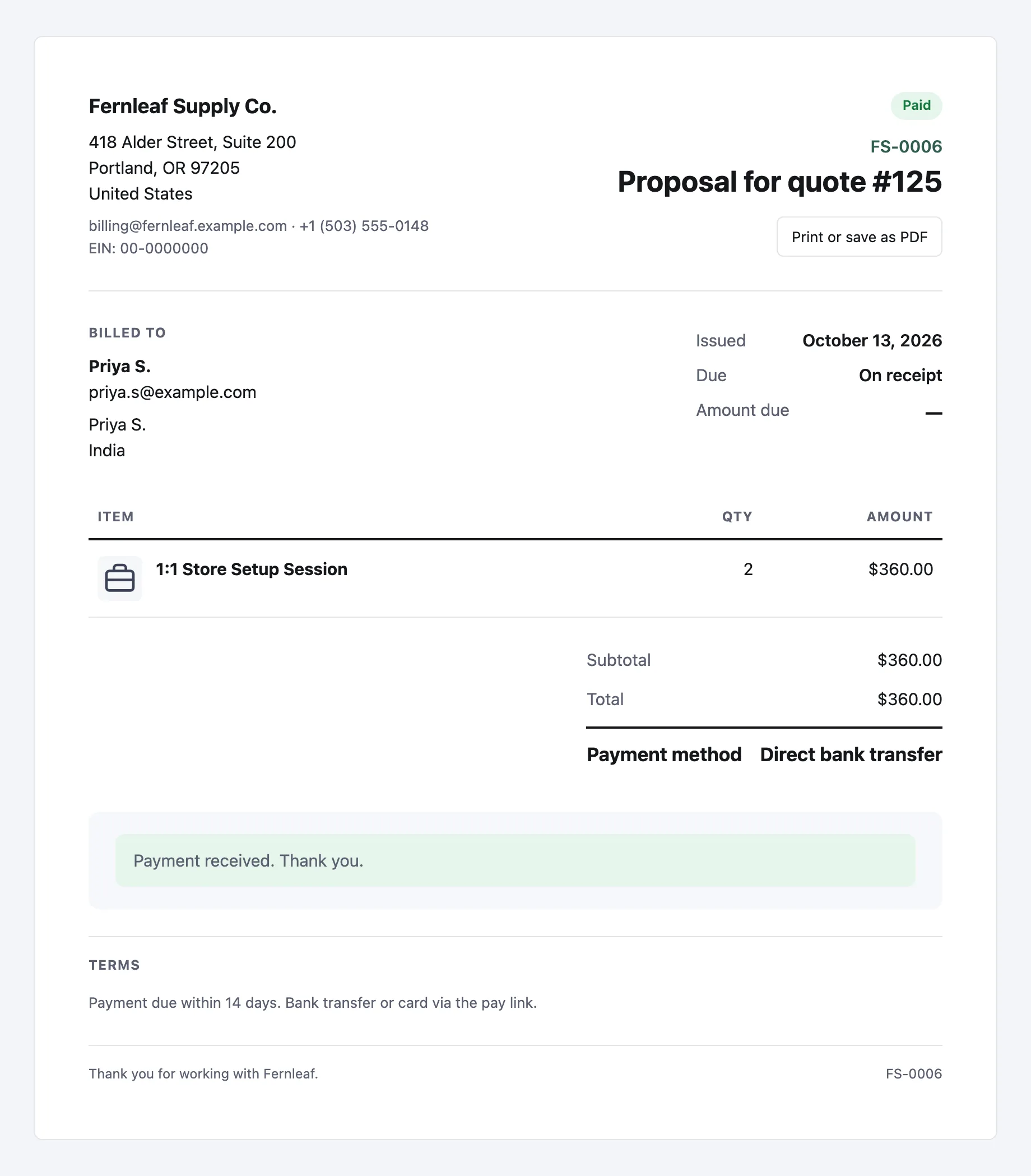
The invoicing module builds on pending orders and WooCommerce’s own order-pay links, so an invoice is a real order from the start. Invoices are numbered, can recur on a schedule, can be split into a deposit with an automatic balance invoice, and send due-date reminders. The customer gets a branded page they can print or pay in one click.
Request a Quote adds a form on any page or product. A request becomes a proposal the customer accepts online, accepting issues the invoice, and the invoice takes them to payment. That’s the whole quote-to-cash path in one module, which we described in platform-neutral terms in how to collect payment for an accepted quote.
Checkout Tools
Four modules touch the checkout, and they work on both the Checkout block and the classic shortcode.
- Order Bumps: one-click offers shown by cart rules (cart contains, total over, category), priced on the server, with a take rate per bump in the admin. Headlines accept
{price},{regular_price}and{discount}tokens, shown in the shopper’s currency. - Checkout Enhancements: consent checkboxes whose acceptance is stored on the order, a shorter checkout for virtual-only carts (no shipping fields), your own field and button wording, and a trust block under the payment methods.
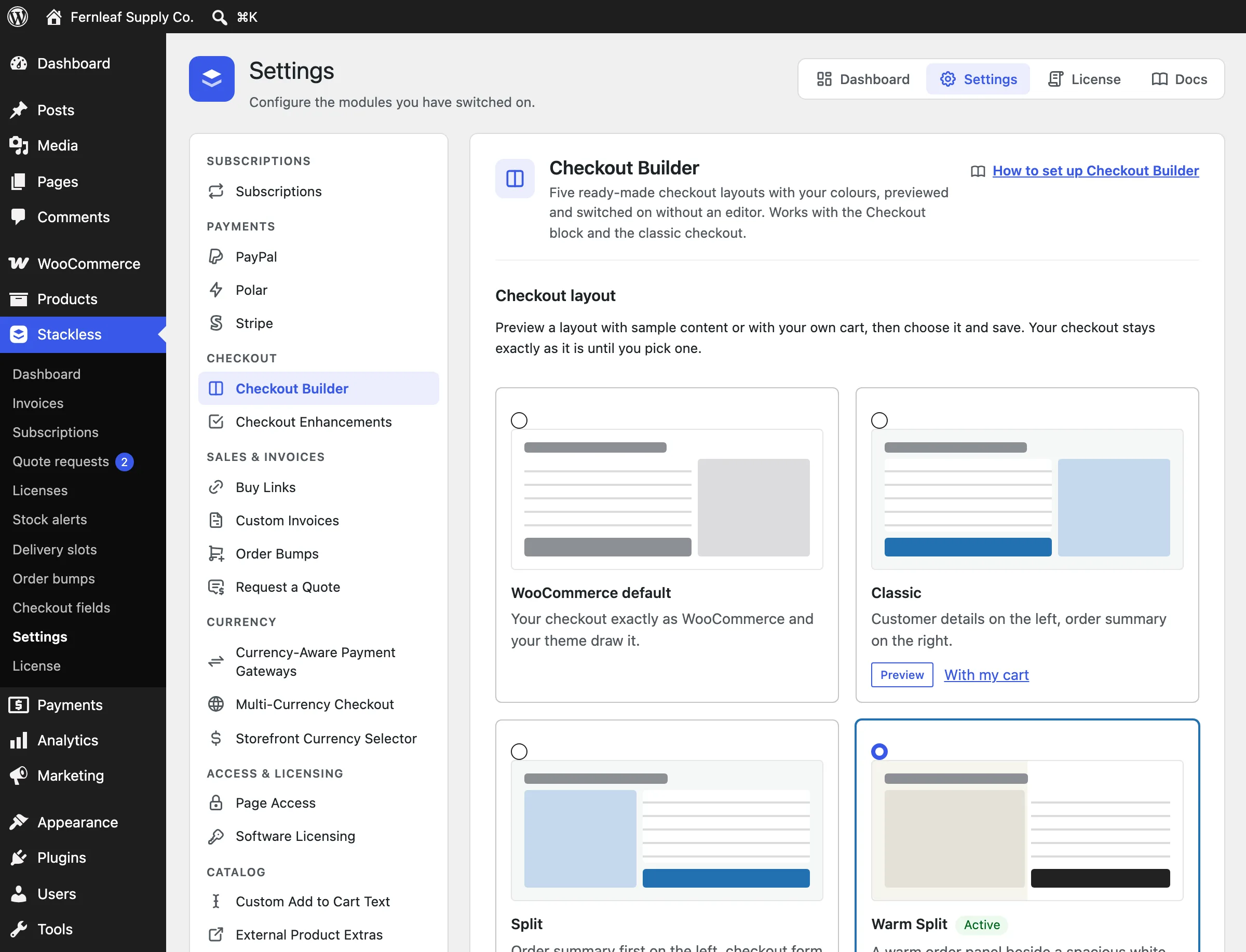
- Checkout Builder: 5 ready-made layouts with your colors, previewed and switched on from settings. No page builder involved.
- Buy Links: signed URLs that fill the cart with a product, variation and coupon and land on checkout. An optional Buy now button on products.
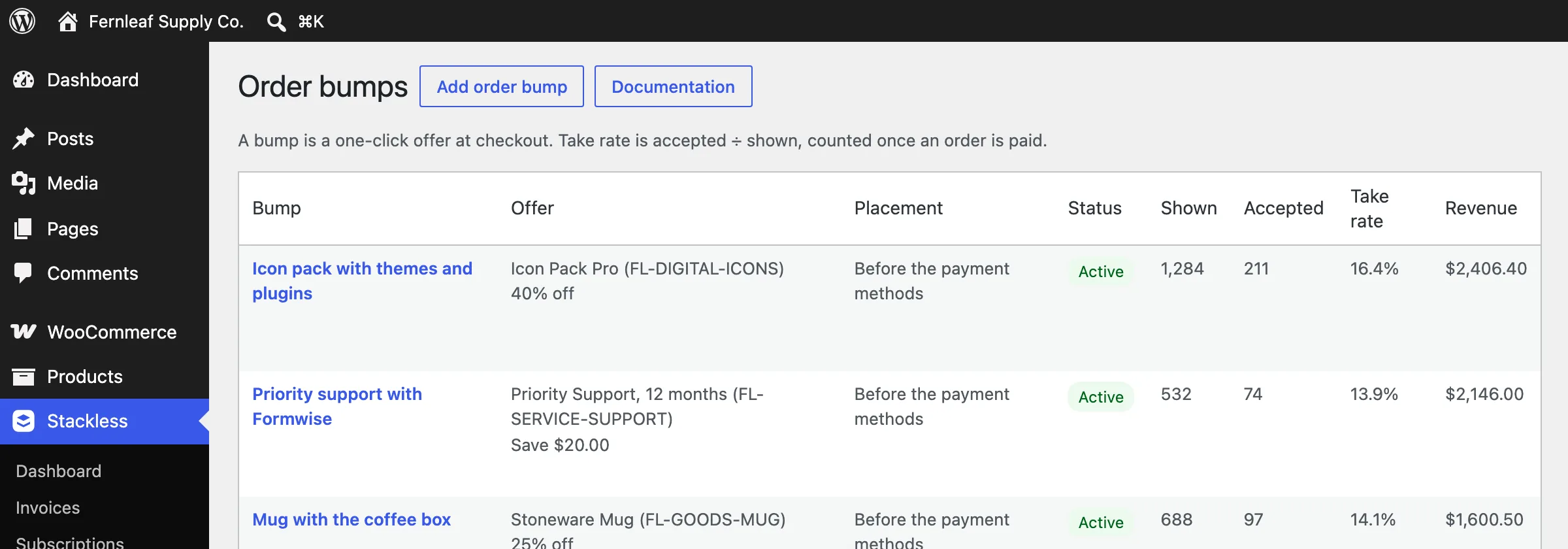
The take-rate column is the quiet winner here. Most bump plugins show you nothing after the sale; this one tells you the icon pack converts at 16% and the mug at 14%, which is the only data you need to decide what stays on the checkout. Our checkout optimization piece lists bumps among the fixes that recover lost orders, with the caveat that a bump nobody takes is pure friction.
Store Tools and Catalog Modules
The remaining 14 modules are small on purpose. Each replaces a plugin you’d otherwise install for one feature:
- Wishlist: guest and account lists that merge on sign-in, a share link, a My Account tab and move-to-cart.
- Back-in-stock Alerts: a confirmed notify-me form on out-of-stock products and variations, one email when stock returns.
- Fields & Paid Add-ons: checkbox, dropdown, text and number add-ons with per-item or one-off prices, plus checkout fields with optional fees. Text add-ons take a character limit.
- Delivery & Pickup Slots: weekly time windows with capacity per slot, lead time, closed dates and per-shipping-method availability.
- Saved Carts & Order Again: named saved carts and reorder from any past order, not only completed ones.
- Service Products: no shipping, after-payment instructions and a booking or intake link on the thank-you page.
- Catalog: free price text, sold count badges, stock urgency labels, min/max quantities, hide price until login, custom add-to-cart text, external product link controls and a product details table that feeds product schema.
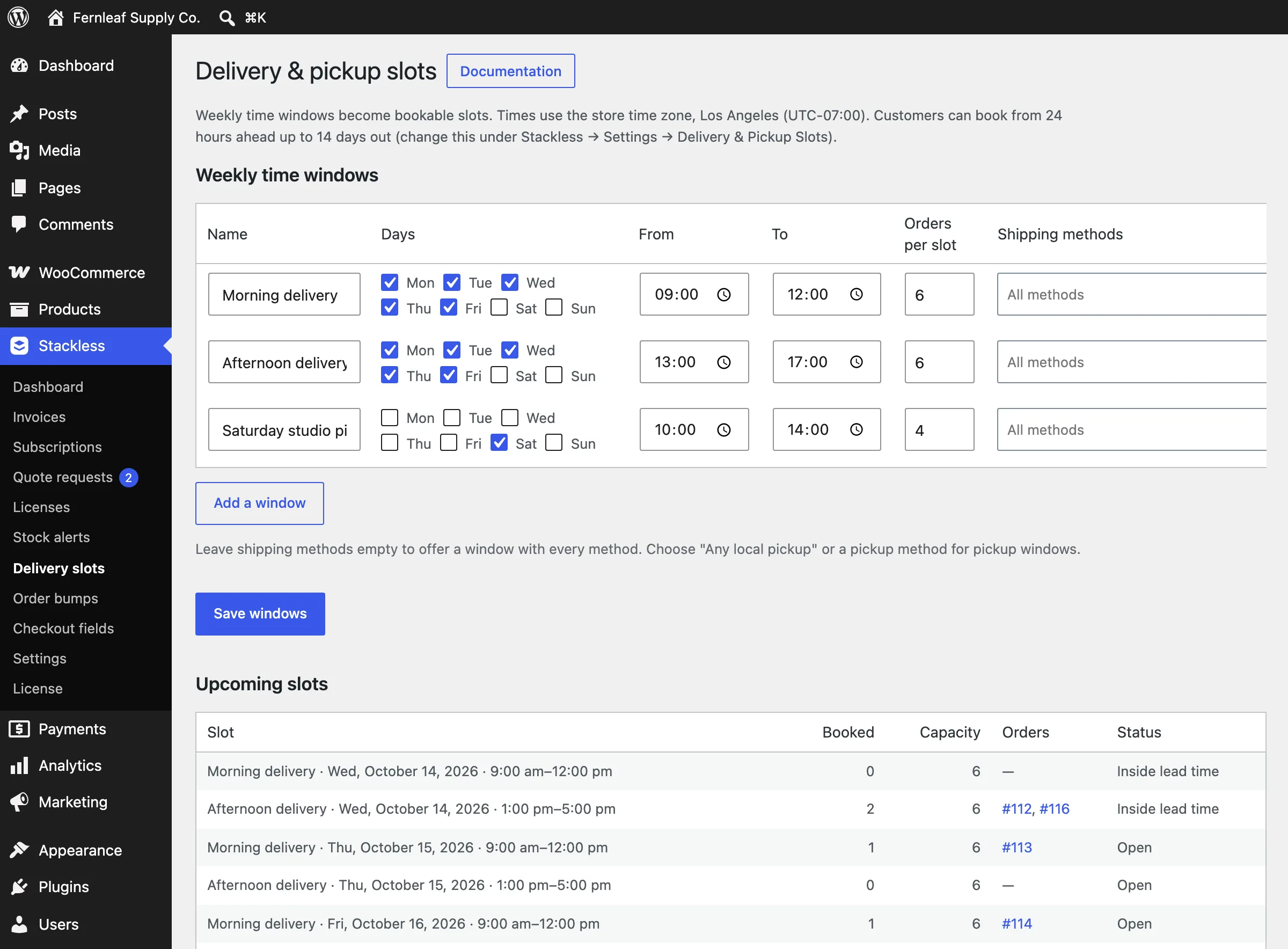
None of these will beat a dedicated plugin on depth. The delivery module doesn’t do route planning yet; the add-ons module has no conditional logic between fields yet. The case for them is that they’re adequate for most stores and they cost nothing extra, in money or in page weight.
The WooCommerce Optimizer
Version 1.1.0 added a module that has nothing to do with selling and everything to do with why stores end up slow. Once a shopper has anything in the cart, WooCommerce adds about 50 prefetch hints to every page so the Checkout block opens faster. Every visitor downloads those scripts whether or not they ever check out. The Optimizer removes them, defers WooCommerce’s storefront scripts outside cart and checkout, and strips the generator tag.
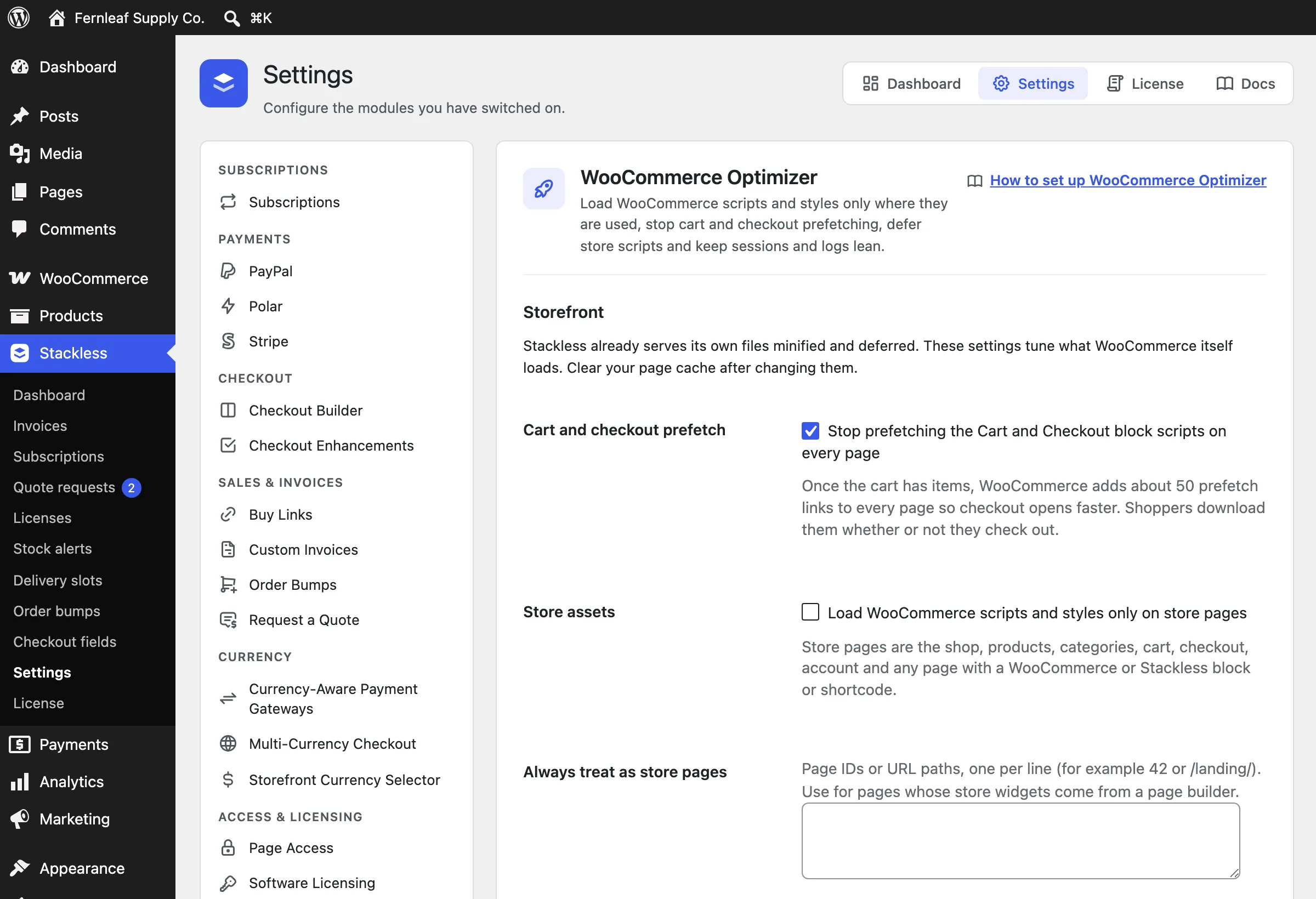
On the demo store the prefetch count went from 52 per page to 0 with the module’s defaults, and nothing in the checkout changed. The optional settings go further: load WooCommerce scripts and styles only on store pages, control cart fragments, drop the 400 KB password strength meter, turn off order attribution tracking, hide marketplace suggestions and inbox notes, and shorten scheduled-action logs and guest cart sessions. These overlap with what a tuning plugin like Perfmatters does for WooCommerce, and if you run one of those you’d keep that and leave this module off. For the caching layer underneath, our caching plugin comparison still applies; the Optimizer doesn’t cache anything.
The Limits
Most of these are on the roadmap and should close with releases. The Polar one is a limit of Polar’s checkout rather than of Stackless.
- No importer from WooCommerce Subscriptions yet. The biggest gap. Subscriptions, saved tokens and renewal dates from the official extension can’t be brought across today, and the module pauses while the official extension is active. A store with existing subscribers has no safe migration path yet.
- Three automatic gateways, for now. Everything else renews by pay link. There’s a published supports flag and renewal hook so third-party gateways can opt in, but as of 1.1.1 none have.
- Polar is single-subscription only. That’s Polar’s hosted checkout, not something Stackless can change. Mixed carts route to Stripe, PayPal or a pay-link gateway.
- Classic add-to-cart form required for add-ons and Buy now, for now. On block themes, the Add to Cart with Options block doesn’t carry the add-on fields. The product page in the demo uses the classic form for that reason.
- Consent label links on the block checkout show as plain text for now. The block’s checkbox labels don’t render markup. The classic checkout is fine.
- Documentation is a course, with no searchable reference site yet. The official docs are a 39-lesson course in a community portal, written against version 1.0.2, with a lesson per module. It’s thorough, but you can’t search it the way you’d search a docs site, and every module’s Docs link in the admin points into it.
- It’s new. 1.0.0 on 13 October 2026, 1.1.1 the next day. The release notes on GitHub are specific and the demo was stress-tested, but a payment product earns trust over years, not days. There’s no Analytics integration, no reports module beyond the widget, and no bundles or pause-subscription feature yet.
- One developer. That’s an advantage for support speed and a risk for continuity. The license is GPL and the plugin keeps working without a key, which limits the downside, but it doesn’t remove it.
Stackless for WooCommerce Pricing
Two licenses, both with every module and unlimited site activations. The license only gates updates and support; every feature keeps working if it lapses. There’s a 14-day unconditional refund.
| License | Price now | Price after the early-adopter period | Includes |
|---|---|---|---|
| Annual | $39 / year | $69 / year | All 30 modules, unlimited sites, updates while active, email support |
| Lifetime | $99 once | $399 once | All 30 modules, unlimited sites, updates for life, email support |
Against the extensions it replaces, the comparison isn’t close. Prices below are list prices for a single site from each vendor’s own page in October 2026; WooCommerce.com shows local-currency pricing, so the dollar figure is the US one.
| Need | Usual extension | Yearly cost | Stackless |
|---|---|---|---|
| Subscriptions | WooCommerce Subscriptions | $279 | Included |
| Subscriptions (cheaper) | YITH WooCommerce Subscription | $99.99 | Included |
| Order bumps and checkout layouts | CartFlows Pro | $199 first year, renews at $299 | Included (bumps and layouts, no funnels) |
| Licensing and update server | Freemius or EDD Software Licensing | 7% of revenue, or $199+ a year | Included |
| Multi-currency | WPML with WCML or a currency switcher | $99 to $199 | Included |
| Wishlist, add-ons, slots, invoices, quotes | 4 or 5 separate plugins | $50 to $100 each | Included |
| Everything above | $900 or more a year | $39 a year or $99 once |
Even a store that only wants 2 of those rows is ahead on the annual license. The lifetime license pays for itself against WooCommerce Subscriptions alone in 5 months.
Stackless vs the Alternatives
Stackless vs WooCommerce Subscriptions
WooCommerce Subscriptions is the reference implementation. It has a decade of handled edge cases, works with almost every gateway that supports tokenization, and every migration tool targets it. It also costs $279 a year, does nothing but subscriptions, and its recurring totals and switching UI haven’t changed much in years. Stackless matches the core lifecycle, adds mixed carts with per-schedule recurring totals, and bundles the gateways. It can’t import from WooCommerce Subscriptions yet and supports automatic renewal on 3 gateways rather than dozens. New store: Stackless. Existing subscribers: WooCommerce Subscriptions, until an importer exists.
Stackless vs SureCart
SureCart replaces WooCommerce rather than extending it. You get a hosted, fast checkout, subscriptions, licensing and a free plan that takes a fee on each sale, with Pro at $179 for the first year on one store. What you give up is everything WooCommerce-specific: your theme’s shop templates, shipping plugins, order management, the Store API and the extension ecosystem. Our ecommerce plugin comparison by product type puts SureCart ahead for a store that’s only selling digital products and hasn’t built on WooCommerce yet. Stackless is for the store that has.
Stackless vs CartFlows
CartFlows is a funnel builder: landing page, checkout, order bump, one-click upsell, thank-you page, with A/B testing on the higher plans. Stackless covers the checkout, the bump and the layout, and stops there for now; funnels and post-purchase upsells aren’t built yet. If post-purchase upsells are part of your model, CartFlows (or FunnelKit) is the right tool and Stackless can sit beside it with the funnel modules off. If bumps are enough, CartFlows is $199 a year for a feature Stackless includes.
Who Should Use Stackless
Stores paying for 3 or more extensions
The typical WooCommerce store renews a subscriptions extension, a gateway add-on, a wishlist plugin, an invoicing plugin and a checkout tweak every year, from 4 different vendors with 4 different update cadences. If that describes your plugins page, Stackless turns 5 renewals into 1 and removes the compatibility matrix between them.
Developers selling their own plugins or themes
If you sell WordPress products and want to own the store, the licensing module plus the update server plus the subscriptions module is the full stack: sell a yearly license, issue keys, serve updates, expire access when the subscription ends. The alternative is Freemius taking a percentage or building the update server yourself.
Stores selling in more than one currency
Price books with a settlement currency per order and currency-aware gateways solve the problem that live-conversion switchers create: a customer paying in a currency the gateway can’t settle. That’s the wrong-currency checkout failure that silently loses international orders.
New stores that want to start lean
A new WooCommerce store with Stackless, a caching plugin and a theme is a complete store with subscriptions and modern payments in 3 plugins. The free Stackless theme is built for exactly this setup, and the WooCommerce vs Shopify cost comparison changes shape when the extension line drops to $39.
A Practical Way to Try It
Because the refund window is 14 days and the demo is public, the evaluation path is short:
- Spend 20 minutes on the demo store. Add a subscription and a one-time product to the cart, open the checkout and read the recurring totals. Log into My Account as one of the demo customers and try switching a plan.
- List your current paid extensions and mark which Stackless module covers each. Anything not covered yet (funnels, bookings, route planning) stays as a separate plugin.
- Install on staging with only the modules you marked switched on. Confirm your gateway situation: Stripe or PayPal means automatic renewals; anything else means pay-link renewals.
- Read the module lessons in the training course for the 2 or 3 modules that carry your revenue, and the changelog on GitHub to see how fast issues close.
- If a conflict guard pauses a module, you have an existing plugin doing the same job. Decide which one stays before going live.
Final Remarks
Stackless does what its name says. It collapses the stack of paid extensions that a WooCommerce store accumulates into one plugin with one license, and it does so without asking you to leave WooCommerce, change themes or move your orders. The subscriptions and licensing modules are complete enough to run a business on; the multi-currency design is better than what most dedicated plugins do; the Optimizer fixes a WooCommerce default that costs every visitor bandwidth. At $39 a year for unlimited sites, the price is low enough that the usual value calculation doesn’t apply.
What it hasn’t earned yet is trust through time. A payment plugin that shipped this week, from one developer, with no migration path from the incumbent yet, is a buy for new stores, for developers selling their own software and for anyone whose subscriptions can start fresh on Stripe or PayPal. For a store with a few hundred live subscribers on WooCommerce Subscriptions, the right move is to watch the changelog and wait for the importer. We’ll update this piece when that ships.
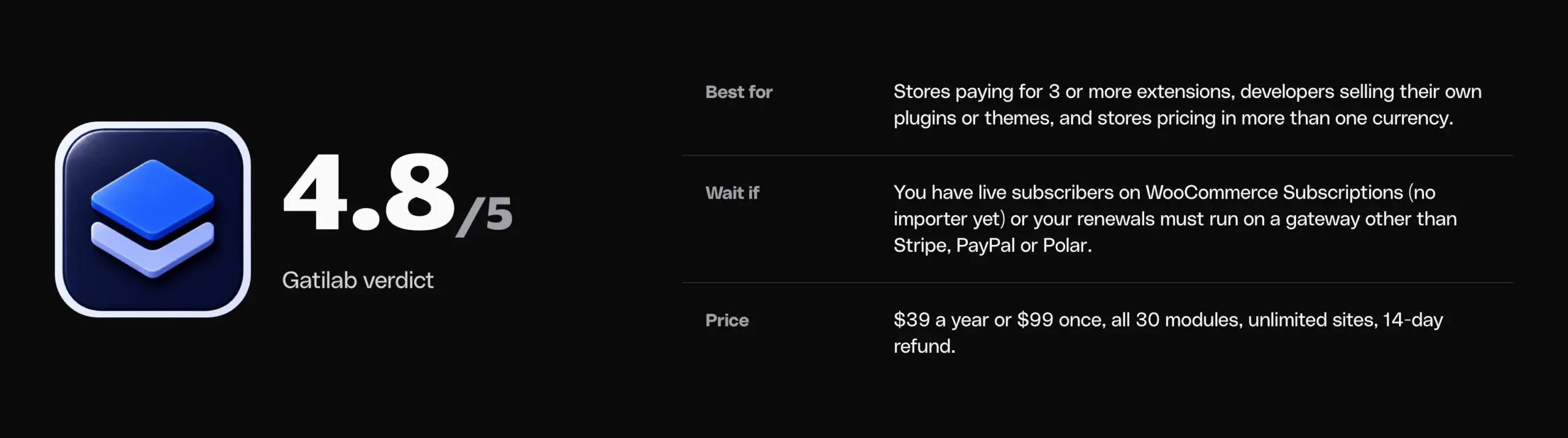
Stackless for WooCommerce
Pros
- 30 modules on one $39 a year or $99 lifetime license, unlimited sites
- Subscriptions, Stripe, PayPal and Polar built in, with automatic renewals and retries
- Switched-off modules load no code; the Optimizer removes WooCommerce's own checkout prefetching
- HPOS and the Cart and Checkout blocks supported from the first release
- Pauses itself instead of fighting an installed subscriptions or currency plugin
Cons
- First public release was 13 October 2026, so there's no long-term track record yet
- No importer from WooCommerce Subscriptions yet
- Only Stripe, PayPal and Polar renew automatically; other gateways renew by pay link for now
- Documentation is a video course; no searchable docs yet
Summary
One plugin that puts subscriptions, Stripe, PayPal and Polar, software licensing, multi-currency, invoices, quotes and 20 store and checkout tools on core WooCommerce. Strong value and a lean footprint; held back today by its age, a WooCommerce Subscriptions importer that hasn’t shipped yet and course-style documentation.
Price: USD 39 /year
See Stackless pricingFAQs on Stackless for WooCommerce
Is Stackless for WooCommerce worth it?
For a WooCommerce store that pays for 3 or more extensions among subscriptions, gateways, licensing, multi-currency, invoices, order bumps and store tools, yes: one $39 a year license replaces all of them on unlimited sites. For a store that only needs one small feature, a free single-purpose plugin may be enough.
Does Stackless work without any other plugins?
Yes. It runs on core WooCommerce alone, including the Stripe, PayPal and Polar gateways, and needs WordPress 6.6, WooCommerce 9.9 and PHP 7.4 or newer. It supports HPOS and both the block and classic checkouts.
Can I migrate from WooCommerce Subscriptions?
Not yet. There’s no importer, and the Stackless subscriptions module pauses itself while WooCommerce Subscriptions is active. Stores with existing subscribers should wait for an importer before switching.
Which gateways renew subscriptions automatically?
Stripe, PayPal and Polar, all built into the plugin. For now, any other gateway can sell subscriptions, but renewals are sent as an emailed pay link that the customer clicks.
Does Stackless take a cut of sales?
No. You use your own Stripe, PayPal or Polar account and pay only their processing fees. The Stackless license is a flat $39 a year or $99 once.
What happens if the license expires?
Every module keeps working. The license only controls updates and support, so an expired annual license means you stop receiving new versions until you renew.
Does Stackless slow down my store?
Modules that are switched off load no code. The WooCommerce Optimizer module goes the other way: on the demo store it removed 52 cart and checkout prefetch hints per page that WooCommerce adds on its own, and it defers storefront scripts outside the checkout.
Can I sell my own WordPress plugins and themes with it?
Yes. The Software Licensing module issues license keys with site activation limits, exposes a REST API for activation, and runs an update server with signed downloads. A small license client ships for you to include in your plugin or theme.
Is there a free version or a demo?
There’s no free tier of the plugin, but there’s a 14-day unconditional refund and a public demo store at demo.gatilab.com/stackless with every module switched on. The Stackless theme is a separate free download.
Where is the documentation?
In a 39-lesson course inside the developer’s community portal, with a lesson per module and a Docs link from every module card in the admin. There’s no searchable reference site yet, which is one of the limits noted in this piece.
Tell Google you want more of this.
Add Gatilab as a preferred sourceOne tap, and this site shows up more often in your own Top Stories, AI Overviews and AI Mode. Remove it any time.