
Position 4, 0.5% Click-Through Rate: When Ranking Stops Paying
A page on one of my sites has spent 5 months sitting at position 4 or 5 for a question tens of thousands of people ask every month. In June it collected 44,467 impressions. It converted 212 of them into visits.
That is a click-through rate of 0.48%. At a position where published CTR curves generally expect somewhere between 5% and 8%.
The obvious diagnosis is that something broke. It didn’t. Nothing broke, because nothing was ever working.
The rate was 0.5% in the first month the page had any volume at all, and it has never been anything else.
The measurements
2 pages on the same site, both answering closely related questions, both tracked from the month they started drawing volume through to early August. Position is impression-weighted, not a simple average, so a big month counts more than a quiet one.
The first page:
| Month | Impressions | Clicks | Click-through rate | Position |
|---|---|---|---|---|
| April | 2,443 | 11 | 0.45% | 6.3 |
| May | 37,660 | 192 | 0.51% | 5.0 |
| June | 44,467 | 212 | 0.48% | 4.4 |
| July | 15,116 | 89 | 0.59% | 4.5 |
| August, first 10 days | 7,177 | 20 | 0.28% | 5.4 |
The second page, a sibling on the same topic:
| Month | Impressions | Clicks | Click-through rate | Position |
|---|---|---|---|---|
| April | 1,425 | 5 | 0.35% | 7.1 |
| May | 5,027 | 27 | 0.54% | 7.3 |
| June | 22,413 | 98 | 0.44% | 5.8 |
| July | 10,907 | 68 | 0.62% | 4.9 |
| August, first 10 days | 4,079 | 15 | 0.37% | 6.0 |
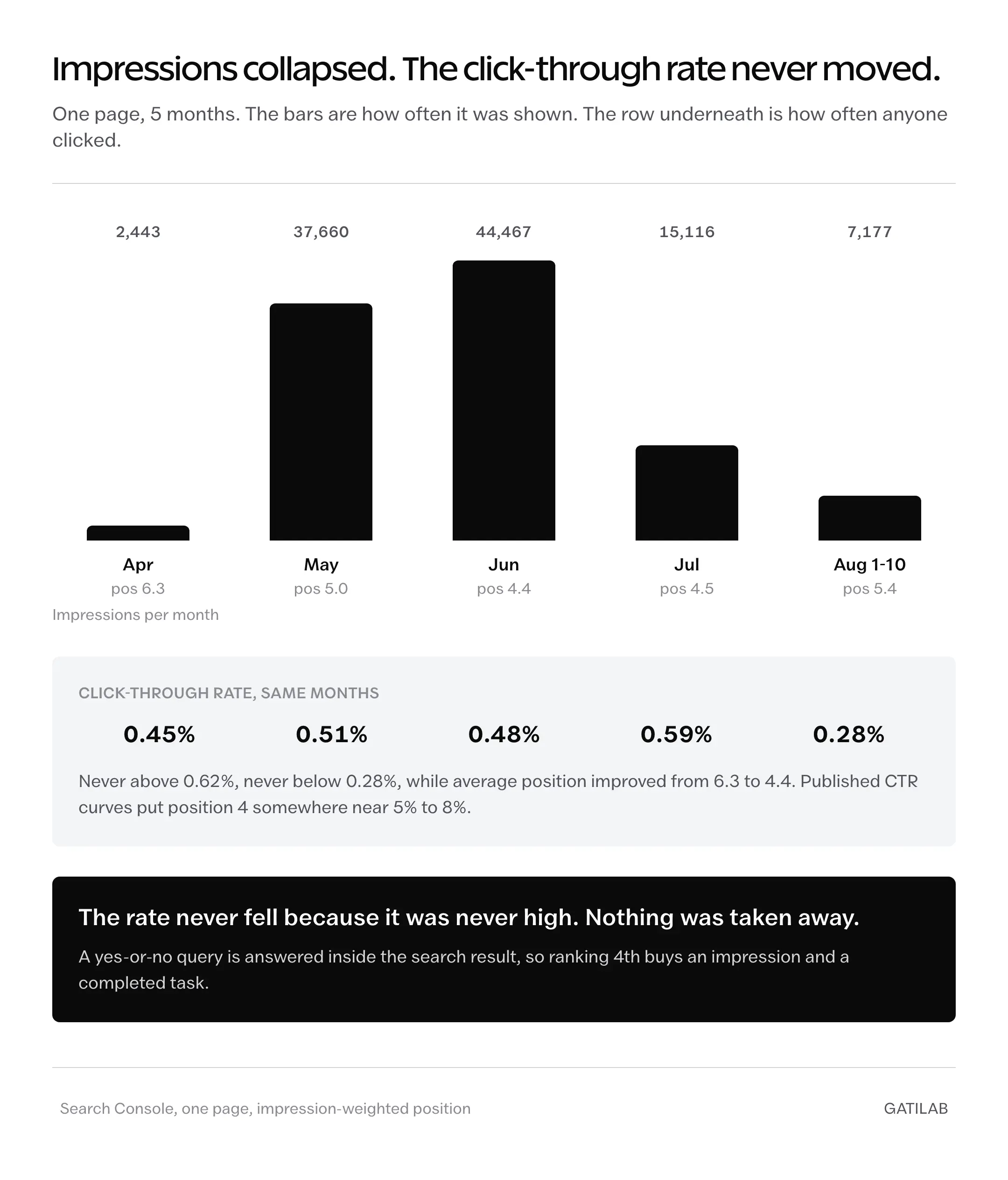
Read the click-through rate column top to bottom on both tables. It moves between 0.28% and 0.62% and does nothing else. Meanwhile position improved on both pages, from 6.3 to 4.4 on the first and from 7.1 to 4.9 on the second.
Better rankings. Same rate. About 151,000 impressions across both pages, and 737 visits to show for it.
Why this isn’t the story people expect
The reflex reading of a 0.5% click-through rate at position 4 is that an AI Overview appeared and took the traffic. That’s the explanation I expected to write when I pulled the data.
The timeline doesn’t support it. A page whose clicks were being taken away would show a healthy rate first and a poor one afterwards, with a visible break between them. These pages show 0.45% in their very first month, at position 6.3, before they ranked well enough for anyone to steal anything.
There is no before. That is the finding.
Whatever is consuming these clicks was consuming them from the beginning, which rules out a change in the SERP as the cause and points instead at something structural about the query itself.
The queries answer themselves
Both pages answer a yes-or-no question. Can you see who clicked your link? The honest answer is no, and it fits in 4 words.
A question with a short, definitive, non-negotiable answer is the worst possible thing to rank for if you need the click. The searcher’s entire need is satisfied by reading the answer, wherever it appears. A snippet satisfies it. An AI summary satisfies it. A competitor’s title tag containing the word “no” satisfies it.
Ranking 4th for that query buys you an impression and a completed task. The task just gets completed without you.
Compare that with a query like a tool comparison or a how-to with 9 steps. The answer cannot be compressed into a sentence, so the SERP can only advertise it, and the click has to happen for the need to be met. Same position, completely different economics.
So position is not the variable. Answerability is.
What actually changed
Something did move, and it wasn’t the rate. Impressions on the first page went 44,467 in June, 15,116 in July, and 7,177 across the first 10 days of August, which annualizes to roughly half the July pace.
Sitewide the same shape holds: 137,840 impressions in May, 116,018 in June, 64,236 in July.
So the pages are being shown less often while converting at the same miserable rate. Those are 2 independent problems, and conflating them is how people end up optimizing the wrong one. A title rewrite fixes a click-through problem. It does nothing about a visibility problem, and vice versa.
Separate the columns before you pick a fix.
What this changes about chasing rankings
The practical consequence is a question worth asking before committing 3 months to a keyword.
Not “can I rank for this,” but “if I rank for this, will anyone need to click?”
A few shapes where the answer is usually no:
- Yes-or-no questions. The answer is shorter than your title tag, and every surface in the results can carry it.
- Single-fact lookups. Dates, conversions, definitions, opening hours, capital cities. The knowledge panel exists for exactly these.
- Questions whose answer is a refusal. Anything of the form can I do X, where the answer is no. There is nothing to elaborate.
And the shapes where ranking still pays:
- Comparisons with more than 2 options. The answer is a judgment, and judgments do not compress into a snippet.
- Procedures with real steps. Someone has to follow along on a page.
- Anything requiring a file, a template, a calculator, or a tool. The click is the delivery mechanism.
- Decisions where the reader needs to trust the source. Money, health, legal, anything they will be held responsible for.
Traffic still has value at 0.5%, incidentally. 737 visits is 737 visits, and it costs nothing extra now that the pages exist. What it cannot do is carry a plan that assumed 8%.
What to do with a page like this
Finding one is not the same as fixing one, and 2 of the 3 available moves are usually wrong.
Rewriting the title and meta description is the reflex. On a genuinely answerable query it buys very little, because the searcher is not choosing between results, they are reading an answer and leaving. Worth 1 attempt if the current title is weak. Not worth a program.
Re-aiming the page at a harder question is the move with real upside. The same topic almost always contains a query the SERP cannot resolve in a sentence: how to set the thing up, which option to choose, what to do once the answer is no. Those queries convert because they have to.
Accepting it is a legitimate third option and the one people skip. A page pulling 0.5% of 40,000 impressions still delivers a few hundred readers a month for no ongoing cost. The mistake is not owning such a page. It is building the next 6 like it, or spending a quarter trying to lift a number the query has capped.
The pages here earn their keep as an entry point, and the useful response was to give arriving readers somewhere specific to go next rather than to keep polishing a rate that has never moved.
What this evidence cannot settle
Some honest boundaries, because a 2-page sample invites over-reading.
The 5% to 8% expectation for position 4 comes from published third-party CTR curves, not from anything measured here. Those curves are averages across wildly different query types, and the sensible way to use one is as a rough order of magnitude. The gap being roughly 10x is the meaningful part, not the exact multiple.
Search Console position is also an average across every query a page appeared for, so a page at 4.4 was above and below that on different searches on the same day. Impression-weighting helps and does not eliminate it.
I have not confirmed which SERP features are present on these queries. That would take feature-level data across the same window, and without it the claim stays where the evidence sits: the rate was structurally low from the start, so a mid-period SERP change cannot explain it. Which specific surface is absorbing the answer remains an inference.
And this is 1 topic, 1 site, 5 months. A different query family would produce different numbers, which is precisely why the useful move is to check your own.
Questions people ask next
Published CTR curves generally put it somewhere between 5% and 8%, though those are averages across very different query types. Treat the figure as an order of magnitude rather than a target, and compare a page against its own history instead.
Usually because the query is answered inside the search result. Yes-or-no questions, single-fact lookups and definitions get resolved by a snippet or summary, so the searcher’s need is met without a visit no matter where you rank.
Check the timeline before assuming so. A page losing clicks to a SERP feature shows a healthy rate first and a poor one after, with a visible break. A rate that was low from the first month points at the query type instead.
It is worth 1 attempt if the current title is weak, and not worth a program. On a genuinely answerable query the searcher is not choosing between results, so a better title moves very little.
Yes, once the page exists. A few hundred visits a month costs nothing further and can feed an email list or a related offer. The mistake is building more pages like it, or spending a quarter lifting a number the query has capped.
Check the rate before you chase the rank
Ranking is a means. Somewhere along the way it turned into the scoreboard, and a page can now win the thing everyone measures while losing the thing that pays.
The check costs about 5 minutes. Open Search Console, filter to a page you consider a success, and put the click-through rate next to the position. If the rate is under 1% while the position is under 10, more ranking will not help, because the ceiling is set by the question and not by where you sit under it.
Then decide whether the query deserves the next 3 months. Sometimes the honest answer is that the page has already done everything it can, and the effort belongs on a query where the answer cannot be given away for free.
Position 4 is not a result. It’s a lottery ticket, and the question decides whether it pays.
Tell Google you want more of this.
Add Gatilab as a preferred sourceOne tap, and this site shows up more often in your own Top Stories, AI Overviews and AI Mode. Remove it any time.