
Website Traffic Checker Estimates: What the Numbers Mean
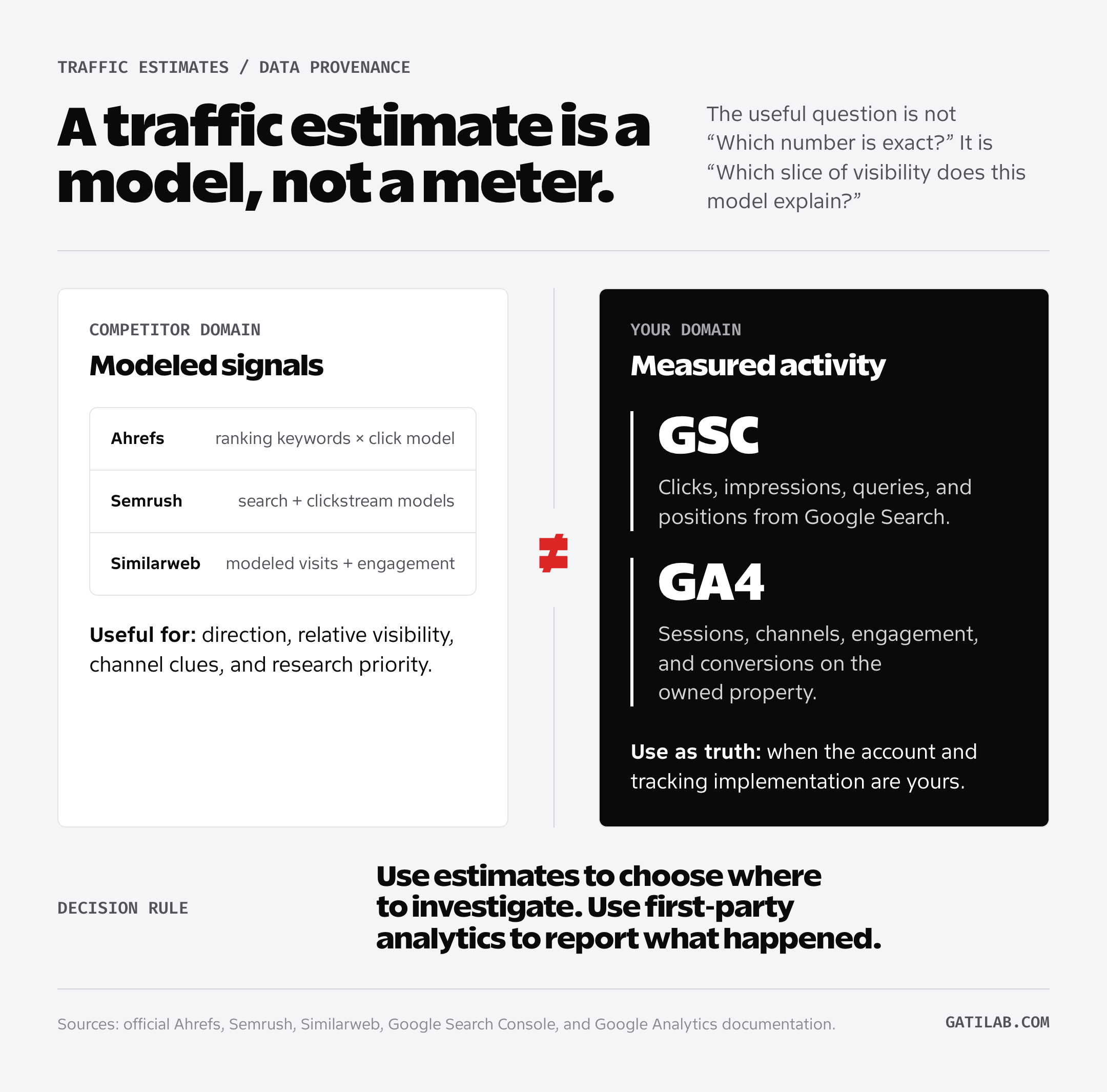
A website traffic checker cannot see a competitor’s Google Analytics account. It builds an estimate from keyword rankings, click-through models, clickstream panels, public signals, or some combination of those inputs. The number is a model, not a hidden analytics report.
That doesn’t make website traffic checkers useless. It means you should use them for relative comparisons, direction, channel clues, and research priorities. Using an estimate as an exact visitor count is where the analysis breaks.
- Evidence: Ahrefs, Semrush, and Similarweb describe modeled estimates, while Search Console and Analytics measure only properties you can verify or instrument.
- Best use: The most useful competitor insight is often direction or relative visibility, not the displayed visit total.
- Limit: No tool is ranked “most accurate” here because that claim requires a controlled, multi-site comparison against first-party data.
How should you compare website traffic checker data?
A traffic web checker is useful only when its model matches the question. Organic-search estimates, total-channel estimates, Search Console clicks, and Analytics sessions measure different scopes.
| Tool or data type | What it estimates | Best use | Main limit |
|---|---|---|---|
| Ahrefs organic traffic | Google clicks from ranking keywords | Organic search comparison | Doesn’t measure total traffic |
| Semrush Domain Analytics | Search traffic from rankings and CTR models | SEO visibility and keyword opportunity | Not first-party visits |
| Semrush Traffic Analytics | Total-channel visits from clickstream modeling | Market and channel benchmarking | Coverage varies by site and market |
| Similarweb | Visits and engagement from modeled data sources | Broad competitor and category comparison | Small sites can have weak or missing estimates |
| Google Search Console | Clicks from Google Search to a verified property | Your own search performance | Not competitor or total-site traffic |
| Google Analytics 4 | Measured on-site activity for an implemented property | Your own audience and conversions | Depends on consent, implementation, and definitions |
Start by deciding which question you are asking. “How much traffic does this site get?” is too broad.
If you are comparing first-party platforms, our guide to Google Search Console versus Google Analytics explains why their numbers can differ even on your own site.
Why do website traffic estimates disagree?
Two tools can report different traffic for the same domain without either being broken.
They may differ in:
- Traffic definition
- Country database
- Device coverage
- Date range
- Search-volume model
- Click-through-rate assumptions
- Keyword database
- Clickstream panel
- Bot filtering
- Subdomain or subfolder scope
- Daily, monthly, or rolling averages
Before comparing numbers, align the domain, country, device, channel, and time period.
How does Ahrefs estimate organic traffic?
Ahrefs describes its organic-traffic number as an estimate of monthly Google clicks.
Its method:
- Find keywords for which the target ranks.
- Estimate clicks using position, search volume, and expected click-through rate.
- Add the estimates across keywords.
Ahrefs explicitly says the result is an estimate, not actual website analytics. Its organic traffic methodology recommends using the metric for comparison.
This explains two common gaps:
- Ahrefs organic traffic should not match Google Analytics total traffic because direct, referral, email, social, and other channels are excluded.
- Ahrefs may not match Search Console clicks because keyword coverage, search volume, CTR, geography, and timing are modeled.
Our Ahrefs vs Semrush comparison covers the wider product decision. For traffic estimates, the narrower question is which data model matches the comparison you want to make.
How do Semrush’s two traffic models differ?
Semrush has more than one traffic number.
Domain Analytics
Domain Analytics estimates search traffic from keyword positions, search volume, and average CTR. It is conceptually similar to other SEO visibility models.
Traffic Analytics
Traffic Analytics estimates visits across channels using clickstream data and modeling. Semrush says its system collects anonymized clickstream data from third-party providers, cleans it, checks it against other databases, and models patterns across countries, devices, demographics, and industries.
Semrush’s explanation of Domain Analytics and Traffic Analytics says the two numbers will usually differ because they measure different things.
Don’t compare an Ahrefs organic estimate with Semrush total modeled visits and call the larger number more accurate. The scope is different.
What is Similarweb useful for?
Similarweb is commonly used for broader market and channel comparisons. Its value is not a magical exact count. It is the ability to examine:
- Relative site size
- Traffic trends
- Channel mix
- Geography
- Audience overlap
- Engagement estimates
Treat missing or unstable data on small sites as a limitation, not as proof the site has no visitors.
How do free website traffic checkers work?
Free estimators often provide:
- A limited version of a paid provider’s model
- Keyword-based organic estimates
- Public rankings or popularity signals
- Cached third-party data
The interface may show a precise number such as 48,327 visits. Precision in display is not precision in measurement.
Before trusting a free tool, ask:
- What traffic source does it estimate?
- Which country does it cover?
- How recent is the data?
- Does it disclose methodology?
- Does it show a range or false precision?
- Does it handle small sites?
- Is the result reproducible?
What can a traffic estimator reliably help you do?
Used with the right scope, modeled data can still support several sound research tasks.
Compare relative organic visibility
If one competitor consistently ranks for more relevant terms and has a stronger estimated search trend, that is useful.
Find pages and topics
Estimated top pages and keywords can show where a competitor likely earns attention. A Search Console keyword-ranking workflow can then help you compare those themes with your own verified data.
Detect direction
A sustained rise or fall across several months is more useful than one month’s exact number.
Compare channel dependence
Modeled channel mix can suggest whether a competitor depends heavily on search, direct traffic, referrals, paid media, or social. Treat it as a research clue.
Size a research priority
If several tools and public signals agree that a competitor’s section is important, inspect it. Don’t put the estimate into a board report as fact.
What can a traffic checker not tell you?
They cannot reliably reveal:
- Exact sessions or users
- Exact conversion rate
- Qualified lead volume
- Revenue
- Profit
- Customer acquisition cost
- Retention
- Consent-adjusted measurement gaps
- Internal bot filtering
- Offline conversions
- Whether traffic is commercially valuable
A site can have less traffic and a better business. A narrow B2B site with 5,000 qualified visits may outperform a general site with 500,000 low-intent visits.
How do you compare an estimate with first-party data?
For a site you own:
- Match the same month.
- Match the same country.
- Match desktop and mobile scope.
- Separate organic search from total traffic.
- Match domain, subdomain, subfolder, or URL.
- Compare clicks with clicks, visits with visits, and users with users.
- Record the tool’s estimate and your measured number.
- Calculate error only after scopes match.
Error formula:
absolute(estimate - measured value) ÷ measured value × 100
One domain isn’t enough to declare a universal winner. A meaningful study would include several site sizes, industries, countries, and channel mixes.
Do not rank tools by invented accuracy. First understand the models, then test them against several sites you control.
What is a safe competitor-traffic research workflow?
Use this sequence:
- Check two traffic-estimation tools.
- Align country, scope, and date.
- Record total and organic estimates separately.
- Inspect top pages and keywords.
- Check trend, not just the latest month.
- Compare public evidence such as publishing frequency, branded demand, backlinks, and ad activity.
- Mark every third-party number as an estimate.
- Base decisions on patterns that survive more than one signal.
If you are choosing between platforms, this Semrush, Ahrefs, and Moz data comparison covers the broader stack. Don’t choose a tool only because its estimate happens to be closest for one domain.
FAQs
The safe answer always starts with the tool’s data source and measurement scope.
Can a website traffic checker show exact traffic?
Not for a site you do not control. Exact traffic requires access to first-party measurement. Competitor tools provide modeled estimates.
Why is Ahrefs traffic lower than Similarweb?
Ahrefs organic traffic estimates Google search clicks. Similarweb may estimate total visits across multiple channels. Different scope produces different numbers.
Is Semrush Traffic Analytics the same as Organic Research?
No. Traffic Analytics models total-channel visits using clickstream and other data. Organic Research estimates search traffic from keyword rankings and click-through-rate assumptions.
Which website traffic checker is most accurate?
Accuracy varies by site size, country, channel, and data coverage. Choose the model that fits the question and validate it against first-party data on sites you own.
Can I use traffic estimates in a client report?
Yes, if you label them as estimates, state the provider and scope, and avoid presenting them as measured sessions, leads, or revenue.
Tell Google you want more of this.
Add Gatilab as a preferred sourceOne tap, and this site shows up more often in your own Top Stories, AI Overviews and AI Mode. Remove it any time.