
SaaS Onboarding Process: 7-Stage Operational Workflow for 2026
The SaaS onboarding process is the seven-stage operational workflow that turns a new signup into a long-term customer. It’s distinct from the customer-facing onboarding experience because the process covers what your team does behind the scenes: the data captured at signup, the routing rules that decide who gets a kickoff call, the in-app events that trigger the next email, the handoff from onboarding to customer success at the activation milestone. Most SaaS teams have a customer-facing onboarding flow but no documented process behind it, which is why the same signup gets a different experience depending on which day they land.
This guide walks the full seven-stage SaaS onboarding process used by product-led teams that treat activation as a measured stage. Each stage gets a defined trigger, a clear KPI, and a written rule for what happens when the stage misses its number. The process applies to a 4-person founding team and a 40-person growth org alike; the difference is who owns each stage, not whether the stage exists.
A working SaaS onboarding process isn’t a longer flow. It’s a shorter one with sharper triggers. Strong onboarding usually ships fewer screens, not more, because every screen has a defined behavioral trigger and an exit rule that fires when the user no longer needs it.
What the SaaS Onboarding Process Actually Covers
The SaaS onboarding process is the operational workflow that runs from the moment a prospect lands on your signup page to the moment they hit the activation event that predicts long-term retention. It includes data capture, routing logic, in-app prompts, email automation, optional human touchpoints, and the eventual handoff to customer success. Done well, it’s mostly invisible to the customer because the experience feels smooth. Done badly, it shows up as missed touches, contradictory emails, and CS reps who don’t know what the customer has already done.
Most teams confuse the SaaS onboarding process with the SaaS onboarding experience. The experience is what the user sees: the welcome modal, the empty state, the first tooltip. The process is everything underneath: which event fires the modal, what data the modal collects, which segment that data routes the user into, which email sequence the segment triggers, and what happens when the user does or doesn’t complete the next step. The experience is the tip; the process is the iceberg.
If you only have time to fix one part of your SaaS onboarding process this quarter, fix the data capture at signup. Every downstream stage depends on knowing the user’s role, use case, and intent. Without that data, every email is generic and every routing rule is guessing.
The Seven Stages of the SaaS Onboarding Process
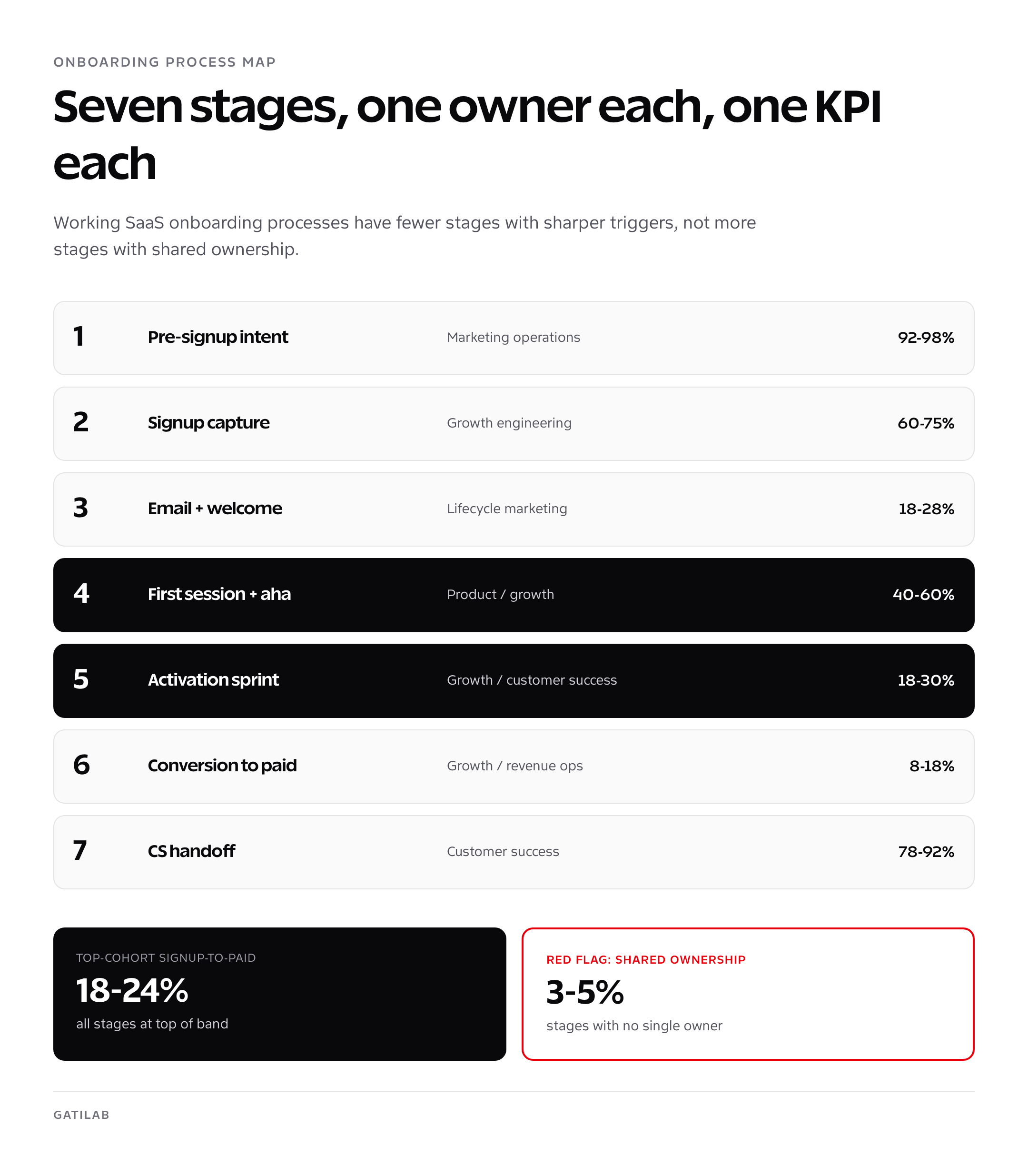
The seven stages below cover the operational workflow from pre-signup intent through the handoff to customer success. Stages 1 to 3 are pre-product. Stages 4 to 6 are in-product. Stage 7 is the post-activation handoff. Each stage has a single owner on the team, a defined trigger event, and a measurable KPI.
Stage 1: Pre-signup Intent Capture
Pre-signup is the marketing layer that decides who lands on your signup page. The intent of the signup shapes downstream conversion: someone who searched “[Competitor] alternatives” or your brand name arrives much closer to a decision than someone who read a top-of-funnel SEO article. The SaaS onboarding process should know which page drove the signup so the in-product experience can adapt.
Capture the referrer URL, UTM parameters, and the last 3 to 5 page views inside a first-party cookie before the signup form fires. Most teams lose this data at form submission because the form runs on a different subdomain or fires before the cookie is read. The fix is a server-side first-touch attribution capture that survives cross-subdomain navigation. Tools like Segment, RudderStack, or a custom-built capture endpoint solve this in a week of engineering.
KPI: Percentage of signups with attributed first-touch source. Aim to attribute as close to every signup as your tracking allows.
Trigger: First page view on a tracked domain.
Owner: Marketing operations.
Stage 2: Signup and Data Capture
Signup is the most heavily over-engineered stage of most SaaS onboarding processes. Every additional field costs some signups, but the right two or three fields are worth that cost because they make personalized routing possible downstream. The trick is keeping the form to email, password, and one routing question, then using progressive profiling to fill in the rest after the user has experienced the product.
The single best routing question is “What will you use [product] for?” with 4 to 6 named options. The answer routes the new user into a different first-session template, sample workspace, or starter content. Personalized routing is usually worth the small friction of one extra field, but test it against your own form completion rate.
KPI: Signup completion rate from form view. Set the target from your own baseline, and report B2B and B2C signups separately.
Trigger: Form submission.
Owner: Growth engineering.
Stage 3: Email Verification and Welcome
Email verification is a friction tax that pays back in deliverability. Skipping verification makes signup easier but lets fake and mistyped addresses into your list, and those hurt deliverability later. The right answer for most SaaS is to verify the email asynchronously: let the user into the product immediately, but send a verification link in the welcome email and gate certain actions (sharing, paying, inviting teammates) until the email is verified.
The welcome email itself should fire within 30 seconds of signup, contain one specific call-to-action (the next in-product step the user should take), and not include a marketing pitch. One clear next step is easier to act on than three competing links.
KPI: Welcome email open rate and click-to-product rate, tracked against your own baseline.
Trigger: Signup form submission.
Owner: Lifecycle marketing.
Stage 4: First Session and Aha Moment
The first session is the most important stage of the SaaS onboarding process. If the user reaches the aha moment in this session, every later stage gets easier. If they don’t, downstream email and re-engagement campaigns are doing damage control on a stage that should have worked. The fix is often a forced first action: the product won’t let the user proceed until they create the artifact the product is built around.
Identify the aha moment with cohort analysis on 6 to 12 months of historical data. Segment users into activated and churned cohorts at month 3, then look at the first-session behavior that splits them. The behavior the activated cohort did and the churned cohort didn’t is the aha moment. Don’t guess this from a workshop.
KPI: Percentage of first sessions that reach the aha moment. Track it weekly and improve it against your own baseline.
Trigger: First product login.
Owner: Product or growth.
Stage 5: Activation Sprint
Activation is a measurable behavior threshold that predicts long-term retention. Slack’s is 2,000 team messages. Linear’s is 5 issues across 2 days. Notion’s is 3 pages with 1 collaborator. The activation sprint is the days 1 to 14 window where the SaaS onboarding process should be most actively pushing the user toward this threshold through in-app prompts, behavioral emails, and (above a certain ARR threshold) human touchpoints.
The activation sprint runs three parallel tracks. In-app: the checklist or progress UI keeps the next action visible. Email: behavior-triggered messages re-engage users who stalled at a specific step. Human: for higher-value accounts, a CSM or onboarding specialist sends a personalized check-in around day 3. The three tracks should not contradict each other. If the email tells the user to try feature X but the in-app checklist is still showing feature Y, the orchestration is broken.
KPI: Activation rate inside the trial window. For reference, Lenny Rachitsky’s 2022 survey, with more than 500 responses, put average SaaS activation at 36 percent and the median at 30 percent. Activation definitions vary, so compare your own cohorts first.
Trigger: Successful first session.
Owner: Growth or customer success.
Stage 6: Conversion to Paid
Conversion to paid is where the SaaS onboarding process meets the billing system. For 14-day trials, the conversion window is days 10 to 16 (a few days before trial end through a few days after). For freemium, it’s whenever the user hits a usage limit that the paid plan removes. The cleanest conversion mechanic is a hard usage cap that the user is approaching, with a clear in-app prompt at 80 percent of the cap.
Trial-end emails deserve the most care. A simple sequence is three messages: 5 days before trial end (“here’s what you’ve built”), 1 day before (“trial ending tomorrow”), and 2 days after (“we paused your account”). The pause-and-resume mechanic can win back expired trials, because the friction of losing access to the artifacts the user already created beats the friction of paying.
KPI: Trial-to-paid conversion rate. Compare cohorts by trial type (card required or not) rather than against an industry median.
Trigger: Activation event or trial day 10.
Owner: Growth or revenue ops.
Stage 7: Handoff to Customer Success
The handoff is where most SaaS onboarding processes break down quietly. The onboarding team has data on what the user did in the first 14 days. The CS team takes over for ongoing relationship management. If the data doesn’t transfer, CS reps spend the first call asking the customer questions the product already knows the answer to, which feels like the company isn’t paying attention.
The clean handoff is a single document or CRM record that captures: the activation event the user hit (or didn’t), the time-to-value, the features used, the first-touch attribution source, the sales-assist flags from the trial, and any open support tickets. The CS rep starts the first call having read this in 60 seconds. The customer feels like one company is talking to them, not three departments.
KPI: 90-day retention rate post-activation. Track it by cohort and by plan.
Trigger: First payment processed or activation event hit.
Owner: Customer success.
A SaaS onboarding process with seven stages and clear ownership outperforms a process with twelve stages and shared ownership every time. Fewer handoffs, sharper triggers, single owner per stage. The teams that miss this end up with elaborate documentation that nobody actually executes against.
Mapping KPIs to Each Stage
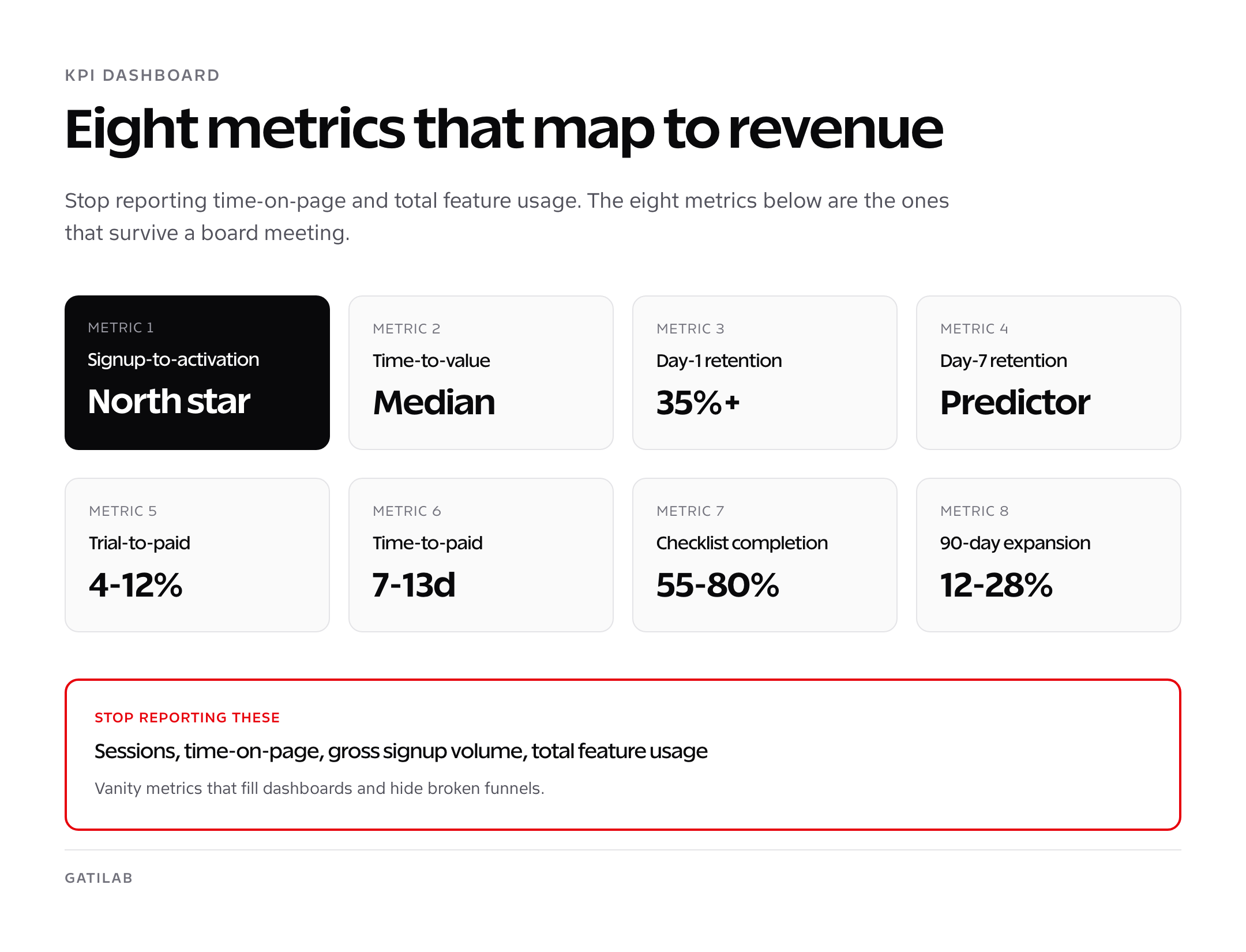
Each stage of the SaaS onboarding process needs one primary KPI and one or two secondary KPIs. Reporting more than three metrics per stage drowns the signal. Reporting fewer than one means you can’t tell when the stage is broken. Below is a stage-by-stage operational dashboard, ranked by stage and weighted by impact on revenue.
| Stage | Primary KPI | Owner |
|---|---|---|
| 1. Pre-signup intent | Attributed first-touch rate | Marketing operations |
| 2. Signup capture | Form completion rate | Growth engineering |
| 3. Email + welcome | Welcome email click-to-product | Lifecycle marketing |
| 4. First session + aha | First-session aha rate | Product or growth |
| 5. Activation sprint | Trial-window activation rate | Growth or customer success |
| 6. Conversion to paid | Trial-to-paid rate | Growth or revenue ops |
| 7. CS handoff | 90-day post-activation retention | Customer success |
Multiply the conversion rates through stages 2 to 6 and you get your signup-to-paid rate. Set each stage’s target from your own trailing baseline, then raise it one stage at a time. The difference isn’t usually one heroic stage; it’s small wins compounded across all five.
When to Branch the Onboarding Process
Not every signup should go through the same SaaS onboarding process. Branching the flow based on segment, intent, or contract value is one of the highest-leverage moves in the playbook. The four most useful branch points:
- Use case branch: The signup form’s “what will you use [product] for?” answer routes into a different first-session template. Most-used branch in the industry.
- Team-size branch: Solo signups get a self-serve flow. Team signups (5+ seats) trigger an in-app invite prompt and an automated kickoff offer at 20+ seats.
- Plan-tier branch: Free signups go through pure self-serve. Paid signups (any tier) get a 1-on-1 kickoff call offer. Enterprise signups get assigned a named CSM in the first 24 hours.
- Source-intent branch: Signups from competitor-comparison pages get a different welcome sequence than signups from top-of-funnel content, because the buying intent is materially different.
The mistake most teams make is branching on too many dimensions and ending up with 20 micro-flows nobody can maintain. Branch on at most two dimensions. Use case plus plan tier covers most of the value. Add the third branch only when the team has a year of data showing the second branch is paying off.
The Tool Stack Behind a SaaS Onboarding Process
A working SaaS onboarding process needs five tool categories: product analytics, in-app guides, customer data platform (CDP), email automation, and customer success platform. Most of these tools price by usage (events, profiles, or monthly active users), so check current pricing against your own volume before budgeting.
- Product analytics: PostHog (1M events free per month), Mixpanel (free up to 1M events per month), Amplitude (free up to 2M events per month). Provides the cohort analysis to define the activation event.
- In-app guides: Userpilot (Starter at $299 per month), Appcues (priced by monthly active users), Userflow (see current pricing). Powers the checklist, tooltips, and forced first action without engineering work for each change.
- Customer data platform: Segment (see current pricing), RudderStack (free up to 250K events per month, Growth at $265 per month), Customer.io Data Pipelines. Routes events between analytics, email, and CRM.
- Email automation: Customer.io (priced by profiles), HubSpot Marketing Hub Starter (per-seat pricing), Userlist (priced by users), Loops (free up to 1,000 contacts). Triggers behavior-based emails on stage transitions.
- Customer success platform: Vitally, ChurnZero, Catalyst, Gainsight. Usually sold through sales calls. Optional for smaller self-serve products; worth it once a dedicated CS team exists.
For a deeper category-by-category comparison of the in-app guides specifically (Userpilot, Appcues, Pendo, WalkMe, Userflow, Chameleon, Userlist, Intercom Product Tours) with verified 2026 pricing, see the SaaS onboarding tools guide. The category has consolidated significantly in the last 18 months, and the right pick depends heavily on your engineering capacity and team size.
Real-World Examples of the Process in Action
Three well-known product-led teams run their SaaS onboarding process in distinctly different ways, and each illustrates a different stage being the bottleneck.
Linear: First-Session Bottleneck Solved
Linear’s process is unusually short on stages 1 to 3 (no marketing-attribution capture beyond what’s needed for ad reporting, no email-verification gate, a 30-second welcome email) and unusually long on stage 4 (first-session investment is enormous). The team owns activation rate as the north-star metric and has invested 18 months of product engineering in shrinking initial TTV from minutes to seconds. The process behind that work is a weekly cohort review of activation rate by signup-week, with a single product engineer assigned to fix the lowest-converting step.
Notion: Conversion Bottleneck Solved
Notion’s process invests heavily in stage 6 (conversion to paid). The company offers a generous free tier, then triggers conversion prompts based on behavioral signals: hitting block-count limits, sharing with collaborators outside the workspace, accessing premium templates. The result is a SaaS onboarding process where stages 4 and 5 are deliberately patient (let the user explore for weeks) and stage 6 is sharp (the upgrade prompt is contextual to the limit they just hit). This works for Notion specifically because the product has natural usage milestones that map to value.
Slack: Activation Bottleneck Solved
Slack’s onboarding process treats team formation as the activation event. Stage 4 (first session) is built entirely around inviting at least 2 teammates inside the first 10 minutes. The behavioral email sequence in stage 5 fires based on team-message volume rather than individual-user behavior, because Slack’s value is multiplayer. Companies copying Slack’s process for solo-user products usually hit a wall here, because the activation event they’re optimizing for doesn’t apply to their product. The lesson is that the SaaS onboarding process should fit the activation math, not the other way around.
Don’t copy onboarding flows from companies whose activation math doesn’t match yours. A solo-user product copying Slack’s team-invitation flow will see lower activation, not higher, because the gating assumes a network effect that doesn’t exist. Match the flow to the math first.
Common Failures in the SaaS Onboarding Process
The same failure modes show up across most SaaS onboarding processes that aren’t working. Each has a known fix and most can be fixed in 2 to 6 weeks of focused work.
- No defined activation event. Team can’t write the activation event in one sentence with a number. Every metric downstream is then unmoored. Fix: cohort analysis on 6 to 12 months of historical data.
- Email and in-app contradict each other. Welcome email tells the user to try feature X. In-app checklist is still showing feature Y from yesterday. Fix: behavior-triggered email rather than time-triggered email.
- Concierge gating wrong. Either every signup gets pushed into a kickoff call (kills self-serve conversion) or no signup ever does (leaves enterprise revenue on the table). Fix: gate by ARR or self-identified intent.
- No CS handoff document. CS reps start the relationship blind. Customer feels unheard. Fix: a single-screen handoff record at activation milestone.
- Signup form too long. Five fields to capture data the team won’t use until day 30. Fix: collect only what’s needed for stage-1 routing. Use progressive profiling.
- No re-engagement for stalled trials. Day-1 dropoffs vanish. Fix: 3-email recovery sequence over days 3, 7, 14, with one specific CTA each.
How the Process Connects to the Broader Customer Journey
The SaaS onboarding process is one layer of a longer customer journey. Upstream sits acquisition: the marketing layer that decides who lands on the signup page. Downstream sits customer success, expansion, and (if it goes wrong) churn prevention. The process needs clean handoffs at both ends.
Upstream, the content marketing layer pre-qualifies signups by intent. A signup from a “[Competitor] alternatives” page already has shopping intent and high conversion probability. A signup from a top-of-funnel SEO article has discovery intent and lower conversion. The onboarding process should know which is which. The SaaS content marketing playbook covers how to build the BOFU layer that pre-qualifies signups before they enter your onboarding process. The SaaS SEO strategy guide covers the keyword-mapping layer that sits one level above content.
Downstream, the activation event you defined in stage 5 is the same event customer success teams should use as the trigger for first health-score calculation. Without that handoff, CS teams are guessing at which accounts to expand and which to triage. The SaaS customer success guide walks through how to build that handoff cleanly. Onboarding done well also reduces churn cheaper than any retention play after the fact, which the churn reduction playbook for bootstrapped SaaS covers in detail.
The process also nests inside the broader product-led growth strategy. PLG is the company-wide motion; onboarding is the operational execution. The product-led growth guide for SaaS covers the strategy layer including freemium versus free-trial trade-offs and the math behind PQL targeting. And if you’re building the full revenue motion, my SaaS marketing strategy guide sequences acquisition, activation, and expansion in priority order. For the customer-experience model that pairs with this operational view, see the complete SaaS onboarding guide.
Frequently Asked Questions
What is the SaaS onboarding process?
The SaaS onboarding process is the seven-stage operational workflow that runs from pre-signup intent capture through the handoff to customer success. It’s distinct from the customer-facing onboarding experience: the process covers what your team does behind the scenes, the experience is what the user sees. Most teams have an experience but no documented process.
How many stages are in the SaaS onboarding process?
Seven: pre-signup intent capture, signup and data capture, email verification and welcome, first session and aha moment, activation sprint, conversion to paid, and handoff to customer success. Each stage has a single owner, a defined trigger event, and a measurable KPI. Fewer stages with sharper triggers outperform more stages with shared ownership.
Who owns each stage of the SaaS onboarding process?
Stages 1 and 3 are marketing operations and lifecycle marketing. Stage 2 is growth engineering. Stages 4 and 5 are product or growth. Stage 6 is growth or revenue ops. Stage 7 is customer success. The mistake most teams make is shared ownership across stages, which produces the slowest decisions and the most contradictory customer experience.
What are the KPI targets for each stage?
Set each target from your own trailing baseline, not from a generic benchmark, because KPI definitions differ between products. One published reference point: Lenny Rachitsky’s 2022 survey, with more than 500 responses, put average SaaS activation at 36 percent and the median at 30 percent. Improve one stage at a time and the signup-to-paid rate compounds.
How do you define the activation event?
Run cohort analysis on 6 to 12 months of historical data. Segment users into activated (still active at month 3) and churned cohorts, then look at the first-session behavior that splits them. The behavior the activated cohort did and the churned cohort didn’t is the aha moment, and the threshold version of it is the activation event. Don’t guess this from a workshop.
Should the SaaS onboarding process branch by segment?
Yes, on at most two dimensions. Use case (the answer to ‘what will you use [product] for?’) and plan tier cover most of the value. Adding a third branch like team size or source intent only pays off after a year of data shows the second branch is working. Twenty micro-flows nobody can maintain is worse than three flows the team executes consistently.
What tools support the SaaS onboarding process?
Five categories: product analytics (PostHog, Mixpanel, Amplitude), in-app guides (Userpilot, Appcues, Userflow), customer data platform (Segment, RudderStack), email automation (Customer.io, HubSpot, Userlist), and customer success platform (Vitally, ChurnZero). Most of these tools price by usage, so check current pricing against your own volume.
Why do email sequences need to trigger on behavior?
Time-triggered emails fire regardless of where the user is in the funnel. Day-3 emails telling the user to try feature X arrive after some users already tried it (creates friction) and before others have even logged in (creates noise). Behavior-triggered emails fire on stage transitions: dropped after first login, completed aha, hit activation. They reach each user at the moment the message is relevant.
What’s the cleanest customer success handoff?
A single document or CRM record at the activation milestone capturing: the activation event hit, time-to-value, features used, first-touch attribution, sales-assist flags, and open support tickets. The CS rep starts the first call having read it in 60 seconds. Without that handoff, CS reps ask questions the product already knows the answer to, which feels like the company isn’t paying attention.
How do you fix a broken SaaS onboarding process?
Pick the stage with the worst conversion rate this quarter, fix one specific failure, measure the stage’s KPI again 30 days later. If it didn’t move, you fixed the wrong thing. Move to the next stage. Redesigning everything in one sprint usually breaks more than it fixes.
The Bottom Line on the SaaS Onboarding Process
A working SaaS onboarding process is a seven-stage workflow with one owner per stage, one primary KPI per stage, and one written rule for what happens when the KPI misses target. Build that, run it for two quarters, and the activation rate will tell you which stage is the next constraint. Skip the documentation and the team will rebuild the same broken process every time someone leaves.
The teams that win don’t have a longer process. They have a shorter one with sharper triggers. Pick the stage with the worst conversion rate this quarter, fix one thing, measure again in 30 days. There’s no shortcut, but the math compounds fast once stages start hitting their numbers.
Tell Google you want more of this.
Add Gatilab as a preferred sourceOne tap, and this site shows up more often in your own Top Stories, AI Overviews and AI Mode. Remove it any time.