
SaaS SEO Strategy: A Quantitative Playbook for 2026
A SaaS SEO strategy is the prioritization layer that decides which pages get built, in which order, against which keywords, with what budget, on what timeline. It’s not keyword research. It’s not on-page checklists. It’s the document that lets a CMO walk into a board meeting and defend why the team is shipping “Pipedrive alternatives” before “what is CRM software.” Most SaaS teams have a backlog and call it a strategy. They are not the same thing.
I’ve built SaaS SEO strategy docs for 40-plus B2B software companies, ARR ranging from $200K to $300M. The teams that hit their pipeline targets share three traits: they map keywords to jobs-to-be-done before they map them to volume, they score every keyword on a quantitative model, and they kill 60 to 70 percent of the queries on their initial list. The teams that miss treat strategy as a kickoff doc that nobody re-opens.
A working SaaS SEO strategy answers six questions before a single page is briefed: which JTBDs do we own, which keywords map to those JTBDs, how do we score them, which BOFU plays do we ship in quarter one, which programmatic plays do we scale in quarter two, and what technical SEO will break if we don’t fix it now. This piece walks through each in order.
SaaS SEO Strategy Starts With Jobs-To-Be-Done, Not Keywords
Every working SaaS SEO strategy begins with the buyer’s jobs-to-be-done, not with a keyword tool’s auto-suggest. JTBDs are the functional, emotional, and social outcomes a buyer hires software to deliver. Keywords are how those JTBDs surface in search. Strategy maps the second to the first; tactics search for keywords without ever mapping them.
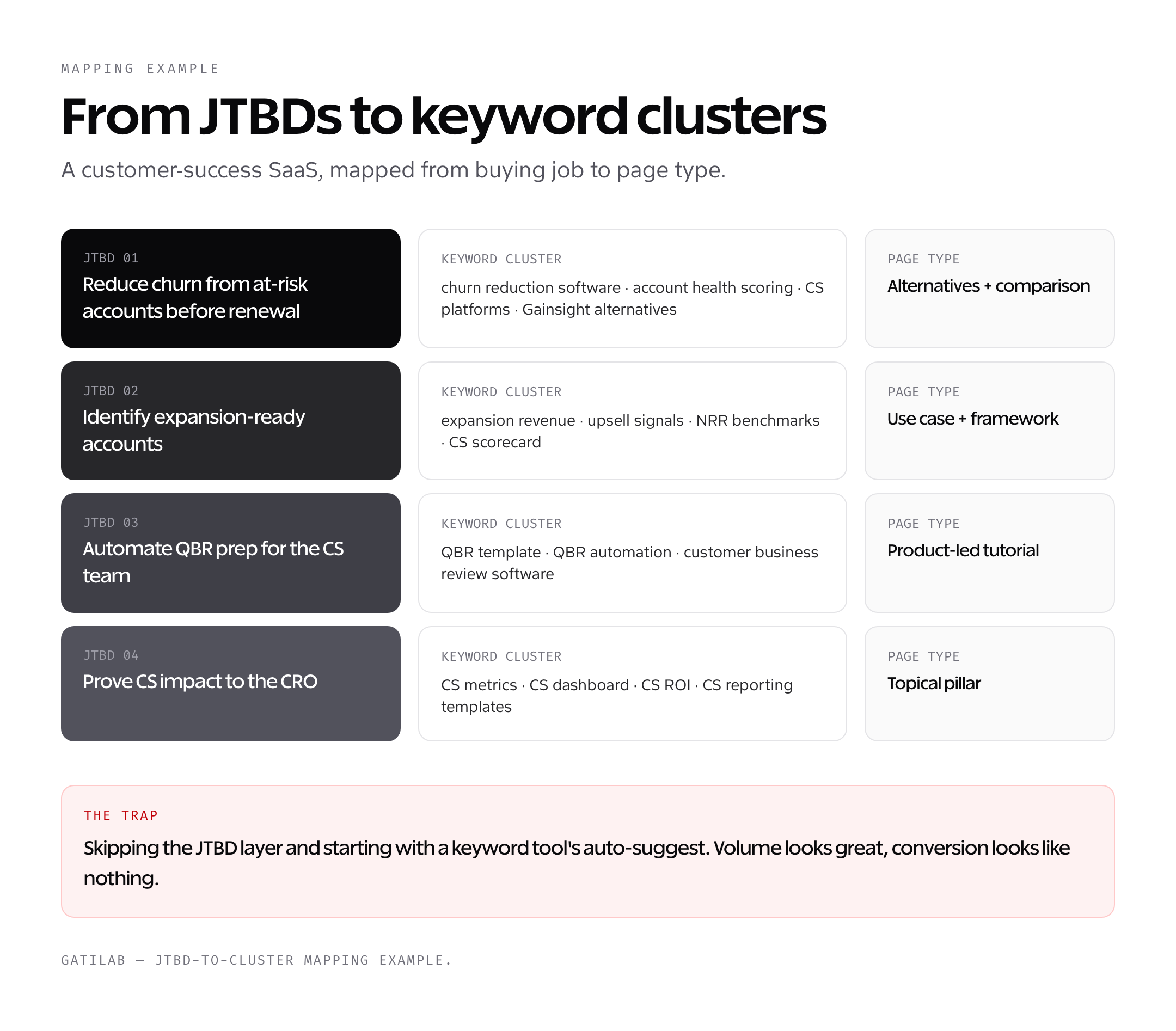
Take a customer-success SaaS as the example. The keyword tool surfaces “customer success software,” “CS platforms,” “client management tool,” “account health scoring.” None of those are JTBDs. The JTBDs sitting underneath are: reduce churn from at-risk accounts, identify expansion-ready accounts before the renewal call, automate the QBR prep, prove CS impact to the CRO. Each JTBD owns a different set of queries, a different buyer, and a different conversion mechanic.
The mapping process I run on every engagement:
- List 8 to 12 JTBDs. Pull from sales-call transcripts, support tickets, churn-survey responses. One sentence each, verb-first.
- Tag each JTBD with the buyer persona. The CRO buys differently than the CS lead. Different queries, different objections.
- Brainstorm queries per JTBD. 20 to 40 candidate queries each. Don’t filter on volume yet.
- Pull volume, KD, and SERP intent. Layer Ahrefs or Semrush data over the candidate list.
- Cluster into topic groups. Group queries that share intent into clusters of 3 to 8. Each cluster becomes a candidate page.
The output is a JTBD-to-cluster map, not a keyword list. The map is what you defend in a planning meeting because every query traces back to a buying job that maps to revenue.
For the introductory SEO mechanics that sit underneath this strategy layer, see the existing SEO for SaaS guide on this site. This piece is the strategy and prioritization layer one level up.
A Quantitative Scoring Framework for SaaS Keyword Selection
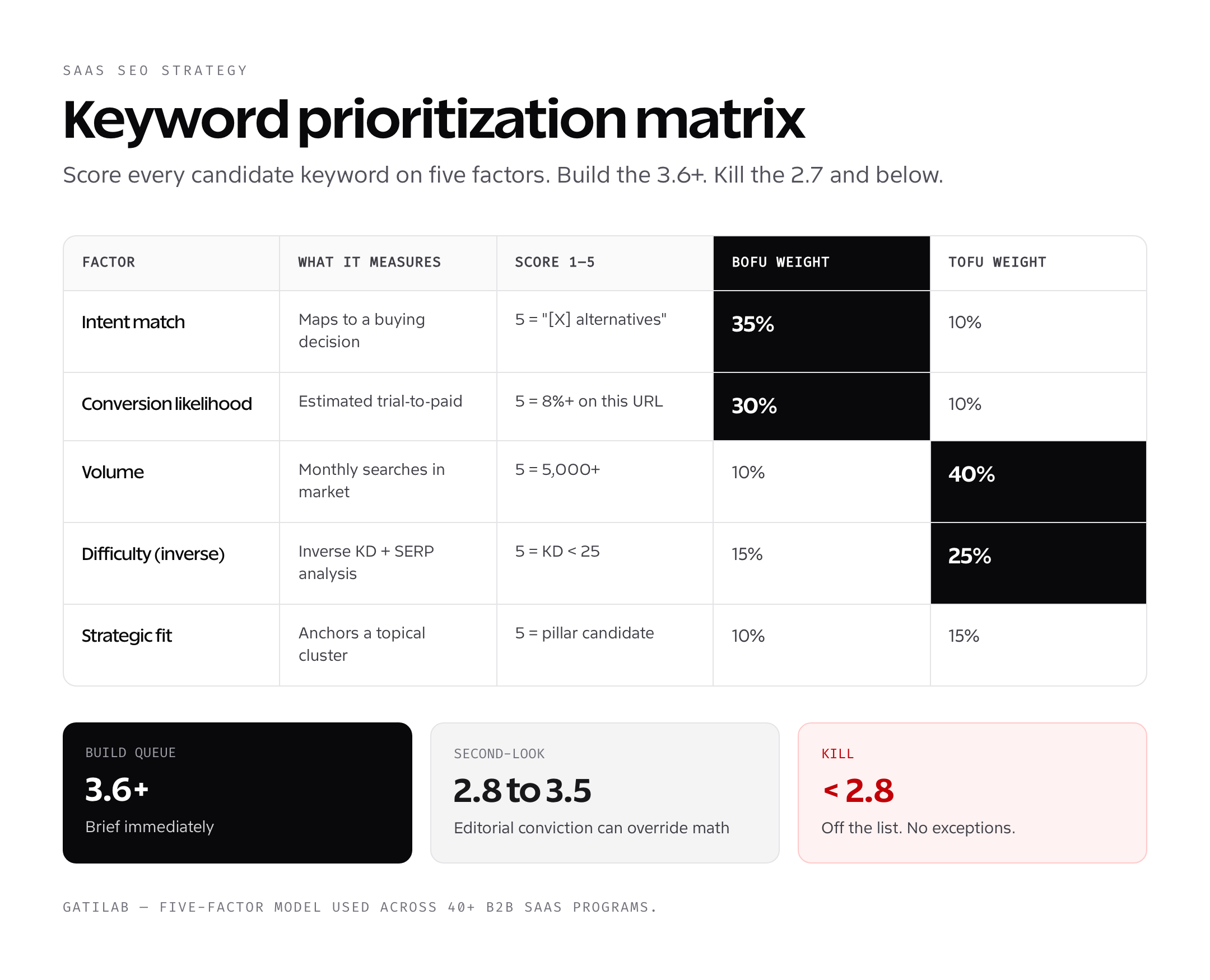
Scoring keywords by hand or by gut is how SaaS SEO strategy stops being a strategy. The teams that win pick a quantitative model, run every candidate keyword through it, and let the model decide. The model I use scores each query on five dimensions, weighted differently by funnel position.
The five-factor scoring model:
| Factor | What it measures | Score 1 to 5 | Weight (BOFU) | Weight (TOFU) |
|---|---|---|---|---|
| Intent match | How well the query maps to a buying decision | 5 = “[competitor] alternatives”; 1 = “what is [category]” | 35 percent | 10 percent |
| Conversion likelihood | Estimated trial-to-paid for traffic from this URL | 5 = 8 percent plus; 1 = under 1 percent | 30 percent | 10 percent |
| Volume | Monthly searches in your primary market | 5 = 5,000 plus; 1 = under 100 | 10 percent | 40 percent |
| Difficulty | Inverse KD plus SERP analysis | 5 = KD under 25; 1 = KD over 70 | 15 percent | 25 percent |
| Strategic fit | How well the page slots into your topical authority story | 5 = anchors a cluster; 1 = orphan | 10 percent | 15 percent |
Multiply each score by its weight, sum, divide by 5. Anything scoring 3.6 plus enters the build queue. Anything below 2.8 gets killed. The middle band, 2.8 to 3.5, gets a second-look review where strategic fit and editorial conviction can override the math.
The weighting matters. BOFU pages should score on intent and conversion before volume. TOFU pages flip toward volume and difficulty because the page is a brand asset, not a conversion mechanism. Most failed SaaS SEO strategies use one weighting for every keyword and end up overspending on TOFU.
Topic Cluster Planning for B2B SaaS SEO
Topic clusters are the structural layer of a SaaS SEO strategy. A cluster is a pillar page plus 6 to 18 supporting pages, internally linked into a hub-and-spoke pattern. The pillar ranks for the head term. The supporting pages rank for long-tail variants and feed authority back to the pillar through internal links.
The cluster math that matters:
- Pillar word count: 3,000 to 5,000. Long enough to demonstrate topical depth, short enough to remain extractable for AI Overviews.
- Spoke word count: 1,800 to 2,800. Each answers a specific query the pillar can’t answer in depth.
- Internal link density: 5 to 9 contextual links per page. 3 to 5 to other spokes, 2 to 4 to the pillar, 1 to 2 to BOFU pages downstream.
- Cluster ship cadence: 4 to 6 weeks per cluster. Faster than that and quality slips. Slower than that and momentum dies.
The cluster mistake I see most often: building eight clusters at once and leaving them all 60 percent finished. A 100 percent finished cluster outranks a 60 percent finished cluster every time, even when the half-built one targets bigger keywords. Topical authority is binary at the cluster level.
For the cluster-construction mechanics, see the content cluster strategy playbook. This piece treats clusters as a strategic unit; that piece walks through how to build one.
Programmatic SaaS SEO Plays That Still Work in 2026
Programmatic SEO is the engine that lifts a SaaS SEO strategy from 40 pages to 4,000 without 4,000 briefs. It’s also the most over-promised tactic in SaaS marketing because most teams ship templated thin content and get hammered by Helpful Content updates. The plays that still work in 2026 share two traits: information gain per cell and editorial review on the template.
Five programmatic plays I’ve watched survive every Google update since 2023:
- Integration directories. “[You] + [App]” pages built from your real integration list. Each page carries a unique screenshot, the actual Zapier or native trigger list, and 200 words of use-case prose.
- Use case pages by JTBD. “[Product] for [job].” Each page leads with the job, shows the workflow, and links to product surface. Notion ships these well.
- Role pages. “[Product] for [job title].” Roles align with internal champions, so the page doubles as a sales-enablement asset.
- Industry pages. “[Product] for [vertical].” Verticals carry pricing modifiers and feature qualifiers buyers search for.
- Glossary entries. Definitional pages tied to your category. Lower conversion but heavy AI Overview citation, especially for category-defining terms.
The information-gain test for any programmatic play: pull the top three competitor pages for a sample row in your data table. If your page has zero data points the others don’t have, kill the play. If your page has at least one unique data point per row plus 80 to 200 words of cell-specific prose, ship it.
Don’t programmatically generate location pages unless your SaaS has a real local angle. “[Product] in [city]” pages from a software vendor with no local operations get flagged as low-quality and pull the rest of the domain down with them.
BOFU Prioritization: The Highest-Leverage SaaS SEO Bets
BOFU is where a SaaS SEO strategy earns its keep. The conversion gap between BOFU and TOFU pages is roughly 12 to 25 times in my measured data, which means a single ranking BOFU page is worth 12 to 25 average TOFU pages on the same domain. Strategy is mostly the discipline to build BOFU first.
The BOFU priority order I run on every engagement:
- “[Top competitor] alternatives.” The single highest-converting page type in B2B SaaS SEO. Build for the top 2 to 4 competitors first.
- “[You] vs [competitor].” Own your own brand-vs-competitor comparison before review sites do. Each page closes a real evaluation loop.
- “Best [category] for [niche].” Niche modifiers cut competition by 60 to 80 percent and lift intent 4 to 6 times.
- “[Competitor] pricing explained.” Hijack high-intent commercial searches headed to competitor pricing pages.
- “[Competitor] review.” Editorial review of a category competitor. Builds trust, ranks fast, converts when paired with your alternative page.
Ship 8 to 12 BOFU pages in the first 90 days of any new SaaS SEO strategy. Each takes 8 to 16 hours of writing, 4 to 8 hours of editorial review, and 60 to 120 days to reach stable ranking. The effort is constant; the patience is what separates the teams that win.
Parasitic SEO Plays That Compound the Strategy
Parasitic SEO is the third lever in a sophisticated SaaS SEO strategy: ranking on someone else’s domain when your own domain is too young or too thin to rank. It’s the fastest way to occupy SERPs while your owned-domain authority builds.
Five parasitic plays that work cleanly for B2B SaaS:
- G2 and Capterra category pages. A high-volume listing with a strong review profile ranks for category head terms long before your own pillar page does.
- Reddit AMAs and category threads. Reddit ranks aggressively in 2026 SERPs. Participating in category threads with substance, not promotion, lands your brand in cited results.
- YouTube product walkthroughs. Video carousels still surface for “how to [product workflow]” queries. A 6-minute walkthrough on YouTube outranks a long-form blog post for many product-led queries.
- Quora and Stack Overflow. Niche-specific Q&A platforms still rank for long-tail technical queries, especially in dev-tools categories.
- Newsletter and Substack syndication. A guest piece in a category newsletter with a domain-rating advantage ranks for terms your own blog can’t reach.
Parasitic plays don’t replace owned-domain SEO. They cover the gap. Treat parasitic visibility as a 12 to 24 month bridge while your own SaaS SEO strategy compounds.
Comparison and Alternatives Strategy: The Mechanics
Comparison and alternatives pages are the two BOFU page archetypes that define a SaaS SEO playbook. Both look simple. Both are surprisingly hard to do well. The difference between a comparison page that converts at 2 percent and one that converts at 14 percent is editorial honesty plus first-party data.
The structure that consistently converts on comparison pages:
- Verdict in the first 200 words. Tell the reader who wins, for whom. Buyers want a recommendation, not a both-sides essay.
- Side-by-side feature table. Honest checks and crosses, no whitewashing. If your product loses on one row, say so.
- Pricing breakdown. Real numbers from current pricing pages, not 18-month-old screenshots.
- First-party benchmark. One test you ran. Speed, deliverability, output quality, integration count, whatever maps to a real buyer concern.
- Use-case picks. “Pick X if you’re solo. Pick Y if you have a team of 30.” The use-case section is the conversion engine.
The alternatives page follows the same structure, with one twist: you list 6 to 8 competitors, not 2. The reader is comparing your product against several at once. Your job is to be the helpful editor of their shortlist, not to position yourself as the obvious winner. Editorial trust converts. Self-promotion doesn’t.
For the keyword research that feeds these pages, my B2B SaaS keyword research walkthrough covers the data-pull side.
Technical SEO Gotchas Specific to SaaS
Technical SEO for SaaS sites breaks in places that don’t break on a standard content site. Three patterns cause more buried rankings than every other technical issue combined.
The auth-walled content trap. SaaS sites often gate documentation, customer stories, or template galleries behind a login. Google can’t crawl those pages, which is fine, except every internal link from the marketing site to those pages becomes a dead end. The fix is a public, lightweight version of the gated content under a stable URL, with the gated experience promoted as the upgrade.
The JS-heavy SPA trap. React, Vue, and Next.js apps that ship as client-side SPAs render almost nothing in the initial HTML response. Google now renders JS, but the rendering queue is 7 to 21 days behind the crawl queue, which means new pages don’t index for weeks. The fix is server-side rendering or static generation with hydration. Next.js with SSR or Astro with islands both solve it. Pure CSR is dead for SEO.
The /pricing canonicalization trap. SaaS pricing pages often live at multiple URLs: /pricing, /pricing/teams, /pricing/enterprise, plus localized variants like /en/pricing. Without explicit canonical tags, Google merges signals across all of them and ranks the wrong one. The fix is a single canonical pricing URL with hreflang for localized variants and 301 redirects from any deprecated paths.
- Don’t ship marketing pages as client-side React. Use SSR or static.
- Don’t gate the only version of a page. Public lightweight version plus gated upgrade.
- Don’t run multiple pricing URLs without canonicals. Pick one canonical, redirect the rest.
- Don’t ignore /sitemap.xml hygiene. Stale entries flag low-quality signals across the domain.
- Don’t leave staging or dev URLs indexable. Robots noindex plus password protection on every non-prod environment.
Measurement: SaaS SEO Strategy Metrics That Survive a Board Meeting
The metrics most SaaS marketing dashboards track (sessions, ranking positions, organic traffic) don’t survive a board meeting. The CFO doesn’t care about positions. They care about pipeline. A working SaaS SEO strategy reports on five revenue-linked metrics:
- Organic-sourced trial signups. Tag every signup with first-touch URL. Roll up by funnel layer.
- Organic pipeline influence. Multi-touch attribution showing organic touches in the path of closed-won deals.
- BOFU page conversion rate. Trial conversion specifically from the comparison/alternatives URL set. Healthy is 8 percent plus.
- Branded search lift. Branded query volume in Search Console. Healthy SaaS SEO programs lift this 8 to 14 percent quarterly.
- AI search citation share. How often your domain appears as a citation in ChatGPT, Perplexity, AI Overviews for category queries.
Reporting cadence: weekly for the team, monthly for the executive scorecard, quarterly for the board. The quarterly view is where strategy adjustments happen, never weekly. SaaS SEO is a 90-day-floor game, not a daily-optimization game.
FAQs
The questions B2B SaaS founders and marketing leads ask me when scoping a SaaS SEO strategy from scratch.
How is SaaS SEO strategy different from regular SEO?
SaaS SEO strategy optimizes for revenue per URL, not traffic. The buyer is an evaluator running a 14 to 90 day procurement loop, comparing 3 to 7 vendors. Page-level conversion rates matter more than position rankings. BOFU pages convert at 8 to 18 percent versus 0.4 to 1.1 percent for category head terms, a gap that defines the entire strategy.
What is the best SaaS keyword to start with?
‘[Top competitor] alternatives’ is the highest-leverage SaaS keyword for almost every B2B SaaS. The intent is shopping, the conversion rate is 10 to 16 percent, and the keyword targets buyers who are already comparing 4 to 6 tools. Build for the top 2 to 4 competitors first, then move to niche-modifier roundups.
How do I score SaaS keywords for prioritization?
Score each candidate keyword on five factors: intent match, conversion likelihood, volume, difficulty, strategic fit. Weight differently for BOFU (intent + conversion = 65 percent) and TOFU (volume + difficulty = 65 percent). Build any keyword scoring 3.6 or higher, second-look review the 2.8 to 3.5 band, kill anything below 2.8.
Are topic clusters still worth building in 2026?
Yes, but only if you finish them. A 100 percent finished cluster with a 3,000-word pillar plus 6 to 18 spokes outranks a 60 percent finished cluster targeting bigger keywords every time. The mistake is starting eight clusters and leaving them all 60 percent done. Topical authority is binary at the cluster level.
What is parasitic SaaS SEO?
Parasitic SaaS SEO is ranking on someone else’s domain (G2, Capterra, Reddit, YouTube, Substack) when your own domain is too young or too thin. Treat it as a 12 to 24 month bridge while your owned-domain authority compounds. It doesn’t replace owned SEO; it covers the gap.
How do I handle JS-heavy SaaS sites for SEO?
Server-side render or statically generate marketing pages. Pure client-side React, Vue, or Next.js CSR is dead for SEO because Google’s rendering queue is 7 to 21 days behind the crawl queue, so new pages don’t index for weeks. Next.js with SSR or Astro with islands both solve it cleanly.
Should SaaS teams build programmatic SEO pages?
Yes, with information-gain per cell. Pull the top three competitor pages for a sample row in your data table. If your page has zero unique data points, kill the play. If your page has at least one unique data point per row plus 80 to 200 words of cell-specific prose, ship it. The math compounds across hundreds of pages.
How long does SaaS SEO take to pay back?
BOFU pages reach stable ranking in 60 to 120 days. Programmatic pages rank in 30 to 60 days. TOFU pieces take 6 to 14 months. A working SaaS SEO strategy reaches break-even on content investment in 8 to 14 months with disciplined BOFU-first execution. Anything faster is usually a signal the team is over-counting attribution.
What metrics matter for SaaS SEO?
Five revenue-linked metrics: organic-sourced trial signups, organic pipeline influence, BOFU page conversion rate, branded search lift, AI search citation share. Sessions, position rankings, and aggregate organic traffic are vanity metrics that don’t survive a board meeting. Report on the five that map to revenue.
How does AI search change SaaS SEO strategy?
AI search rewards entity strength and citation density. Brand mention frequency across the open web is now a ranking input alongside backlinks. Original research, frameworks, and definitional pages earn citation slots in AI Overviews and ChatGPT Search. SaaS SEO strategy in 2026 layers AI citation tracking onto traditional ranking metrics.
Backlink Strategy: What Actually Builds SaaS Domain Authority
Backlinks remain the strongest off-page signal for SaaS SEO strategy in 2026, despite Google’s repeated public framing that on-page quality matters more. The data from large-scale link studies still shows that SaaS domains in the top three positions for commercial-intent keywords have 3 to 6 times more referring domains than positions four to ten. The link layer is decisive at the BOFU layer where margins are thinnest.
The four backlink tactics that consistently move the needle for B2B SaaS:
- Original-research outreach. Publish one piece of original data per quarter. Pitch it to 80 to 150 category journalists and bloggers via personalized email. Conversion to placement runs 6 to 14 percent.
- Free-tool linkbait. Build a calculator, generator, or audit tool inside your topic area. Free tools earn 4 to 8 times more referring domains than equivalent-effort blog posts.
- Podcast guesting. Twenty podcast appearances a quarter, each yielding a single contextual backlink, builds a category-leadership profile faster than any other channel for SaaS founders.
- HARO and Qwoted replies. Daily journalist-source platforms still place 1 to 3 backlinks per week for engaged participants. Lower quality than original research, but cheap and predictable.
Avoid the link-building tactics that actively hurt a SaaS SEO strategy in 2026: paid placements, link exchanges, low-quality directory submissions, and any tool that promises “guaranteed DR-50 backlinks.” Google’s manual-action team has gotten aggressive about footprint detection, and a single penalty wipes out 6 to 18 months of organic progress.
Don’t build links faster than your content publishes. A backlink velocity that outpaces content velocity by more than 4 to 1 looks unnatural and triggers algorithmic discounting. Match the two cadences within reason.
A One-Year SaaS SEO Strategy That Pays Back
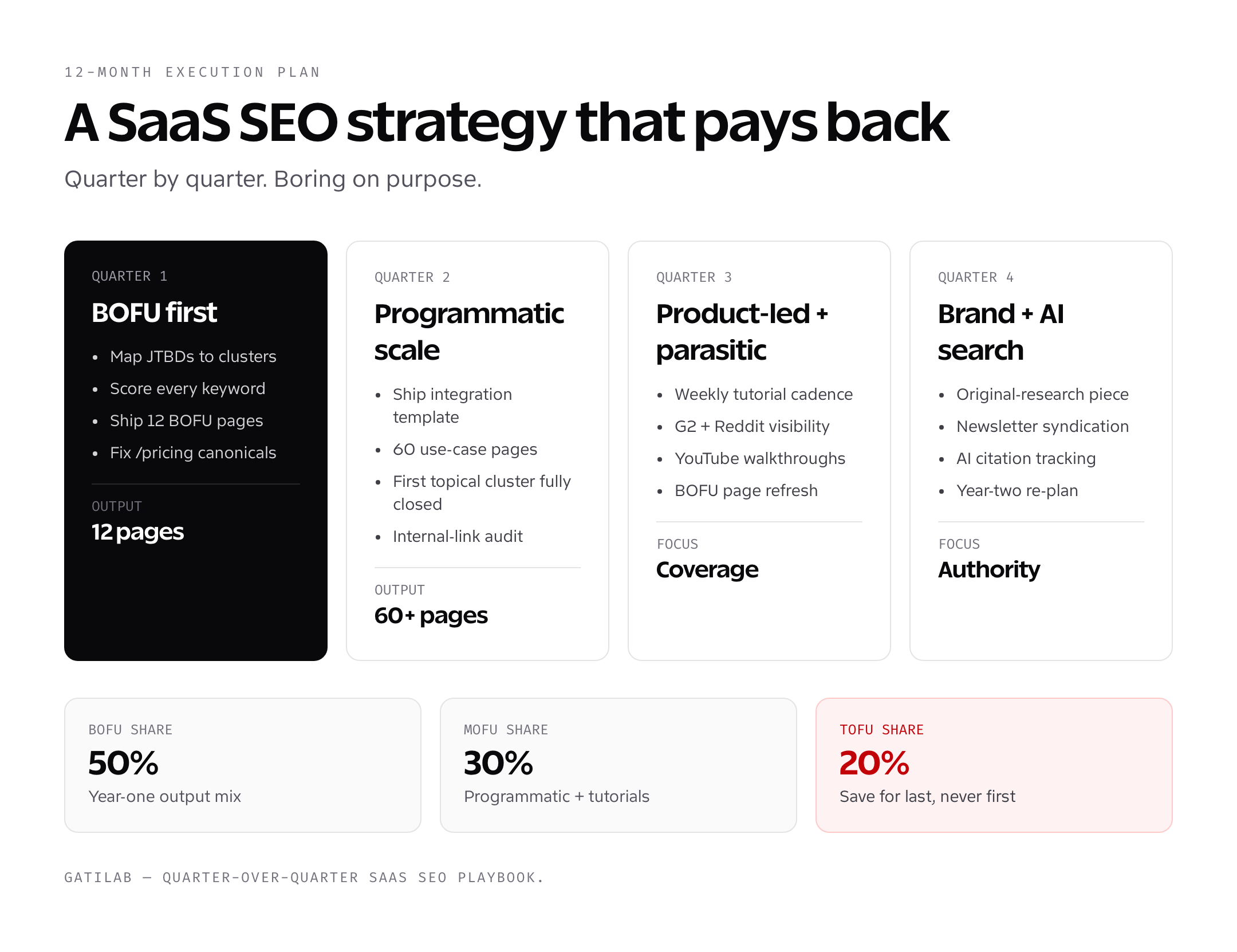
If you’re shipping a new SaaS SEO strategy in 2026, the plan that pays back is dull and disciplined. Quarter one ships 12 BOFU pages mapped to your top JTBDs. Quarter two scales programmatic templates plus a topical cluster. Quarter three layers in product-led tutorials and parasitic plays. Quarter four publishes the original-research piece that earns the brand its citation slots in AI search.
The teams that beat their pipeline targets are not the ones with the cleverest content. They’re the ones who score keywords against a quantitative model, ship BOFU first, build clusters fully before starting the next, fix the technical SaaS SEO traps before they index, and refuse to grade success on session count. SaaS SEO strategy is the prioritization layer that makes all of that hold together.
If you’re earlier in the marketing journey, start with the SaaS marketing strategy guide, then layer this SEO strategy on top. For the technical SEO foundations a young SaaS site needs to ship first, see SEO for startups.
Tell Google you want more of this.
Add Gatilab as a preferred sourceOne tap, and this site shows up more often in your own Top Stories, AI Overviews and AI Mode. Remove it any time.