
8 Best SaaS Onboarding Tools (2026 Pricing)
SaaS onboarding tools fall into a tighter category than most teams realize: in-app guides that ship checklists, tooltips, modals, and walkthroughs without engineering for each change. The eight tools that matter in 2026 are Userpilot, Appcues, Pendo, WalkMe, Userflow, Chameleon, Userlist, and Intercom Product Tours. Most published starter plans land between $149 and $299 a month, while Appcues, WalkMe, and Pendo’s paid tiers are quote-only. The right pick at $5K MRR is rarely the right pick at $200K MRR, and the wrong pick burns six months of activation work that should have been a clean 30-day implementation.
Prices below come from each vendor’s own pricing page. Where a vendor only quotes on request, the breakdown says so.
Don’t pick a SaaS onboarding tool before you’ve defined your activation event. The tool is the executor; the activation event is the target. Teams that buy the tool first end up with a $300-a-month tooltip platform pointing at the wrong moment in the user journey, and no amount of feature depth fixes that.
What SaaS Onboarding Tools Actually Do
SaaS onboarding tools are no-code or low-code platforms that let product, growth, and customer success teams ship in-app guidance without filing engineering tickets. They cover six functional jobs: checklists, tooltips, modals, walkthroughs, in-app surveys, and behavior-triggered messages. The strongest tools also include user segmentation, A/B testing, and analytics that connect onboarding behavior to retention.
The reason this category exists at all is engineering capacity. A growth team that wants to test five different first-session checklists in a quarter would consume 40 to 80 engineering hours doing it natively. The same five tests run in Userpilot or Appcues take 4 to 8 hours of growth-team time and zero engineering. The math works at almost any company size above 4 engineers, which is why 70 to 80 percent of mid-market SaaS companies in 2026 run one of these eight tools.
- Checklists. Persistent UI showing 4 to 7 steps the user should complete in their first session. Stripe, Linear, Asana use this pattern at 55 to 80 percent completion rates.
- Tooltips. Contextual hints fired by user behavior, not by time. Behavior-triggered tooltips convert 4 to 8 times better than tour-based ones.
- Modals. Welcome screens, announcements, and call-to-actions overlaid on the product. Useful for major moments, harmful when overused.
- Walkthroughs. Multi-step guided flows showing the user how to complete a task. Best for complex products with multiple primary jobs.
- In-app surveys. Short qualitative feedback collection at activation, churn, or feature-adoption moments. NPS, CSAT, and custom questions.
- Behavior-triggered messages. Banners, slideouts, or modals fired when a user hits a specific event or fails to hit one over a defined window.
If you’re choosing your first SaaS onboarding tool, optimize for time-to-first-flow-shipped. The team that ships their first working in-app checklist inside two weeks of buying outperforms the team that picks a more powerful tool and takes three months to launch. Speed of iteration matters more than feature depth in the first year.
The Eight SaaS Onboarding Tools That Matter in 2026
The category has consolidated to eight serious players. Below is a tool-by-tool breakdown with published pricing where vendor pages show it, and a quote-only flag where they don’t.
1. Userpilot
Userpilot is the strongest all-in-one SaaS onboarding tool for product-led teams between $1M and $20M ARR. It covers checklists, tooltips, modals, walkthroughs, surveys, in-app resource centers, and behavior-triggered messages on a single canvas. Segmentation is a first-class feature, with cohorts that update in near-real-time based on event and property data piped in from your product analytics or CDP.
Pricing starts at $299/mo for the Starter plan covering up to 2,000 monthly active users. Growth starts from $849/mo with 10,000 MAUs included (scaling to 100,000), adds A/B testing, and includes the resource center. Enterprise pricing is quote-only. Userpilot’s strongest single feature is the segmentation builder, which lets growth teams target a flow at “users who created a project in the last 7 days but haven’t shared it yet” without writing SQL.
- Best-in-class segmentation builder for behavior-triggered onboarding flows.
- Native NPS, CSAT, and microsurvey support.
- Resource center and AI-driven feature adoption insights on Growth plan.
- Strong integration breadth: Segment, Mixpanel, Amplitude, HubSpot, Salesforce, Intercom.
- Starter plan caps at 1 product. Multi-product SaaS jumps to Growth fast.
- The visual builder has a learning curve. Expect 10 to 20 hours of team training.
2. Appcues
Appcues is the original category leader and remains the most polished tool for visual flow design. The drag-and-drop builder is the smoothest in the category, and the templates library is the largest. Strong fit for marketing-led teams that want a designer-friendly tool, weaker fit for engineering-heavy product teams that want raw flexibility.
Appcues doesn’t publish prices. The Start plan covers up to 3,000 MAUs, with Grow and Enterprise above it, and every tier is quoted by sales. Appcues stands out on cross-platform support: the same tool ships flows for web, iOS, and Android, which Userpilot and Userflow can’t match without separate SDKs.
- Smoothest visual builder in the category.
- Cross-platform: web, iOS, and Android flows from one tool.
- Largest template library and pattern gallery.
- Pricing is gated past Essentials. Hard to forecast spend at scale.
- Segmentation is shallower than Userpilot’s. Behavior-based cohort targeting requires more workarounds.
3. Pendo
Pendo is the enterprise-grade pick that combines product analytics, in-app guides, surveys, and roadmap tooling into one platform. The free tier covers basic product analytics for up to 500 MAUs, which is more generous than the rest of the category for analytics specifically. Paid tiers (Base, Core, and Ultimate) are quote-only.
Pendo’s strength is the integrated product analytics layer. If you don’t already run Mixpanel or Amplitude, Pendo replaces both alongside the onboarding tool. The weakness is that the analytics is good-enough rather than best-in-class, so teams that already have a product analytics stack rarely consolidate onto Pendo. The right buyer is a mid-market or enterprise SaaS that hasn’t picked a product analytics tool yet.
- Generous free tier for product analytics up to 500 MAUs.
- Integrated product analytics + onboarding + surveys in one platform.
- Strong enterprise integrations: Salesforce, ServiceNow, Workday, Okta SSO.
- Paid pricing is fully gated: Base, Core, and Ultimate are all quote-only.
- Visual builder is heavier than Appcues or Userflow. Steeper learning curve.
4. WalkMe
WalkMe is the enterprise-only pick. Pricing is fully gated, and every deployment is quoted through sales. The product is built for large internal-tooling deployments (Salesforce, Workday, ServiceNow rollouts inside Fortune 500 companies) more than for SaaS product onboarding. WalkMe is the strongest in the category at overlay-driven guidance for legacy enterprise software your team didn’t build, and the weakest fit for a $5M ARR SaaS picking its first onboarding tool.
If you’re an enterprise IT team rolling out a complex internal tool to 5,000 employees, WalkMe is probably the right pick. If you’re a SaaS company onboarding paying customers, Userpilot, Appcues, or Userflow will get you to launch faster and cost a tenth as much.
5. Userflow
Userflow is the no-code-friendly pick that has gained the most ground in the last 24 months. The visual flow builder is the most accessible in the category. Pricing starts at $240/mo for the Essentials plan billed annually ($300 billed monthly) with 1,000 MAUs, and Studio runs $400/mo billed annually, with Enterprise above.
Userflow is the right pick for a small product team (1 to 4 product managers) that wants the fastest time-to-first-flow-shipped. The trade-off is that Userflow’s segmentation is shallower than Userpilot’s at scale, which becomes a constraint above 50,000 MAUs.
- Fastest time-to-first-flow in the category.
- Cleanest no-code experience for non-technical product managers.
- Strong A/B testing on Pro tier.
- Segmentation depth lags Userpilot at scale.
- Mobile SDKs are newer and less mature than Appcues.
6. Chameleon
Chameleon is the developer-friendly pick. Strong CSS customization, a solid API, and the cleanest theming controls in the category. Pricing starts at $279/mo for the Startup plan with 2,000 MTUs; Pro starts at $750/mo and Growth at $1,250/mo (billed annually) for 5,000 MTUs, with Enterprise above. Chameleon is the right pick for a SaaS with a strong design system that wants the in-app guides to feel native to the product, not bolted on.
The trade-off is that Chameleon’s strength comes from its flexibility, which means a slightly slower initial setup than Userflow. Teams without dedicated design resources sometimes find Chameleon’s customization options more burden than benefit.
7. Userlist
Userlist is the email-first pick. Strictly speaking, Userlist is a behavior-triggered email tool with light in-app messaging, not a full in-app guides platform. But for early-stage SaaS where the onboarding “flow” is mostly an email sequence with a few in-app banners, Userlist is the cheapest serious pick, with the Basic plan from $149/mo including 10,000 users.
The right buyer is a bootstrapped SaaS at $5K to $50K MRR that needs behavior-triggered welcome emails, recovery sequences for stalled trials, and basic in-app banners, but doesn’t yet need the full Userpilot or Appcues feature set. Past $200K MRR most teams graduate to one of the in-app guides platforms or layer Userpilot on top of Userlist for in-app while keeping Userlist for email.
8. Intercom Product Tours
Intercom Product Tours is the integrated pick for teams already running Intercom for support and lifecycle messaging. Intercom plans start at $29 per seat per month (Essential, billed annually), but Product Tours sit in the Proactive Support Plus add-on, from $99 per workspace per month. Strong fit if you already have Intercom; weak fit if you don’t, because buying Intercom solely for the Product Tours feature is materially more expensive than buying a dedicated tool.
The advantage of Intercom Product Tours over Userpilot or Appcues is that the in-app messages, support chat, and onboarding flows all live in one customer profile. The CSM can see the same timeline that triggered the onboarding tour, opened the help article, and started the support chat. That continuity is genuinely valuable, but only if you’ve already committed to Intercom for the rest of the customer-facing stack.
SaaS Onboarding Tools Pricing Comparison
Below is the side-by-side pricing matrix for the eight tools, normalized to the entry tier and the next tier up. “Quote only” means the vendor doesn’t publish the price. Use this matrix for shortlisting, then confirm against the vendor’s current quote during the trial.
| Tool | Entry plan | MAU cap | Mid-market tier | Best fit |
|---|---|---|---|---|
| Userpilot | From $299/mo Starter | 2,000 MAUs | From $849/mo Growth | Product-led B2B SaaS, $1M to $20M ARR |
| Appcues | Start (quote only) | Up to 3,000 MAUs | Grow (quote only) | Marketing-led teams, polished design preferred |
| Pendo | Free up to 500 MAUs | 500 MAUs free | Base, Core, Ultimate (quote only) | Mid-market without a product analytics stack |
| WalkMe | Quote only, enterprise | N/A | Quote only | Enterprise IT rollouts |
| Userflow | From $240/mo Essentials (annual) | 1,000 MAUs | From $400/mo Studio (annual) | Small product teams, fastest time-to-launch |
| Chameleon | From $279/mo Startup | 2,000 MTUs | From $750/mo Pro (5,000 MTUs) | Design-system-heavy SaaS |
| Userlist | From $149/mo Basic | 10,000 users | From $349/mo Professional | Bootstrapped SaaS, email-first onboarding |
| Intercom Product Tours | $29/seat/mo Essential plus add-on | Per seat | Proactive Support Plus add-on, from $99/mo | Teams already on Intercom |
Always verify pricing on the vendor’s site before committing. The category re-prices roughly every 12 months, and the gated tiers (Appcues Growth, Pendo paid, WalkMe everything) are negotiable in the 15 to 30 percent range during the buying cycle. The list price is rarely the price you actually pay above the entry tier.
Which SaaS Onboarding Tool to Pick by Stage
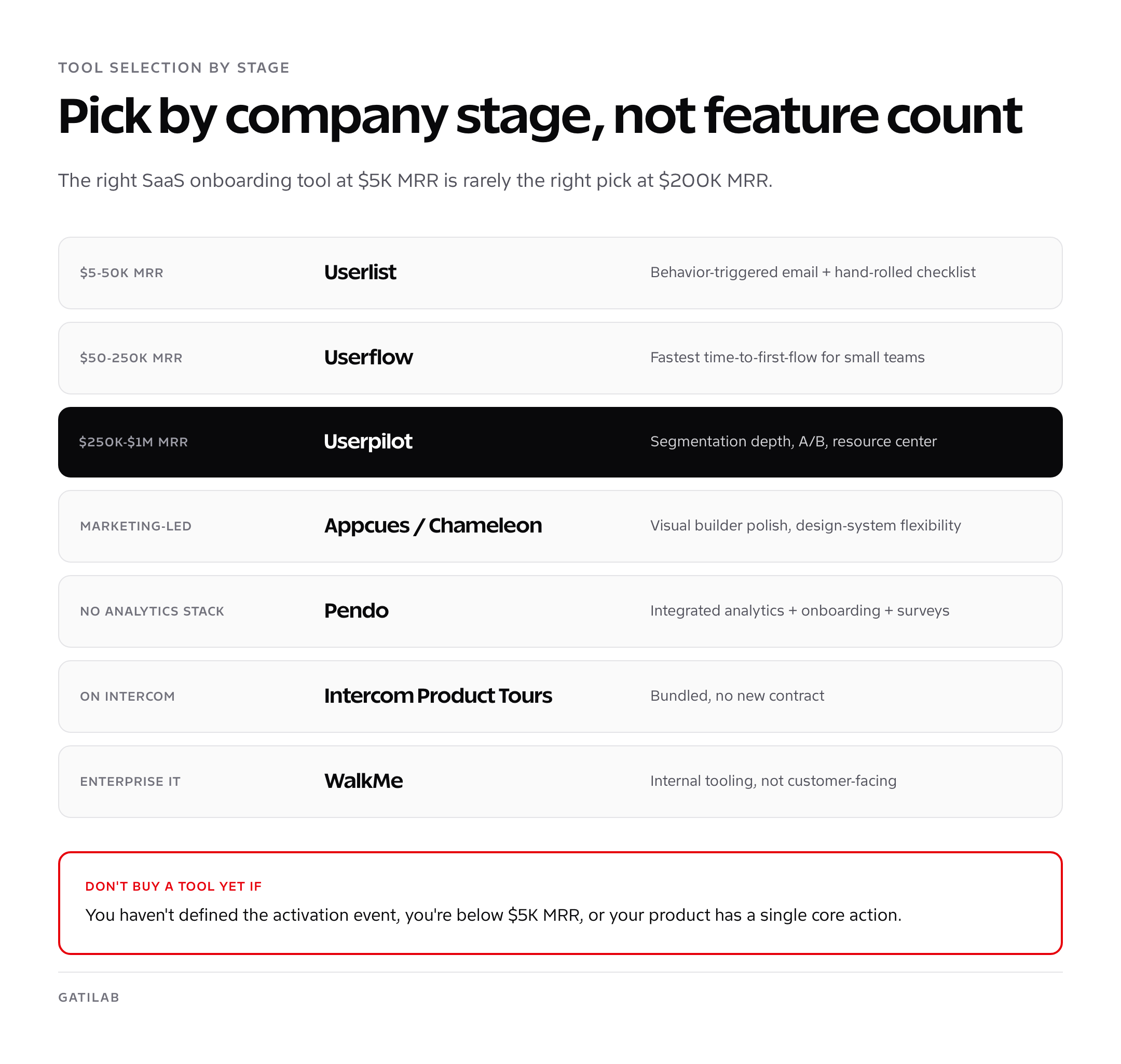
The right SaaS onboarding tool depends on company stage, team composition, and whether you’ve already committed to an analytics or messaging stack. Below are the picks I recommend most often after auditing client SaaS programs at Gatilab.
- Bootstrapped SaaS, $5K to $50K MRR: Userlist for behavior-triggered email plus a hand-rolled in-app checklist. Userlist runs from $149/mo. Save full in-app guides for after $50K MRR.
- Funded SaaS, $50K to $250K MRR, 1 to 4 PMs: Userflow for fastest time-to-launch. Layer in product analytics (PostHog, Mixpanel) separately. Userflow starts at $240/mo billed annually.
- Funded SaaS, $250K to $1M MRR, 4+ growth/PM: Userpilot for segmentation depth, A/B testing, and resource center. Growth starts from $849/mo.
- Marketing-led teams or design-heavy SaaS: Appcues for the visual builder polish, or Chameleon for design-system flexibility. Chameleon publishes prices from $279/mo; Appcues quotes on request.
- Mid-market without a product analytics stack: Pendo for the integrated platform. Paid tiers are quote-only, so budget after the sales call.
- Already running Intercom for support: Intercom Product Tours bundled into the existing plan. No new vendor, no new contract.
- Enterprise IT rollouts (internal tooling, not customer-facing): WalkMe.
My single most-recommended pick across the SaaS onboarding tools category in 2026 is Userpilot for product-led B2B SaaS between $1M and $20M ARR. The segmentation depth pays back the price within 4 to 6 months for any team running more than 2 onboarding experiments per quarter. For everything outside that band, the picks above apply.
Feature Comparison Matrix
The matrix below covers the eight features that consistently matter when choosing between SaaS onboarding tools: checklists, tooltips, modals, walkthroughs, in-app surveys, A/B testing, segmentation depth, and mobile SDK support.
| Feature | Userpilot | Appcues | Pendo | Userflow | Chameleon | Userlist | Intercom PT |
|---|---|---|---|---|---|---|---|
| Checklists | Strong | Strong | Strong | Strong | Strong | Limited | Strong |
| Tooltips | Strong | Strong | Strong | Strong | Strong | N/A | Strong |
| Walkthroughs | Strong | Strong | Strong | Strong | Strong | N/A | Strong |
| In-app surveys | Strong (NPS, CSAT, custom) | Strong | Strong | Moderate | Moderate | N/A | Strong |
| A/B testing | Growth tier+ | Vendor tier-dependent | Enterprise tier | Pro tier+ | Growth tier+ | N/A | Advanced tier |
| Segmentation depth | Best in category | Moderate | Strong | Moderate | Moderate | Strong (email) | Strong |
| Mobile SDK | iOS + Android | iOS + Android (mature) | iOS + Android | iOS + Android (newer) | iOS + Android | N/A | iOS + Android |
| Resource center | Yes (Growth+) | Yes | Yes | Limited | Yes | N/A | Yes |
The honest takeaway from the matrix is that the eight tools are more similar than different on individual features. The differentiators that actually matter at purchase time are pricing transparency, segmentation depth (Userpilot leads), time-to-first-flow (Userflow leads), and integration breadth with your existing analytics and CRM stack. Don’t pick on feature count; pick on which tool gets your team to a working flow fastest.
When You Don’t Need a SaaS Onboarding Tool
Not every SaaS needs to buy an onboarding tool. There are three legitimate scenarios where a $0 stack outperforms a $300/mo stack.
- Pre-product-market-fit: If you’re below $5K MRR and still iterating on the core product, every hour spent on onboarding tooling is an hour not spent on the product. Build a hand-rolled checklist in your codebase, ship it in a day, move on.
- Single-action products: If your product has one core action (like a domain checker or a one-shot calculator), the entire onboarding is the first form. A tooltip platform is overkill.
- Strong engineering capacity, low experiment volume: If you have engineers and you ship 1 onboarding change per quarter, native code is faster than learning a tool. The math flips above 5 changes per quarter.
Outside those three scenarios, a SaaS onboarding tool pays back inside 6 to 9 months on improved activation rate alone, before counting the engineering time saved. The cheapest mistake is buying too early; the more expensive one is buying too late and watching the activation rate sit at 8 percent for 18 months while the team debates which tool to pick.
How SaaS Onboarding Tools Fit the Broader Stack
SaaS onboarding tools don’t sit alone. They connect upstream to product analytics (which defines the activation event), sideways to email automation (which carries the out-of-product touchpoints), and downstream to customer success platforms (which inherit the activated user). The fastest path to a working stack is buying the in-app guides tool last, after the analytics and email layers are already shipping data.
If you’re still defining the onboarding flow itself, the complete SaaS onboarding guide walks through the five customer-facing stages and how to identify your activation event. For the operational workflow that wraps around the customer experience, the SaaS onboarding process guide covers the seven-stage workflow that turns the experience into a repeatable system. Most teams need both before they need the tool.
The tools also overlap with the broader product-led growth motion. PLG is the company-wide strategy; in-app guides are the execution layer. The product-led growth guide for SaaS covers the strategy layer including the freemium-versus-trial trade-offs that determine which onboarding flow makes sense. And on the downstream side, the activation event your onboarding tool fires on should be the same event your CS team uses for first health-score calculation. The SaaS customer success guide covers that handoff in detail.
For the upstream content layer that pre-qualifies your signups, the SaaS content marketing playbook and SaaS SEO strategy guide show how to build the BOFU pages that send higher-intent traffic into your funnel. Onboarding tools work better when the input is qualified. And to reduce churn the cheap way (before customers ever consider leaving), the churn reduction playbook for bootstrapped SaaS covers how a working onboarding stack feeds the rest of the retention motion. If you’re sequencing the full revenue motion, the SaaS marketing strategy guide covers the order of operations.
Frequently Asked Questions
What are SaaS onboarding tools?
SaaS onboarding tools are no-code platforms that ship in-app guidance (checklists, tooltips, modals, walkthroughs, surveys, behavior-triggered messages) without filing engineering tickets. The eight that matter in 2026 are Userpilot, Appcues, Pendo, WalkMe, Userflow, Chameleon, Userlist, and Intercom Product Tours.
Which SaaS onboarding tool is best?
For product-led B2B SaaS between $1M and $20M ARR, Userpilot. The segmentation depth pays back the price within 4 to 6 months for any team running more than 2 onboarding experiments per quarter. Outside that band, Userflow wins on time-to-launch for small teams, Userlist is the cheapest serious pick for bootstrapped SaaS, and Pendo fits mid-market without an existing analytics stack.
How much do SaaS onboarding tools cost in 2026?
Published entry prices: Userpilot $299/mo, Userflow $240/mo billed annually, Chameleon $279/mo, Userlist $149/mo, and Pendo free up to 500 MAUs. Intercom starts at $29 per seat per month, and Product Tours need the Proactive Support Plus add-on (from $99/mo). Appcues, WalkMe, and Pendo’s paid tiers are quote-only.
What’s the difference between Userpilot and Appcues?
Userpilot has the best segmentation builder in the category and stronger native NPS/CSAT support. Appcues has the smoothest visual builder, the largest template library, and the most mature mobile SDKs. Userpilot fits product-led B2B better. Appcues fits marketing-led teams that want a designer-friendly tool. Pricing is comparable in the entry tier.
Is Pendo or Userpilot better for SaaS?
Pendo if you don’t already have a product analytics stack, because it bundles analytics, in-app guides, and surveys into one platform. Userpilot if you already run Mixpanel, Amplitude, or PostHog and want best-in-class in-app guides separately. Pendo’s analytics is good-enough rather than best-in-class, so teams with existing analytics rarely consolidate onto Pendo.
What’s the cheapest SaaS onboarding tool?
Userlist, with the Basic plan from $149/mo including 10,000 users. Strictly speaking, Userlist is a behavior-triggered email tool with light in-app messaging, not a full in-app guides platform. But for bootstrapped SaaS at $5K to $50K MRR where the onboarding flow is mostly an email sequence with a few in-app banners, Userlist is the cheapest serious pick by a wide margin.
Do you need a SaaS onboarding tool?
Not if you’re below $5K MRR, your product has a single core action, or you have strong engineering capacity and ship fewer than 5 onboarding changes per quarter. Outside those scenarios, a tool typically pays back inside 6 to 9 months on improved activation rate alone, before counting engineering time saved.
What’s the difference between WalkMe and Userpilot?
WalkMe is built for enterprise IT rollouts of complex internal software (Salesforce, Workday, ServiceNow) inside Fortune 500 companies. Userpilot is built for customer-facing SaaS product onboarding. WalkMe quotes every deployment through sales. Userpilot starts at $299/mo. They solve different problems for different buyers.
Can you build SaaS onboarding without a tool?
Yes, with engineering capacity. Native code is faster than learning a tool when you ship 1 onboarding change per quarter. The math flips above 5 changes per quarter, where the no-code speed of Userpilot, Appcues, or Userflow wins. Most SaaS programs above $1M ARR run a tool because the experiment volume justifies it.
How fast can you launch a SaaS onboarding tool?
Userflow ships first-flow-launches in 4 to 8 days. Userpilot in 10 to 18 days. Appcues in 8 to 14 days. Pendo and WalkMe take 3 to 8 weeks because the platforms are heavier. Time-to-first-flow matters more than feature depth in the first year, because the team that ships fast iterates fast.
The Bottom Line on SaaS Onboarding Tools
The eight SaaS onboarding tools that matter in 2026 (Userpilot, Appcues, Pendo, WalkMe, Userflow, Chameleon, Userlist, and Intercom Product Tours) cover almost every legitimate use case in the category. Userpilot is my single most-recommended pick for product-led B2B SaaS between $1M and $20M ARR. Userflow wins on time-to-launch for small teams. Userlist is the cheapest serious pick for bootstrapped SaaS under $50K MRR. Pendo, WalkMe, and Intercom Product Tours fit specific situations where the integrated platform value outweighs the standalone alternatives.
Don’t buy a tool before you’ve defined the activation event. Don’t buy the most expensive option because the feature list is longer. Pick on time-to-first-flow, segmentation depth, and price transparency. Then ship one experiment in week two and measure activation rate at day 30. That’s the only number that matters, and any of the eight tools above will get you there if the rest of the stack is in place.
Tell Google you want more of this.
Add Gatilab as a preferred sourceOne tap, and this site shows up more often in your own Top Stories, AI Overviews and AI Mode. Remove it any time.