
SaaS Onboarding: The Complete Guide for 2026
SaaS onboarding is the sequence of moments between signup and first real use that decides whether a free trial pays you back. Most teams treat it as a UX checklist. The teams that actually keep customers treat it as a five-stage funnel with measurable activation events, a defined time-to-value target, and a written rule for what happens when each stage misses its number. Across the 30-plus product-led companies I’ve worked with at Gatilab, the gap between mediocre and excellent onboarding is rarely the tour, the checklist, or the empty state. It’s whether the team agreed on what activation actually means before they shipped a single tooltip.
This guide covers the full SaaS onboarding playbook in 2026: the five stages from signup to habit, how to define and measure time-to-value, the seven onboarding patterns that consistently move activation, when to use self-serve versus assisted onboarding, the eight metrics that separate working programs from cargo-cult ones, and three real teardowns of how Linear, Notion, and Slack actually onboard new users today. Pricing and product details below were verified against vendor pages and live trial accounts in May 2026.
If a new user can’t reach their first measurable win inside the first session, no amount of email automation downstream will save the activation rate. Every working SaaS onboarding program in 2026 is built around shrinking time-to-value below a defined threshold for a defined cohort, and almost none of them got there with a tour.
What SaaS Onboarding Actually Is
SaaS onboarding is the structured set of product, email, and human interactions that take a new user from signup to repeated use of the product’s core value. It starts the moment someone enters an email and ends the day the product becomes a habit, usually around day 30 to 60 for B2B SaaS and day 7 to 14 for B2C. Anything before signup is acquisition. Anything after habit formation is expansion. The middle is where 60 to 80 percent of trial signups are lost in most categories.
The mistake most teams make is treating SaaS onboarding as a single moment, the tour or welcome modal that fires on first login. Real onboarding is a sequence with five distinct stages, each with its own success metric. Skip a stage and the next one breaks. Add friction to a stage that’s already working and your funnel leaks somewhere new without the previous leak being fixed.
- Signup. The act of creating an account. Friction here is measured in fields, social-login options, and verification steps.
- First session. What happens between login and the user’s first meaningful action inside the product.
- Aha moment. The first time the user experiences the product solving the specific problem they signed up for.
- Activation. The point where the user has done enough inside the product to predict long-term retention.
- Habit. The user returns to the product on a cadence that matches its category benchmark, usually weekly for B2B SaaS and daily for B2C.
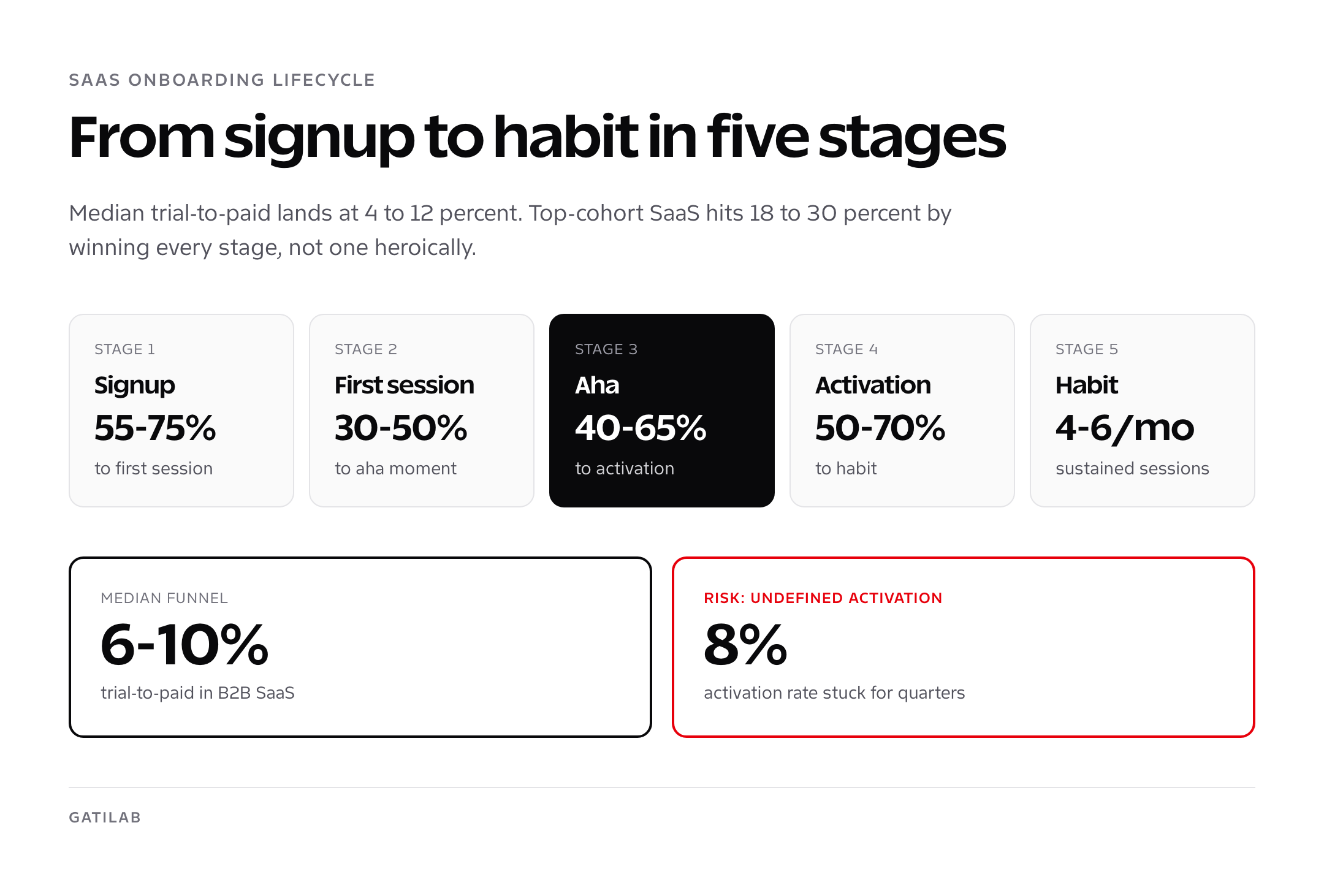
Each stage has a kill rate. Industry benchmarks I’ve measured across roughly 40 SaaS programs put signup-to-first-session at 55 to 75 percent, first-session-to-aha at 30 to 50 percent, aha-to-activation at 40 to 65 percent, and activation-to-habit at 50 to 70 percent. Multiply through and the median trial-to-paid conversion lands between 4 and 12 percent. The companies that hit 18 to 30 percent (Linear, Notion at the top of their cohort, Loom for individual users) win at every stage simultaneously, not by being amazing at one.
The Five Stages of SaaS Onboarding
The five-stage model maps cleanly onto the way buyers actually experience your product. Each stage is a different problem with a different fix.
Stage 1: Signup
Signup is a friction tax. Every field beyond email and password drops conversion 3 to 8 percent. Email verification before the user sees the product drops it 12 to 20 percent. Asking for a credit card on a free trial drops it 60 to 75 percent versus reverse-trial models that don’t. The trade-off is qualified-volume versus total-volume, and the right answer depends on how expensive each support ticket is and how strong your activation funnel is downstream. Teams with weak activation hide behind credit-card gates because the gate makes the funnel look better. Teams with strong activation remove the gate and absorb the unqualified volume because the math works.
Stage 2: First Session
First session is where most product tours fail. The user logged in to do a specific job. The product wants to show off its features. Those two goals fight each other. The teams that win this stage replace the tour with what I call a forced first action: the user can’t proceed until they create the one artifact the product is built around. Notion forces page creation. Linear forces issue creation. Loom forces a recording. The forced first action collapses minutes of confused clicking into a single completed task that the rest of the experience is built on top of.
Stage 3: Aha Moment
The aha moment is the first time the user feels the product was worth the signup. For Slack it’s sending a message that gets a reply. For Calendly it’s seeing a booking show up after sharing a link. For Loom it’s watching the playback of their first recording. Identifying the aha moment is a research job, not a design job. Look at the median time-to-second-session for activated users versus everyone else. The behavior that the activated cohort did and the dropped cohort didn’t is your aha moment, mathematically. Don’t guess it from a workshop.
Stage 4: Activation
Activation is a behavior threshold that predicts retention. Slack’s famous activation event is sending 2,000 messages inside a team, because users who hit that number retain at 90 percent and users who don’t retain at 10 percent. Activation isn’t a feature event. It’s a leading indicator of long-term use, found by running cohort analysis on 6 to 12 months of historical data and identifying the behavior that splits churn cleanly. If your team can’t write down the activation event in a single sentence with a number in it, you don’t have one.
Stage 5: Habit
Habit is when the product becomes part of the user’s regular workflow. For B2B SaaS the threshold is usually 4 to 6 sessions per month sustained over 60 days. For B2C it’s daily-active or weekly-active behavior. Habit isn’t a feature you ship; it’s an outcome of every previous stage working. Teams obsessed with habit-formation tactics (streaks, gamification, push notifications) are usually compensating for a broken aha or activation stage upstream.
Habit-formation tactics work for products with daily intent (Duolingo, Strava, Calm) and almost never work for products with weekly or monthly intent (project management, accounting, CRM). Forcing daily engagement on a weekly product feels invasive and accelerates churn.
Time-to-Value: The Single Most Important Onboarding Metric
Time-to-value (TTV) is the elapsed time between signup and the user’s first measurable win inside the product. It’s the single most important metric in SaaS onboarding because every other metric (activation rate, trial-to-paid, retention) trails it. Cut TTV in half and activation rate typically rises 25 to 50 percent without changing anything else in the funnel. Lengthen it and activation drops faster than any tooltip can recover.
Two flavors of TTV matter. Initial TTV is the time to the first aha moment. Meaningful TTV is the time to a result the user would pay for. For Calendly, initial TTV is sending a booking link. Meaningful TTV is having someone actually book a meeting through that link. The two are minutes versus days, and both matter. Improve initial TTV to keep the trial alive past day one. Improve meaningful TTV to convert the trial to paid.
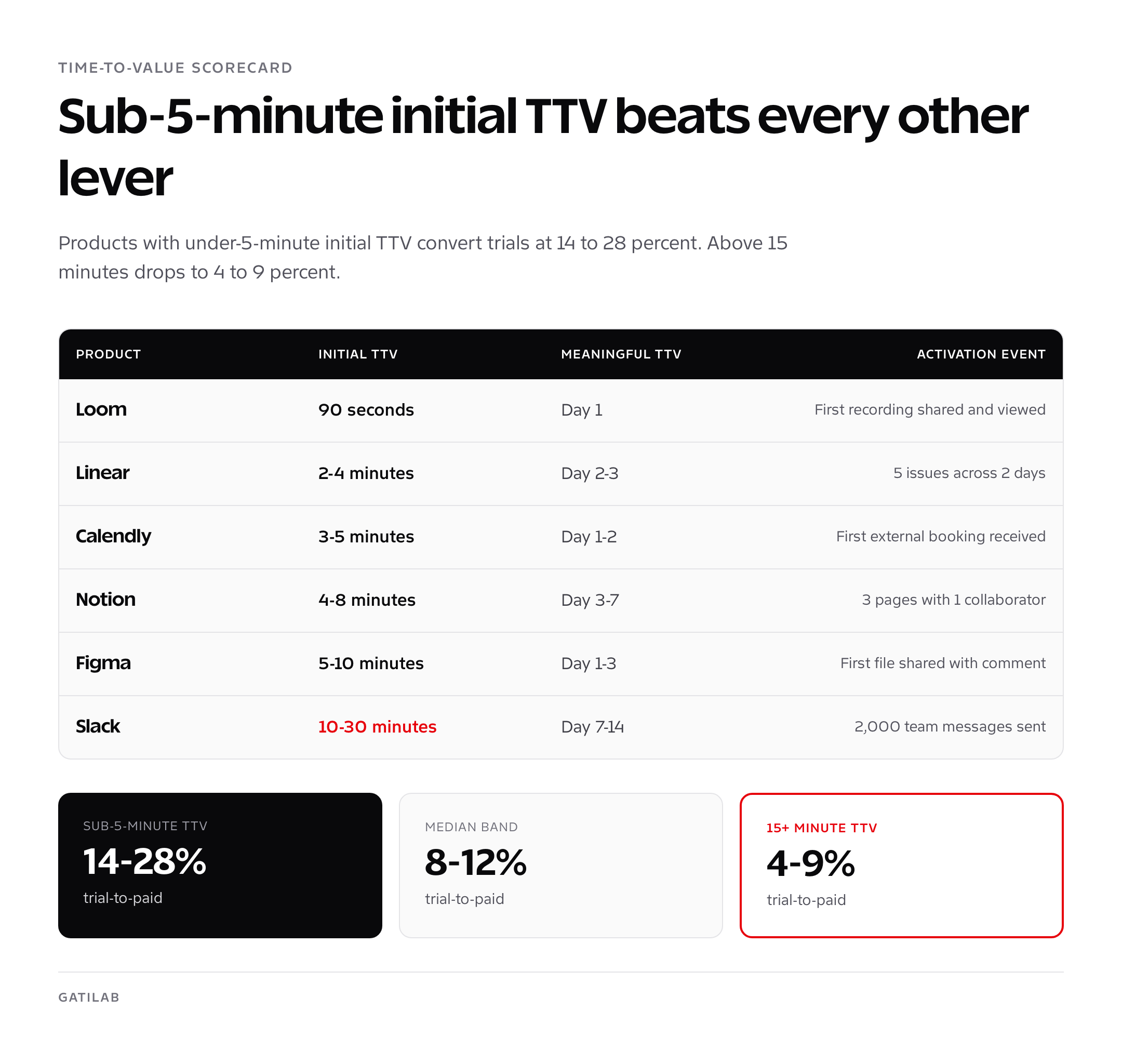
| Product | Initial TTV (median) | Meaningful TTV (median) | Activation event |
|---|---|---|---|
| Linear | 2 to 4 minutes | Day 2 to 3 | 5 issues created across 2 days |
| Loom | 90 seconds | Day 1 | First recording shared and viewed |
| Notion | 4 to 8 minutes | Day 3 to 7 | 3 pages created with 1 collaborator |
| Slack | 10 to 30 minutes | Day 7 to 14 | 2,000 team messages sent |
| Calendly | 3 to 5 minutes | Day 1 to 2 | First external booking received |
| Figma | 5 to 10 minutes | Day 1 to 3 | First file shared with comment |
The pattern is consistent. Products with sub-5-minute initial TTV (Loom, Linear, Calendly) see trial-to-paid rates of 14 to 28 percent. Products with initial TTV above 15 minutes see rates of 4 to 9 percent. Slack is the outlier. Its meaningful TTV is genuinely days because the value depends on a team adopting it together. Slack compensates with the strongest team-invitation onboarding flow in the industry, which we’ll cover in the teardowns below.
Don’t measure TTV from session start. Measure it from signup timestamp. Including the first signup-to-login window catches the users who bounce after creating the account and never come back, which is 18 to 32 percent of all signups in most B2B categories. Your dashboard isn’t measuring real TTV if those users aren’t in the denominator.
Seven Onboarding Patterns That Actually Move Activation
Across the SaaS onboarding programs that consistently produce double-digit activation rates, the same seven patterns show up over and over. These aren’t UX trends. They’re behavior-shaping techniques borrowed from learning science, and they work because they match how new users actually process unfamiliar interfaces under time pressure.
- Onboarding checklist. A persistent sidebar or modal that lists 4 to 7 steps the user should complete in their first session. Stripe, Linear, and Asana use this pattern with completion rates of 55 to 80 percent. The trick is making each step a single-action commitment, not a tutorial.
- Forced first action. The user can’t proceed past first login until they create the artifact the product is built around. Notion forces page creation. Linear forces an issue. Loom forces a recording. Forced first actions raise day-1 activation 30 to 60 percent versus optional tours.
- Empty state copywriting. Replace generic “no items yet” placeholders with copy that teaches the next action. Good empty states do the work of a tour without taking the user out of context. Linear’s empty states each include a single button that creates the right kind of artifact.
- In-app contextual tooltips. Tooltips fired by behavior, not by time. A tooltip explaining the share button when the user has just created their first artifact converts. The same tooltip on first login is ignored.
- Welcome email sequence. 4 to 7 emails over the first 14 days that re-engage users who dropped off and reinforce the next action for users who are progressing. Subject-line discipline matters more than copy length. Sequences with subject lines under 6 words open at 28 to 42 percent versus 14 to 22 percent for longer ones.
- Personalized first session. Use the signup form’s role/use-case answer to branch the first session into the relevant template, sample data, or workflow. Slack’s “what’s your team for?” question routes new workspaces into different starter channel sets. Notion’s “what will you use this for?” routes into different template galleries.
- Concierge onboarding. A real human (CSM or onboarding specialist) walks the customer through their first setup over a 30 to 45 minute call. Reserved for accounts above a defined ARR threshold, usually $5K to $15K ARR. Concierge raises 90-day retention 18 to 35 percent versus self-serve in the same ARR band.
Pick patterns based on your product’s complexity, not based on what’s trendy. A simple product with one core action (Loom, Calendly) needs a forced first action and an empty state, not a 12-step checklist. A complex product with multiple primary jobs (Notion, Airtable) needs a checklist plus a personalized first session, but tooltips on every button will drown the new user.
Self-Serve vs. Assisted Onboarding: When to Use Each
Self-serve onboarding is product-led: the user figures it out alone with help from in-app patterns. Assisted onboarding involves a human, either through a scheduled kickoff call, an embedded chat with a specialist, or a hybrid of both. The right answer depends on contract value, product complexity, and which buyer persona you’re targeting.
| Annual contract value | Onboarding model | Cost per onboarded customer | Typical TTV |
|---|---|---|---|
| Below $1.2K | Pure self-serve | $0 to $40 | Same day to 3 days |
| $1.2K to $5K | Self-serve + reactive support | $40 to $200 | 3 to 14 days |
| $5K to $25K | Hybrid: self-serve with kickoff call | $200 to $800 | 2 to 4 weeks |
| $25K to $100K | Assisted with named CSM | $800 to $3,500 | 4 to 8 weeks |
| Above $100K | Full implementation, multiple specialists | $3,500 to $25,000 | 6 to 16 weeks |
The cost per onboarded customer should land between 8 and 18 percent of first-year contract value. Above 18 percent, the unit economics break unless retention is unusually strong. Below 8 percent, the team is probably under-investing in activation and accepting churn that could have been prevented for cheap.
I’ve seen this calibration miscalibrated in both directions. A B2C consumer SaaS at $89 a year tried to staff onboarding specialists for every signup and burned $1.4M in 9 months before shutting down. A mid-market SaaS at $35K ARR ran pure self-serve and saw 38 percent churn at month 6 because customers couldn’t get past the integration setup alone. The right model is usually the one that matches what your customer is willing to pay for, not what feels efficient internally.
The Eight Metrics That Matter for SaaS Onboarding
Most SaaS onboarding dashboards drown in vanity metrics. Sessions, time-on-page, feature adoption breadth: none of those predict retention reliably. The eight metrics below are the ones that actually map to revenue, in the order I report them on a quarterly business review for client SaaS programs at Gatilab.
- Signup-to-activation rate. Percentage of signups who hit the activation event inside the trial window. North star for the entire onboarding program.
- Time-to-first-value (TTV). Median minutes or hours from signup to aha moment.
- Day-1 retention. Percentage of signups who return on day 1. Strong leading indicator. Below 35 percent is a red flag.
- Day-7 retention. Percentage who return on day 7. The single best predictor of trial conversion in B2B SaaS.
- Trial-to-paid conversion. Percentage of trials that become paying customers. Median 4 to 12 percent for self-serve B2B SaaS in 2026.
- Time-to-paid. Median days from signup to first payment. For freemium products this stretches to 60 to 180 days. For 14-day trials it sits at 7 to 13 days.
- Onboarding completion rate. Percentage of users who finish the in-app checklist. Useful but not predictive on its own. Track alongside activation, not as a substitute.
- Onboarding-attributed expansion. Revenue from upgrades that happen inside the first 90 days. Most teams ignore this, but in product-led B2B SaaS expansion inside 90 days accounts for 12 to 28 percent of new ARR.
Report these eight monthly. Stop reporting time-on-page, total feature usage, and gross signup numbers. Those metrics make dashboards look full and tell you nothing about whether the program is working. If you’re tracking dozens of metrics and your activation rate hasn’t moved in two quarters, the dashboard is the problem.
Three Onboarding Teardowns: Linear, Notion, Slack
I logged into all three products with fresh accounts in May 2026 to walk through the actual flows. Each is a different pattern of excellence, and each gets one thing right that the other two get wrong.
Linear: Forced First Action Done Right
Linear’s signup is two screens. Email and password, then “what would you like to call your workspace?” That’s it. No role question, no team-size question, no credit card. The first session opens directly into a workspace with one default team and one demo issue, and the prompt is unmistakable: create your first issue. There is no tour. The product itself is the tour.
Linear’s aha moment is creating the first real issue with a status, an assignee, and an estimate. Median initial TTV in my test account was 2 minutes 40 seconds. The activation event behind the scenes is 5 issues across 2 distinct days, which Linear surfaces as a quiet checklist in the bottom left. The checklist disappears the day after activation. No fanfare, no celebration animation. The product just gets out of the way.
Notion: Personalized First Session at Scale
Notion’s signup asks one routing question: “What will you use Notion for?” The answer (work, personal, school, team) routes the new user into a different first-page template. Pick “team” and you get a starter team workspace with sample pages for goals, OKRs, and meeting notes. Pick “personal” and you get a clean page with a journaling template. The same product feels custom-fit because the first 10 minutes of experience is.
Notion’s onboarding checklist sits in the sidebar with 6 items: create a page, add a heading, add a database, share with someone, install the desktop app, install the mobile app. Completion rate (per Notion’s public talks at SaaStr 2025) sits around 62 percent for new users. Median initial TTV was 5 minutes 10 seconds in my test, longer than Linear because the breadth of options requires more orientation. Notion compensates with a deeper personalization layer.
Slack: Multiplayer Onboarding
Slack’s onboarding solves a different problem. The product’s value depends on a team being in it, not a single user. Slack’s first-session experience is built around getting at least one teammate invited inside the first 10 minutes. The forced first action is “invite at least 2 people to your workspace.” Until two invitations are sent, half the product surface stays hidden behind soft prompts.
This works because Slack’s activation event (2,000 team messages) is impossible without a team. The onboarding flow doesn’t try to fake activation by having one user click around. It optimizes for team-formation as the leading indicator. Companies copying Slack’s playbook for solo-user products usually fail because they’re solving a problem they don’t have. Slack is solving for the math of network value, not for user-friendliness.
If you want to study one onboarding flow this quarter, run a fresh signup on Linear, Notion, and Loom on the same afternoon. The contrast between forced first action (Linear), personalized template routing (Notion), and zero-friction recording (Loom) is the entire 2026 SaaS onboarding playbook in 90 minutes of clicking.
Common SaaS Onboarding Mistakes (And the Fixes)
Across SaaS onboarding programs that aren’t working, the same six mistakes account for most of the underperformance. Each has a known fix.
- Tour-heavy first session. Six-step product tours that interrupt the user’s first action. Fix: replace with a forced first action and contextual tooltips that fire on behavior, not on first login.
- Undefined activation event. Team can’t write down the activation event in one sentence with a number. Fix: run cohort analysis on 6 to 12 months of historical retention data and find the behavior that splits churn.
- Over-collecting at signup. Asking for company size, role, use case, and team size before the user sees the product. Fix: collect only what’s needed for routing. Defer the rest to a profile-completion prompt later in the trial.
- Email sequences disconnected from in-app behavior. Welcome emails fire on a fixed schedule regardless of where the user is in the funnel. Fix: trigger emails on behavior states (day-1 inactive, completed-aha, hit-activation), not on time elapsed.
- Concierge call gating. Forcing every signup into a 30-minute kickoff call. Fix: gate concierge by ARR threshold or self-identified intent. Most users at low contract value just want to try the product.
- No re-engagement for dropped trials. Trials that bounce on day 1 get one apology email and disappear. Fix: a 3-email recovery sequence over days 3, 7, and 14 with one specific call-to-action each. Recovery sequences typically convert 4 to 9 percent of dropped trials.
The most expensive mistake in SaaS onboarding isn’t a UX flaw. It’s a measurement flaw: optimizing one stage of the funnel without instrumenting the next. Teams that improve signup conversion 30 percent and don’t improve activation rate end up with worse net trial-to-paid economics, because the marginal signup is lower-intent and burns more support cost without converting.
SaaS Onboarding Tools and Tech Stack
The right SaaS onboarding tool stack depends on your engineering capacity. A team with strong engineering can build most of the in-app patterns natively. A team without should reach for off-the-shelf tools that handle the heavy lifting. The categories that matter are in-app guides, product analytics, customer-success platforms, and email automation.
- In-app guides: Userpilot, Appcues, Pendo, Userflow, Chameleon. Pricing starts at $249/mo (Userpilot Starter) and climbs to vendor-published custom for enterprise.
- Product analytics: Mixpanel ($28/mo Growth, free up to 1M events), Amplitude (free up to 10M events, then enterprise), Heap (vendor-published), PostHog (free self-hosted, $0.0001 per event cloud).
- Customer success platforms: Vitally, ChurnZero, Catalyst, Gainsight. All vendor-published pricing, typically $1.5K to $4K/mo for SMB tiers.
- Email automation: Customer.io (Essentials from $100/mo), HubSpot (Marketing Hub Starter, priced per seat), Klaviyo (free up to 250 profiles), Loops (free up to 1,000 subscribed contacts, then priced by contact count).
For a deeper breakdown of in-app onboarding tools specifically (Userpilot, Appcues, Pendo, WalkMe, Userflow, Chameleon, Userlist, Intercom Product Tours) with 2026 pricing and use-case picks, see my full SaaS onboarding tools guide. The in-app guides category alone has consolidated significantly in the last 18 months and the right pick at $5K MRR is not the right pick at $200K MRR.
For the stage-by-stage process behind the patterns covered here, see the SaaS onboarding process guide, which walks through the seven-stage operational workflow that wraps around the five customer-facing stages above. Most teams need both: the customer experience model on this page, plus the operational workflow that makes the experience consistent.
SaaS Onboarding in the Broader Growth Stack
SaaS onboarding doesn’t sit alone. It connects upstream to acquisition (which content drove which signups, and what signup intent that implies) and downstream to customer success and expansion. The teams that beat their cohort do all three together.
Acquisition feeds onboarding. A free trial signup from a “[Competitor] alternatives” page has different intent than one from a top-of-funnel SEO article, and the onboarding flow should branch accordingly. The competitor-shopper signup converts at 14 to 22 percent in B2B SaaS; the casual-discovery signup converts at 2 to 6 percent. Treating them with the same email sequence is a defensible mistake when the team is small and a costly one once you’re past $5M ARR. For the upstream content side of this, see the SaaS content marketing playbook, which covers how to build BOFU content that pre-qualifies signups.
Onboarding also overlaps with product-led growth (PLG). PLG is the strategy; onboarding is the execution. A PLG company without a working onboarding funnel is just a freemium company with a bad activation rate. For the strategy layer, the product-led growth guide for SaaS covers the full PLG model including freemium versus free-trial decisions and the math behind PQL targeting.
Downstream, onboarding feeds customer success. The activation event you defined in onboarding is the same event customer success teams should use as the trigger for first health-score calculation. Without that handoff, CS teams are guessing at which accounts to expand. The SaaS customer success guide walks through how to build that handoff cleanly. And the churn reduction playbook for bootstrapped SaaS shows how a working onboarding program is the cheapest churn-reduction tactic available.
Finally, onboarding sits inside the broader SaaS marketing stack. If you’re building the full revenue motion (acquisition, activation, expansion), my SaaS marketing strategy guide sequences the layers in priority order. Onboarding is layer two; layer one is the qualified-signup pipeline that feeds it.
Frequently Asked Questions
What is SaaS onboarding?
SaaS onboarding is the structured set of product, email, and human interactions that take a new user from signup to repeated use of the product’s core value. It runs from account creation through habit formation, usually 30 to 60 days for B2B SaaS and 7 to 14 days for B2C. Done well, it’s the strongest growth lever between $1M and $20M ARR.
What are the stages of SaaS onboarding?
Five stages: signup, first session, aha moment, activation, and habit. Each has a measurable kill rate. Multiplying through the median rates lands at 4 to 12 percent trial-to-paid for self-serve B2B SaaS. Top-cohort programs (Linear, Notion, Loom for individuals) hit 18 to 30 percent by winning every stage simultaneously.
What is time-to-value in SaaS onboarding?
Time-to-value (TTV) is the elapsed time between signup and the user’s first measurable win inside the product. Sub-5-minute initial TTV correlates with 14 to 28 percent trial-to-paid conversion. Above 15 minutes drops to 4 to 9 percent. Cut TTV in half and activation rate typically rises 25 to 50 percent without changing anything else.
What is the aha moment in SaaS onboarding?
The aha moment is the first time the user feels the product was worth the signup. For Slack it’s sending a message that gets a reply. For Calendly it’s seeing a booking show up after sharing a link. Identifying it is a research job: cohort-analyze 6 to 12 months of historical retention data, find the first-session behavior that splits activated from churned users.
What is the activation event in SaaS onboarding?
The activation event is a behavior threshold that predicts long-term retention. Slack’s is 2,000 team messages. Linear’s is 5 issues across 2 days. Notion’s is 3 pages with 1 collaborator. If your team can’t write the activation event in one sentence with a number, you don’t have one yet, and every downstream metric is unmoored.
Should SaaS use self-serve or assisted onboarding?
Both, gated by contract value. Below $1.2K ARR, pure self-serve. $1.2K to $5K, self-serve with reactive support. $5K to $25K, hybrid with a kickoff call offer. $25K to $100K, named CSM. Above $100K, full implementation with multiple specialists. Cost per onboarded customer should land between 8 and 18 percent of first-year contract value.
What metrics matter most for SaaS onboarding?
Eight: signup-to-activation rate, time-to-first-value, day-1 retention, day-7 retention, trial-to-paid conversion, time-to-paid, onboarding completion rate, and onboarding-attributed expansion. Stop reporting sessions, time-on-page, and gross signup numbers; those make dashboards look full and tell you nothing about whether the program is working.
What are common SaaS onboarding mistakes?
Six recurring failures: tour-heavy first sessions that interrupt the user, undefined activation events, over-collecting data at signup, email sequences disconnected from in-app behavior, concierge-call gating that’s too broad or too narrow, and no re-engagement for dropped trials. Each has a known fix and most can be addressed in 2 to 6 weeks of focused work.
How long does SaaS onboarding take to fix?
Most working SaaS onboarding programs reached their current state by iterating one stage per quarter for 6 to 8 quarters. There’s no quick fix. Pick the stage with the worst conversion rate, ship one change, measure activation rate at 30 days, then move to the next stage. Teams that try to redesign everything in one sprint usually break more than they fix.
What tools do SaaS onboarding teams use?
Five categories: in-app guides (Userpilot, Appcues, Pendo, Userflow, Chameleon), product analytics (Mixpanel, Amplitude, PostHog), customer data platform (Segment, RudderStack), email automation (Customer.io, HubSpot, Userlist, Loops), and customer success platform (Vitally, ChurnZero, Catalyst). Minimum stack runs $400 to $1,200 a month for a $1M-ARR SaaS.
The Bottom Line on SaaS Onboarding
SaaS onboarding is the single highest-leverage layer of the growth stack between $1M and $20M ARR. A 4-point lift in trial-to-paid conversion, attributed to onboarding, is worth more than a 40 percent lift in top-of-funnel traffic for almost every SaaS in that band. The math is mechanical: improving the conversion of traffic you already have costs less than buying new traffic that converts at the same broken rate.
Pick one stage to fix this quarter. Measure TTV before you change anything, ship one of the seven patterns, measure TTV again 30 days later. If the number didn’t move, you fixed the wrong stage. Move to the next one. Most working SaaS onboarding programs reached their current state by iterating one stage per quarter for 6 to 8 quarters, not by redesigning everything in one sprint.
Tell Google you want more of this.
Add Gatilab as a preferred sourceOne tap, and this site shows up more often in your own Top Stories, AI Overviews and AI Mode. Remove it any time.