
How Much Does a Website Cost? Price Ranges and What Drives Them
How much does a website cost is a question with a frustrating range for an answer, anywhere from a few hundred dollars a year to tens of thousands, and that range isn’t much help when you’re setting a budget. So if you are planning a new site, or comparing quotes that look nothing alike, this guide will help you work out a realistic number for yours.
We quote and build websites at Gatilab, so the gap between a cheap quote and a realistic one is familiar ground.
Every site is different, so no single number fits everyone. But most of the price comes down to two decisions, who builds the site and how much of it has to be custom, and I will walk through both properly, along with the yearly costs that most quotes leave out.
There is also a calculator further down that turns your choices into a price range, and a free budget and brief template in PDF and Word for collecting quotes. If you’d like a quote from us, we are happy to give one. Here is the short version first.
Website Cost at a Glance
This is what each route typically costs for a small business site of around 5 to 10 pages. The build is paid once, while the running cost comes back every year:
| Route | Build Cost | Running Cost per Year | Best For |
|---|---|---|---|
| Website builder, done yourself | $0 to $300 | About $200 to $500 in plan fees | Simple sites you want live this week |
| WordPress, done yourself | $0 to $300 | About $150 to $400 for hosting and a domain | People happy to learn the tools |
| Freelancer | About $750 to $6,000 | About $500 to $2,000 with hosting and tools | A tailored site on a modest budget |
| Agency | $3,500 to $8,000, more for custom design | $500 to $2,000, plus $150 to $800 a month for a maintenance plan | Businesses that want it handled end to end |
| Custom online store with an agency | $15,000 to $60,000 | Higher hosting and extension costs | Stores with real volume and custom needs |
The build price is where quotes differ most, but the running costs are what you keep paying, so both belong in the budget. Our WordPress cost breakdown goes line by line through the WordPress side of these numbers.
What Makes a Website Cost More
These are the decisions that move a quote up or down, roughly in order of how much they matter:
- Who builds it. Doing it yourself costs time instead of money, a freelancer charges for hours and an agency adds project management and a team.
- Custom design or a template. A good template gets a small business most of the way, while a design made from scratch can multiply the build cost.
- Number of pages. Each page needs layout, content and testing, so the page count drives the hours more than almost anything else.
- Content. Writing the copy yourself saves money, but it is often the part that delays the launch, and paying for copywriting adds noticeably to the build.
- An online store. Products, payments, shipping and tax rules add setup time and higher running costs.
- Features and integrations. Booking systems, member areas, multiple languages and connections to a CRM each add work.
- Migration. Moving an existing site means redirects and content transfer, which need care to protect your search rankings.
Most of these are decisions rather than fixed costs, which means the budget is more in your control than a quote makes it look.
Doing It Yourself vs Hiring Someone
People setting a website budget tend to go wrong in one of two directions. Some pick the cheapest route to save money and then spend months of evenings building and fixing the site themselves. Others pay for a large custom build before they know what their visitors want, and end up with a site that is expensive to change.
The sensible middle for most small businesses is a template-based site built by a freelancer or a small team, with the content written by the people who know the business best. It is quick to launch and cheap to change once you see what visitors actually use.
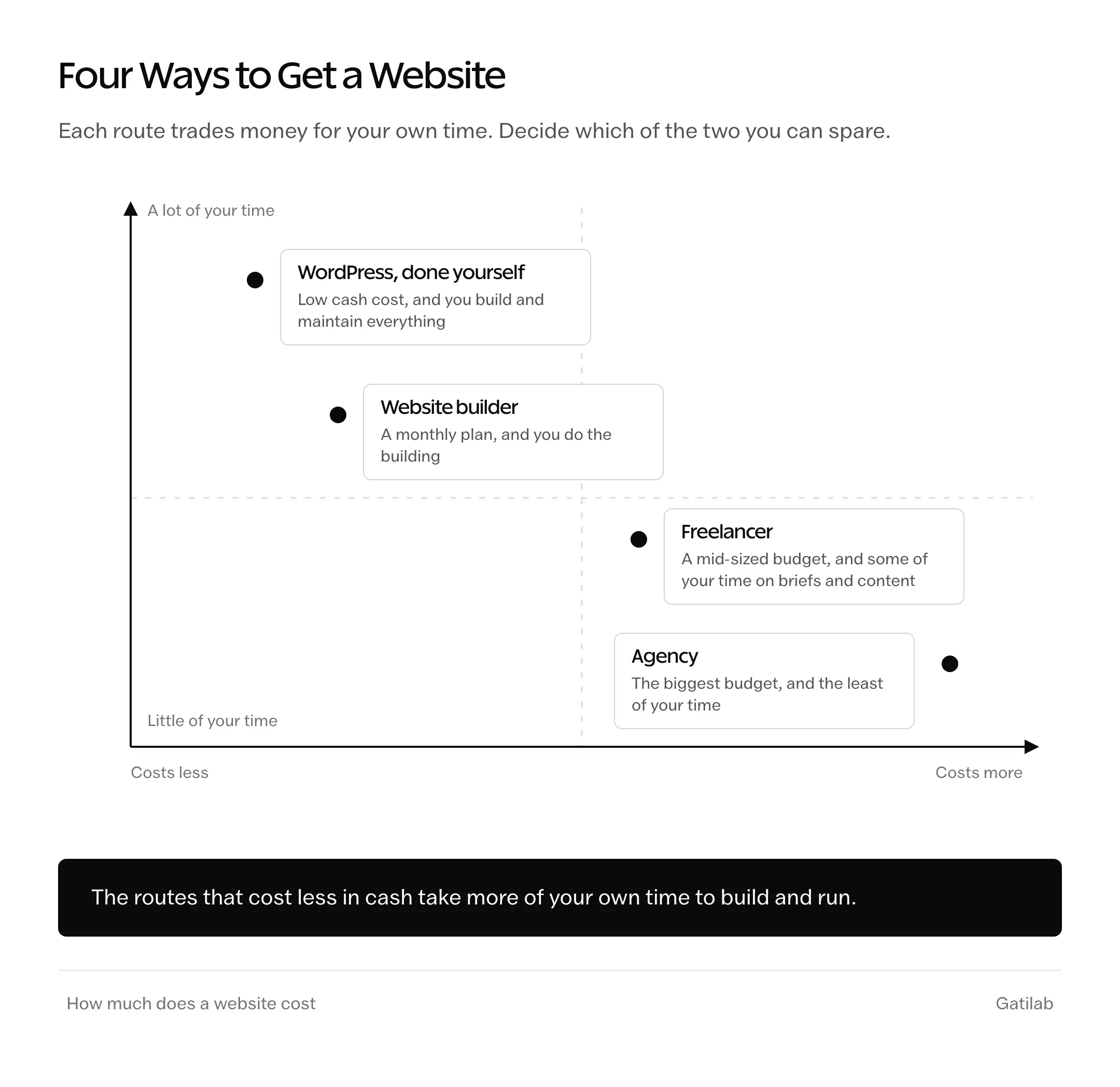
If your time is scarce, it is wise to pay for the build. If your budget is scarce, a builder or WordPress and your own hours will get you a perfectly good start.
Website Cost Calculator
Pick the route and the options that match your site to see a planning range for the build, the yearly running cost and the first 3 years together:
The ranges come from the typical prices in this guide, so treat the result as a starting budget rather than a quote. A written brief is what turns it into a real price.
How Much Does a Website Cost per Month?
A free website does exist, on a builder’s free plan with its branding and web address, but a business site has running costs. They usually come from:
- a domain, around $10 to $20 a year for a .com, with renewals sometimes priced higher than the first year
- hosting or a builder plan, from a few dollars a month for basic shared hosting to $25 to $100 a month for managed WordPress hosting, or roughly $16 to $40 a month for most builder plans billed yearly
- business email, usually priced per user each month
- premium plugins, themes or apps, mostly billed yearly
- maintenance, if you pay someone for updates, backups and fixes, often $150 to $800 a month from an agency
It is worth adding these up for a year and multiplying by 3 before comparing routes, because a cheaper build with expensive upkeep can end up costing more.
How Much Does a Website Cost in India?
The same routes apply in India, at lower prices:
- freelancers usually charge ₹15,000 to ₹80,000 for a small business website
- agencies usually charge ₹80,000 to ₹3,00,000 for the same scope, with more structure, specialists and support
- most small businesses end up spending somewhere between ₹25,000 and ₹1,00,000
- a domain costs roughly ₹1,000 to ₹2,000 a year, and hosting anywhere from ₹2,000 to ₹50,000 a year depending on the plan
Quotes at the low end often leave out content or support after launch, so the advice on comparing quotes below matters just as much here.
How to Get an Accurate Website Quote
- Write a one-page brief. Who the site is for, what it must do and when it needs to launch.
- List every page. Even a rough list turns a guess into a quote.
- Decide who writes the content. Say it in the brief, because it changes both the price and the timeline.
- Send the same brief to two or three builders. Freelancers or agencies, but the same brief to each one.
- Ask for an itemized quote. Design, pages, content, revisions and support after launch, each on its own line.
- Compare the 3-year cost, not the build price. Add the running costs to each quote before deciding.
- Keep the domain and hosting in your name. Whoever builds the site, those accounts should belong to you.
An itemized quote built on your brief is the only number worth comparing, because it shows exactly what you’re paying for.
Website Budget and Brief Template (PDF and Word)
Everything you need to collect comparable quotes and see the real cost of each one.
- A one-page brief every designer, developer or agency can quote from
- A page list and a features checklist
- A side-by-side quote comparison
- A running cost sheet and a 3-year total
- A decision summary that keeps the domain and hosting in your name
Free to use for your own projects or your clients’.
The Limits
The ranges in this guide are typical US prices for small business sites. Large sites and anything with custom software sit well outside them, and local labor markets change the numbers a lot.
A price range also can’t tell you whether a site will work. A $3,000 site that brings in enquiries is cheaper than a $500 one that nobody finds, so the brief should say what the site has to achieve, not only what it has to include.
And prices move. Hosting and software prices change from time to time, so it is worth checking the current price of anything before you commit to it.
Mistakes That Blow a Website Budget
Comparing build prices without the running costs. The cheapest build can carry the most expensive upkeep.
Choosing the lowest quote without reading what it includes. The missing content, revisions or support usually shows up later as extra invoices.
Paying for custom design before you know what visitors need. A template launched this month teaches you more than a custom design launched next year.
Letting someone else register the domain. If the relationship ends, getting your own domain back can take weeks.
Leaving the content until the end. It is often the reason a finished design sits unlaunched for weeks.
Skipping maintenance to save money. Out-of-date plugins and missing backups cost far more to fix after something breaks.
FAQs on Website Cost
How much does a website cost for a small business?
A small business site of 5 to 10 pages usually costs $0 to $300 to build yourself on a builder or WordPress, roughly $750 to $6,000 with a freelancer and $3,500 to $8,000 with an agency, plus a few hundred to a couple of thousand dollars a year to run.
Is $1,000 a good price for a website?
It can be, for a small template-based site built by a freelancer, especially if you supply the content. It is on the low side for a custom design or an online store, so it is worth checking exactly what the quote includes.
Does a website have a monthly fee?
Almost always. At minimum you pay for a domain and hosting or a builder plan, and many sites add email, premium plugins and a maintenance plan on top.
Can I run a website for free?
Yes, on a builder’s free plan, but it comes with the builder’s branding and web address. A business site needs its own domain and paid hosting or a paid plan.
How much does website maintenance cost?
Doing the updates and backups yourself costs only your time. Agencies typically charge $150 to $800 a month for a maintenance plan, depending on how much they handle.
Why do website quotes vary so much?
Different quotes usually assume different scopes, like a template versus a custom design, content included or not, and different levels of support. Sending the same brief to everyone makes the quotes comparable.
Final Remarks
If you’ve worked through this, you have a realistic range for your site and a clear idea of what moves it. The one idea to keep is that the brief decides most of the price, so it is worth writing before you ask anyone for a quote.
The budget and brief template above gives every quote the same starting point and adds up the 3-year cost for you. If you’d like us to quote on your project, our web development team will work from the same brief, with every number itemized.
I hope your new site pays for itself sooner than you expect.
Tell Google you want more of this.
Add Gatilab as a preferred sourceOne tap, and this site shows up more often in your own Top Stories, AI Overviews and AI Mode. Remove it any time.