
Product-Led Growth: The 2026 Guide for SaaS Founders
Product-led growth is the strategy where the product itself does the selling. Users sign up, hit value, and convert to paid without ever talking to a sales rep. The pitch isn’t on a deck. It’s in the first ten minutes of the app.
I’ve watched founders try to bolt PLG onto sales-led companies and fail. I’ve also watched five-person teams cross $10M ARR on freemium alone. The difference isn’t budget. It’s whether the product creates a moment of obvious usefulness inside the first session, and whether everything around it (pricing, onboarding, expansion paths) reinforces that moment instead of fighting it. This guide covers the mechanics of product-led growth in 2026, with the metrics, models, and named examples I keep coming back to.
What Product-Led Growth Means in 2026
Product-led growth is a go-to-market strategy where product usage drives acquisition, conversion, retention, and expansion. The product is the primary marketing channel, the primary sales rep, and the primary customer success motion. Everything else (content, ads, sales) supports the product, not the other way around.
The PLG label gets applied loosely, so it helps to be specific. A company is genuinely product-led when self-serve revenue is at least 50% of new ARR, when the median user reaches activation without human help, and when expansion happens through usage growth rather than upsell calls. Slack, Notion, Figma, Linear, and Loom all clear that bar. Salesforce, despite a free trial, does not.
OpenView’s 2025 PLG benchmarks report shows product-led companies grew at a median of 47% year-over-year compared to 21% for sales-led peers, and they trade at roughly 2x the revenue multiples in public markets. The advantage isn’t permanent, but it’s structural. A self-serve onboarding flow scales for free. A sales team scales by hiring.
PLG vs Sales-Led vs Marketing-Led
The three motions describe who carries the buyer from awareness to revenue. Sales-led puts a human in the middle: SDR books the call, AE works the deal, contract gets signed. Marketing-led generates demand through content and ads, then hands warm leads to sales. Product-led skips both and lets the user self-serve through the entire path.
None of these is universally correct. ACV (annual contract value) decides which fits. Below $5,000 ACV, sales-led usually loses money: a $1,500 cost per opportunity destroys the unit economics. Above $50,000 ACV, pure self-serve usually fails because procurement, security review, and multi-stakeholder approval cannot happen in-product. PLG dominates the $0 to $30,000 ACV range, which is where most modern SaaS sits.
| Motion | Best ACV range | Lead time | Margin | Headcount cost |
|---|---|---|---|---|
| Product-led | $0 to $30k | Minutes to days | 75 to 85% | Low (engineers, designers) |
| Marketing-led | $5k to $50k | Weeks | 65 to 75% | Medium (marketers, BDRs) |
| Sales-led | $25k and up | Months to a year | 55 to 70% | High (AEs, SEs, CSMs) |
The strongest companies in 2026 run hybrid motions. Notion is product-led at the bottom and sales-assisted for enterprise. Linear is purely product-led but layers a thin sales motion above 250 seats. Atlassian invented the playbook of self-serve up to mid-market and field sales for enterprise, and they still run it 20 years later.
Free Trial vs Freemium vs Free Tool
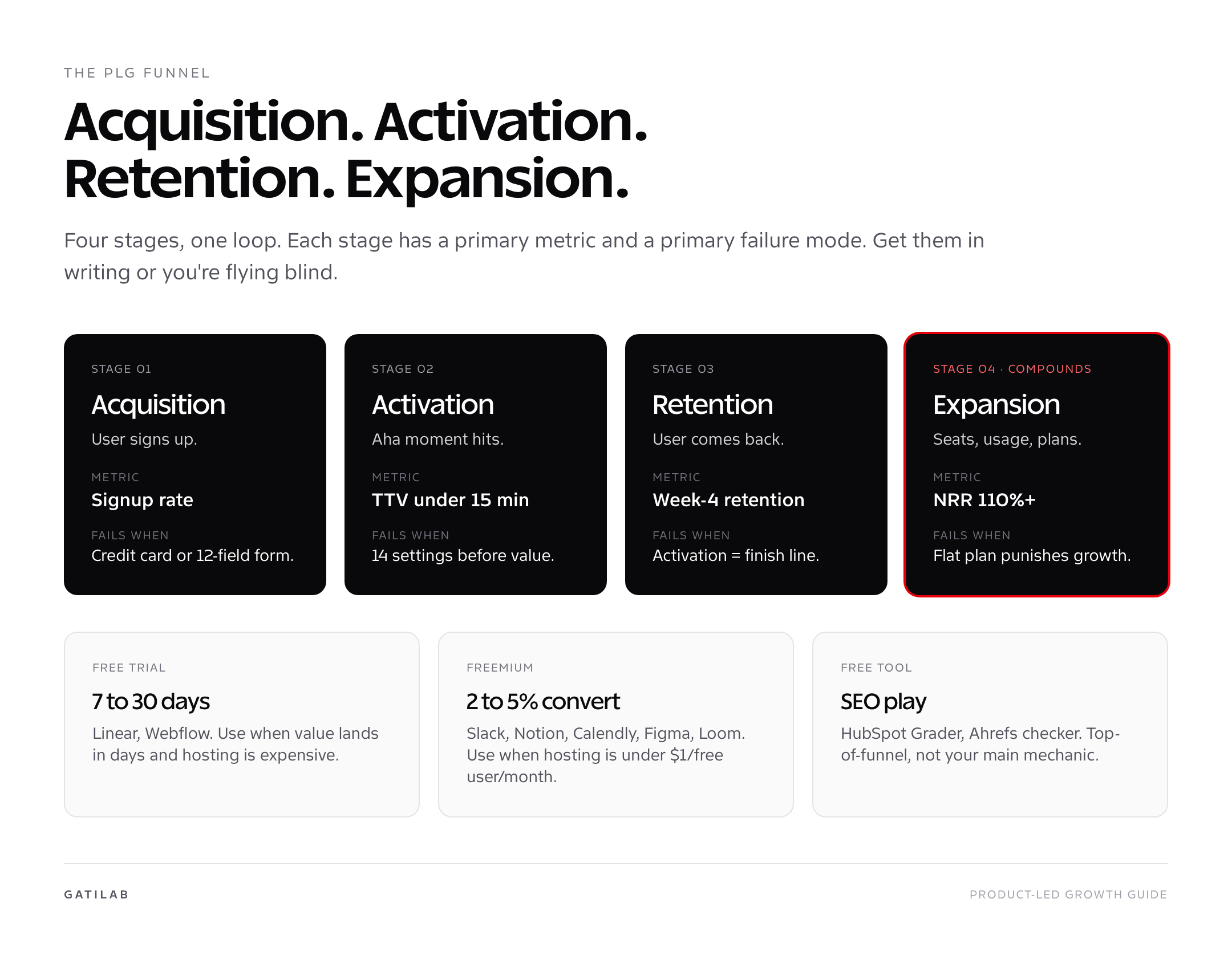
Every PLG company picks one of three acquisition mechanics. The choice isn’t aesthetic. It comes from how long it takes a user to feel value, and how much it costs to host them.
Free trial gives full product access for a fixed window (7, 14, or 30 days). It works when value is obvious within days but the product is too expensive or sensitive to host forever. Linear runs 14-day trials. Webflow runs 30. Reverse trials (start free, get premium for 14 days, drop back to free) blend trial urgency with freemium retention and tend to convert 20 to 30% better than standard trials based on Reforge cohort studies.
Freemium gives a permanently free tier with usage caps or feature limits. It works when hosting cost per free user is low and natural usage growth pushes users into paid plans. Slack, Notion, Calendly, Figma, and Loom all run freemium. The trap: a freemium plan that’s too generous traps revenue, while one too restrictive kills viral growth. Most successful freemium tiers convert 2 to 5% of free users to paid, with the rest serving as marketing through invitations and word of mouth.
Free tool is a standalone utility tied loosely to the main product. HubSpot’s Website Grader, Ahrefs’ free backlink checker, Hotjar’s session recording calculator. Free tools generate awareness and emails but rarely convert directly. They’re an SEO play more than a PLG play, though they feed the funnel.
Pick free trial when activation takes hours or days, hosting is expensive, and your buyer expects a deadline. Pick freemium when activation takes minutes, hosting cost per free user is under $1 a month, and viral loops are real. Pick free tool only as a top-of-funnel asset, not as your main acquisition mechanic.
The PLG Funnel: Acquisition, Activation, Retention, Expansion
The PLG funnel has four stages. Each one has a primary metric and a primary failure mode. If you can’t name yours, you’re flying blind.
- Acquisition: a user signs up. Primary metric is signup rate from your highest-intent traffic. Failure mode is requiring a credit card, a demo call, or a 12-field form. Strip the signup to email, password, and one work-context question.
- Activation: the user reaches the “aha moment”, the first time the product proves its value. Primary metric is activation rate within session one. Failure mode is asking the user to configure 14 settings before showing them anything useful.
- Retention: the user comes back. Primary metric is week-2 and week-4 retention. Failure mode is treating activation as the finish line. Habit forms between session two and session ten.
- Expansion: the user invites teammates, hits a usage limit, or upgrades. Primary metric is net revenue retention (NRR), with 110%+ as healthy and 130%+ as elite. Failure mode is a flat pricing plan that punishes growth instead of capturing it.
For more on retention specifically, my churn reduction guide for bootstrapped SaaS walks through the tactics that move week-4 retention 5 to 10 percentage points without adding headcount.
Activation: Engineering the Aha Moment
Activation is the single highest-leverage point in the PLG funnel. A 10-point activation lift compounds through retention and expansion to roughly 3x ARR over 24 months in cohort modeling I’ve run for client SaaS. Most teams under-invest because activation work feels less glamorous than acquisition.
Define your activation event in measurable behavior, not vibes. “User sees value” isn’t an event. “User sends 2,000 messages” was Slack’s. “User invites at least 1 collaborator” is Figma’s. “User publishes a page” is Webflow’s. The event should be the smallest action that historically correlates with week-4 retention above 60%.
Time-to-value (TTV) is the clock from signup to activation. Sub-5-minute TTV is elite. Sub-15-minute TTV is good. Anything above 30 minutes leaks badly. Loom’s TTV is roughly 90 seconds: install extension, hit record, send link. That’s why their viral coefficient is closer to a consumer app than a B2B tool.
The patterns that consistently lift activation: progressive onboarding (don’t ask for everything upfront), templates and example data (so the empty state doesn’t look like work), in-product checklists with 3 to 5 steps maximum, and a “delete the friction” audit of every form, modal, and verification step in the first session. Skip the product tour unless your product is genuinely complex. Most tours pad TTV without lifting activation.
Expansion: Where PLG Companies Print Money
Acquisition gets the press. Expansion pays the bills. The strongest PLG companies generate 40 to 60% of new ARR from existing accounts, which is why they can outbid sales-led competitors on paid acquisition without burning through cash.
Three expansion patterns dominate. Seat expansion happens when one user invites teammates: Slack workspaces grow from 1 to 50 users on average, and Slack captures revenue on the way. Usage expansion happens when the customer’s usage grows past a tier limit: Vercel, Cloudflare, and Stripe all monetize this way. Plan expansion happens when the customer needs a feature locked behind a higher tier: Notion’s enterprise plan unlocks SSO, audit logs, and SCIM, and that’s where most enterprise revenue lands.
The pricing structure has to support expansion. Per-seat pricing supports seat expansion. Usage-based pricing supports usage expansion. Tiered pricing with feature gating supports plan expansion. Most healthy PLG companies use two of the three (per-seat plus tiered is the most common combination). For a deeper breakdown, see SaaS metrics explained: MRR, ARR, churn, LTV, and CAC.
PLG Metrics That Actually Matter
Vanity metrics flatter dashboards. Real PLG metrics tell you whether the product is working without humans. Track these and ignore most of the rest.
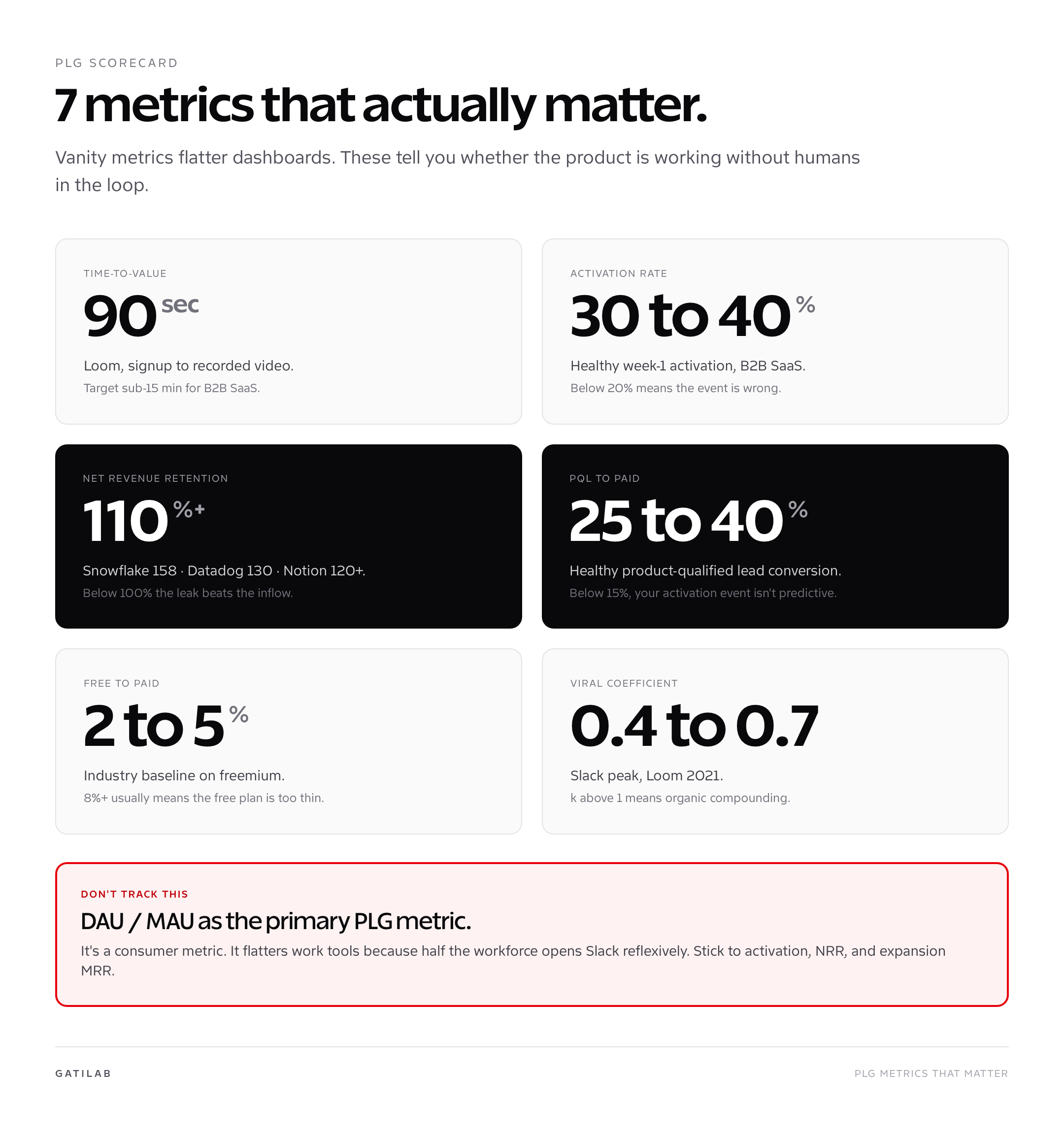
- PQL (product-qualified lead): a free user who has hit the activation event AND a usage threshold predictive of paid conversion. PQL-to-paid conversion of 25 to 40% is healthy. Below 15% means the activation event isn’t predictive.
- Time-to-value (TTV): median minutes from signup to activation. Target sub-15. Loom hits 90 seconds. Calendly hits about 5 minutes.
- Activation rate: % of signups that reach the activation event. Target 30 to 40% in week one for self-serve B2B SaaS.
- Net revenue retention (NRR): (starting MRR + expansion – downgrades – churn) / starting MRR. 110%+ is healthy. Snowflake reports 158%, Datadog 130%, Notion 120%+ on enterprise.
- Expansion MRR: dollar growth from existing accounts. Should equal or exceed new MRR by month 18 in a healthy PLG model.
- Viral coefficient (k): average number of new signups generated per user. K above 1 means organic compounding. Slack’s k was 0.4 to 0.6 at peak. Loom hit 0.7 in 2021.
- Free-to-paid conversion: % of free users who become paying customers. 2 to 5% is industry baseline. Above 8% usually means freemium is too restrictive.
Don’t track DAU/MAU as a PLG primary metric. It’s a consumer metric that flatters work tools because half the workforce opens Slack reflexively. Stick to activation, NRR, and expansion MRR.
Examples: Slack, Notion, Linear, Loom, Calendly
Five PLG playbooks worth studying because they each illustrate a different mechanic. The full roster, with twelve named examples and lessons, lives in my product-led growth examples companion piece.
Slack: viral team adoption
Slack’s freemium tier capped message history at 10,000 messages, which a 5-person team hits in roughly 8 weeks. The cap was the upgrade trigger. Activation event: 2,000 messages sent. ARR went from $0 to $100M in 14 months on essentially no paid acquisition. The lesson is that the right usage limit is a pricing decision, not a billing one.
Notion: bottoms-up template ecosystem
Notion’s growth came from individual users dragging entire companies onto the product. Free personal plan, paid team plan. The template gallery turned every power user into an unpaid marketing channel. By 2024, 80%+ of Notion enterprise deals started as a single seat that grew organically. NRR sits above 120% on enterprise.
Linear: opinionated product, no marketing
Linear is the cleanest pure-PLG case I know. No outbound, no demos, almost no content marketing. The product is fast enough and opinionated enough that engineers tell their teammates. Free for up to 250 issues, then $8 to $14 per seat. Linear hit $50M ARR in 4 years with under 60 employees.
Loom: viral by output
Every Loom video shared is a marketing asset. Recipients land on Loom’s domain, watch, then sign up to send their own. The viral coefficient is structural, not accidental. The free plan caps at 25 videos and 5-minute lengths, which is exactly where most users hit the wall and convert.
Calendly: single-product clarity
Calendly does one thing: scheduling. The free plan covers individuals. The $10 to $16 per month plans add team features, integrations, and custom branding. Activation is sub-5-minute. NRR sits around 115%, mostly from solo users converting to team plans. Calendly proves you don’t need a big surface area to be a $300M+ ARR PLG company.
Where Product-Led Growth Fails
PLG is not a default. It fails predictably in specific situations, and forcing it where it doesn’t fit wastes 18 to 24 months of runway.
- High-touch products: anything requiring data integration, custom workflows, or multi-week implementation. A self-serve trial of an EHR system is not a real trial.
- Heavily regulated buyers: hospitals, banks, and government agencies don’t sign up with a credit card. They sign POs after security review. PLG can support these motions, but it can’t replace them.
- Expensive infrastructure: products where each free user costs more than a few dollars a month to host (heavy compute, large storage). Free tiers become a tax on growth.
- Single-player products with no expansion: if a customer never invites teammates and never grows usage, you have a transaction, not a PLG company. Look hard at whether expansion mechanics actually exist.
- Bolt-on PLG inside a sales-led culture: when the comp plan rewards AEs for closing deals over self-serve revenue, the self-serve flow gets starved of engineering attention. PLG dies of neglect.
The honest test: ask whether your last 10 customers reached value before talking to a human. If 8+ did, you’re product-led. If 3 did, you’re sales-led with a marketing layer. Knowing which is fine. Pretending is what burns the runway.
Building a PLG Strategy: a 90-Day Plan
If you’re moving from sales-led or marketing-led toward product-led, the first 90 days matter more than the next 9 months. Most failed PLG transitions die in the first quarter from scope sprawl.
- Days 1 to 14: define the activation event in writing. Pull historical data and confirm it correlates with week-4 retention above 60%. If it doesn’t, you have the wrong event.
- Days 15 to 30: instrument every step of signup, first session, and the activation event. Use Amplitude, Mixpanel, or PostHog. Without instrumentation, you’re guessing.
- Days 31 to 60: run a friction audit. Watch 20 user-session recordings. List every form, modal, and configuration step before activation. Cut half of them. Re-measure TTV.
- Days 61 to 75: define your free-to-paid conversion trigger. Usage cap, feature gate, or both. The trigger should align with where customers naturally feel pain, not where pricing math feels neat.
- Days 76 to 90: turn off one outbound or marketing channel that isn’t directly supporting product activation, and reinvest the budget into engineering activation work. The forcing function matters.
For broader strategy context, my SaaS marketing strategy guide covers how PLG fits into the wider go-to-market stack, and SaaS content marketing covers the content patterns that feed product-led funnels without leaning on outbound.
PLG and Customer Success
Sales-led companies hire CSMs (customer success managers) per account. PLG companies build customer success into the product. The math is simple: you can’t afford a $90,000-a-year CSM for a $1,200-a-year customer, but you can afford to build a smart in-app empty state once and serve a million customers with it.
The PLG customer success stack typically includes: in-app guides (Userpilot, Appcues), help docs with deep search (Helpscout, Intercom), community forums (Discourse, Circle), and a usage-based health score that triggers light-touch nudges. Human CSMs only enter above a revenue threshold, usually $25k to $50k ACV. For more on this layer, see my complete guide to SaaS customer success.
Marketing for PLG Companies
Marketing in a PLG company looks nothing like marketing in a sales-led one. The job is not to generate MQLs. The job is to put the product in front of the right user and step out of the way. SEO, comparison pages, integration pages, free tools, and developer-friendly content do most of the heavy lifting.
The single highest-ROI channel for B2B PLG companies in 2026 is bottom-funnel SEO: “[competitor] alternative”, “[product] integration with X”, “[use case] tool”. These pages convert at 3 to 8% to signup, vs 0.5 to 1% for top-funnel content. My SaaS SEO strategy guide breaks down the specific page types that drive product-led pipelines.
Paid acquisition still has a role: branded search defense, retargeting trial signups, and a small budget on bottom-funnel intent keywords. But paid is a tactical layer, not the primary channel. If paid is your primary channel and you’re calling yourself product-led, you’re marketing-led with a free trial.
Pricing Decisions That Make or Break PLG
Pricing is where most PLG strategies quietly fail. Founders pick a number that feels reasonable, ship it, and discover six months later that the free plan is too generous, the paid plan is priced 40% under market, and the upgrade trigger fires for 4% of users instead of 25%. Pricing is product work, not finance work, and it deserves the same iteration cadence as any other surface.
Three rules I’ve watched hold across PLG companies in 2026. First, the free plan should solve a real problem for a real user, not be a crippled demo. A user who can’t accomplish anything on the free plan won’t invite teammates, and the viral loop dies. Second, the upgrade trigger should fire when the user is already getting value: hitting a usage cap, needing collaboration features, or wanting integrations. Triggers that fire before value gets internalized convert badly. Third, the paid plan should price for the workflow the customer is already running, not for arbitrary feature tiers. Per-seat for collaborative work. Usage-based for infrastructure. Tiered for breadth-of-feature products.
The single most underrated lever is price discrimination across plans: free, individual, team, business, enterprise. Five tiers feels like overkill until you watch revenue spread across them. Notion runs five. Figma runs four plus a developer plan. Linear runs four. The tier proliferation isn’t accidental; it’s how PLG companies capture value across a 100x range of customer sizes without forcing everyone into one plan.
FAQs
What is product-led growth in simple terms?
Product-led growth is a go-to-market strategy where the product itself drives signups, conversion, retention, and expansion. Users self-serve through the funnel without needing to talk to a salesperson. Slack, Notion, Linear, Loom, and Calendly are textbook examples.
What is the difference between product-led and sales-led growth?
Sales-led growth puts a human in the middle: SDRs book calls, AEs close deals. Product-led growth lets users find, try, and buy the product themselves. PLG dominates the $0 to $30,000 ACV range. Sales-led wins above $50,000 ACV. Most modern SaaS picks one as the dominant motion and layers the other on top.
What are the key product-led growth metrics?
The seven that matter: PQL (product-qualified lead) volume, time-to-value (target sub-15 minutes), activation rate (target 30 to 40% in week one), net revenue retention (target 110%+), expansion MRR, viral coefficient, and free-to-paid conversion (2 to 5% baseline). Skip DAU/MAU as a primary PLG metric.
Free trial or freemium: which is better for PLG?
Free trial works when value lands in days, hosting is expensive, and the buyer responds to deadlines (Linear, Webflow). Freemium works when activation takes minutes, hosting cost per free user is under $1/month, and viral loops are real (Slack, Notion, Calendly). Reverse trials (start free, get premium for 14 days, drop back to free) often outperform standard trials by 20 to 30%.
What is a PQL (product-qualified lead)?
A PQL is a free user who has hit your activation event AND a usage threshold predictive of paid conversion. Healthy PQL-to-paid conversion is 25 to 40%. Below 15% means your activation event isn’t actually predictive of paid intent and you need to redefine it.
What is a good NRR for a PLG company?
Net revenue retention of 110% is healthy. 130%+ is elite. Snowflake reported 158% at IPO; Datadog hit 130%; Notion sits above 120% on enterprise. NRR above 100% means the business grows ARR even with zero new customers, which is the structural advantage PLG companies have over sales-led peers.
Does product-led growth work for enterprise SaaS?
Pure PLG doesn’t work above $50k ACV because procurement, security review, and multi-stakeholder approval can’t happen in-product. The model that works is hybrid: self-serve up to mid-market, sales-assisted for enterprise. Atlassian invented this playbook 20 years ago and still runs it.
How long does it take to transition to product-led growth?
Plan 12 to 24 months for a meaningful transition. The first 90 days are about defining your activation event, instrumenting the funnel, and running a friction audit on first-session UX. After that, expect 9 to 18 months of iteration on time-to-value, pricing, and expansion mechanics before the model clearly outperforms.
What’s the most common PLG failure mode?
Bolting PLG onto a sales-led culture. When the comp plan rewards AEs for closing deals over self-serve revenue, the self-serve flow gets starved of engineering attention and dies of neglect. PLG transitions need executive air cover and an explicit decision to invest in product-led infrastructure for at least 18 months.
Which companies are the best PLG examples to study?
The 12 worth studying for different mechanics: Slack (usage caps), Notion (templates), Linear (opinionated product), Loom (viral output), Figma (multiplayer), Calendly (single-product), Dropbox (referral), Zoom (network spillover), Atlassian (self-serve to enterprise), Canva (consumer-to-B2B), Airtable (template + workspace), and ConvertKit/Kit (creator-aligned cap).
Tell Google you want more of this.
Add Gatilab as a preferred sourceOne tap, and this site shows up more often in your own Top Stories, AI Overviews and AI Mode. Remove it any time.