
Product-Led Growth Examples: 12 Companies and the Lessons They Teach
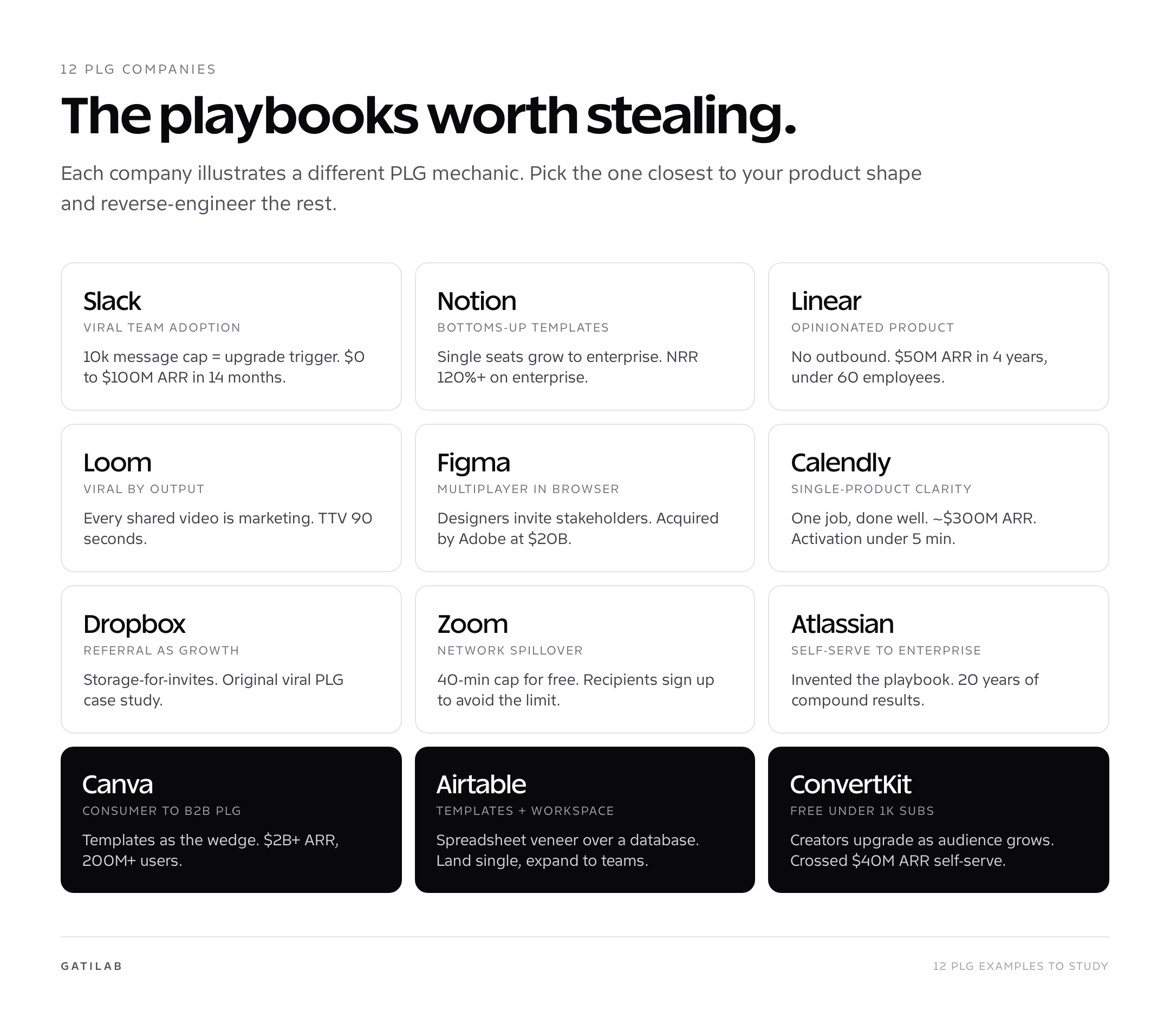
Product-led growth examples are easy to list and hard to learn from. Everyone names Slack and Dropbox, then stops. The companies worth studying are the ones whose mechanics map to your product shape, your price point, and your buyer. That’s where the real lessons live.
I’ve spent the last decade watching SaaS companies grow, fail, and pivot, and I run my own bootstrapped products at Gatilab. The 12 companies in this guide aren’t here because they’re famous. They’re here because each one solves a specific PLG problem in a way you can copy. I’ve grouped them by mechanic so you can pull the playbook closest to your situation, not the one with the best logo.
What Makes a Real Product-Led Growth Example
The best product-led growth examples share a structural pattern: the product itself does the selling, the marketing, and the customer success. Most “PLG examples” lists fail one of three honesty tests. They include sales-led companies that happen to have a free trial. They credit growth to “the product” while ignoring the $40M marketing budget. Or they stop at acquisition without showing how the company actually monetizes self-serve revenue. None of those is a product-led growth example. The bar is higher.
A genuine PLG company hits three marks. Self-serve revenue is at least 50% of new ARR (this is the cutoff OpenView and ChartMogul both use in their benchmarks). The median user reaches the activation event without human help. And expansion happens through organic usage growth or seat invites, not through a sales call. Companies that clear all three: Slack, Notion, Figma, Linear, Loom, Calendly, Atlassian, Canva, Airtable, ConvertKit, Zoom, and Dropbox. Companies that don’t, despite a free trial: Salesforce, HubSpot’s enterprise tier, most CRMs, and most CDPs.
For the underlying mechanics, see my product-led growth guide, which covers the funnel stages, metrics, and pricing decisions in depth.
Slack: the Usage-Cap Playbook
Slack is the case study every PLG founder reads first. Free tier. 10,000 message history cap. Workspace invites are zero-friction. The 10k cap was the upgrade trigger: a 5-person team hit it in roughly 8 weeks of normal usage. Slack went from $0 to $100M ARR in 14 months, almost entirely through self-serve workspaces, with viral growth driven by teammates being invited into workspaces.
What it does well: the cap is on something the user wants more of (history), not something they need to function (sending messages). The user keeps using the product daily, and the upgrade decision is made at the moment of pain, not at signup. This is the textbook PLG move.
The lesson: pick a usage cap that scales with team size, fires when the user is already deeply engaged, and locks behavior people have already invested in. Don’t cap signup. Don’t cap a feature people need on day one.
Notion: the Bottoms-Up Template Engine
Notion’s growth came from individual users dragging entire companies onto the product. Free personal plan with unlimited blocks. Paid team plan with collaboration. Enterprise plan with SSO, audit logs, and SCIM. By 2024, Notion reported that 80%+ of enterprise deals started as a single seat that grew organically. NRR sits above 120% on enterprise, which means existing accounts grow faster than they churn.
What it does well: the template gallery turned every power user into an unpaid marketing channel. Notion-built templates for productivity, hiring, project management, and personal use ranked organically and pulled in tens of millions of free users. The flywheel: user discovers template, signs up, builds workspace, invites team, hits paid plan.
The lesson: when your product is flexible enough to build many things in, templates are both onboarding and SEO. They reduce time-to-value and rank for hundreds of long-tail queries that paid acquisition can’t compete on.
Linear: the Opinionated, Marketing-Free Playbook
Linear is the cleanest pure-PLG case I know in 2026. No outbound, no demos, almost no traditional content marketing. The product is fast enough and opinionated enough that engineers tell their teammates. Free for up to 250 issues, then $8 to $14 per seat. Linear hit roughly $50M ARR in 4 years with under 60 employees, which is wildly capital-efficient.
What it does well: opinionation. Linear refuses to ship every feature that competitors have. The product is faster, smaller, and more obvious than Jira. Engineers who switch tell other engineers, because using a faster tool is a tangible quality-of-life upgrade.
The lesson: the right move sometimes is to build a smaller, sharper product than the market leader, not a bigger one. Word of mouth works when the product is meaningfully better in a way users can feel.
Loom: Viral by Output
Every Loom video shared is a marketing asset. The recipient lands on Loom’s domain, watches a video, then signs up to send their own. The viral coefficient peaked around 0.7 in 2021, which is closer to consumer-app territory than B2B SaaS. Free plan caps at 25 videos and 5-minute lengths, exactly the spot most users hit before they need to pay.
What it does well: the output is the marketing. Loom didn’t have to buy ads because every video sent to a colleague functioned as one. Time-to-value is 90 seconds: install the extension, hit record, send link. Activation happens before the user even returns to the website.
The lesson: if your product creates a shareable artifact (video, document, link, design, dashboard), make sharing it part of the core loop, not an afterthought. The artifact does the cold outreach for free.
Figma: Multiplayer in the Browser
Figma did something obvious in retrospect: it made design files multiplayer in the browser at a time when Sketch shipped Mac-only files over Dropbox. That single technical decision created a new acquisition loop. Designers invited stakeholders (product managers, engineers, executives) into files for review. Each invite was a free signup. Each free signup eventually needed an editor seat. Adobe acquired Figma at a $20B valuation in 2022 (the deal later collapsed on regulatory grounds, but the valuation tells you the underlying business worked).
What it does well: the free viewer tier is genuinely useful for non-designers. The paid editor tier is genuinely necessary for designers. The split aligns price with value perfectly.
The lesson: a free tier that generously serves a different role from your paying customer can be an acquisition machine, not a leak. Figma’s free viewers became Figma’s biggest sales force.
Calendly: Single-Product Clarity
Calendly does one thing: scheduling. The free plan covers individuals booking 1-on-1 meetings. The $10 to $16 per month plans add team features, integrations, and custom branding. Activation is sub-5 minutes (connect calendar, share link, get first booking). NRR sits around 115%, mostly from solo users converting to team plans as their company grows. Calendly proves you don’t need a big surface area to be a $300M+ ARR PLG company.
What it does well: every shared Calendly link is a sign-up driver, similar to Loom. The product surface is so small that onboarding is essentially impossible to mess up.
The lesson: a tightly-scoped product with viral output and team-tier pricing is one of the highest-yield shapes a PLG company can take. You don’t have to be a platform.
Dropbox: Referral as the Growth Engine
Dropbox is the original viral PLG case study. The 2009 referral program (extra storage in exchange for inviting friends) drove the user base from 100,000 to 4 million in 15 months. The referral mechanic was so effective that it became the default growth-hacking lesson in every textbook. Dropbox IPO’d at a $9B valuation in 2018.
What it does well: it incentivized the right behavior with the right reward. Users who needed more storage invited friends, who joined and got their own storage, who eventually needed more, who paid. The reward was the product itself, not a coupon.
The lesson: referral programs work when the reward maps to the value the user already wants. Generic discount-for-invite referral programs in 2026 mostly don’t work. Storage-for-invites still does.
Zoom: Network Spillover
Zoom won the video conferencing market by being the only one that worked. Free plan, 40-minute meeting cap. The cap matters for a specific reason: when a meeting hits 40 minutes and abruptly ends, half the attendees who weren’t already Zoom users sign up afterward to avoid the same disruption next time. Zoom IPO’d in 2019 at a $16B valuation and crossed $4B ARR by 2022.
What it does well: every meeting is an acquisition channel. Recipients of Zoom links don’t need to install the app to join (browser fallback), but the experience is meaningfully better with the app, which converts.
The lesson: when your product requires multiple participants, the participants are your acquisition funnel. Optimize the participant experience as aggressively as the host experience, because the participant is the next host.
Atlassian: the Original Self-Serve to Enterprise Motion
Atlassian invented the playbook of self-serve up to mid-market and field sales for enterprise. They’ve been running it for 20 years, and they still print money. Jira and Confluence both ship as self-serve products with free or low-priced starter tiers, and the enterprise sales motion is layered on top, not in place of, the self-serve flow.
What it does well: the self-serve flow doesn’t get starved when sales arrives. Engineering keeps investing in the bottoms-up onboarding even though sales-led deals close at higher ACV. Most companies fail at the transition because comp plans reward sales over self-serve, and engineering attention follows the comp plan.
The lesson: hybrid PLG plus enterprise sales is the dominant model for SaaS over $50M ARR, but it only works if the self-serve flow keeps getting engineering attention forever, not just in year one.
Canva: Consumer-to-B2B PLG
Canva took a consumer-PLG model (templates, free tier, viral output) and grew it into B2B revenue. By 2024 the company crossed $2B ARR with 200M+ users. Most of the revenue comes from individual creators and small teams; the rest comes from a Canva Teams and Canva Enterprise tier that adds collaboration, brand kits, and approval workflows.
What it does well: templates as a wedge. A user lands looking for “Instagram post template”, builds one, saves time, comes back. Eventually their team needs brand consistency, which pushes them into the paid plan.
The lesson: consumer PLG patterns (templates, free tier, viral output) work in B2B when the buyer is also the user. They don’t work when procurement and security review are between the user and the credit card.
Airtable: Templates Plus Workspace
Airtable wraps a relational database in a spreadsheet veneer. The free plan is generous (1,200 records per base, unlimited bases). Paid plans unlock advanced views, automations, and integrations. The acquisition pattern: a single user builds a base for their own work, invites teammates, and the workspace grows organically into a paid plan.
What it does well: it disguises the database as a spreadsheet, which lowers the technical bar dramatically. Non-technical users build CRMs, project trackers, and content calendars without realizing they’re using a relational database. That’s the unlock.
The lesson: if your product is technically powerful but conceptually heavy, find a familiar metaphor that hides the complexity until the user is already invested.
ConvertKit (now Kit): Free Under 1,000 Subscribers
ConvertKit (rebranded as Kit in 2024) is free for creators under 1,000 subscribers. The cap is the upgrade trigger: as a creator’s audience grows, they hit 1,000 subscribers and pay. The product is opinionated for creators rather than generic email marketing, and the brand is built around the creator persona, not the marketer persona. Kit crossed $40M ARR self-serve before adding any sales team.
What it does well: aligns price with customer success. A creator below 1,000 subscribers is unlikely to pay anyway. A creator above 1,000 has either monetized or is on track to. The cap captures revenue from the right cohort.
The lesson: tying the upgrade trigger to a milestone the customer is already trying to hit (1,000 subscribers) makes the upgrade feel like a graduation, not a tax.
Five Patterns That Recur Across These Product-Led Growth Examples
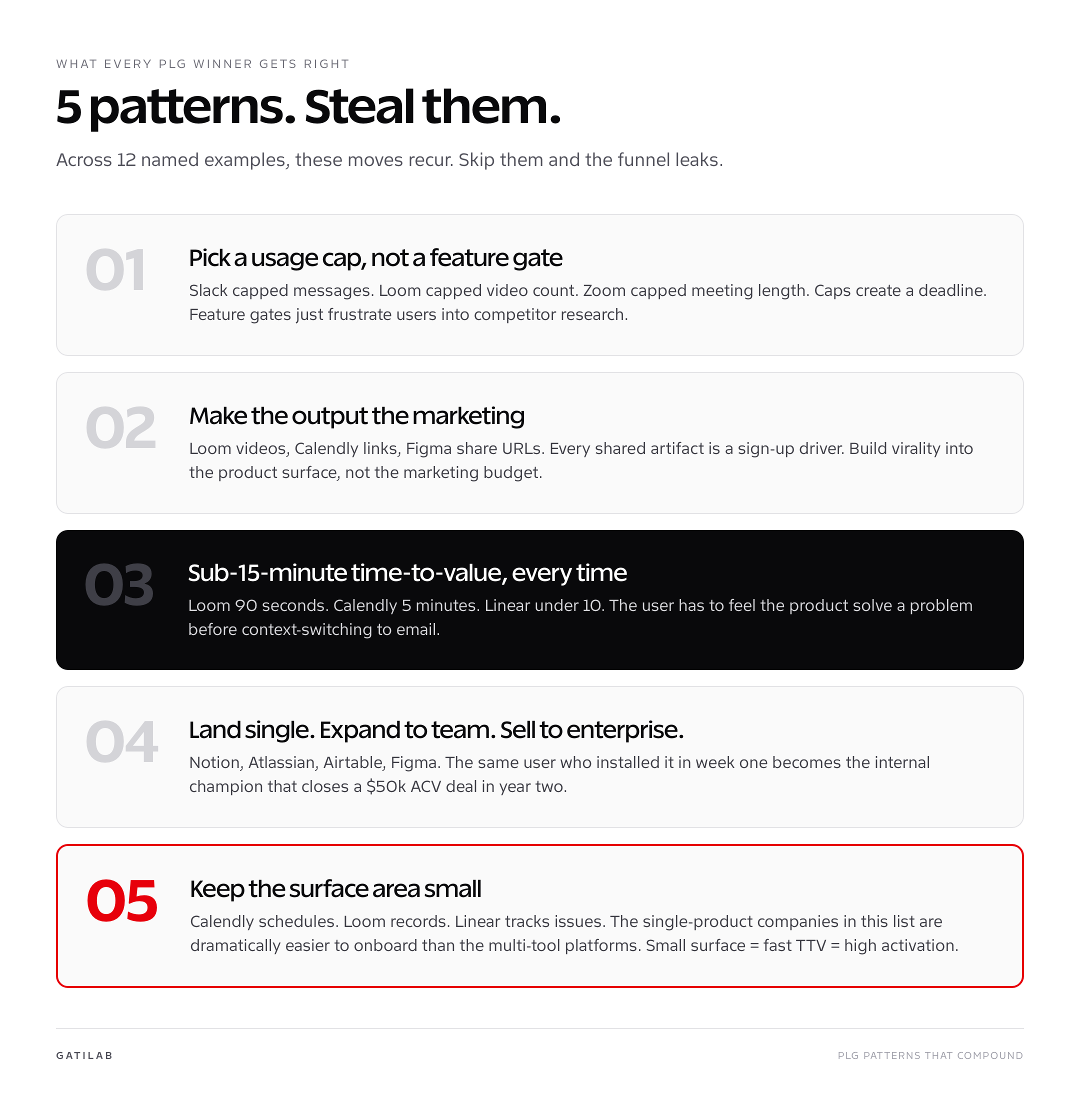
Across the 12 companies above, five moves recur. If you’re building or running a PLG company in 2026, copy these. If your strategy ignores them, your funnel probably leaks where these would plug it.
- Pick a usage cap, not a feature gate. Slack capped messages. Loom capped video count. Zoom capped meeting length. Caps create a deadline. Feature gates push users to competitor research.
- Make the output the marketing. Loom videos, Calendly links, Figma share URLs, Notion templates. Every shared artifact is a sign-up driver.
- Sub-15-minute time-to-value. Loom 90 seconds. Calendly 5 minutes. Linear under 10. The user has to feel the product solve a problem before context-switching kills the session.
- Land single, expand to team, sell to enterprise. Notion, Atlassian, Airtable, Figma. The same user who installed it in week one becomes the internal champion in year two.
- Keep the surface area small. Calendly schedules. Loom records. Linear tracks issues. Single-product companies are dramatically easier to onboard than multi-tool platforms.
For the metrics behind these patterns (PQL, NRR, expansion MRR, time-to-value), see SaaS metrics explained. For how PLG fits inside the broader go-to-market, see SaaS marketing strategy and SaaS content marketing.
Where Product-Led Growth Examples Stop Applying
The 12 companies above all share three structural features: low-touch onboarding, fast time-to-value, and clear expansion mechanics. Products without those features cannot copy these playbooks regardless of effort. EHR systems, ERP platforms, CDPs, and most security tools cannot run a Slack-style usage cap because their users don’t reach value in days, and procurement won’t let a credit card buy them.
The honest move when your product doesn’t fit is hybrid: a marketing-led top-of-funnel feeding a sales-assisted middle, with a self-serve bottom for the smallest accounts. Understanding product-led growth for SaaS covers this trade-off in depth, and my SaaS customer success guide covers the in-product success layer that makes hybrid PLG work without armies of CSMs.
How to Apply These Product-Led Growth Examples to Your Product
Studying examples is only useful if you can map them to your situation. Three questions to answer before copying anything from the playbooks above.
What is your shareable artifact? Loom videos, Calendly links, Figma files, Notion templates. If your product creates an output that gets shared with non-users, you can run the Loom or Calendly playbook. If it doesn’t, you need to engineer one or the viral mechanic doesn’t exist.
What is your usage cap? Messages, videos, meeting minutes, subscribers, storage. The cap should be on something the user wants more of, not something they need to function. Pick one that fires when the user is already engaged, not at signup.
What is your land-and-expand path? Notion grew from individual to enterprise through invites. Figma grew from designer to stakeholder. Atlassian grew from team to organization. If your product has no natural expansion path, you have a transaction model, not a PLG model, and forcing PLG won’t change that.
The companies above didn’t get lucky. They picked the right mechanic for their product shape and invested in it for years. Pick yours, write it down, and resist the urge to chase three at once.
Reading the Numbers Behind These Examples
Logos and stories make for good slides, but the underlying numbers are what separate genuine product-led growth examples from sales-led companies with a free trial. Three numbers I look at first when I’m trying to verify whether a company is actually PLG or just badged as one.
Self-serve revenue mix. If less than 50% of new ARR comes through self-serve, the company is sales-led with a marketing layer. Slack disclosed 90%+ self-serve at IPO. Atlassian famously scaled to over $1B ARR before hiring a single salesperson. Linear is essentially 100% self-serve. The number tells you whether the product can actually carry the company.
Headcount per million ARR. Sales-led SaaS companies typically run 8 to 12 employees per $1M ARR. PLG companies run 4 to 6. Linear is roughly 1.2 employees per $1M ARR, which is wildly capital-efficient. The number captures the structural advantage of self-serve onboarding: it scales for free; sales teams scale by hiring.
Time from signup to activation. Loom 90 seconds. Calendly 5 minutes. Notion under 10. Linear under 10. The product-led growth examples that actually work all clear sub-15-minute time-to-value, because that’s the threshold below which users still have working memory of why they signed up.
Together, those three numbers are the operational signature of a product-led growth example worth studying. If a company you’re benchmarking against doesn’t clear all three, it’s running a different model and the lessons translate poorly.
A Final Note on Studying Product-Led Growth Examples
The temptation when reading product-led growth examples is to extract one tactic (a usage cap, a referral program, a freemium tier) and bolt it onto your existing product. That almost never works. The companies above are coherent systems where pricing, onboarding, activation event, expansion mechanic, and product surface area all reinforce one another. Pull out one piece and the rest stops working.
The better approach is to identify which company’s product shape most closely resembles yours and study the entire system. If you sell collaborative software, study Figma and Notion together, not just one feature from each. If you sell developer infrastructure, study Linear and Vercel. If you sell creator tools, study ConvertKit and Canva. Match shape to shape, then copy the playbook end to end.
Bookmark this guide and come back to it whenever you’re stuck. The patterns repeat. So do the failure modes. Twelve product-led growth examples across a decade of SaaS history, and the lessons are remarkably consistent.
FAQs
What are the best examples of product-led growth?
Twelve worth studying: Slack (usage cap on message history), Notion (bottoms-up templates), Linear (opinionated product, no marketing), Loom (viral video output), Figma (multiplayer in browser), Calendly (single-product clarity), Dropbox (storage-for-invites referral), Zoom (40-minute meeting cap), Atlassian (self-serve to enterprise), Canva (consumer-to-B2B templates), Airtable (database-as-spreadsheet), and ConvertKit/Kit (free under 1,000 subscribers).
What does Slack do that makes it a PLG company?
Slack’s free tier capped message history at 10,000 messages, which a 5-person team hits in roughly 8 weeks. The cap was the upgrade trigger. Workspace invites were zero-friction, so each new user pulled in teammates. Slack went from $0 to $100M ARR in 14 months on essentially no paid acquisition.
How did Notion grow without sales?
Notion’s growth came from individual users dragging entire companies onto the product. Templates ranked organically and pulled in tens of millions of free users. By 2024, 80%+ of Notion enterprise deals started as a single seat. NRR sits above 120% on enterprise.
What is unique about Linear’s PLG approach?
Linear runs a near-pure-PLG model: no outbound, no demos, almost no traditional content marketing. The product is fast and opinionated enough that engineers tell their teammates. Linear hit roughly $50M ARR in 4 years with under 60 employees, which is among the most capital-efficient SaaS scaleups in the last decade.
Why is Loom considered a viral product?
Every Loom video shared is a marketing asset. The recipient lands on Loom’s domain, watches the video, and signs up to send their own. The viral coefficient peaked around 0.7 in 2021. Time-to-value is 90 seconds: install extension, hit record, send link.
Can enterprise SaaS use product-led growth examples like Slack or Notion?
Pure PLG doesn’t translate to enterprise SaaS where procurement, security review, and multi-stakeholder approval block self-serve. The hybrid model (self-serve for SMB, sales-assisted for mid-market, enterprise sales for big accounts) does work, and that’s what Atlassian, Notion, Figma, and Canva all run.
What patterns do all PLG companies share?
Five recur across the strongest examples: a usage cap rather than a feature gate, output that doubles as marketing, sub-15-minute time-to-value, a land-single-expand-to-team-sell-to-enterprise path, and a small surface area that’s easy to onboard. Companies missing more than one of these struggle to make PLG actually work.
Which PLG example is closest to a creator-economy product?
ConvertKit (now Kit) is the cleanest example: free under 1,000 subscribers, paid above. The cap aligns with creator monetization milestones, so the upgrade feels like a graduation rather than a tax. Kit crossed $40M ARR self-serve before adding any sales motion.
Are referral programs still effective for PLG in 2026?
Generic discount-for-invite referral programs mostly don’t work anymore. Programs that reward users with the product itself (Dropbox storage, ConvertKit subscribers, Loom recording minutes) still work because the reward maps directly to the value the user already wants more of.
How can I tell if my company is genuinely product-led?
Three tests. Self-serve revenue is at least 50% of new ARR. The median user reaches the activation event without human help. Expansion happens through usage growth or seat invites, not sales calls. If your last 10 customers needed a sales call to reach value, you’re sales-led with a free trial, not product-led.
Tell Google you want more of this.
Add Gatilab as a preferred sourceOne tap, and this site shows up more often in your own Top Stories, AI Overviews and AI Mode. Remove it any time.