
Services Marketing Characteristics: 4 That Change the Sale
Services marketing characteristics matter for one blunt reason: the buyer is asked to trust a result they can’t inspect before paying. A laptop can be compared by its screen, battery, processor, and price. A strategy engagement, legal consultation, training program, or design project is mostly a promise until delivery begins.
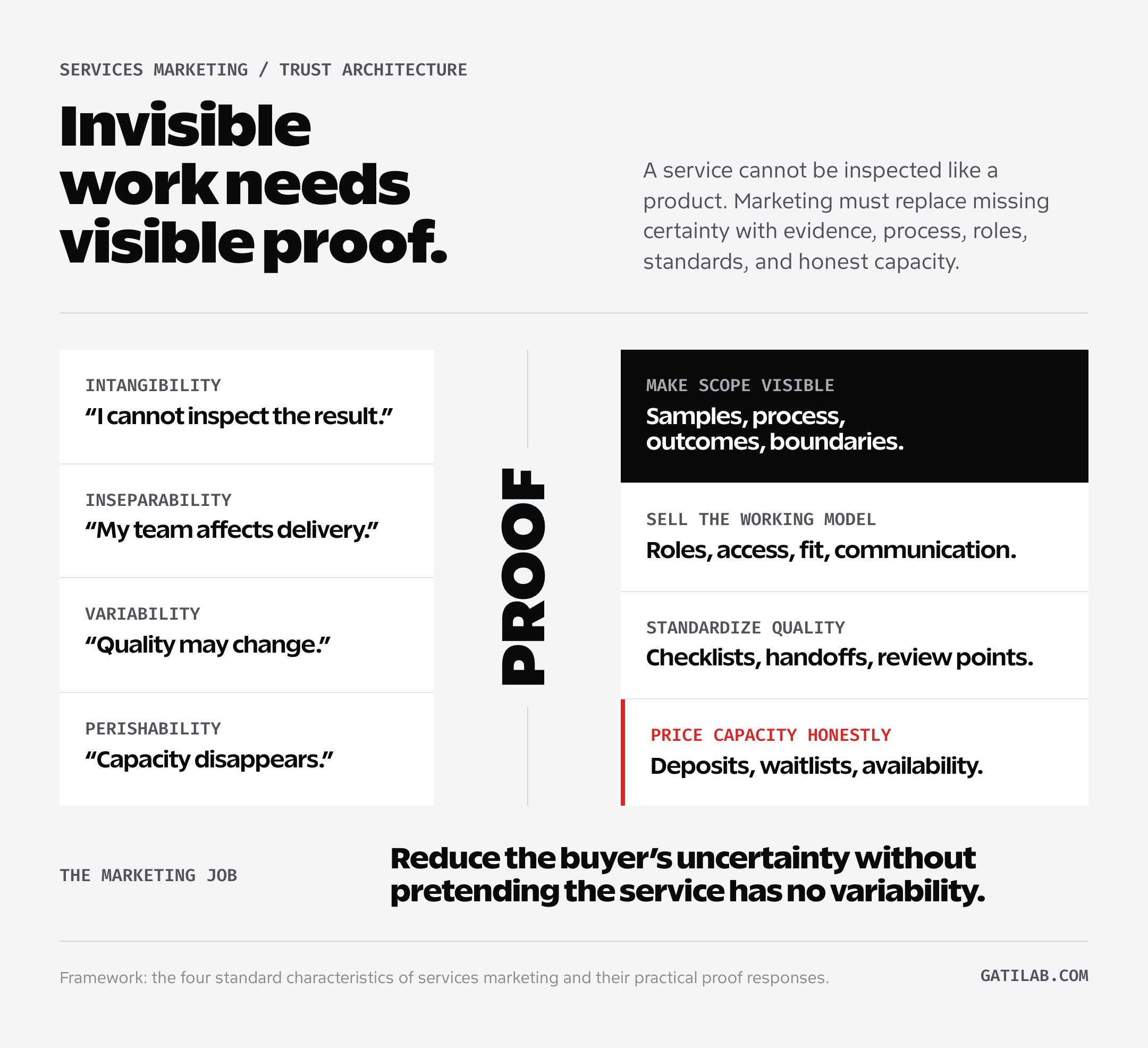
The classic four characteristics of services are intangibility, inseparability, variability, and perishability. Those words sound academic. Their practical meaning is simple: make the work visible, manage the relationship, standardize what should be consistent, and protect capacity you can’t store.
- Framework: OpenStax’s Principles of Marketing defines the four characteristics as intangibility, inseparability, variability, and perishability.
- Practical response: Each characteristic creates a buyer risk that can be reduced with proof, process, fit, or capacity controls.
What are the four services marketing characteristics?
The four characteristics are intangibility, inseparability, variability, and perishability. Each creates a specific buyer risk and requires a different marketing response.
| Characteristic | Plain-English problem | Marketing response |
|---|---|---|
| Intangibility | The buyer can’t inspect the service first | Show proof, process, scope, and outcomes |
| Inseparability | Delivery depends on provider and client interaction | Sell fit, access, roles, and communication |
| Variability | Quality can change by person, day, or project | Standardize critical steps and expectations |
| Perishability | Unused time or capacity can’t be stored | Manage demand, scheduling, pricing, and waitlists |
These four constraints explain why a service business needs more than an attractive website. A good marketing agency guide can explain categories and fees, but the buyer still needs evidence that this specific provider can deliver this specific result.
OpenStax’s classification of services is the source I trust for the framework because it defines all four concepts in one openly available marketing textbook.
How do you market an intangible service?
An intangible service can’t be held, sampled, or inspected like a physical product. That makes vague language dangerous.
“We create transformational solutions” gives the buyer nothing to evaluate.
A stronger service page shows:
- The problem the service solves
- The deliverables
- The sequence of work
- The client’s responsibilities
- The decision points
- The definition of done
- Relevant proof
- Honest exclusions
The goal isn’t to reveal every internal method. It is to reduce uncertainty.
Use proof that matches the claim
If you promise faster delivery, show a delivery timeline. If you promise better conversion, show the before-and-after page, the measurement window, and the context. If you promise senior attention, name who does the work.
Testimonials help, but a testimonial saying “Great team!” is weak evidence for a technical or financial claim. The proof should answer the buyer’s actual risk.
Package the service
Packaging turns an abstract engagement into something the buyer can compare. Define:
- Starting condition
- Scope
- Inputs
- Milestones
- Output
- Time frame
- Price model
- Boundary
This is why productizing agency services can improve both sales and delivery. The service remains customized where judgment matters, but the buying decision becomes clearer.
Why is inseparability important in services?
Many services are produced and consumed through interaction. A consultant needs access to information. A teacher needs participation. A designer needs decisions. A developer needs credentials, requirements, and feedback.
That makes the client part of the production system.
Poor services marketing hides this dependence until kickoff. Good services marketing explains it before the sale.
Sell the working relationship
The buyer needs to know:
- Who will work with them
- How often the team communicates
- Which decisions require client input
- How quickly feedback is expected
- What happens when an approval is late
- What access or data is required
- How disagreements are resolved
This isn’t paperwork. It is part of the offer.
Qualify for fit
Not every lead should become a client. If your process requires weekly access to a decision-maker, a company that can only offer a junior coordinator may be a poor fit.
Start with a clear target audience definition, then add operational fit. Industry and company size aren’t enough. You also need readiness, access, budget, urgency, and the ability to implement.
How can a service business reduce variability?
Service quality can vary because people, context, and customer participation vary. The wrong response is pretending every project will be identical.
The better response is to standardize the parts that protect quality:
- Discovery questions
- Brief and scope
- Quality checks
- Handoffs
- Client approvals
- Reporting definitions
- Escalation paths
- Documentation
Judgment can remain flexible. Quality control should not.
Create a minimum service standard
A minimum service standard describes what every client receives regardless of project complexity.
For example:
- Kickoff within five business days after required access is received
- Written decisions after every review
- One owner for each deliverable
- Defined response windows
- A pre-delivery quality review
- A final handoff with documentation
Notice what this avoids: promising a business result you can’t control. You can standardize the work and the evidence. You can’t guarantee the market’s response.
Match the message to the buyer
The same service may need different proof for different buyers. Developers care about implementation detail and technical risk. Marketers care about speed, coordination, and business impact.
The offer doesn’t need to become inconsistent. The explanation needs to meet the buyer where they are. Our guide to selling to developers versus marketers shows how the same capability can be translated without changing the underlying work.
How should a service business manage perishability?
A consultant can’t store an unused Tuesday afternoon and sell it next quarter. A hotel can’t sell last night’s empty room. A training cohort can’t recover a seat after the session ends.
This makes capacity part of marketing.
Manage demand instead of discounting blindly
When demand is uneven, service businesses often reach for discounts. That can attract the most price-sensitive work exactly when the team is already under pressure.
Better options include:
- Waitlists
- Deposits
- Paid discovery
- Off-peak packages
- Office hours
- Group delivery
- Retainers with defined capacity
- Priority pricing for urgent work
- Referral partnerships for overflow
The right choice depends on whether the constraint is people, expertise, calendar time, or approvals.
Make scarcity honest
“Only three spots left” is useful only if capacity is genuinely limited. Artificial scarcity trains buyers to distrust future deadlines.
State the real constraint: two implementation starts per month, one workshop cohort per quarter, or a specific support window.
How do people, process, and physical evidence complete the 7 Ps?
The 7 Ps add people, process, and physical evidence to product, price, place, and promotion. For a service business, those three additions make an invisible offer easier to evaluate and deliver.
People
Show who delivers the service, their role, and the expertise relevant to the task. Avoid biography padding. The buyer needs decision-relevant evidence.
Process
Show the stages, inputs, decisions, and quality checks. A process reduces uncertainty when it clarifies how the result will be produced.
Physical evidence
Use tangible signs of an intangible service:
- Sample deliverables
- Dashboards
- Checklists
- Templates
- Before-and-after artifacts
- Recorded walkthroughs
- Reports
- Documentation
Physical evidence should represent the actual work, not decorate it.
How do you audit a service-marketing page?
Review one core service page and answer:
- Can a buyer explain the deliverable after one minute?
- Is the outcome separated from the activities?
- Does the proof match the strongest claim?
- Are client responsibilities visible?
- Is the delivery team clear?
- Are quality controls named?
- Are exclusions stated?
- Is capacity or timing explained honestly?
- Can the buyer compare options without a sales call?
- Is the next step appropriate for their level of readiness?
If half the answers are no, the problem isn’t more traffic. The offer is making the buyer carry too much uncertainty.
FAQs
The useful definitions are the ones that change what you show, sell, and standardize.
What is services marketing?
Services marketing is the positioning, pricing, proof, promotion, sale, and delivery communication for intangible work. The buyer often evaluates the provider, process, and relationship before the result exists.
What are the four characteristics of services?
They are intangibility, inseparability, variability, and perishability. In plain language, a service is hard to inspect in advance, depends on interaction, can vary in quality, and uses capacity that cannot be stored.
Why is inseparability important in services?
The provider and customer often influence the result together. Access, feedback, decisions, communication, and fit therefore become part of both marketing and delivery.
How can a service business reduce intangibility?
Show scope, process, samples, relevant outcomes, client responsibilities, timelines, and honest limits. Make the buying decision concrete without pretending the service is a fixed product.
Should every service be productized?
No. Productize repeatable boundaries and quality controls. Keep custom judgment where it creates value. A rigid package is harmful when the problem genuinely requires diagnosis.
Tell Google you want more of this.
Add Gatilab as a preferred sourceOne tap, and this site shows up more often in your own Top Stories, AI Overviews and AI Mode. Remove it any time.