
Best Newsletter Platforms by Business Model (2026)
The best newsletter platforms fit different business models. Beehiiv is the strongest all-round choice for a newsletter-first business, Kit fits creators selling products, Ghost combines publishing and membership ownership, MailerLite suits small-business email, and Buttondown keeps the workflow deliberately simple.
Substack remains the easiest route from idea to first issue, but its revenue share changes the economics of a successful paid publication. Before choosing, compare ownership, automation, monetization, export quality, current subscriber limits, and the cost at the audience size you expect to reach.
Quick verdict
The table below gives one primary recommendation per business model. Platform features overlap; incentives and switching costs do not.
| Business model | Best fit | Why | Main catch |
|---|---|---|---|
| Newsletter-first media business | Beehiiv | Built-in referrals, recommendations, ads, and paid subscriptions | The platform steers you toward its network |
| Creator selling products | Kit | Tagging, sequences, and commerce-oriented automation | Serious automation requires a paid plan |
| Owned publication and membership | Ghost | CMS, site, newsletter, members, and Stripe connection in one system | Custom themes begin above Starter |
| Writer starting with distribution | Substack | Fast setup and network discovery | 10% paid-subscription revenue share |
| Small-business email marketing | MailerLite | Forms, automations, ecommerce blocks, and a conventional email workflow | The free limit is now only 250 subscribers |
| Developer or minimalist writer | Buttondown | Markdown, API access, clean exports, and modular features | Advanced automation is an add-on |
Compare the cost where your newsletter is going
Free-tier ceilings matter at launch; revenue share, automation, ownership, and export quality matter later. Model both states before you commit.
| Platform | Current entry point | Best reason to choose it | Watch before committing |
|---|---|---|---|
| Beehiiv | Free to 2,500 subscribers | Newsletter growth and monetization rails | Scale begins at $43/month billed annually |
| Kit | Free to 10,000 subscribers | Product sales and subscriber automation | Creator starts at $33/month at 1,000 subscribers on annual billing |
| Ghost(Pro) | Starter at $18/month billed annually | Ownership and integrated publishing | Paid subscriptions and custom themes require Publisher at $29/month |
| Substack | Free for free publications | Fast publishing and discovery | Paid publications give Substack 10% of subscription revenue |
| MailerLite | Free to 250 subscribers and 2,500 monthly emails | Small-business campaigns and automation | The free ceiling is much lower than older comparisons report |
| Buttondown | Free for the first 100 subscribers | Focused writing and developer-friendly control | Some features are separate monthly add-ons |
Want the newsletter operation built for you? Gatilab’s email automation service handles setup, sequences, and the deliverability checks that decide whether it lands in the inbox.
What changes the newsletter-platform decision
Deliverability matters, but no public comparison can promise your inbox placement. Sender reputation, authentication, list quality, engagement, content, and the platform’s infrastructure interact. Compare the controls you receive and the evidence you can inspect.
- Business model: free publication, paid publication, product sales, sponsorships, or small-business marketing.
- Ownership: domain, site, Stripe connection, member data, exports, API, and theme control.
- Automation: tags, sequences, branching, ecommerce events, and the plan that unlocks them.
- Economics: subscriber tiers, monthly sends, platform fees, paid-subscription revenue share, and add-ons.
- Switching cost: metadata exports, paid-member migration, DNS, forms, archives, and automation rebuilds.
Newsletter platform scorecard
Beehiiv is the default for a newsletter-first business; Kit for creator commerce; Ghost for an owned publication; Substack for the fastest start; MailerLite for conventional small-business email; and Buttondown for a focused developer-friendly workflow.
Use the scorecard as a shortlist, then price the platform at your expected subscriber count and required features. A generous free tier can still lead to an expensive migration if the later business model does not fit.
Beehiiv: best for a newsletter-first business
Beehiiv treats the newsletter as a business product. Its referrals, recommendation network, ad tools, paid subscriptions, and audience-growth features reduce the number of separate systems a newsletter operator must connect.
Beehiiv pricing in 2026
- Launch: free for up to 2,500 subscribers with unlimited sends.
- Scale: $43/month when billed annually, adding monetization and automation features with 0% Beehiiv fee on paid subscriptions.
- Max: $96/month when billed annually, adding higher-level publishing and support features.
The catch is incentive alignment. Beehiiv works best when you want to use its growth and monetization network. If you want the site and membership layer to be the primary product, Ghost offers more publishing ownership.
You can try Beehiiv free on Launch.
Substack: best for the fastest start and network discovery
Substack removes setup friction. The editor, web archive, email delivery, payments, recommendations, and discovery network arrive together, which makes it easier to publish the first issue instead of configuring a stack.
The tradeoff is economic and architectural. Free publications can use the platform without a software subscription, while paid publications give Substack 10% of subscription revenue. That fee grows with success, so model it against a flat-fee platform before paid subscriptions become the core business.
Export is possible, but a future move still requires rebuilding the site, forms, automations, domains, and parts of the paid-member experience. Choose Substack for its network and simplicity, not because migration will be free.
Start at Substack if those tradeoffs fit the publication.
Kit: best for creators selling products
Kit connects broadcasts, tags, sequences, forms, and purchase-aware automation around a creator business. It is a better fit than a pure publishing platform when the newsletter’s job is to move readers toward books, courses, templates, memberships, or services.
Kit pricing in 2026
- Kit Free: up to 10,000 subscribers, with email broadcasts, landing pages and signup forms. Compare automation allowances before choosing it for a multi-step sequence.
- Creator: starts at $33/month for 1,000 subscribers when billed annually, adding unlimited automations and sequences.
- Kit Pro: starts at $66/month for 1,000 subscribers when billed annually. Pricing scales with subscribers; check the reporting, engagement and referral features included in your chosen tier.
The generous free ceiling can hide the later automation cost. Build the sequence you need on paper, then confirm which current plan supports every trigger, branch, and integration.
Get started at Kit. Its app store is useful only when a listed integration supports a workflow you already need.
Ghost: best for owning the publication and membership layer
Ghost combines a CMS, website, newsletter, memberships, and a direct Stripe connection. You can self-host the open-source software or use Ghost(Pro), which makes it the clearest option here when the publication itself is the owned product.
Ghost(Pro) pricing in 2026
- Starter: $18/month when billed annually, for a simple publication with up to 1,000 members.
- Publisher: $29/month when billed annually, adding paid subscriptions, advanced analytics, and custom themes.
- Business: $199/month when billed annually for larger teams and advanced operational requirements.
Ghost charges 0% platform transaction fees, though Stripe processing still applies. The catch is that its automation model is lighter than Kit or MailerLite, and self-hosting transfers the operating burden to you.
Review Ghost and choose self-hosting only if someone owns updates, email configuration, backups, recovery, and the underlying web hosting.
MailerLite: best for conventional small-business email
MailerLite is an email-marketing platform first. Forms, landing pages, campaigns, automations, ecommerce blocks, and list management make more sense here than a creator discovery network when the newsletter supports an existing business.
Its free plan changed in June 2026 and now covers 250 subscribers and 2,500 monthly emails. Comfort starts at $12/month and Power at $25/month, with limits scaling by subscriber count. Older comparisons that promise a 1,000-subscriber free tier are no longer current.
The lower free ceiling makes early cost arrive sooner, but the conventional marketing workflow can be a better long-term fit than moving later from a publishing-first platform.
Check the current limits at MailerLite.
Buttondown: best for developers and minimalists
Buttondown keeps the product focused on writing and sending. Markdown, a strong API, clean exports, and a restrained interface make it appealing when you do not want a network, page builder, or broad marketing suite.
The first 100 active subscribers are free. Paid pricing scales with active subscribers, while capabilities such as custom domains and multiple newsletters are modular $9/month add-ons; automations are a $29/month add-on.
The modular model is clear when you need only a few capabilities, but it can become less simple once several add-ons are required. Price the exact combination rather than comparing the base subscriber tier alone.
Review Buttondown if a plain, API-friendly workflow is the priority.
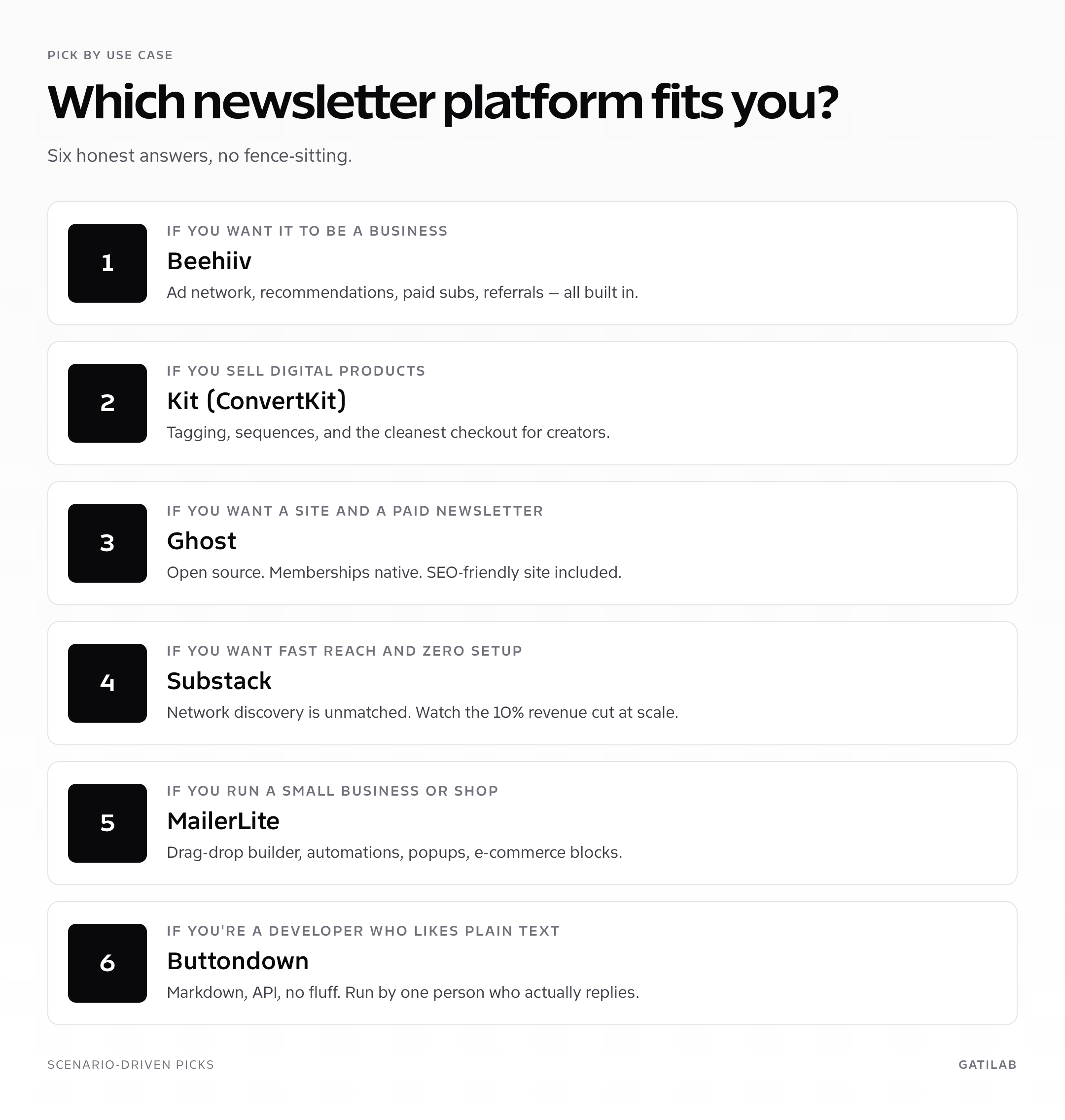
Best newsletter platforms by use case
Use the business model as the tie-breaker. Feature overlap is high; platform incentives and ownership are not.
- Independent writer who wants the fastest start and network discovery: Substack.
- Creator selling courses, books, templates, or services: Kit.
- Newsletter operator building referrals, sponsorships, ads, and paid subscriptions: Beehiiv.
- Publisher who wants the site, archive, newsletter, members, and Stripe relationship together: Ghost.
- Small business running forms, campaigns, and lifecycle automation: MailerLite.
- Developer or minimalist writer prioritizing Markdown, API access, and clean exports: Buttondown.
If two options still fit, compare the required plan at the expected audience size and prove the export path before deciding.
How to switch between newsletter platforms safely
All six paid newsletter platforms support CSV import and export. The pain points are tags, paid subscriber metadata, and DNS. Here’s the migration order I follow when moving a list.
- Export the source list as CSV with all tags, segments, and paid subscriber Stripe IDs
- Set up the destination platform with custom domain DNS verified before importing
- Import in batches of 1,000 to catch syntax errors early; Beehiiv and Kit both flag malformed rows
- Run a single-recipient test send before broadcasting to your full list
- Move paid subscriptions through the destination platform’s Stripe migration tool, not manually
- Run both platforms in parallel for one full send cycle before fully cutting over
- Cancel the source platform only after you’ve confirmed the new platform is sending cleanly
A clean migration takes about a week of elapsed time and roughly 4 hours of focused work. If you have a list over 50,000 subscribers, run a site audit first to make sure your forms, popups, and embedded signups are all pointing at the new platform before you flip DNS.
Compare newsletter platforms on the decision that matters
A head-to-head table is useful only when the rows describe the business model rather than a pile of features.
| Platform | Publishing | Automation | Monetization | Ownership | Best fit |
|---|---|---|---|---|---|
| Beehiiv | Strong | Strong on paid plans | Ads, boosts, referrals, paid subs | Good exports; platform network | Newsletter business |
| Substack | Very simple | Light | Paid subs and network discovery | Exportable list; platform-centric site | Writer starting fast |
| Kit | Broadcast-first | Excellent | Product sales and creator integrations | Strong list controls | Creator commerce |
| Ghost | Excellent CMS | Light to moderate | Paid memberships, direct Stripe | Strongest site and theme control | Owned publication |
| MailerLite | Campaign-first | Strong | Ecommerce and lead workflows | Conventional email ownership | Small business |
| Buttondown | Minimal | Add-on | Paid subscriptions and integrations | Strong export and API posture | Developer or minimalist |
How to compare a newsletter platform responsibly
A fair comparison separates verified plan facts from outcomes controlled by the sender. Pricing, subscriber limits, exports, DNS support, APIs, and feature gates can be checked directly. Inbox placement and revenue cannot be transferred from one publication to another as a universal score.
- Authenticate a test domain with SPF, DKIM, and DMARC.
- Import a small consented segment with representative tags and custom fields.
- Rebuild the welcome flow and one real automation before judging the interface.
- Send seed tests across the inbox providers that matter to your audience.
- Export the list and metadata before committing, so the exit path is proven too.
- Compare the invoice at your current size and at the next two realistic growth tiers.
Common newsletter platform mistakes
Choosing the platform before the business model
A writer building network reach, a creator selling products, a paid publication, and a small business running lifecycle email need different incentives and automation. Define the newsletter’s job before comparing editors.
Sending before authentication and list hygiene are ready
Set up the platform’s required SPF and DKIM records, establish a DMARC policy appropriate to the domain, import only consented contacts, and remove invalid or chronically unengaged addresses under a documented policy. Authentication supports deliverability; it does not guarantee inbox placement.
Treating the welcome flow as decoration
The first messages should deliver the promised value, establish the sender and cadence, set expectations, and move the reader toward the next useful action. Build and test that flow before importing the full list.
Where AI features matter in a newsletter platform
AI writing buttons are not a durable reason to choose a newsletter platform. Similar drafting and summarization features are available in many products and can change quickly.
The more consequential use of machine learning sits behind discovery, recommendations, audience matching, spam controls, and analytics. Those systems affect distribution, but they also make the platform’s incentives more important. A network-first product may reward behavior that an owned publication does not want.
Choose the platform for its business model, ownership, automation, and exit path. Treat AI features as replaceable conveniences unless one is tied to a workflow you have verified.
Choose with a small proof-of-work migration
Shortlist the two platforms that fit the business model, then rebuild one real signup path, welcome flow, issue, segment, and export in each. That exposes the operating differences a feature table cannot show.
- Price the exact feature set at the current list size and two realistic growth tiers.
- Verify domain authentication, reply handling, unsubscribe behavior, and test rendering.
- Import a small consented segment and confirm tags, custom fields, and suppression data.
- Export subscribers and metadata before committing, so the exit path is proven.
- Choose the workflow the team can publish and maintain consistently.
After the platform is settled, use the SEO for SaaS and content-cluster strategy guides only if search is part of the newsletter’s acquisition model.
FAQs about the best newsletter platforms
What is the best newsletter platform in 2026?
Beehiiv is the best default for a newsletter-first media business, Kit for creator commerce, Ghost for an owned publication, Substack for the fastest network-led start, MailerLite for small-business email, and Buttondown for a focused developer workflow.
Which newsletter platform has the best free tier?
Kit has the highest subscriber ceiling here at up to 10,000 on its free Newsletter plan, while Beehiiv Launch supports up to 2,500. MailerLite’s free plan is now limited to 250 subscribers and 2,500 monthly emails. Features and terms still differ.
Is Beehiiv better than Substack?
Beehiiv is better for a newsletter business that wants flat platform pricing, referrals, ads, recommendations, and 0% Beehiiv fee on paid subscriptions. Substack is easier to start and has strong network discovery, but takes 10% of paid subscription revenue.
How much does a newsletter platform cost in 2026?
Current entry points range from free plans to paid tiers based on subscribers, features, or add-ons. Model the invoice at the current size and future tiers, including Substack’s revenue share and any payment processing.
Can you migrate from Substack to Beehiiv?
Yes. Export subscribers and available metadata, authenticate the destination domain, map fields and suppressions, test with a small segment, and plan how the archive, forms, automations, and paid-member experience will move.
Do I need a newsletter platform if I have a website?
Yes when email is the main publishing or relationship channel. A website and newsletter solve different jobs; Ghost combines them, while other platforms can use forms and archives alongside an existing site.
Which newsletter platform has the best deliverability?
No platform has universally best deliverability. Sender reputation, consent, engagement, authentication, content, complaint rate, list hygiene, and infrastructure interact. Compare controls and test the actual domain and audience.
Is Ghost better than WordPress for newsletters?
Ghost is better when the publication, membership, and newsletter should live in one focused CMS. WordPress is better when the site needs its wider plugin, commerce, and content ecosystem. The operating burden differs too.
What’s the cheapest paid newsletter platform?
The cheapest option depends on subscriber count and required features. Buttondown is free for the first 100 subscribers, MailerLite for 250, Beehiiv for 2,500, and Kit for 10,000; their paid capabilities are not equivalent.
Can I use multiple newsletter platforms at once?
Use one primary sending platform for a given audience unless a migration or a clearly separated transactional workflow requires overlap. Multiple marketing senders create suppression, consent, attribution, and reputation problems.
Tell Google you want more of this.
Add Gatilab as a preferred sourceOne tap, and this site shows up more often in your own Top Stories, AI Overviews and AI Mode. Remove it any time.