
Best Email Marketing Software in 2026: 7 Platforms Compared
Picking the best email marketing software in 2026 is harder than it looks. Mailchimp is still the default answer for beginners, but its pricing past 25,000 contacts has driven serious teams elsewhere. Klaviyo took ecommerce. ActiveCampaign owns B2B automations. Kit (the rebranded ConvertKit) became the creator platform of record. Brevo replaced Sendinblue and quietly out-priced everyone on send-based plans. Customer.io won product-led SaaS by treating user events as the unit of email. And Resend rebuilt the developer-facing transactional email category that SendGrid used to own.
Each of these tools wins a different job, and picking the wrong one usually shows up later as a painful migration. This comparison sorts them by the job each does best, so you can pick once.
Picked the tool and stalled on the setup? Gatilab’s email automation service builds the sequences, the segmentation, and the deliverability work that decides whether any of it arrives.
What I look for in the best email marketing software
Five criteria, weighted by what actually predicts success. Deliverability comes first because every other feature is worthless if your campaigns land in spam. Automation depth comes second, because every business that grows runs on lifecycle flows, not one-off broadcasts. Integration sprawl comes third: your email tool has to talk to your CRM, your store, your help desk, your data warehouse. Total cost comes fourth, including the inevitable upgrade tier you’ll hit at 25,000 contacts. Implementation speed comes last, because no email marketing platform is useful if it takes six weeks to launch.
This list of email marketing platforms isn’t ranked top-to-bottom because the right answer depends on what you’re trying to do. A pure ecommerce shop and a 5-person SaaS will pick different tools, and both can be right. The matrix below covers the five questions worth answering before you sign up for anything.
- Deliverability: inbox placement on Gmail, Outlook, Yahoo at 25k+ list sizes
- Automation depth: branching logic, event triggers, multi-channel orchestration
- Integrations: Shopify, Stripe, Segment, HubSpot, Salesforce, custom webhooks
- Total cost: what you pay at 5k, 25k, and 100k contacts
- Implementation speed: from blank account to first automated flow live
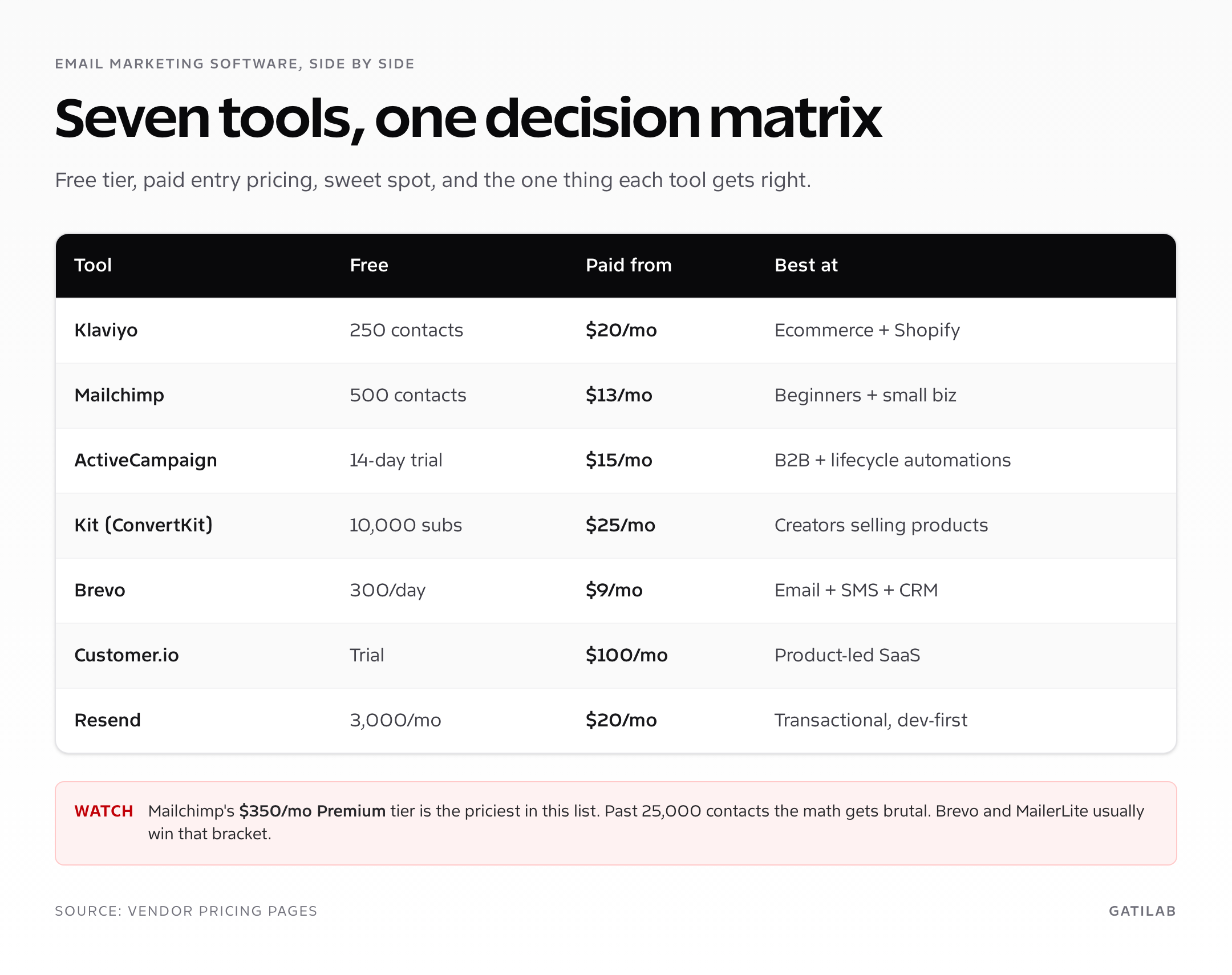
Quick verdict on the best email marketing software
If you sell physical products online, Klaviyo is the best email marketing software in 2026. Period. Nothing else competes on Shopify integration depth or ecommerce data modeling. If you sell B2B services, ActiveCampaign wins. If you sell digital products to a list, Kit wins. If you’re brand new and want a familiar UI, Mailchimp is the sensible starting point. If budget is tight and you need email plus SMS, Brevo is the answer. If you’re a product-led SaaS sending behavioral emails, Customer.io is the platform. If you’re a developer who needs transactional email, use Resend.
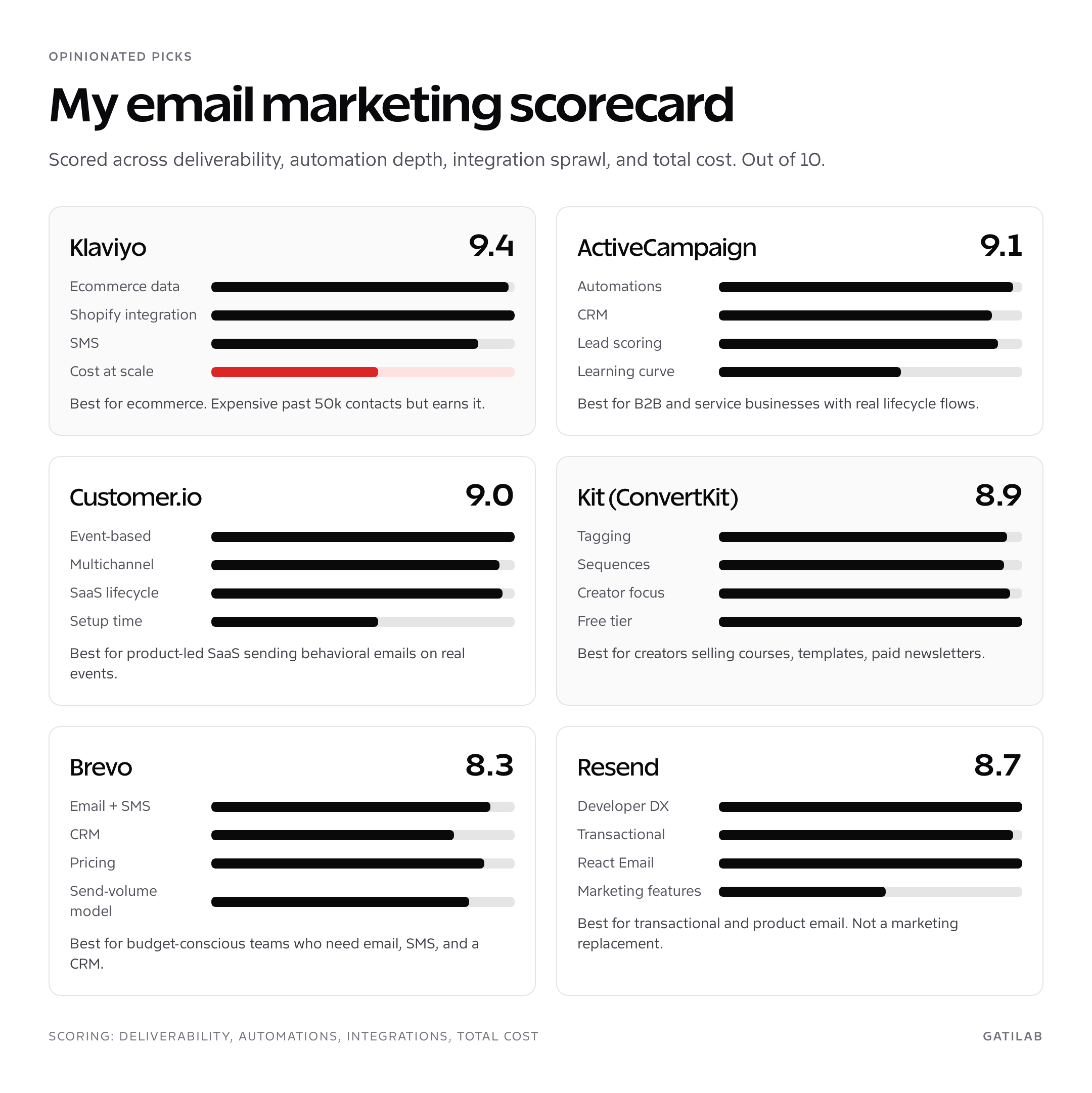
1. Klaviyo: best email marketing software for ecommerce
Klaviyo is the best email marketing platform for any business that sells physical products. The ecommerce data model is in a different league. When a Klaviyo account connects to Shopify, BigCommerce, or WooCommerce, it pulls every product, every variant, every order, every customer event, and treats them as first-class data. You can segment a list by “people who bought from collection X but not collection Y in the last 90 days” without writing a single line of SQL.
The payoff usually comes from segmentation a list-based tool can’t express, plus the standard abandoned-cart, browse-abandonment, and post-purchase flows, which take a day or two to build and then run on their own. That kind of compounding ROI is why ecommerce stores default to Klaviyo even though it costs more than Mailchimp at scale.
Klaviyo pricing in 2026
- Free: up to 250 contacts, 500 sends/month, basic segmentation
- Email: from $20/mo for 500 contacts, scales by contact count to about $720/mo at 50,000
- Email + SMS: email pricing plus SMS and other mobile messages billed per message, which varies by country
- Reviews and CDP add-ons: separate pricing, available on higher tiers
Try Klaviyo free up to 250 contacts. The free tier is enough to validate the move from Mailchimp before paying anything.
2. Mailchimp: best email marketing tool for beginners
Mailchimp is the default for a reason. The onboarding is the cleanest in the category, the templates are familiar, and the brand is universally trusted. For a small business owner sending a monthly newsletter to 1,500 customers, Mailchimp is genuinely fine. The free tier covers 250 contacts and 500 sends per month. The paid Essentials, Standard and Premium plans are priced by contact count, and Standard is the tier that adds the fuller automation builder.
The two pain points show up later. Deliverability past 25,000 contacts has historically been weaker than Klaviyo or Brevo because Mailchimp shares IP pools across millions of senders. And the pricing curve gets punishing as the list grows, with Premium priced well above the other tiers. Growing stores and B2B teams often outgrow Mailchimp and move to Klaviyo or ActiveCampaign.
If you’re a freelancer or a brand-new business and you want one email marketing platform you can stop thinking about for a year, Mailchimp is a perfectly good answer. Migrate later when the numbers force the question.
3. ActiveCampaign: best email marketing platform for B2B
ActiveCampaign suits B2B and service businesses that need a flexible automation builder. Contacts, tags and email workflows sit at its core. Enhanced pipeline management and sales engagement are separate CRM add-ons, so include them in the cost comparison when your workflow needs them.
The downside is the learning curve. Branching automations with multiple triggers, conditional waits, and CRM updates can become genuine spaghetti if you don’t plan them. Map each automation on paper before you build it. Teams that skip that step are why running ActiveCampaign is a steady line of agency work.
ActiveCampaign pricing in 2026
- Starter: 5 actions per automation, limited segmentation and 1 user. From $15/month billed annually ($19 billed monthly) at 1,000 contacts.
- Plus: unlimited automation actions, standard segmentation, landing pages and 1 user. Enhanced CRM features are add-ons.
- Pro: advanced segmentation, attribution and conversion tracking, predictive content and 3 users.
- Enterprise: premium integrations, custom objects, single sign-on, a dedicated account team and 5 users.
Get started at ActiveCampaign. The 14-day trial is enough to import a list and ship one real automation.
4. Kit (formerly ConvertKit): best for creators and digital products
Kit is the best email marketing software for creators selling digital products to a list. Tagging is the killer feature. You can tag a subscriber based on what link they clicked, what form they came in through, or what product they bought, and then route them through branching sequences that feel personal even at 50,000 subscribers.
The 2024 rebrand from ConvertKit to Kit added a creator app store with native integrations to Stripe, Gumroad, Teachable, Podia, and a long list of creator tools. The free tier covers 10,000 subscribers, the most generous in the category for a tool with this feature set. Paid Creator plans start at $33/month billed annually ($39 billed monthly) for 1,000 subscribers.
Sign up for Kit (ConvertKit) free. If your business is “I make digital things and sell them to a list,” this is the tool.
5. Brevo: best email marketing software for budget plus SMS
Brevo (formerly Sendinblue) is the price-performance pick. Plans start at $9/month and pricing is based on send volume rather than contact count, which is unusual in this category. If you have a 100,000-contact list but only email 10,000 of them per month, Brevo is dramatically cheaper than Mailchimp or Klaviyo. The platform also bundles email, SMS, WhatsApp, transactional, and a basic CRM into one account, which makes it the cleanest pick for teams that want fewer SaaS subscriptions. Use the affiliate link at Brevo to start.
Brevo pricing in 2026
- Free: 300 emails/day, drag-drop builder
- Starter ($9/mo for 5,000 sends): no daily limit, basic reporting, no Brevo logo
- Standard ($18/mo for 5,000 sends): A/B testing, advanced stats, marketing automation
- Professional ($499/mo) and Enterprise (custom pricing): the tiers for larger teams that need multi-user access, SSO and a dedicated rep
The downside is that Brevo’s automation builder is less polished than ActiveCampaign’s, and integrations are thinner than Klaviyo’s on the ecommerce side. For pure cost-per-send and a CRM bundled in, though, no other email marketing platform comes close.
6. Customer.io: best for product-led SaaS
Customer.io is the email marketing software you pick when your product generates events and you want emails to fire on those events instead of on list updates. A user signs up, hits a feature flag, completes onboarding step 3, fails to upgrade after their trial, downgrades, churns. Every one of those is an event your code can stream to Customer.io, and a campaign can react in real time.
Pricing starts around $100/month for the Essentials plan with 5,000 profiles. That’s expensive for a small list and trivially cheap for a SaaS doing $1M+ ARR where lifecycle email moves real revenue. The platform pairs naturally with Segment, Snowflake, and most modern data warehouses, which is why product teams reach for it instead of bolting events onto a marketing-list tool.
If your business runs on user events, see Customer.io. If your business runs on broadcast newsletters and seasonal campaigns, this is overkill. Go with Klaviyo or ActiveCampaign instead.
7. Resend: best for developer-first transactional email
Resend isn’t really competing with the rest of this list, and that’s why it belongs on it. Resend is the developer-first transactional email API that replaces SendGrid for most modern teams. The DX is exceptional. React Email components let you write transactional templates as React JSX. The dashboard is the cleanest in the category. Pricing starts at $20/month for 50,000 emails, scales linearly, and the free tier covers 3,000 emails/month.
Resend doesn’t do segmentation, automations, or marketing campaigns in the way the other six tools do. Use it for password resets, receipts, magic-link signups, and product notifications. Pair it with Klaviyo or Customer.io for marketing email and you have a stack that’s hard to beat. Sign up at Resend.
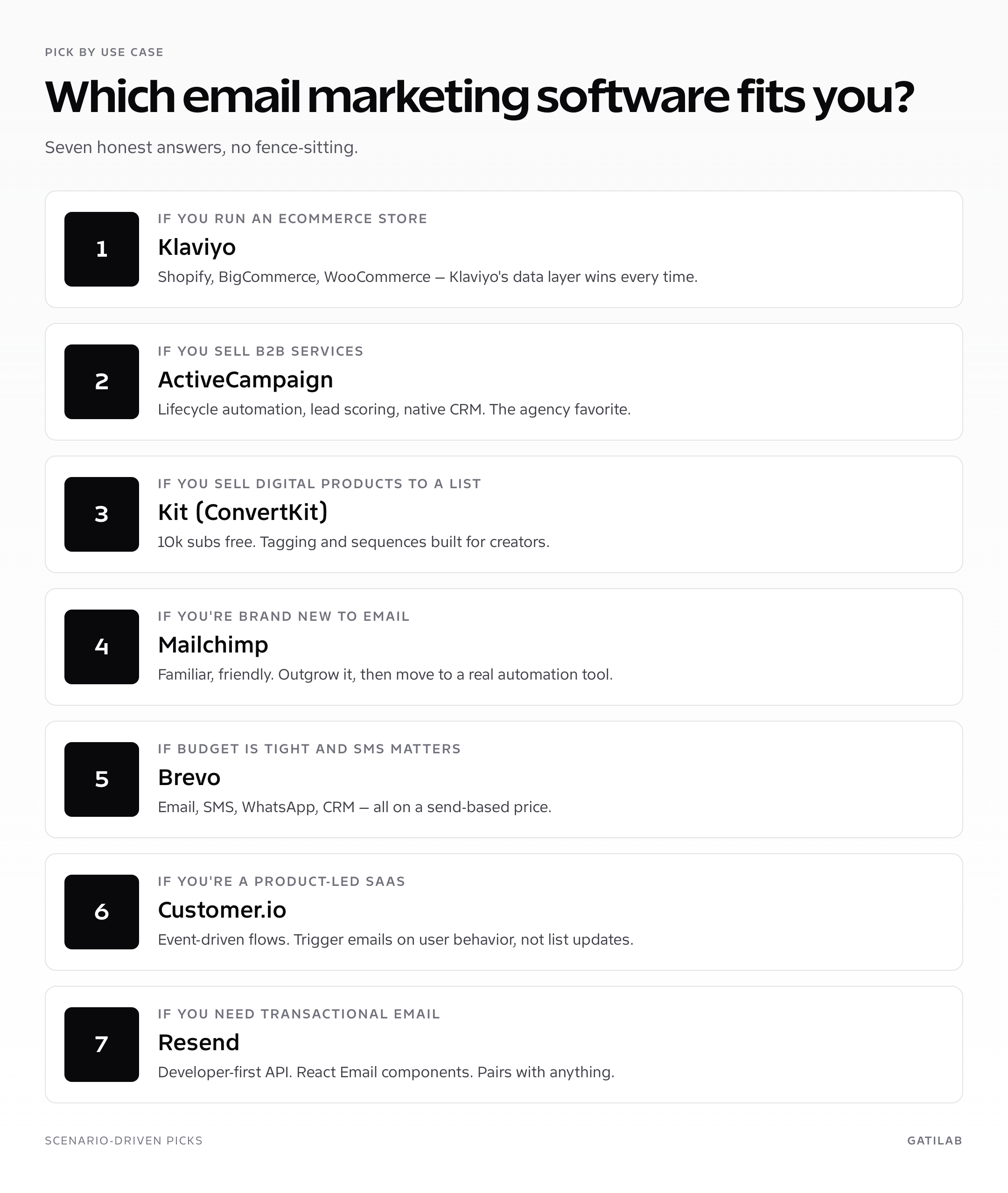
Best email marketing software by use case
Here’s the five-second answer for the most common scenarios. Top email marketing tools sorted by who you are, not by feature count.
If you sell physical products online
Klaviyo. Don’t overthink it. The Shopify integration alone is worth the higher price.
If you sell B2B services or run an agency
ActiveCampaign. Lifecycle automation, lead scoring, and a real CRM you’ll actually use.
If you’re a creator selling digital products
Kit. Free up to 10,000 subscribers and built around tagging plus sequences.
If you run a small business and want familiar tools
Mailchimp. Migrate to Klaviyo or ActiveCampaign once you cross 25,000 contacts.
If you need email plus SMS plus a CRM on a budget
Brevo. Send-volume pricing instead of contact-count pricing changes the math in your favor.
If you’re a product-led SaaS
Customer.io. Trigger emails on user events, not list updates. Pair with Segment for clean data.
If you need transactional email
Resend. Developer-first, React Email native, replaces SendGrid for most modern stacks.
How to test email marketing tools before you commit
Run your own trial before you move a real list. Import a sample of a few hundred contacts, set up full DNS authentication (SPF, DKIM, DMARC), and send the same campaign from each shortlisted tool to a seed list of Gmail, Outlook, and Yahoo inboxes so you can see where each one lands.
Then time the work that matters to you: how long the first automated flow takes to build, how the tool handles conditional logic, and how cleanly it exports your data if you leave. Once authentication is right, deliverability differences between serious platforms are usually small. The real gaps show up in automation flexibility, integration depth, and total cost at scale.
Comparing the best email marketing software head-to-head
Here’s the side-by-side on the metrics that decide an email marketing software comparison: free tier, ecommerce integration quality, automation depth, and SMS support.
| Tool | Free tier | Ecommerce | Automations | SMS |
|---|---|---|---|---|
| Klaviyo | 250 | Best in class | Strong | Yes |
| Mailchimp | 500 | Decent | Decent | No native |
| ActiveCampaign | Trial | Decent | Best in class | Yes |
| Kit | 10k subs | Via integrations | Strong | No |
| Brevo | 300/day | Decent | Decent | Yes |
| Customer.io | Trial | Via Segment | Best in class | Yes |
| Resend | 3k/mo | API-driven | Limited | No |
Common email marketing software mistakes to avoid
Three mistakes keep showing up in email platform migrations. Each one costs real money. Each one is fixable in under a day if you catch it early. Use this section as a pre-launch checklist for whatever email marketing platform you pick.
Mistake 1: Skipping DNS authentication on day one
SPF, DKIM, and DMARC. If your domain doesn’t have all three set up correctly, your mail is far more likely to land in spam or be rejected. Since February 2024, Gmail requires SPF, DKIM, and DMARC from anyone sending 5,000 or more messages a day to Gmail addresses. Every email marketing platform on this list shows you exactly which records to add. Add them. Verify them. Don’t send a campaign until you have.
Mistake 2: Treating list-cleanliness as optional
A list with 30 percent dead addresses will tank your sender reputation in two campaigns. Every tool here ships some flavor of list cleanup, and you can pre-clean a list with NeverBounce or ZeroBounce for about $0.005 per address. Do it before you import. The first send to a clean list is the difference between Promotions tab and Spam folder.
Mistake 3: Building automations without an exit
Every automation needs an end state. “What happens when this person buys?” should be answered in the flow itself. Otherwise you’ll have customers receiving abandoned-cart emails three days after their order arrived. ActiveCampaign and Customer.io let you exit on event. Klaviyo lets you exit on segment. Use these. Don’t trust yourself to remember manually.
Where to go from here
Pick a platform from the use-case list above, sign up for the free tier, and import 100 contacts. Send one campaign. Build one automation. Two days from now you’ll know whether the tool fits how you think. Expect to switch email marketing platforms once or twice in your company’s lifetime, usually around 10,000 contacts (when small-business tools start to feel cramped) and again around 100,000 (when scale economics force a different tool). Plan for it, pick a platform with clean exports, and don’t lock yourself in.
If your goal is to grow the list itself, the email marketing platform matters less than the acquisition strategy. Pair whatever tool you pick with strong content and a clear CTA on every page. The SEO for SaaS playbook covers how to drive list signups from search, and the content cluster strategy walks through how to turn a single high-intent keyword into a long-term subscriber funnel. If you also send a publication-style newsletter, my best newsletter platforms roundup covers the creator-side tools, and Mailchimp vs Klaviyo goes deeper on the ecommerce migration most stores hit at 25k contacts.
Whatever you pick, start sending. Tooling is the easy part. Cadence and content are what move revenue. The best email marketing software for your business is the one that doesn’t get in the way of the send button.
Email marketing software trends to watch in 2026
Three shifts are reshaping the best email marketing software category right now. The first is the consolidation of email and SMS into single platforms. Klaviyo, ActiveCampaign, Brevo, and Customer.io all ship native SMS in 2026, with delivery rates well above 95 percent and pricing that finally competes with standalone SMS providers like Twilio. If your customer base is mobile-first, that bundle has become a real reason to consolidate vendors.
The second shift is AI subject lines and send-time optimization. Every email marketing platform on this list ships some flavor of AI in 2026. My take: A/B test AI subject lines against your own, turn on send-time optimization once your list is warmed up, and keep writing the body copy yourself, because AI body copy still reads like AI body copy. Use the optimization features. Skip the writing features.
The third shift is BIMI and brand-protected sending. Gmail, Yahoo, and Apple Mail now show your verified logo in the inbox if you have a BIMI record plus a Verified Mark Certificate. Outlook does not support BIMI yet. Klaviyo, ActiveCampaign, and Brevo all support BIMI natively. Mailchimp’s support is partial. Customer.io and Resend assume you handle DNS yourself, which most teams should anyway.
Total cost of ownership at scale
Sticker price is not total cost of ownership. The hidden costs that bite hardest are: paid integrations and SaaS bolt-ons (Mailchimp’s ecosystem assumes you’ll add Zapier, popup tools, and reporting dashboards), paid IP warmup services (about $300 to $800 for a clean migration on Klaviyo or Customer.io), agency time to build automations (the first 5 lifecycle flows usually take 30 to 60 hours of focused work), and the inevitable second migration most teams do somewhere between 25,000 and 100,000 contacts. Budget for these up front and you will not be surprised on month four.
Run that math on your own stack: add up the email tool, Zapier, the popup tool and the review platform, then compare the total with one platform that bundles those jobs. That kind of math is why the best email marketing software for your business at year one is rarely the best one at year three.
FAQs about the best email marketing software
What is the best email marketing software in 2026?
Klaviyo is the best email marketing software in 2026 for ecommerce, ActiveCampaign is best for B2B and lifecycle automation, and Kit is best for creators selling digital products. There is no single winner because the right tool depends on your business model. For most small businesses just getting started, Mailchimp remains the easiest entry point.
Which email marketing platform has the best deliverability?
Deliverability depends more on your setup than on the platform: SPF, DKIM, and DMARC authentication, a clean list, and steady sending volume. With that in place, Klaviyo, ActiveCampaign, Brevo, and Kit all deliver well. Mailchimp’s deliverability has lagged for shared-IP senders past 25,000 contacts. Dedicated IP setup on the higher tiers narrows the gap for any platform on this list.
How much does email marketing software cost in 2026?
Email marketing software pricing in 2026 ranges from free to $300+ per month at typical small-business and creator volumes. ActiveCampaign Starter starts at $15/mo billed annually, Klaviyo at $20/mo, Kit Creator at $33/mo billed annually, and Brevo Starter at $9/mo. Customer.io starts at about $100/mo. Expect to pay $50 to $200 per month at the 10,000-contact mark on most platforms.
Is Klaviyo better than Mailchimp?
Klaviyo is better than Mailchimp for ecommerce stores because of the deeper Shopify, BigCommerce, and WooCommerce integrations and a far stronger data model for product-based segmentation. Mailchimp is better than Klaviyo for non-ecommerce small businesses, beginner users, and any team that wants the simplest possible learning curve. Most ecommerce stores doing more than $100k in annual revenue should be on Klaviyo.
What is the best email marketing software for small business?
Mailchimp and Brevo are the best email marketing software options for most small businesses in 2026. Mailchimp wins on familiarity and ease of use, Brevo wins on price and bundles in SMS plus a basic CRM. Both have generous free tiers (250 contacts on Mailchimp, 300 emails/day on Brevo). For service-based small businesses with real lifecycle flows, ActiveCampaign Starter (from $15/mo billed annually) is the upgrade path.
Can I migrate from Mailchimp to Klaviyo?
Yes, Klaviyo has a native Mailchimp importer that pulls contacts, lists, segments, and tags. The migration takes 24 to 48 hours for the contact import, and most teams can rebuild their core automations in another week of focused work. Run both platforms in parallel for one full send cycle, then cut DNS over to Klaviyo and pause sends from Mailchimp before you cancel.
Which email marketing platform is best for ecommerce?
Klaviyo is the best email marketing platform for ecommerce in 2026. The Shopify, BigCommerce, and WooCommerce integrations are the deepest in the category, the segmentation engine handles product-level data natively, and the automation flows for cart abandonment, browse abandonment, and post-purchase are built specifically for stores. ActiveCampaign and Brevo are reasonable second choices.
Is ActiveCampaign worth the price?
ActiveCampaign is worth the price for any business running real lifecycle automations or B2B sales sequences. The native CRM, lead scoring, and branching automations justify the premium over Mailchimp for service businesses. For a hobbyist newsletter or a simple monthly digest, ActiveCampaign is overkill. Use Mailchimp or Kit instead.
What’s the difference between Resend and the rest?
Resend is a transactional email API for developers, not a marketing email platform. It sends password resets, receipts, magic links, and product notifications via API instead of campaigns from a dashboard. Pair Resend with Klaviyo, ActiveCampaign, or Customer.io for a complete email stack: transactional via Resend, marketing via the marketing tool.
Should I use email marketing software with my CRM or pick separate tools?
Most teams under 50 employees should use email marketing software with built-in CRM (ActiveCampaign or Brevo) to keep things simple. Teams over 50 employees, especially in B2B SaaS, should use a dedicated CRM (HubSpot, Salesforce, or Pipedrive) and connect it to a best-in-class email marketing platform. Customer.io and Klaviyo both integrate cleanly with most major CRMs.
Tell Google you want more of this.
Add Gatilab as a preferred sourceOne tap, and this site shows up more often in your own Top Stories, AI Overviews and AI Mode. Remove it any time.