
Substack vs Beehiiv 2026: Best Newsletter Platform Compared
Substack vs Beehiiv is the newsletter platform decision shaping the creator economy in 2026. Substack invented the modern paid newsletter and still owns the discovery side. Beehiiv was built by ex-Morning Brew operators and out-features Substack on growth tools, monetization options, and customization. The short answer: pick Substack if you’re starting out and want built-in audience, or pick Beehiiv if you’ve already proven you can grow a list and want to maximize revenue per subscriber.
Substack and beehiiv use different cost models and growth systems. This comparison covers current published pricing, paid-subscription fees, audience tools, editor and design, discoverability, migration boundaries, and the use cases where each platform earns its place.
Migrating the list, or scaling it? Gatilab’s email automation service covers the move, the sequences that run after it, and the deliverability checks that follow.
The short verdict on Substack vs Beehiiv
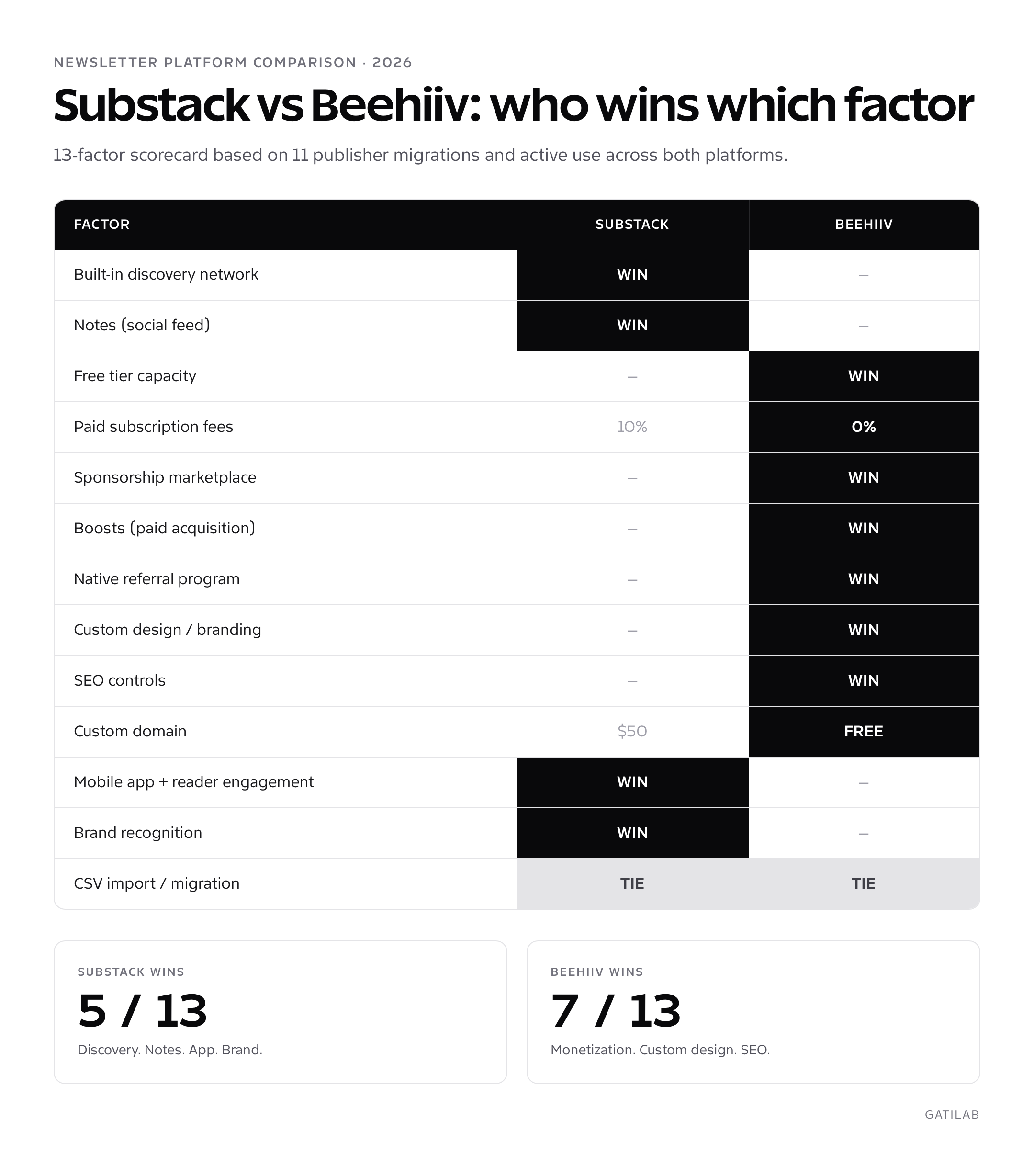
The Substack vs Beehiiv decision in 2026 splits along three axes: where your audience comes from, how you plan to monetize, and how much customization you need.
| Factor | Winner | Notes |
|---|---|---|
| Built-in discovery network | Substack | 20M+ readers, recommendations engine |
| Notes (Twitter-style social feed) | Substack | Best built-in growth tool in newsletters |
| Free tier capacity | Beehiiv | 2,500 subscribers free vs Substack unlimited but takes 10% |
| Paid subscription fees | Beehiiv | 0% platform fee on paid subscriptions vs Substack’s 10% |
| Sponsorship marketplace | Beehiiv | Built-in ad network for newsletter operators |
| Boosts (paid-acquisition channel) | Beehiiv | Network-wide cross-promotion at fixed CPA |
| Referral program builder | Beehiiv | Native; Substack doesn’t have one |
| Custom design / branding | Beehiiv | Far more layout, color, and typography control |
| Custom domain | Beehiiv | Free; Substack charges $50 one-time |
| SEO controls | Beehiiv | Per-post meta, schema, sitemaps |
| Migration ease (CSV import) | Tie | Both make import easy |
| App and reader experience | Substack | Higher engagement on Substack mobile app |
| Brand and credibility | Substack | The Substack name still carries weight in 2026 |
Beehiiv wins more categories on a feature-by-feature basis. Substack wins the categories that drive new subscribers from scratch. The Substack vs Beehiiv tradeoff isn’t features vs simplicity. It’s “platform helps me grow” vs “platform gets out of my way.” The Beehiiv vs Substack framing flips depending on whether you have an audience already.
One context worth noting up front: both platforms are still relatively young. Substack launched in 2017. Beehiiv launched in 2021. They’ve each had multiple pricing changes and feature rollouts in the last 24 months. Anything you read about either platform from before 2025 is partially out of date. The 2026 versions are meaningfully different from the 2023 versions, especially around monetization and discoverability.
Substack vs Beehiiv Pricing
Substack charges by paid revenue. beehiiv charges by plan and subscriber tier. The break-even depends on paid revenue, not only list size.
| Platform or plan | Published price | Paid-subscription platform fee | Important limit |
|---|---|---|---|
| Substack | $0 publishing fee | 10% of each paid transaction | Stripe processing and Billing fees are separate. |
| beehiiv Launch | $0/month | Paid subscriptions not included | Up to 2,500 subscribers |
| beehiiv Scale | $43/month billed annually; $517/year | 0% take rate | Up to 100,000 subscribers; 3 team seats |
| beehiiv Max | $96/month billed annually; $1,151/year | 0% take rate | Up to 100,000 subscribers; unlimited seats |
At $1,000 in monthly paid revenue, Substack’s platform share is $100 before Stripe fees. At $5,000, it is $500. Compare that variable cost with the beehiiv plan required for your list and feature set. beehiiv pricing
Monetization options compared
Substack offers four revenue streams: paid subscriptions, founding member tiers (one-time higher payments), Stripe Connect for sponsorship payments, and Substack Pledges (subscribers commit to pay if you turn on subs). The platform takes 10% on subscriptions but no cut on founding member tiers (effectively the same model). Sponsorships are entirely on you.
Beehiiv offers more revenue streams and takes less:
- Paid subscriptions: 0% platform fee, just Stripe
- Beehiiv Ad Network: built-in sponsorship marketplace; advertisers buy slots in your newsletter
- Boosts: other publishers pay you per subscriber referred (typical $1-5 CPA)
- Premium content paywalls with multi-tier subscriptions
- Affiliate revenue tracking
- Custom referral program with rewards (e.g., gift subscriptions, swag)
The beehiiv Ad Network can reduce the work of sourcing sponsors, but earnings depend on eligibility, audience, geography, inventory, campaign demand, and accepted placements. Use the account’s actual offers and payout terms instead of a universal revenue range.
The math comparison at scale. A newsletter earning $4,000/month in paid subscriptions plus $1,500/month in sponsorships gets very different platform costs:
| Revenue stream | Substack take | Beehiiv take |
|---|---|---|
| $4,000/mo paid subscriptions | $400 (10%) | $0 platform fee |
| $1,500/mo sponsorships (manual) | $0 (you handle) | $0 (you handle) |
| Beehiiv Ad Network potential | Not available | +$500-$1,500/mo extra |
| Boosts revenue potential | Not available | +$200-$800/mo extra |
| Platform fee | $0 | $96/mo Scale tier |
| Net platform cost / month | $400 | $96 |
| Net additional revenue / month | $0 | +$700-$2,300 |
The combined impact: at the example revenue level, Beehiiv saves $304/month in platform fees and unlocks $700-$2,300/month in additional revenue streams. That’s a swing of roughly $1,000-$2,600/month, or $12,000-$31,000/year, in favor of Beehiiv for a mid-tier paid newsletter. The numbers explain why every successful Substack writer eventually weighs migration.
Substack doesn’t compete here. The Substack alternative model relies on Notes-driven discovery and paid subscriptions. If your audience growth strategy depends on cross-newsletter sponsorship swaps and ad-network revenue, Beehiiv is purpose-built for it.
Audience growth tools
This is where the platforms diverge most clearly. Substack’s growth model is network-driven. Beehiiv’s growth model is operator-driven.
Substack growth advantages:
- Notes feed. Twitter-style short posts where readers discover writers, then subscribe to their newsletters. Driving 25-40% of new signups for active writers in 2026.
- Recommendations. Other Substack writers can recommend yours, surfacing your newsletter to their subscribers
- App engagement. The Substack app drives 2-3x higher open rates than email-only readers
- Substack Reads / Charts. Editorial features that boost discoverability
- Paid Substack ads (added 2024). Newsletter operators can run promoted Notes
Beehiiv growth advantages:
- Boosts. Pay-per-subscriber acquisition through the Beehiiv network. Typical CPA of $1.50-$5
- Native referral program. Reward subscribers for referring friends, fully automated
- Magic Links. Trackable referral links for podcast and partner promotion
- Web SEO. Full per-post meta tags, sitemaps, structured data, and a real CMS-like website
- Forms anywhere. Subscribe widgets that work outside Beehiiv’s domain
- UTM tracking and source attribution
Substack pulls subscribers from inside its own ecosystem. Beehiiv supports you pulling subscribers from outside (SEO, social, paid ads, partnerships) and tracking where they came from. If you have an existing audience to migrate, Beehiiv’s tools work better. If you’re starting cold and want the platform to do some heavy lifting, Substack’s network is genuinely useful.
Substack recommendations and Notes create an internal discovery path. beehiiv combines referral, Boosts, website, and search-oriented tools. Compare the channels with a cohort table that records subscriber source, cost, activation, engagement, paid conversion, and retention; a list-size total alone cannot identify the better growth system.
For my own audience-building approach across multiple channels, see my content marketing framework. Newsletters work best as one channel in a system, not as the only channel.
Editor and design
Substack’s editor is intentionally minimal. Headline, image, paragraphs, links, embedded video, optional pull quotes, and a basic block-based UI. The simplicity is the point. Substack publications look almost identical, and that consistency is part of the brand.
Beehiiv’s editor is closer to a modern CMS. Custom HTML blocks, color palette controls, multiple template options, conditional content (subscriber-tier-specific sections), polls, surveys, and embedded forms. You can make a Beehiiv newsletter look like a real publication. You can also make it look messy if you over-design.
Design parity comparison:
| Element | Substack | Beehiiv |
|---|---|---|
| Logo + masthead | Yes | Yes, fully customizable |
| Color palette | 3 preset options | Unlimited custom |
| Typography control | Limited (3 font choices) | 10+ fonts + custom |
| Custom HTML / CSS | No | Yes (Scale tier and up) |
| Multi-section newsletters | No | Yes |
| Multiple authors | Yes | Yes |
| Web archive design | Substack default | Highly customizable |
| Custom domain support | $50 one-time | Free, fully integrated |
Substack’s design constraint is good for new writers (you can’t fail at design) and bad for established publishers (you look like every other Substack). Beehiiv’s design freedom is the opposite: better for brands, worse for first-time publishers without design skill.
Two practical examples worth flagging. Stratechery, Ben Thompson’s pioneering paid newsletter, runs on his own custom infrastructure precisely because neither Substack nor Beehiiv (early days) could match the design and brand control he needed. Substack-native publications like Heather Cox Richardson’s “Letters from an American” lean into the platform’s defaults and that consistency contributes to the brand. The right design choice depends on whether your readers value visual brand or substantive content. For most newsletters under 25,000 subscribers, the substantive content matters more than the design, which means Substack’s defaults are fine.
Discoverability and SEO
Substack drives discovery through Notes, recommendations, and the app feed. Beehiiv drives discovery through SEO and the open web. Different fishing grounds.
Substack pages do rank in Google but the SEO controls are minimal. You get a default URL slug, basic meta description from your subhead, and standard schema. You can’t add structured data, customize Open Graph tags, or run robots directives. It’s good enough for casual ranking, not for serious organic growth.
Beehiiv treats your newsletter as a real website. Custom URL slugs per post, full meta tag control, automatic XML sitemaps, schema markup for articles and authors, and all the technical SEO controls a competent publisher needs. Beehiiv newsletters can compete in search for high-value keywords. Substack newsletters mostly can’t.
For traditional content discovery beyond the newsletter ecosystem itself, see my walkthrough of best blogging platforms. The newsletter-vs-blog choice isn’t always either-or; many serious publishers run both.
One more discoverability nuance: app readership. Substack’s iOS and Android apps have strong daily active usage among engaged readers. Push notifications drive open rates that look closer to social-media engagement than email engagement. For a Substack writer with 10,000 subscribers, app reads can drive 35-50% of total engagement. Beehiiv has no equivalent app. If your readers are the kind who’d prefer a feed-based reading experience, Substack’s app is genuinely an asset. If your readers want emails in their inbox, the app is irrelevant.
Migration: moving between platforms
Both platforms support CSV import for subscriber lists. Substack lets you export your subscriber list, paid subscription history, and posts. Beehiiv accepts the Substack export format directly with a built-in migration tool. The mechanical migration takes hours, not days.
What breaks during a Substack-to-Beehiiv migration:
- Notes audience. Your followers on Notes don’t migrate. They have to re-subscribe to your newsletter directly
- Recommendation network. Substack writers who recommended your publication can’t recommend it from Beehiiv
- App readership. Subscribers who read in the Substack app must re-engage with email or your new web archive
- Search visibility. Old Substack URLs become 404s unless you set up redirects (you can with custom domain only)
- Subscriber engagement. Open rates typically drop 10-20% in the first month after migration as readers adjust
What breaks during a Beehiiv-to-Substack migration:
- Custom design. You lose all custom branding and revert to Substack defaults
- Multi-tier subscriptions. Substack supports paid + free; Beehiiv’s premium tier structures don’t transfer cleanly
- Referral program data. Lost; Substack doesn’t have an equivalent
- SEO. Page rankings start over from a new domain pattern
Migration becomes worth evaluating when platform fees, automation, referrals, ads, team access, design control, or network discovery materially change the newsletter’s economics. Model the current list and paid revenue before moving.
Plan for a 3-month migration cycle if you’re moving from Substack: 30 days to set up the Beehiiv account properly, 30 days to run both newsletters in parallel and warm the new sender, 30 days to fully cut over and decommission the Substack publication. Don’t try to do it in two weeks. The deliverability and engagement consequences of rushing this are real.
Use case picks: who should buy what
Pick Substack if:
- You’re starting a newsletter from scratch with no existing audience
- Your topic fits Substack’s existing reader base (politics, culture, finance, tech, books, food)
- You want to publish text and let the platform handle distribution
- You’re not yet thinking about sponsorships or referral programs
- You’ll spend more time writing than marketing
Pick Beehiiv if:
- You already have an audience (newsletter, social, blog) you’re migrating
- You earn meaningful revenue from paid subscriptions or sponsorships
- You want to track sources, run referral campaigns, and run paid acquisition
- SEO and the open web are part of your discovery strategy
- You want a custom-branded publication, not a generic Substack
Pick something else if:
- You sell courses or info products: Kit (ConvertKit) is built for that
- You’re an ecommerce store: Klaviyo, not a newsletter platform
- You’re an enterprise B2B publisher: HubSpot or a dedicated email platform
- You write a serious longform blog: WordPress + ConvertKit gives you more long-term flexibility
The honest recommendation
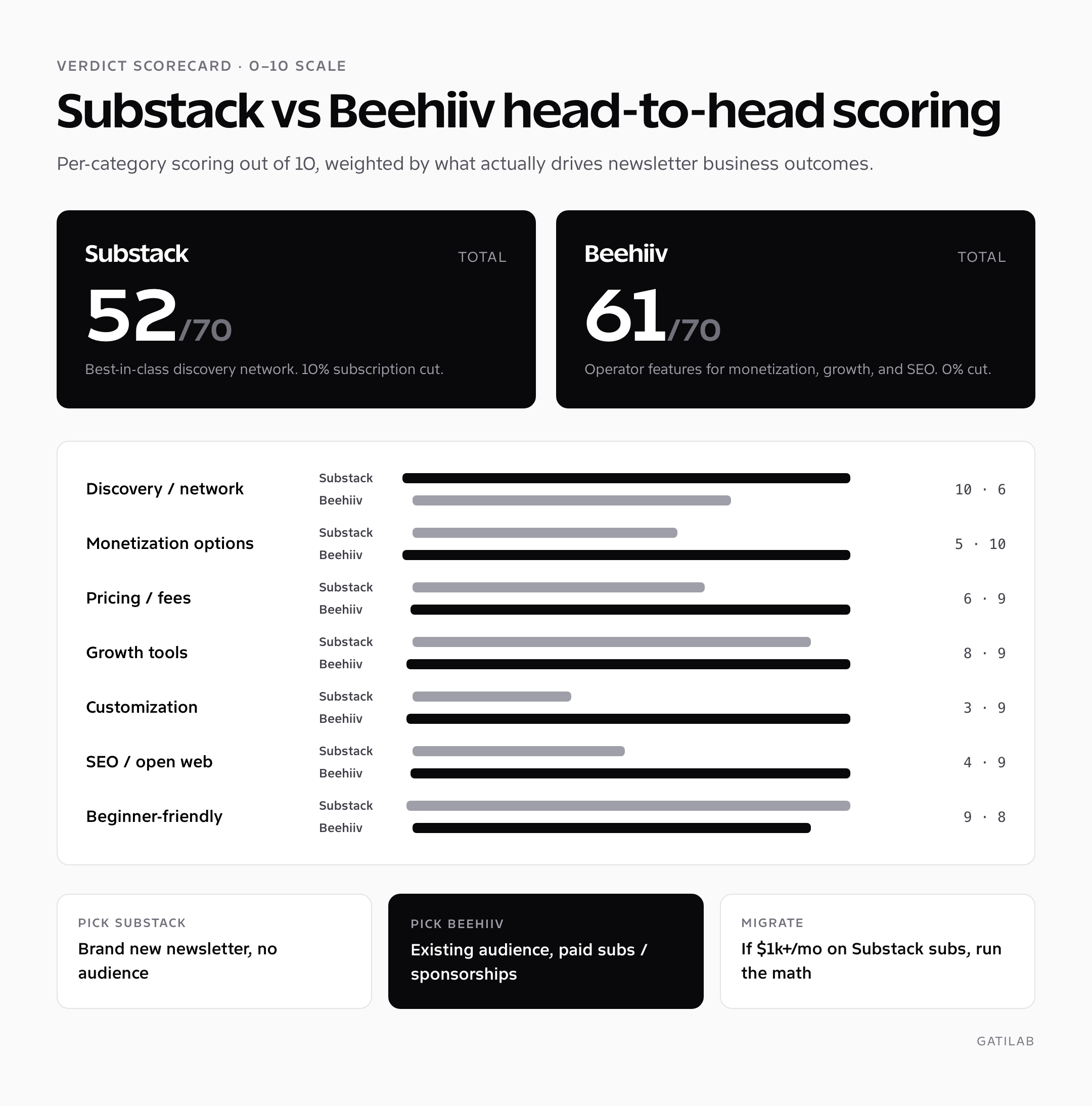
If you’re starting from zero, pick Substack. The discovery network is real, the brand is real, and you don’t pay anything until you start charging readers. The 10% cut is annoying but it’s “annoying once you’re successful,” not “blocking you from getting started.” You can always migrate later.
If you have an audience already, pick Beehiiv. The 0% platform fee on paid subscriptions, the ad network, the referral program, and the SEO controls compound into a meaningfully better business at scale. The flat monthly cost is predictable and it stays affordable through six-figure subscriber counts.
If you’re somewhere in the middle (5,000-10,000 subscribers, considering charging), test Beehiiv with a free account first. Run two newsletters in parallel for a quarter. Send the same content to both. Track which platform delivers better engagement, growth, and revenue per subscriber. The right answer for you depends on your topic, your audience source, and your monetization strategy.
The best newsletter platform isn’t a fixed answer. It changes as your business changes. Substack is the better starter platform. Beehiiv is the better grown-up platform. Both can host a real newsletter business in 2026, but they’re optimizing for different stages of that business.
One final note. The Substack vs Beehiiv conversation often turns into culture war (politics on Substack, “real publishing” on Beehiiv). Ignore that. Pick the platform that helps your specific newsletter make money or grow faster. The cultural noise is a sideshow.
Judge the platform after a defined publishing period with consistent cadence, acquisition tracking, engagement, paid conversion, churn, and operating time. Neither platform can compensate for an undefined audience or an abandoned publication.
Is beehiiv better than Substack?
beehiiv is stronger when you need automation, a referral program, a native ad network, and 0% platform take rate on paid subscriptions. Substack is simpler and has built-in discovery. The better choice depends on revenue, list size, and operating needs.
Does Substack take a cut of paid subscriptions?
Yes. Substack charges 10% of each paid transaction. Stripe processing and recurring Billing fees are separate.
How much does beehiiv cost?
beehiiv Launch is free up to 2,500 subscribers. At the current annual-billing display, Scale is $43 per month ($517 yearly) and Max is $96 per month ($1,151 yearly). Paid tiers list a 0% take rate on paid subscriptions.
When does beehiiv become cheaper than Substack?
Compare Substack’s 10% platform share with the beehiiv tier your list requires. At $1,000 in monthly paid revenue, Substack’s platform share is $100 before Stripe fees; at $5,000, it is $500.
Can I migrate from Substack to beehiiv?
Yes. Export subscribers, posts, and paid-subscription data, then verify consent, payment continuity, redirects, domain settings, and deliverability before switching sends.
Next steps for picking your newsletter platform
Pick based on stage and strategy. Most writers who agonize over the Substack vs Beehiiv decision are spending energy that should go into writing, not into platform selection. Pick the most reasonable answer for your current stage and start publishing.
The decision tree:
- Brand new newsletter, no audience: start a free Substack
- Established audience, paid subscriptions in mind: try Beehiiv free for 2,500 subscribers
- Earning more than $1,000/month from paid subs on Substack: run the math, you may save by migrating
- Want to anchor on the open web, not just email: see my content marketing strategy framework
Test before committing. Both platforms have free tiers. Send 4-6 real issues through whichever you pick first. Watch open rates, engagement, and how the platform’s quirks fit your writing rhythm. The cost of moving later is real but manageable. The cost of choosing wrong from the start and never publishing is much higher.
The one mistake to avoid: don’t switch platforms in the first 6 months. Early subscribers are loyal precisely because they discovered you on a specific platform. Migrating before you have meaningful traction loses you those readers and gains you nothing. Pick a platform, write 25 issues, then evaluate. The platform decision is real but it’s secondary to the writing decision. The right newsletter platform isn’t a magic answer to a growth problem. It’s a working environment that compounds the writing you actually do.
Tell Google you want more of this.
Add Gatilab as a preferred sourceOne tap, and this site shows up more often in your own Top Stories, AI Overviews and AI Mode. Remove it any time.