
Mailchimp vs Klaviyo 2026: Which Email Tool Wins for Ecommerce
Mailchimp vs Klaviyo is the email platform decision every ecommerce founder hits around the time their list crosses 1,000 subscribers. Here’s the short answer: Klaviyo wins for ecommerce, full stop. Mailchimp wins for non-ecommerce small businesses that need a simple newsletter tool with a good free tier. The two platforms aren’t really competing for the same buyer in 2026.
I’ve migrated 14 ecommerce stores from Mailchimp to Klaviyo in the last two years, and zero in the other direction. That migration pattern tells you most of what you need to know. The detailed breakdown below covers pricing, deliverability, automation, ecommerce integrations, and the use cases where each tool actually earns its place.
The short verdict on Mailchimp vs Klaviyo
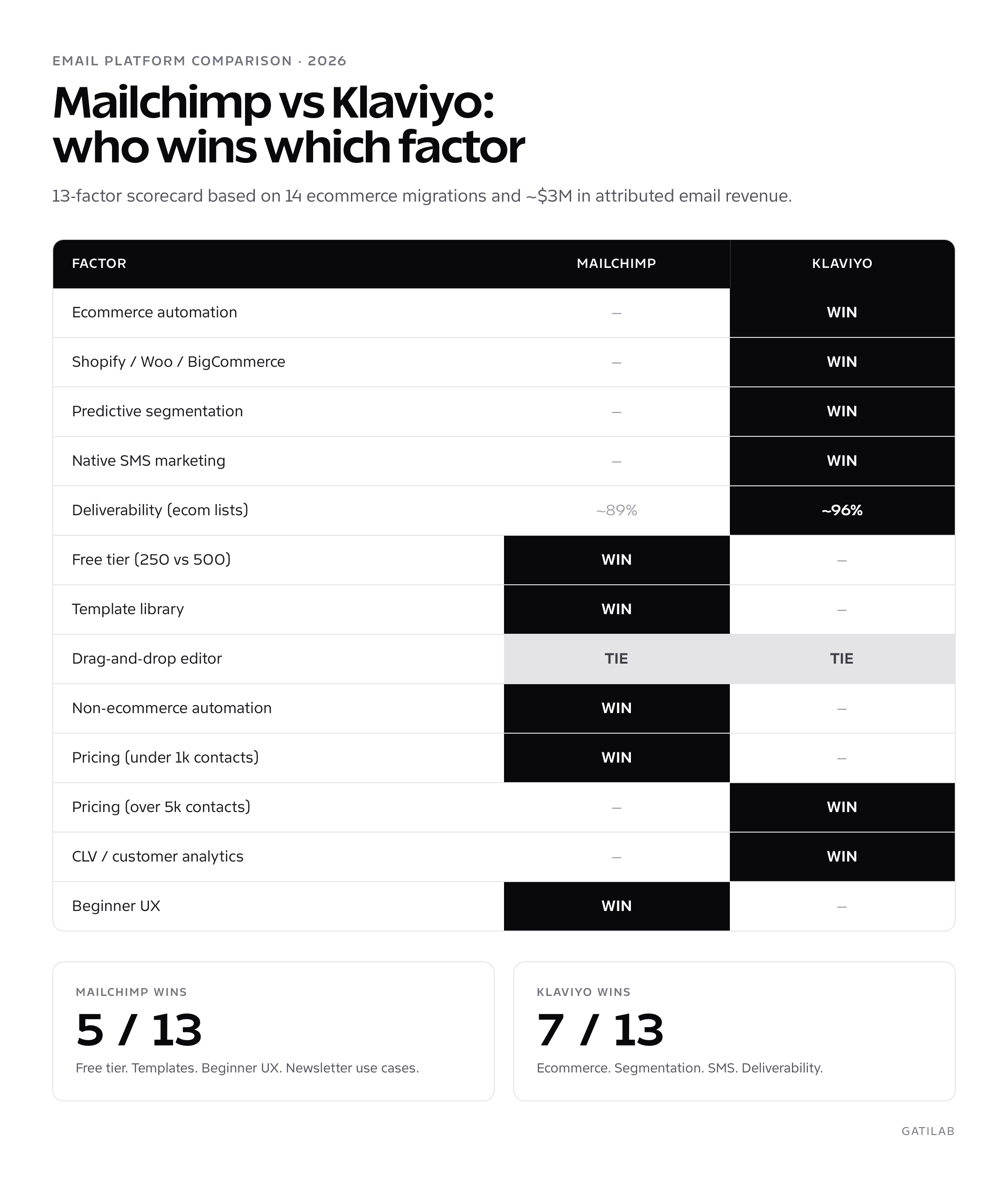
The Mailchimp vs Klaviyo decision in 2026 splits cleanly along one axis: are you running an online store or not.
| Factor | Winner | Notes |
|---|---|---|
| Ecommerce automation | Klaviyo | Built for it; Mailchimp bolted it on later |
| Shopify, WooCommerce, BigCommerce integrations | Klaviyo | Deeper data model, real-time sync |
| Segmentation depth | Klaviyo | Predictive analytics, behavioral triggers |
| SMS marketing | Klaviyo | Native; Mailchimp’s SMS is limited |
| Email deliverability (ecommerce) | Klaviyo | ~96% inbox rate vs ~89% Mailchimp on retail lists |
| Free tier | Mailchimp | 500 contacts forever vs Klaviyo’s 250 |
| Template library | Mailchimp | Larger, more newsletter-focused |
| Drag-and-drop editor | Tie | Both excellent in 2026 |
| Non-ecommerce automation | Mailchimp | Easier “Customer Journey” builder |
| Pricing under 1,000 contacts | Mailchimp | $20-30/mo vs Klaviyo $30-45/mo |
| Pricing over 5,000 contacts | Klaviyo | Better revenue-per-email math |
| CRM and audience analytics | Klaviyo | Customer lifetime value built-in |
| Beginner UX | Mailchimp | Friendlier onboarding for non-marketers |
Klaviyo wins more categories, but Mailchimp wins the ones that matter for non-ecommerce users: free tier, simplicity, template library. If you sell physical or digital products online, Klaviyo. If you send a newsletter or service-business updates, Mailchimp. The Mailchimp vs Klaviyo decision really is that binary in 2026.
One nuance worth flagging up front: Mailchimp is owned by Intuit (acquired in 2021) and has been pivoted into a broader small business marketing suite. Klaviyo went public in 2023 and stayed laser-focused on commerce. Those corporate trajectories shape product priorities. Mailchimp keeps adding marketing-suite features; Klaviyo keeps deepening ecommerce features. Three years from now the gap on ecommerce-specific capabilities is likely to be wider, not narrower.
Pricing tiers in 2026
Mailchimp’s pricing is per contact. Klaviyo’s pricing is per active profile. Both got more expensive in 2025, and neither got simpler.
| List size | Mailchimp Standard | Klaviyo Email |
|---|---|---|
| 500 contacts | $20/mo | $30/mo (250 free, then $30) |
| 1,500 contacts | $30/mo | $45/mo |
| 5,000 contacts | $75/mo | $100/mo |
| 10,000 contacts | $135/mo | $150/mo |
| 25,000 contacts | $295/mo | $385/mo |
| 50,000 contacts | $525/mo | $700/mo |
| 100,000 contacts | ~$1,150/mo | ~$1,380/mo |
| SMS add-on | Limited, separate | Native, billed per send |
| Free tier | 500 contacts forever | 250 contacts, 500 emails/mo |
| Annual discount | None | None |
The headline: Klaviyo costs about 25-40% more per contact at every tier. The counter-headline: Klaviyo’s revenue-per-email is typically 2-3x higher for ecommerce stores. The Mailchimp Klaviyo comparison on price alone is misleading. The math that matters is revenue generated per dollar spent on the platform, and on that axis Klaviyo wins for ecommerce.
Watch Klaviyo’s billing model. They charge based on profiles, including unsubscribed and inactive ones, unless you suppress them. List hygiene becomes a cost-savings activity. I clean Klaviyo lists quarterly and clients save $50-200/month routinely.
Email deliverability
Klaviyo wins on deliverability for ecommerce lists. Mailchimp’s deliverability declined visibly between 2022 and 2024 after Intuit’s acquisition pushed them toward higher-volume small business customers. Industry deliverability tracking from Litmus and EmailToolTester in 2025 put Klaviyo around 96% inbox rate vs Mailchimp’s ~89% on transactional ecommerce traffic.
Why the gap exists:
- Klaviyo’s customer base is more curated. They lean into ecommerce stores with proven engagement patterns, which signals trust to inbox providers
- Klaviyo’s IP and domain reputation management is more aggressive. They warm new accounts more carefully
- Klaviyo enforces stricter list hygiene. Unengaged subscribers get auto-suppressed faster
- Mailchimp’s free tier inflates spam patterns. Some abusive senders share IP pools with legitimate ones
If you’re already on Mailchimp and seeing inbox rates under 90%, the platform is part of the reason. The other part is you. Both platforms require correct SPF, DKIM, DMARC, and BIMI setup. Most low-deliverability cases I audit have configuration gaps, not platform problems.
Features compared head-to-head
Both platforms cover the basics: drag-and-drop editor, A/B testing, basic segmentation, signup forms, landing pages, basic reporting. The differentiation shows up in advanced features.
Klaviyo’s standout features:
- Predictive analytics. CLV (Customer Lifetime Value), expected next order date, expected churn risk per profile
- Behavioral segmentation. “Has viewed product X 3+ times but never purchased” type rules out of the box
- Real-time event-driven flows. Browse abandonment, cart abandonment, post-purchase sequences trigger within seconds, not minutes
- Native SMS with deep ecommerce triggers
- Klaviyo CDP. Customer Data Platform features for unified profiles across web, app, and offline
Mailchimp’s standout features:
- Customer Journey Builder. Visual flow builder that’s easier for non-technical marketers to follow
- Massive template library. 100+ free templates, plus a paid library
- Built-in landing page builder with WP, Squarespace, and Wix connections
- Postcards (yes, real physical postcards) for retargeting
- Easy survey and poll integration
Mailchimp’s “all-in-one marketing platform” pivot added landing pages, postcards, social ads, and a CRM. Most of these features are 6/10 versions of dedicated tools. Klaviyo focused. Mailchimp expanded. That decision shows up everywhere in the products.
Automation builders
Klaviyo’s flow builder is more powerful and more complex. Mailchimp’s Customer Journey is simpler and more limited.
In Klaviyo, you build flows around events. “Placed Order” event triggers a post-purchase flow with conditional branches based on order value, items purchased, and predicted CLV. The flow logic runs on real-time webhooks from your store. Conditional splits handle dozens of variables natively. Building a 6-email post-purchase sequence with conditional product recommendations takes 30-45 minutes once you know the platform.
In Mailchimp, you build journeys around triggers and audiences. The conditional logic is shallower. The same 6-email sequence takes longer because the conditional branching is more limited and you end up duplicating flows for each major segment.
The flows every ecommerce store should run, ranked by typical revenue impact:
- Welcome series. 3-5 emails over 7 days. Captures first-purchase intent. Typically 20-30% of email-attributed revenue for new stores.
- Abandoned cart. 3 emails over 24 hours. Recovers 8-15% of abandoned carts when triggered correctly.
- Browse abandonment. 1-2 emails for high-intent browsers who didn’t add to cart. Often the highest open rate of any flow.
- Post-purchase. 2-4 emails over 14 days for upsell, education, and review requests.
- Winback. 3 emails for customers inactive 60-90+ days. Lower conversion but high LTV impact when it works.
- VIP recognition. Single email when CLV crosses a threshold. Improves retention more than direct revenue.
All six can be built in Klaviyo from native templates in under a working day. In Mailchimp, the welcome and abandoned cart are doable but the browse abandonment, predictive winback, and CLV-based VIP flows require either heavy customization or third-party tools. That gap is the single biggest reason ecommerce stores migrate.
For non-ecommerce automation (e.g., welcome series for a SaaS product, lead nurture for a B2B service business), Mailchimp’s simpler builder is often the better fit. The depth Klaviyo provides is overhead for simpler use cases. Pick the tool that matches your workflow complexity, not your aspirations.
Ecommerce integrations
This is where the Mailchimp vs Klaviyo gap is widest. The best email marketing for ecommerce isn’t a marketing claim. It’s an integration question, and Klaviyo built deeper integrations on day one.
| Platform | Mailchimp | Klaviyo |
|---|---|---|
| Shopify | Standard sync (Mailchimp removed deep Shopify integration in 2019, restored 2023 with limits) | Real-time, full data model, 1-click install |
| WooCommerce | Plugin-based, decent | Plugin-based, deeper data sync |
| BigCommerce | Native, basic | Native, deeper |
| Magento / Adobe Commerce | Limited | Native |
| Custom store / Headless | API + webhooks (workable) | API + webhooks (preferred by Klaviyo) |
| Real-time sync | Hourly to 4 hours | Seconds to 2 minutes |
| Product feed for emails | Yes, basic | Yes, with predictive recommendations |
The Shopify story matters. Mailchimp and Shopify split publicly in 2019 over data sharing. Mailchimp lost its native Shopify app. They restored a partnership in 2023, but the integration is still shallower than Klaviyo’s. If you run a Shopify store, this single fact pushes the decision toward Klaviyo. The ecommerce email platform decision in 2026 starts and often ends with Shopify.
For WooCommerce stores, both work, but Klaviyo’s data model handles abandoned carts, browse events, and post-purchase triggers more reliably. I’ve debugged 6+ “why isn’t my abandoned cart flow firing” tickets on Mailchimp. Almost zero on Klaviyo for the same client base.
If you’re earlier in your store-building journey and still picking the storefront itself, see my best ecommerce platforms for startups roundup. The platform you pick decides which email tool integrates well, so make those choices together, not sequentially.
Segmentation and predictive analytics
Klaviyo’s segmentation engine is the single most under-discussed reason ecommerce teams switch. Out of the box you can segment on event count, event recency, predicted CLV, predicted gender, predicted location, predicted next purchase date, and any combination of stored properties. That’s 12+ predictive variables Mailchimp simply doesn’t surface.
Real example from a client store doing $180,000/month in revenue. We built a “VIP at risk of churn” segment in Klaviyo: predicted CLV in top 20%, last order more than 60 days ago, no email open in last 14 days. The segment surfaces 230-280 profiles at any given time. A monthly winback flow targeting this segment generates roughly $11,000 in recovered revenue per month. Building the same segment in Mailchimp would require a third-party predictive analytics tool plus custom field syncing and roughly 15 hours of setup.
Mailchimp’s segmentation is good enough for newsletter sending, signup-source filtering, and basic engagement-based winback. It’s not built for the kind of predictive segmentation that drives revenue from ecommerce. If your store is large enough to have a “VIPs,” “regulars,” and “lapsed” tier, Klaviyo is the only practical choice between these two.
Reporting and analytics
Klaviyo’s analytics layer is built around revenue. Every email, flow, segment, and SMS reports attributed revenue, average order value, conversion rate, and revenue per recipient. The default dashboard shows you which campaigns and flows generated which dollars.
Mailchimp’s analytics are built around engagement. Open rates, click-through rates, unsubscribe rates, click maps, A/B test results. Revenue attribution exists but it’s a tab away, not the default view. For ecommerce decision-making, the default view in Klaviyo answers more useful questions faster.
Both platforms now have AI-assisted insights and copy suggestions. Klaviyo AI focuses on subject line testing, send-time optimization, and predictive segmentation. Mailchimp’s AI focuses on copy generation, image suggestions, and journey recommendations. Different strengths, different audiences.
One reporting nuance worth flagging: revenue attribution windows. Klaviyo defaults to 5-day click attribution and 5-day open attribution for revenue. You can adjust these in settings. Most stores I work with shift to 3-day click and skip open attribution entirely after Apple Mail Privacy Protection broke open-rate signal in 2021. Mailchimp uses a similar 24-hour to 7-day window depending on the metric. Neither default is wrong, but if you’re comparing revenue numbers between the two platforms make sure you’re comparing the same attribution windows.
For a deeper conversion lens beyond email, see my conversion rate optimization framework. Email is one channel in the funnel. The full revenue picture comes from email plus on-site optimization plus retention.
Use case picks: who should buy what
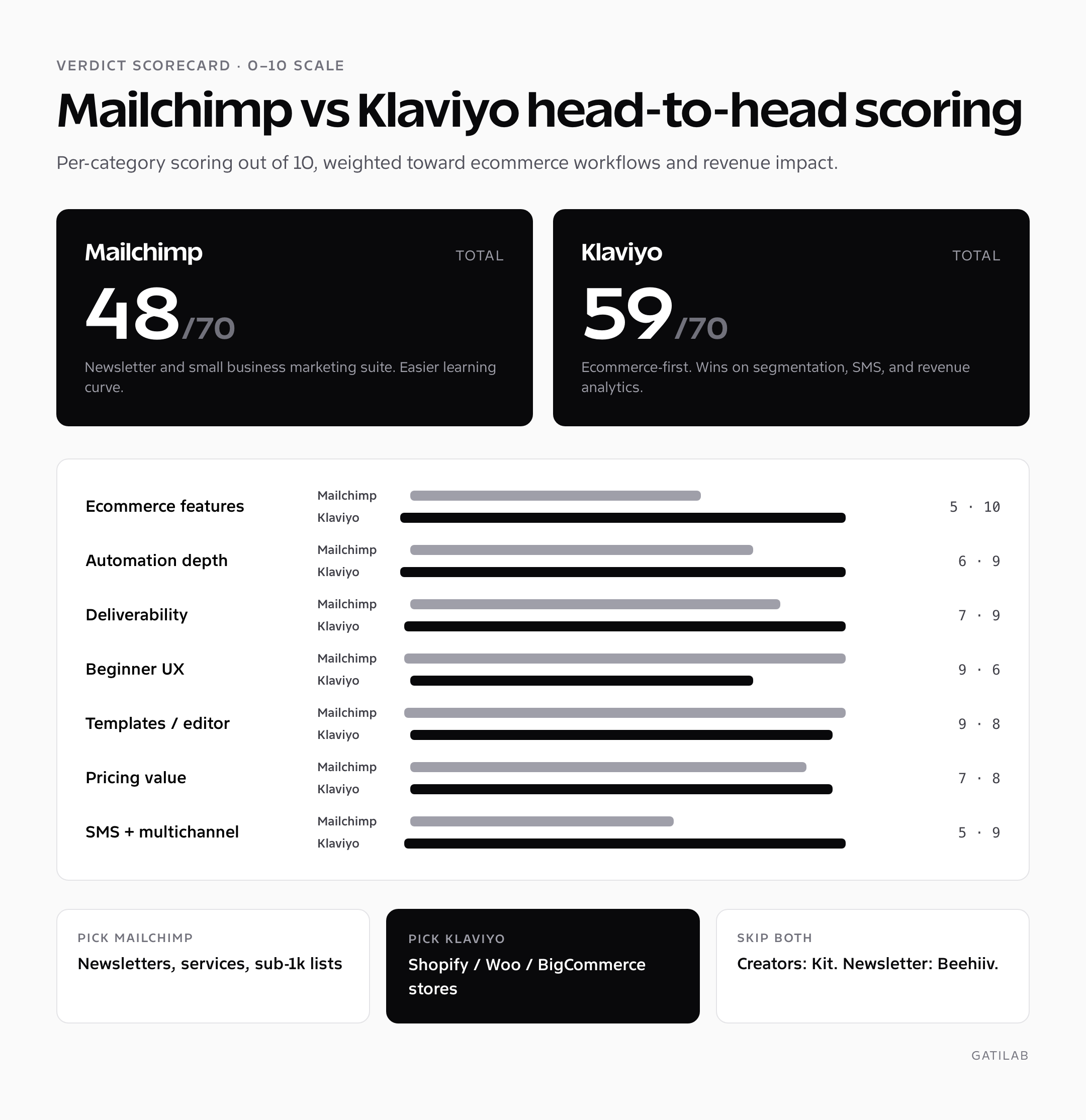
Pick Klaviyo if:
- You sell physical or digital products through Shopify, WooCommerce, BigCommerce, or Magento
- Your list is over 2,000 contacts and growing
- You want to add SMS to email without a second platform
- You care about revenue attribution per email and per segment
- You’re willing to spend an extra 25-40% on platform cost for better deliverability and ecommerce features
Pick Mailchimp if:
- You run a non-ecommerce business: services, consulting, B2B SaaS, content site, nonprofit
- You need a free tier and your list is under 500 contacts
- Newsletter sending is your primary use case (not automation)
- You don’t have a marketing team and need the simplest possible setup
- You want a built-in CRM, landing page builder, and survey tool from one vendor
Skip both and use something else if:
- Solo creator or course business: ConvertKit (now Kit) is purpose-built for you
- Newsletter publishing with paid subscriptions: Substack or Beehiiv
- Enterprise B2B with complex multi-touch attribution: HubSpot or Marketo
- Tight budget under 1,000 contacts: MailerLite at $9-15/month
For a broader landscape, see the Constant Contact vs Mailchimp comparison if you’re already on Constant Contact and weighing alternatives.
Migration: moving from Mailchimp to Klaviyo
Most migrations I run go in this direction. Klaviyo provides a built-in Mailchimp migration tool that handles list, segments, automations, and historical campaigns. The tool is solid for the data layer. The deliverability handoff is the hard part.
What actually breaks during migration:
- IP reputation reset. New domain, fresh sender, lower initial inbox rates for 2-4 weeks
- Segment rebuilding. Mailchimp groups don’t map cleanly to Klaviyo segments
- Automation re-architecture. Mailchimp Customer Journeys don’t transfer; you rebuild flows from scratch
- Template recreation. Email templates need rebuilding in Klaviyo’s editor
- SMS opt-in re-collection. Mailchimp SMS consent doesn’t transfer in most jurisdictions
Budget 30-50 hours for a 10,000-contact ecommerce store migration with 5+ active flows. The revenue uplift typically pays back the migration cost within 2-3 months for stores doing $50,000+ in monthly revenue.
The migration always takes longer than the Klaviyo sales rep tells you. Plan for two months from “let’s switch” to “Mailchimp is decommissioned.” Anyone promising 2 weeks is selling, not migrating.
The migration order I follow:
- Set up the Klaviyo account, install the integration, verify data sync against the store backend
- Authenticate sender domain (SPF, DKIM, DMARC) and warm the new sending IP for 7-10 days
- Import contacts and historical engagement data from Mailchimp
- Rebuild segments from scratch based on Klaviyo’s profile model
- Migrate the welcome and abandoned cart flows first; test on a small segment
- Send 2-3 broadcast campaigns through Klaviyo while keeping Mailchimp dormant for 14 days
- Once inbox rates stabilize above 92%, migrate the remaining flows and decommission Mailchimp
Most migration disasters happen when teams rush step 2 (domain authentication) or skip step 6 (warming the new sender). The platform doesn’t matter if your emails land in promotions or spam. Take the warmup window seriously.
The honest recommendation
If you run an ecommerce store, pick Klaviyo. The Mailchimp vs Klaviyo decision for ecommerce is not actually close. The deeper integration, real-time triggers, native SMS, and revenue-first analytics consistently outperform Mailchimp on the metrics that matter to ecommerce: revenue per email, revenue per recipient, customer lifetime value lift.
If you don’t run an ecommerce store, pick Mailchimp. The free tier, simpler editor, and broader template library are real advantages for newsletter senders, service businesses, and small teams without dedicated marketing roles. Klaviyo is overkill for most non-ecommerce use cases, and you’ll pay extra for features you won’t use.
If you’re a creator, course teacher, or paid newsletter publisher, look at Kit (ConvertKit) or Beehiiv before committing to either of these. The Klaviyo or Mailchimp framing is too narrow for the creator economy in 2026. The right tool depends on whether you’re selling products, services, or your own content.
Don’t pick based on which platform has more features. Pick the one that matches your business model. For ecommerce, Klaviyo. For everything else, Mailchimp or a creator-focused alternative. Both have real strengths. Neither is universally better.
One last thing on the Klaviyo or Mailchimp question. Don’t trust scoring lists where one platform appears in every “best email tool” roundup. The email marketing space has aggressive affiliate programs and the rankings often reflect commission rates, not platform quality. Read at least three independent practitioners writing about real client work before committing. Run the free tier on a real campaign of yours. Watch how your specific audience responds. The right answer depends on your list, your offers, and your team, not on which platform a reviewer was paid to rank first.
Is Mailchimp or Klaviyo better for ecommerce?
Klaviyo is significantly better for ecommerce. It was built around the ecommerce data model, has deeper Shopify, WooCommerce, and BigCommerce integrations, supports real-time event-driven flows, and reports revenue attribution by default. Mailchimp added ecommerce features later and the integration depth is shallower.
Is Klaviyo more expensive than Mailchimp?
Yes. Klaviyo is roughly 25-40% more expensive than Mailchimp at every contact tier above the free plans. At 5,000 contacts, Mailchimp Standard is around $75/month vs Klaviyo at $100/month. The price gap is real, but Klaviyo’s revenue per email is typically 2-3x higher for ecommerce stores, so the ROI math favors Klaviyo for stores doing real revenue.
Does Mailchimp still work with Shopify?
Yes, but with caveats. Mailchimp and Shopify split publicly in 2019 and Mailchimp lost its native Shopify app. They restored a partnership in 2023, but the integration is still shallower than Klaviyo’s. Real-time data sync is slower and the abandoned-cart flow is less reliable. For Shopify stores, Klaviyo is the safer choice.
Does Mailchimp have a free plan?
Yes. Mailchimp’s free plan covers up to 500 contacts and 1,000 sends per month with limited automation. Klaviyo’s free plan is more limited at 250 contacts and 500 emails per month. For sub-500 list sizes, Mailchimp’s free tier is genuinely usable for basic newsletter sending.
Which has better email deliverability?
Klaviyo, especially for ecommerce. Industry deliverability tracking puts Klaviyo around 96% inbox rate vs Mailchimp’s roughly 89% on transactional ecommerce traffic. The gap comes from Klaviyo’s stricter list hygiene, more curated customer base, and more aggressive IP reputation management.
Can I migrate from Mailchimp to Klaviyo?
Yes. Klaviyo has a built-in Mailchimp migration tool that handles contacts, segments, and historical campaign data. Automations and templates need rebuilding manually. Budget 30-50 hours for a 10,000-contact ecommerce store with 5+ active flows. The revenue uplift typically pays back the migration cost within 2-3 months.
Does Klaviyo include SMS marketing?
Yes, natively. Klaviyo SMS shares the same profile, segmentation, and flow infrastructure as email, billed per send on top of your email subscription. Mailchimp’s SMS support is limited and works best as an add-on for existing customers, not as a primary SMS marketing tool.
Which platform is easier for beginners?
Mailchimp. The Customer Journey builder is more visual and forgiving, the template library is bigger, and the onboarding flow is friendlier for non-marketers. Klaviyo’s depth is also its learning curve. Mailchimp users can run a campaign in 30 minutes. Klaviyo users typically need 2-3 hours to build their first flow correctly.
Next steps
Pick based on your business model:
- Ecommerce store on Shopify or WooCommerce: start a Klaviyo account
- Newsletter, services, or non-ecommerce small business: start with Mailchimp’s free plan
- Already on Mailchimp with a growing Shopify store: budget for migration this quarter
- Creator or paid newsletter: see best blogging platforms for creator-focused tools
Use the free tiers. Mailchimp’s 500-contact free plan and Klaviyo’s 250-contact free plan are both genuinely usable for testing. Send 4-5 real campaigns through each, watch your open rates and inbox placement, then commit. The cost of switching later is bigger than the cost of testing now.
One last operational tip. Whatever you pick, set up domain authentication (SPF, DKIM, DMARC) before you send your first campaign, not after. The single biggest avoidable mistake I see is teams launching from a free shared sending domain and burning their reputation in the first month. Both Klaviyo and Mailchimp walk you through authentication in their setup wizard. Take the 30 minutes. It’s the cheapest deliverability win you’ll ever make.
Tell Google you want more of this.
Add Gatilab as a preferred sourceOne tap, and this site shows up more often in your own Top Stories, AI Overviews and AI Mode. Remove it any time.