
What Is Branded Content? Definition, Examples, and When to Skip It (2026)
Branded content is media a company funds or creates that entertains or informs first and sells never, at least not on the surface. The brand’s fingerprint is on the story, not in a pitch. Think Red Bull filming a man jumping from the stratosphere, or LEGO releasing a full feature film that grossed $468 million. No product demo, no discount code, no ‘book a call.’ The bet is that association and affection convert later, at brand-recall time.
Here’s my short version after producing content on agency budgets for years: branded content is the most misunderstood line item in marketing, because the famous examples cost millions and the definition gets stretched over everything from TikTok skits to sponsored articles. This guide gives you the working definition, the examples worth stealing from, the numbers on whether it works, and the honest answer on when a smaller business should skip it entirely.
What Is Branded Content? A Working Definition
Branded content is content produced or funded by a brand where the primary value is entertainment, emotion, or information, and the commercial message is implicit. The audience chooses to watch, read, or share it because it’s good, not because they were interrupted by it. That voluntary attention is the entire point, and it’s what separates branded content from advertising.
Four traits make something branded content rather than an ad or a blog post:
- Story before product: the product is background context or absent entirely. Patagonia’s films are about public lands, not fleece jackets.
- Values on display: the piece communicates what the brand stands for. That’s why it’s a branding tool, not a demand-capture tool.
- Chosen, not forced: people opt in. Nobody opts in to a pre-roll ad.
- Emotional target: success is measured in recall, association, and affinity, the stuff I covered in my guide to measuring brand awareness, not in clicks.
If a piece of content ends with a product pitch and exists to rank on Google or capture a lead, that’s content marketing doing its job. Both are legitimate. They’re just different tools with different payback periods, and confusing them is how budgets get wasted.
Branded Content vs Content Marketing vs Native Ads vs Product Placement
The fastest way to keep the terms straight is to ask two questions: who hosts it, and what’s the call to action? Branded content entertains on any channel with no direct ask; content marketing educates on your own channels with a next step; native advertising rents someone else’s audience in their format; product placement buys a cameo inside someone else’s story:
| Branded content | Content marketing | Native advertising | Product placement | |
|---|---|---|---|---|
| Primary goal | Affinity, recall | Traffic, leads, sales | Reach, consideration | Familiarity |
| Product visibility | Implicit or absent | Explicit, contextual | Explicit, disclosed | Visual cameo |
| Where it lives | Any channel, often earned | Your site, your list | Publisher’s platform | Someone else’s content |
| Typical cost | $10K to millions per piece | $2.5K-$10K/month programs | $5K-$50K per placement | $50K+ per integration |
| Measurable in | Months to years | Weeks to months | Days to weeks | Rarely measurable |
The disclosure line matters too: native ads legally require an ‘sponsored’ label (the FTC has fined publishers for burying it), while branded content a brand publishes itself doesn’t. And if you’re deciding where a limited budget goes first, the compounding math in my content marketing ROI breakdown is the comparison branded content has to beat.
Branded Content Examples Worth Studying
The canon of branded content examples is dominated by huge budgets, but every one of them contains a mechanic a small team can copy. Five worth studying, with the stealable part labeled:
- Red Bull Stratos (2012, still the benchmark): Felix Baumgartner’s stratosphere jump drew 8 million concurrent YouTube viewers. The steal: own an idea adjacent to your product (‘energy’ and ‘extremes’), not the product itself.
- The LEGO Movie (2014): a $60 million marketing asset that audiences paid $468 million to watch. The steal: your product can be the medium of the story instead of its subject.
- Patagonia’s documentary films: multi-decade series on conservation. The steal: values repetition compounds; one film is a stunt, twenty is a position.
- Mailchimp Presents: a streaming library of short films and series for entrepreneurs. The steal: B2B branded content works when it’s about the customer’s life, not the software.
- Duolingo’s TikTok owl: zero production budget, a mascot, and comedic timing built 10M+ followers. The steal: branded content in 2026 can be a personality, not a production.
Notice what’s missing from that list: any example where the brand explained its features beautifully. That’s not an accident. Feature explanations, however cinematic, are ads, and audiences file them as ads. The identity groundwork underneath all five examples is what I cover in branding fundamentals: know what you stand for before you fund a film about it.
Does Branded Content Work? What the Numbers Say
Branded content works measurably for recall and affinity, with real but slower revenue effects. The honest data picture, confirmed numbers first, tension included:
- Completion beats length: Meta’s Creative Performance Lab found 30-to-89-second videos beat 2-minute-plus videos by 118% on completion and 94% on CTR. Short branded video is the efficient frontier.
- B2B video pulls pipeline: LinkedIn platform data shows B2B video under 5 minutes generating 52% more pipeline-attributed conversions than static posts.
- The UGC tension: content from real customers engages roughly 28% more than brand-made content, and UGC drives purchase decisions dramatically harder. Your audience trusts people over polish.
- Awareness spend is sticky: 92% of marketers planned to maintain or grow brand-awareness investment going into 2025, and 61% of video-using marketers produce branded stories.
That UGC number deserves a second look, because it’s the strongest argument against overproducing. If real-people content outperforms brand-made content on engagement, the winning move for most companies is branded content that recruits customers into the story (contests, creator collabs, documentary-style customer features) rather than a polished film about the brand. The metric to watch either way is brand salience: do buyers think of you first when the need shows up?
When Branded Content Is the Wrong Buy
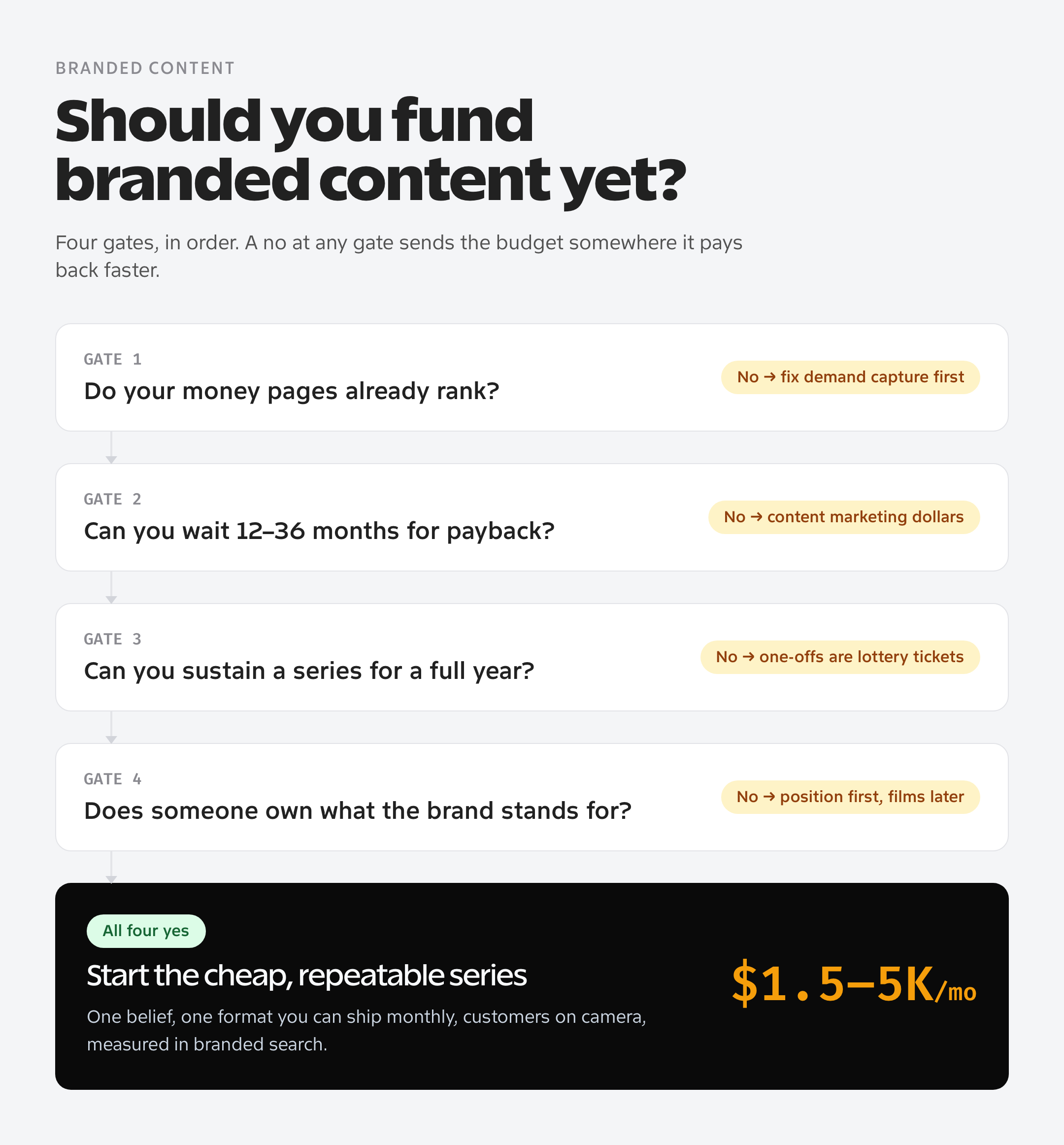
Skip branded content if you haven’t maxed out demand capture first. That’s the blunt rule I give clients, and it filters most of them out. Branded content builds future demand; it does nothing for the buyers searching for your category today, and most sub-$5M businesses haven’t finished collecting those. The disqualifiers, in order:
- Your money pages don’t rank and your comparison keywords belong to competitors. Fix that first; it pays in months, not years.
- You need attributable pipeline this year. Branded content’s returns show up in branded search and win rates over 12 to 36 months, and attribution will never hand you a clean number.
- The budget only covers one piece. One-off branded content is a lottery ticket. Patagonia works because it’s twenty years deep. If you can’t sustain a series, don’t start one.
- Nobody internally owns ‘what we stand for.’ Branded content amplifies a position. No position, nothing to amplify.
None of this means small companies can’t do it. It means the entry format should be cheap and repeatable, which is the next section.
How to Do Branded Content on a Small Budget
The affordable version of branded content is a repeatable series built on a strong point of view, shot simply, published relentlessly. The playbook I actually run:
- Pick one belief your market argues about and take a side. The belief is the brand message; every episode is evidence.
- Choose a format you can produce monthly for a year: a founder video essay, a customer mini-documentary, a data story from your own numbers. Consistency beats production value (Duolingo proved the ceiling on this).
- Feature customers, not yourself, to capture the UGC trust premium inside brand-controlled content.
- Distribute natively: full video on LinkedIn or TikTok, not links out. Branded content that asks for a click stops being branded content.
- Measure like a brand campaign: branded search volume, direct traffic, ‘how did you hear about us’ answers, and salience surveys twice a year. Expect nothing attributable for two quarters.
Budget-wise, a credible monthly series runs $1,500 to $5,000 a month with a freelance editor and a committed founder, less than one native-ad placement and infinitely more compounding. If even that’s out of range, put the money into search-driven content first and revisit branded content when demand capture is saturated.
How Creators and AI Changed Branded Content in 2026
The center of gravity moved from brand-produced films to brand-creator co-productions, because creators arrive with the two things brands can’t manufacture: an audience and its trust. The platforms industrialized this: TikTok’s Branded Mission lets brands crowdsource creator videos and boost the winners, YouTube’s BrandConnect brokers integrations, and Instagram’s paid-partnership tools handle the disclosure line automatically. For most companies, renting a creator’s storytelling beats building a studio.
Three rules keep a 2026 co-production from backfiring:
- Disclose cleanly: the FTC’s updated endorsement guides treat vague labels (‘collab’, ‘spon’) as inadequate. Use the platform’s paid-partnership tag plus a plain-language line. Trust is the asset; don’t spend it on a technicality.
- Brief the belief, not the script: creator content collapses when brands hand over talking points. Give the position you want embodied and let the creator translate. Their audience can smell a scripted read in two seconds.
- Label AI where it matters: synthetic voiceovers and AI-generated visuals are fine for illustration, corrosive for testimony. If a ‘customer’ in your branded content is generated, you’ve made an ad, and an FTC problem, not a story.
The through-line: branded content keeps drifting toward whatever audiences trust most. In 2012 that was spectacle. In 2026 it’s people, specificity, and receipts. Budgets that follow trust age well.
Branded Content: FAQ
Quick answers to the branded content questions that fill my inbox:
What is branded content in simple terms?
Content a brand funds or creates that people choose to watch or read because it’s entertaining or useful on its own, with no direct sales pitch. Red Bull’s stunt videos and LEGO’s movies are the classic examples: the brand is the storyteller, not the subject.
What is the difference between branded content and content marketing?
Branded content builds emotion and recall with no direct ask; content marketing educates and captures demand with a clear next step (subscribe, demo, buy). Content marketing pays back in weeks to months and is measurable; branded content pays back in years and mostly isn’t.
Is branded content the same as native advertising?
No. Native advertising is paid placement in a publisher’s format with a required disclosure label. Branded content is the brand’s own storytelling and can live anywhere. A branded film on your YouTube channel isn’t native; the same film promoted inside a publisher’s feed as sponsored content is.
What are the best branded content examples?
Red Bull Stratos (8 million concurrent viewers), The LEGO Movie ($468M box office), Patagonia’s conservation films, Mailchimp Presents for entrepreneurs, and Duolingo’s TikTok mascot. Each proves a different budget tier works when the story leads and the product recedes.
Does branded content actually drive sales?
Indirectly and slowly. It lifts recall, branded search, and win rates over 12 to 36 months rather than producing attributable pipeline this quarter. Meta’s data shows short branded video winning on completion and CTR, and LinkedIn reports B2B video under 5 minutes driving 52% more pipeline-attributed conversions than static posts.
How much does branded content cost?
The famous stuff costs millions, but a credible monthly series runs $1,500 to $5,000 with a freelancer and a founder who shows up. The real cost is consistency: a series that dies after three episodes returns nothing.
Should a small business invest in branded content?
Only after demand capture is working: money pages ranking, comparison keywords owned, reviews handled. Then start with a cheap repeatable series built on a point of view. If you need measurable pipeline this year, content marketing is the better dollar.
The Call I’d Make
Branded content is real, it works, and almost everyone reading this should do the small version, not the famous one. Take a position, build a series you can sustain for a year at $2K a month, put customers on camera, and measure it in branded search rather than last-click revenue.
And if you’re choosing between a branded film and fixing the money pages that don’t rank… fix the money pages. The film can wait; the buyers searching for you this month can’t.
Tell Google you want more of this.
Add Gatilab as a preferred sourceOne tap, and this site shows up more often in your own Top Stories, AI Overviews and AI Mode. Remove it any time.