
How to Write a Product Description That Sells
You have a product page that gets traffic and doesn’t convert. The photos are decent, the price is in range, and the product description reads like it was pasted from the supplier’s spec sheet, because it was. Something on that page is losing the sale, and the copy is the cheapest part of it to fix.
Store owners usually land in one of two camps. The first writes 40 words of adjectives, ships it, and assumes the photos do the selling. The second writes 900 words of atmosphere, buries the dimensions and the shipping terms somewhere in paragraph 6, and loses the buyer to a competitor whose page answers the same question in 5 seconds.
The version that works sits between them, and it’s structural rather than stylistic.
The parts that move a buyer
A description that sells does 7 jobs. Not always in this order, not always with equal weight, but a page missing 3 of them is asking the buyer to fill the gaps from imagination. Buyers fill gaps pessimistically. That’s the mechanism behind most of what follows, and it applies to the rest of the page too, which is the subject of a separate walkthrough on structuring product pages to rank and convert.
1. Benefit-first headline
This isn’t the product name. The name already sits in the H1 further up the page. The headline is the first line inside the description block, and it states the primary benefit in the words the buyer would use.
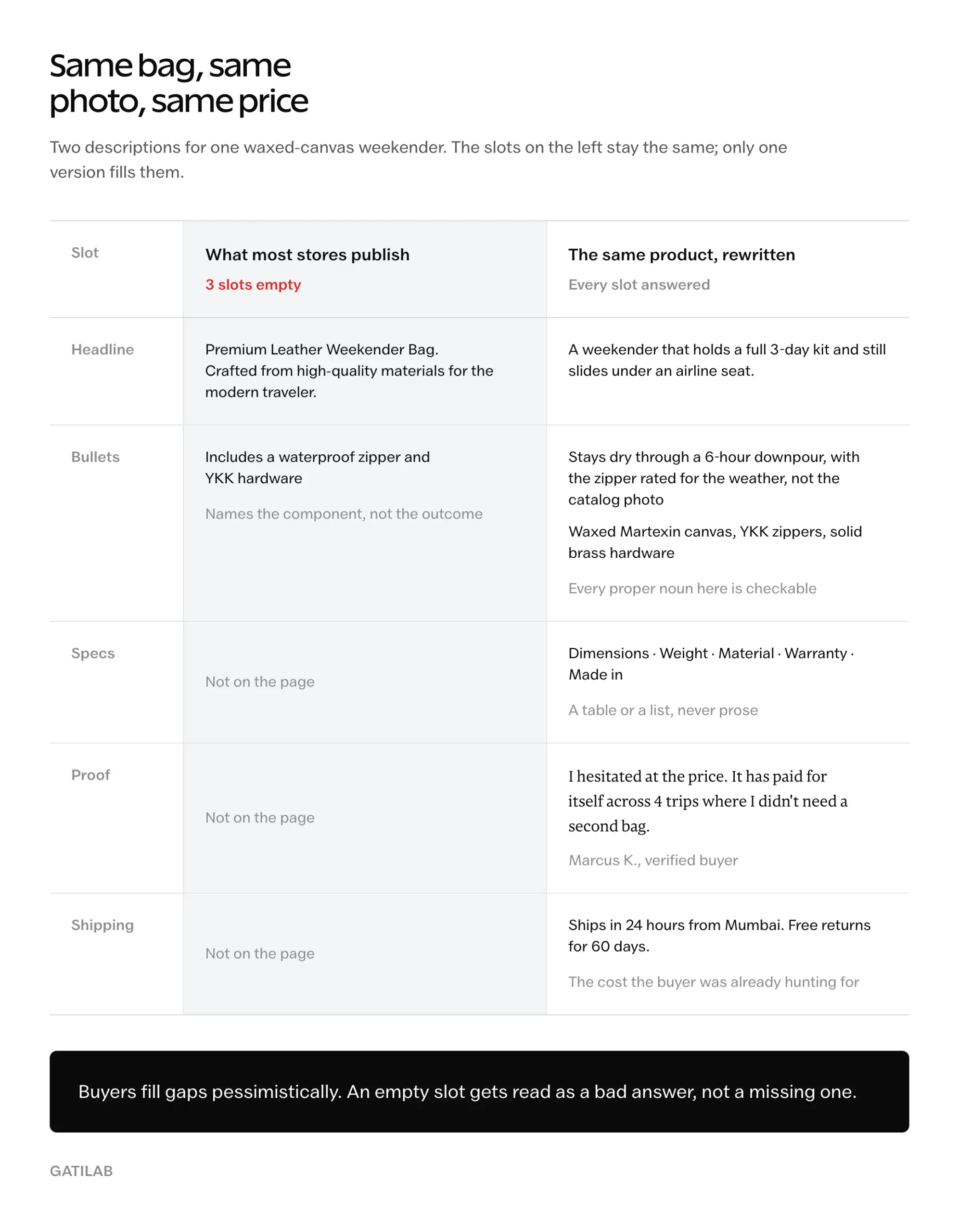
What most stores write:
Premium Leather Weekender Bag. Crafted from high-quality materials for the modern traveler.
What works better:
A weekender that holds a full 3-day kit and still slides under an airline seat.
Same bag, same photo, same price. The second line answers the question the buyer already has open in another tab, which is whether this thing will get past a gate agent.
2. Benefit bullets
Three to 5 bullets under the headline, each one carrying a benefit rather than a component. Nielsen Norman Group’s eyetracking research found that 79% of test users always scanned a new page and only 16% read word by word. That’s general web reading behavior measured in the late 1990s, not a study of product bullets, so treat it as a reason to write lines that survive a scan, not as a conversion number.
Each bullet earns its slot when it:
- Leads with what the buyer gets, not what the product contains
- Carries a number, a duration, or a measurement wherever one exists
- Runs short enough to hold one line on a phone, which in practice means keeping it tight rather than hitting a character count
- Answers an objection instead of repeating the headline
Feature phrasing: “Includes a waterproof zipper and YKK hardware.” Benefit phrasing: “Stays dry through a 6-hour downpour, with the zipper rated for the weather, not the catalog photo.”
Draft 8 to 10 bullets, then keep the 4 that would move a skeptic. The other 6 were written for you, not for the buyer.
3. Specs
Specs belong in a table or a clean list, never in prose. Dimensions, weight, material, compatibility, warranty, country of manufacture.
Specs don’t sell anything. They remove reasons to leave. A buyer choosing between 2 similar bags often decides on a single line, usually carry-on dimensions or weight under 3 pounds, and a missing line gets read as a bad answer rather than a blank one.
Nobody should read 80 words to find a product’s weight.
4. Social proof
One or 2 customer quotes sitting inside the description block, not only down in the reviews section. Pick the ones that handle an objection rather than the ones that say the product is great.
“I hesitated at the price. It has paid for itself across 4 trips where I didn’t need a second bag.” Marcus K., verified buyer
That quote does something the copywriter can’t do without sounding defensive, which is name the price objection out loud and then answer it in the buyer’s own arithmetic.
On the value of reviews existing at all, the Medill Spiegel Research Center at Northwestern found that a page showing 5 reviews converted about 270% higher than a page with none, that the first review alone accounted for roughly a 65% lift, and that a verified-buyer badge raised purchase likelihood by about 15%. Those figures measure reviews being present on the page. They don’t measure quotes pasted into a description block, so don’t stretch them into a promise about the snippet itself.
5. FAQ block
Two to 5 short questions that handle pre-purchase doubt without sending the buyer to a support page. Sizing, shipping, returns, care, compatibility, what’s in the box. Keep answers under 80 words and link out for anything that needs more room.
One caveat that changed recently, covered in full in the schema section below: an FAQ block is worth having for the buyer and for AI search, and no longer worth having for a Google rich result.
6. Imagery cues
The copy should point at what the photos and video already show. A description read alongside guided imagery does better than one that leaves the buyer to interpret a gallery on their own, and the cue costs a sentence.
- “The second photo shows the interior pocket layout with a 16-inch laptop inside”
- “The video shows the one-handed open, filmed in real time”
- “Swipe for all 4 colorways under daylight, not studio light”
Each cue is a small instruction that keeps attention on the page instead of releasing it back to the tab bar.
7. Shipping and stock
The closing lines of a description are not the Add to Cart button and shouldn’t try to be. They set expectations, which is where most of the abandonment risk actually sits. Baymard Institute’s checkout research puts extra costs, shipping included, at roughly 40% of abandonments, the single biggest reason, and finds that 64% of users look for the shipping cost on the product page before they add anything to the cart.
So put the number where they’re already looking:
- “Ships in 24 hours from Mumbai. Free returns for 60 days.”
- “Flat $6 shipping, or free over $75. In stock.”
- “Order by 3pm ET for same-day dispatch. Backordered sizes ship March 4.”
Specific and boring beats “Order now!” every time, because the buyer is doing math and urgency copy doesn’t feed the math. If the cost is genuinely bad news, it’s still better delivered here than at step 3 of a checkout, where the fix belongs to checkout optimization rather than to copy.
Three templates worth copying
Three skeletons for the 3 categories that behave differently: physical goods, software, and info products. Fill the brackets, delete what doesn’t apply, and change the order when the product demands it. The slots matter more than the sequence.
Physical goods
[Product name]
[One-sentence benefit headline: the problem this solves, in the buyer’s words]
What you get:
• [Benefit with a number]
• [Benefit with a named outcome]
• [Benefit that answers the top objection]
• [The thing the nearest competitor doesn’t do]
[2 to 3 sentences with a named scenario: a 6-hour flight, a Delhi summer, a Seattle winter commute]
[Customer quote, first name and last initial, verified buyer]
Specs: [dimensions] [weight] [material] [warranty] [made in]
Q: [Top pre-purchase question]
A: [Under 80 words]
Q: [Second question]
A: [Under 80 words]
[Ships in X. Returns for Y days. In stock, or the backorder date.]
The scenario slot is the one people skip and the one that does the most work. “A 6-hour flight” gives the buyer a picture to test the product against; “for the modern traveler” gives them nothing to test.
Software and SaaS
[Product name]
[One-sentence benefit headline: the outcome, not the feature set]
Who this is for:
• [Role or team, stated specifically]
• [Second role or use case]
• [Third role or use case]
What it does:
• [Feature tied to an outcome]
• [Feature tied to an outcome]
• [Feature tied to an outcome]
• [Integration or data-portability detail]
[2 to 3 sentences on the before and after: hours per week, error rate, revenue per seat]
[Testimonial with role and company]
Pricing:
• [Tier: price, limits, what’s capped]
• [Tier: price, limits, what’s capped]
• [Enterprise: price or contact route]
Works with: [named integrations]
Q: [Security, data export, or onboarding time]
A: [Direct answer]
Q: [Cancellation, refund, or price increases]
A: [Direct answer]
[Trial length, demo route, or direct signup]
The “who this is for” block is doing disqualification work on purpose. A software description that tries to fit everyone converts worse than one that names 3 roles and lets the wrong buyer leave in 10 seconds instead of after a trial.
Info products
[Product name]
[One-sentence benefit headline: the change the buyer is paying for]
This is for you if:
• [Situation, stated specifically]
• [Second situation]
• [Third situation]
What’s inside:
• [Module with its outcome]
• [Module with its outcome]
• [Module with its outcome]
• [Bonuses or assets]
[2 to 3 sentences on why you’re the one teaching it. Not credentials. One specific result you can name and back up.]
[Testimonial from a past student, with the outcome]
What you get:
• [Format: pages, video hours, templates]
• [Delivery: immediate, drip, or live]
• [Support: community, email, 1:1]
• [Guarantee, with its conditions]
Q: [Time commitment or prerequisites]
A: [Direct answer]
Q: [Refund policy or outcome guarantee]
A: [Direct answer]
[Enrollment status, bonus expiry, or next cohort date]
Whatever goes in the expertise slot has to be defensible if a buyer screenshots it. A specific, checkable result carries the section; a round number with no context invites the exact scrutiny you were trying to avoid.
Length follows the research, not a benchmark
There’s no credible public benchmark for product description length. Search for one and you’ll find the same handful of ranges recycled between marketing blogs that cite each other, arriving at 50 to 300 words, 100 to 300, 150 to 400, and 300 to 600 as “the” optimal number. They can’t all be right and none of them names a study. Ignore all of them.
What actually moves the number is how much research the purchase requires. The ranges below are Gatilab’s starting drafts by category, offered as working preferences rather than findings:
| Category | Starting draft length | What sets it |
|---|---|---|
| Fashion and accessories | 100 to 200 words | Visual purchase, fit is the only real question |
| Home goods and furniture | 200 to 400 words | Dimensions and materials decide it |
| Electronics | 400 to 700 words | Spec comparison against 3 open tabs |
| Software and SaaS | 600 to 1,200 words | Long evaluation, switching cost, security questions |
| Info products | 800 to 1,500 words | Trust carries the sale, not features |
| Supplements and health | 500 to 900 words | Claims need support and compliance language |
| B2B services | 600 to 1,000 words | Multiple approvers, each with a different objection |
Treat the range as a draft target, then cut. A 90-word description that answers every question beats a 400-word one padded to hit a range. The case for going genuinely long is the same case that holds for long copy ads, which is that more words only sell when each one is removing a specific doubt.
The SEO layer under the copy
Good copy still needs the technical scaffolding to get found. Four pieces do most of the work, and one of them stopped working in the last few years without much of the internet noticing.
Where the keyword goes
Product title, first 100 words of the description, one image alt attribute, and the URL slug. That’s 4 placements for a 400-word description, which is enough. Using the phrase 8 times in 200 words reads as damaged copy to a buyer long before it reads as spam to a crawler.
Schema markup
Structured data isn’t required to appear in Google Search at all. It’s required to be eligible for specific result types. For merchant listing rich results, Google’s required properties are name, image, and offers containing price and priceCurrency. Brand, aggregateRating, and review are recommended, not mandatory, and a plugin that fills every optional field isn’t buying eligibility you didn’t already have. The full property list and the WooCommerce implementation are in this product schema markup guide.
FAQ schema is the piece that changed. Google restricted FAQ rich results to well-known authoritative government and health sites in August 2023, then removed the feature from Search entirely on May 7, 2026, and retired the FAQ structured data documentation with it. FAQPage markup on a commercial product page produces no Google snippet today.
Keep the FAQ block anyway. It answers objections in front of the buyer, and a clean question-and-answer structure is the easiest thing for an assistant to lift when it’s summarizing your page, which is a growing share of how product pages get read now. That’s a separate calculation from rich results, and it depends on which AI crawlers you allow through.
Entity density
Named things are checkable. Adjectives aren’t. That distinction matters more than it used to, because a language model summarizing your page has nothing to do with “high-quality materials” and quite a lot to do with a named mill in a named town.
Low density:
Made with high-quality materials and premium hardware.
High density:
Waxed Martexin canvas, finished by Martin Dyeing and Finishing in Bridgeton, New Jersey. YKK zippers. Solid brass hardware. Lifetime warranty on the stitching.
Every proper noun in the second version is something a buyer, a competitor, or a model can verify. The first version is verifiable by nobody, which is precisely why it reads as filler to all three. Apple’s own spec language works the same way: the iPhone 17 Pro is described as a heat-forged 7000-series aluminum unibody, not as a premium metal frame.
One warning that matters more than the technique. Only name a standard, mill, certification, or spec number you can produce a source for. An invented specification is far worse than a vague adjective, because it’s falsifiable and someone will falsify it.
Review text
A product page with 200 words of your copy and 40 customer reviews holds thousands of words that Google can index. That’s real, and it’s the honest version of a claim that usually gets overstated.
What review text does not do is lift rankings by volume. Google’s reviews system evaluates first-party standalone review content, the kind a publisher writes, and explicitly doesn’t evaluate the third-party reviews users post in a product page’s review section. So a 400-review product doesn’t outrank a 4-review product on review count. It outranks it on coverage, because 400 buyers describe the product in 400 different phrasings and some of those phrasings are queries you’d never have thought to write.
Which is an argument for prompting reviews well. Ask “what problem did this solve for you?” rather than “how would you rate this?” and you get sentences instead of stars.
Internal links
Three to 5 internal links per description is a workable range: related products in the category, one buying guide or how-to, the collection page, and the shipping or returns policy. Past 7 the links stop being navigation and start being noise. Link architecture across a whole catalog is a bigger problem than any single page, and it sits inside the wider question of ecommerce SEO that produces revenue rather than traffic.
What three brands actually publish
Worth checking these against the live pages rather than against how they’re usually described in copywriting posts, because the gap between the two is wide.
Apple
The iPhone 17 Pro page leads with a single benefit line, currently “Innovative design for ultimate performance and battery life,” then hands the rest of the work to swipeable visual chapters. Technical specs live on a separate page entirely. The description carries the benefit story and almost nothing else.
That split only works with Apple’s photography budget and Apple’s brand recall. What transfers is the discipline of one benefit line at the top, not the decision to move every spec off the page.
Warby Parker
Warby Parker’s sunglasses start at $95, every lens blocks 100% of UVA and UVB rays, and prescription sunglasses start at $195. Their descriptions run short and repeat a fixed set of slots: material, lens type, sizing in millimeters, and a short backstory for the frame name.
Those first 3 facts are also a demonstration of what a benefit headline is made of. “Blocks 100% of UVA and UVB, starting at $95” is a sentence any brand could write if the facts were true on their side, and most can’t, which is the point. The backstory slot isn’t filler either. It’s the only thing making a $95 frame feel chosen rather than picked.
Away
Away’s Carry-On description is short, roughly 100 words, and it opens with brand positioning about award-winning suitcases designed by travelers rather than with a use-case scenario. There’s no FAQ block on the page. The specs, the LifetimeCare warranty terms, and the TSA-approved lock detail all sit in separate sections below the description.
So Away isn’t proof that long, scenario-led descriptions win. It’s proof that the objections can live in page structure instead of in the description block, as long as they live somewhere the buyer will actually reach.
Marketplaces need a different file
Your store description doesn’t port to Amazon, and the limit most people quote is the wrong one. The 2,000-character cap applies to Amazon’s product description field, which takes plain text with no bullets and no line breaks. Bullets are a separate field with separate rules: 5 maximum, roughly 200 characters each for standard sellers and up to 500 for Brand Registry sellers. Amazon publishes the current field limits in its Seller Central listing reference.
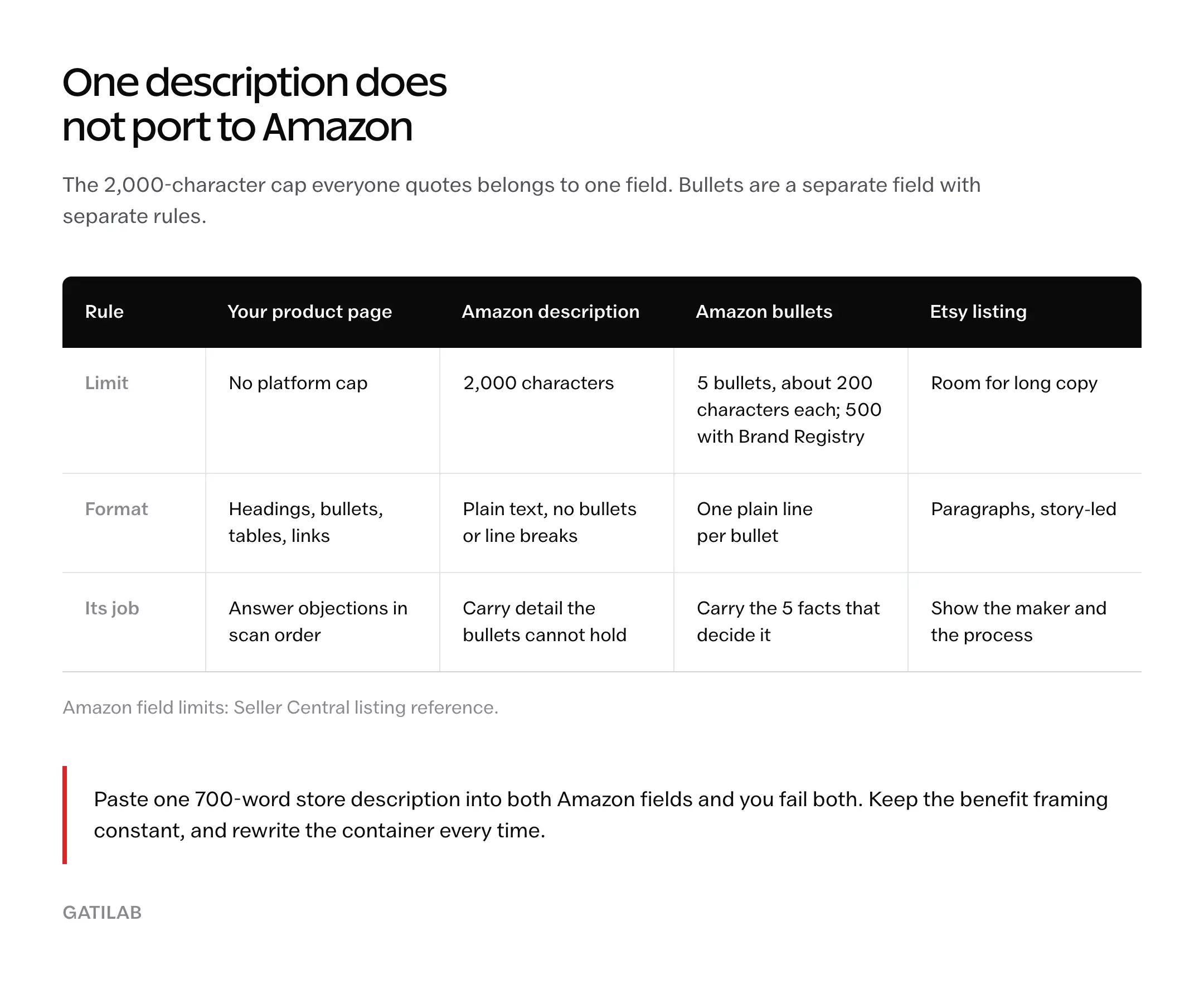
Paste one 700-word store description into both fields and you fail both. Etsy shifts again, favoring the story and the maker, and a description tuned for Amazon’s spec-scanning buyer lands flat there.
Keep the benefit framing constant across channels. Rewrite the container every time.
What a rewrite will not fix
The description is one variable on a page with several, and it loses to most of them.
- A price gap. If the same item is 30% cheaper on a marketplace tab the buyer already has open, no headline closes that. Copy competes on ambiguity, not on arithmetic.
- Missing photography. Imagery cues point at images. If the gallery never shows the interior, the sentence about the interior pocket is pointing at nothing and reads as evasion.
- No reviews yet. Every template above has a proof slot that assumes customer language exists. On a launch product it doesn’t, and you have to earn it before that part of the page works at all.
- No demand. Better copy converts a slightly larger share of the people already arriving. If 30 people a month arrive, better copy is worth a few sales a year.
- Thin traffic for testing. A page doing 40 sessions a month can’t produce a readable result in 14 days. Rewrite it on judgment, and reserve the actual test for pages with volume.
The honest sequence is price, then photography, then copy. Copy is third. A rewrite that jumps the queue usually produces a flat result and a wrong conclusion about whether copy matters.
What quietly kills a good description
None of these look like errors. They all cost money.
Writing one description for 40 variants. It saves an afternoon and it means the buyer looking at the tall size finds nothing addressing the tall size, so they assume it runs short and leave. Variant-specific sentences are boring to write and they’re the ones that convert.
Rewriting the headline and leaving the spec table stale. The new copy promises a 3-pound bag and the table still says 3.4 pounds from the previous supplier. The buyer trusts the table, notices the gap, and now distrusts the copy too.
Copying the manufacturer’s description and stopping there. Google calls the duplicate content penalty a myth and doesn’t treat duplication as a spam violation, so nothing gets punished. What happens instead is canonicalization: Google picks one version, consolidates the signals into it, and that version is usually the brand’s own page rather than your listing. You aren’t penalized. You’re just not the page being shown. Rewrite it anyway. The rewrite is where your shipping terms, your review quotes, and your buyer’s phrasing get onto the page at all.
Testing 2 descriptions while a promo runs. The promo moves conversion more than the copy does, the result reads as a win, and the wrong version gets rolled out to the rest of the catalog on the strength of it.
Recycling the same 4 adjectives across the whole catalog. Premium, durable, versatile, innovative. They cost nothing to write, they carry no information, and a buyer comparing 3 of your products in 3 tabs sees identical copy and concludes the products are identical too.
Fewer questions, answered sooner
Buyers haven’t gotten worse at reading. They’ve gotten faster at deciding whether a page is going to answer them, and they make that call in the first 40 words. A description that resolves 3 real doubts up front beats one that resolves 12 over 600 words, because the second one never gets read that far.
The trade is real. Writing this way takes 30 to 45 minutes per product and doesn’t scale by copy-paste, which is exactly why most catalogs don’t do it and why doing it is worth something.
Pick the product with the most traffic and the fewest sales. Start there.
Tell Google you want more of this.
Add Gatilab as a preferred sourceOne tap, and this site shows up more often in your own Top Stories, AI Overviews and AI Mode. Remove it any time.